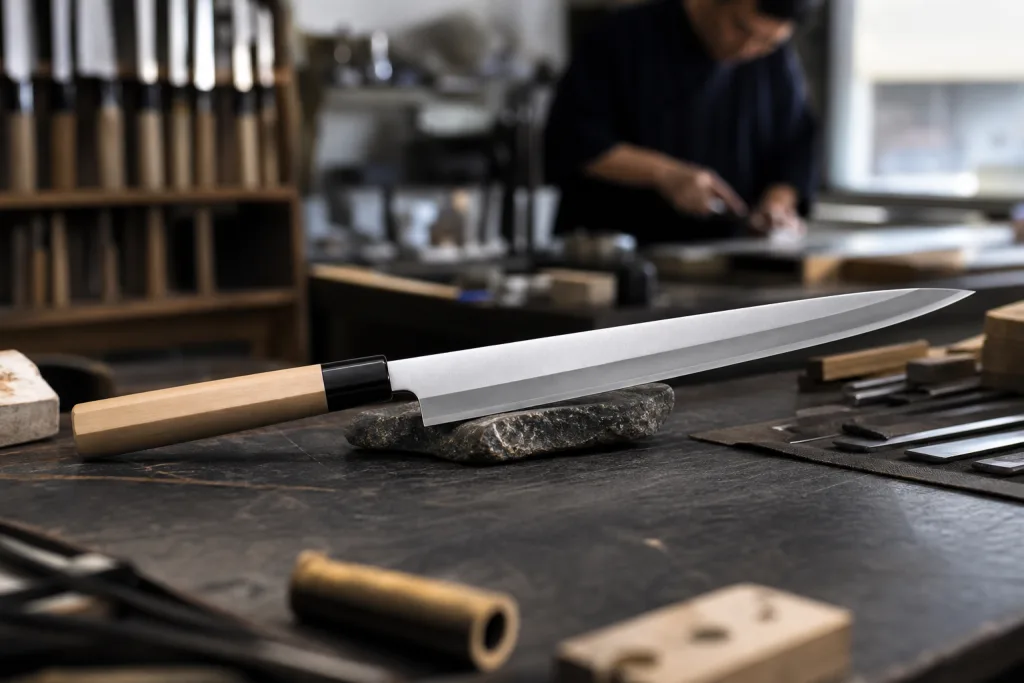
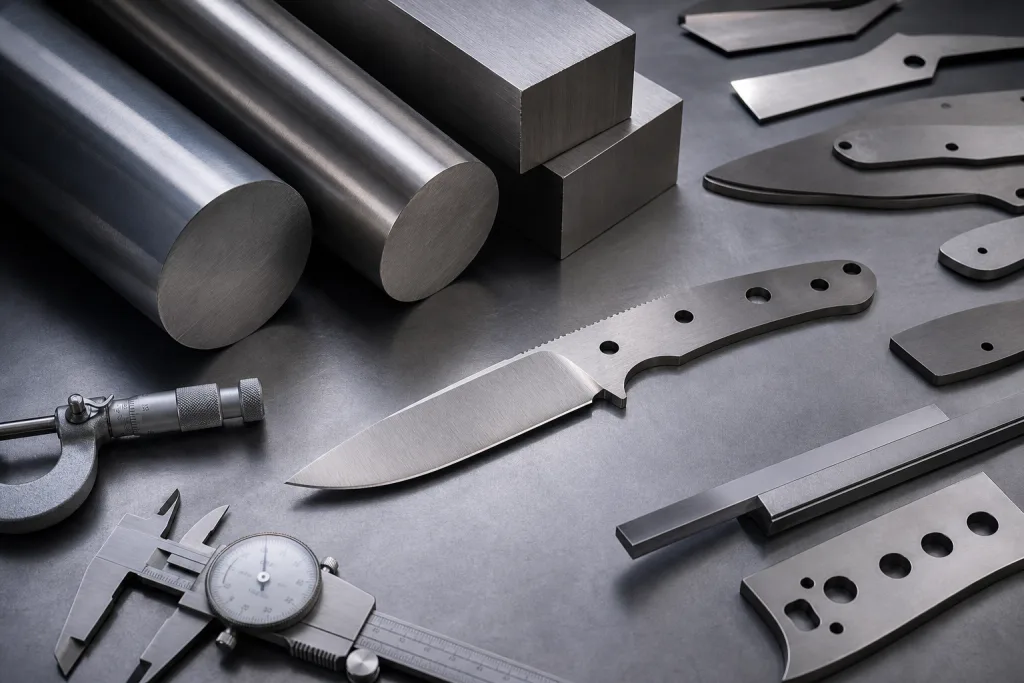
For a custom damascus kitchen knife used in a promotion, employee gift, retail bundle, or loyalty campaign, buyers inspect the blade first. Fair enough. The blade sells the story. Packaging decides whether a 67-layer knife at 60±2 HRC arrives as a premium gift or as a sharp item rattling inside a crushed color box; last season, one buyer flagged a 0.8 mm gap around the molded tray on the approval sample.
At TANGFORGE in Yangjiang, Zhejiang, China, we see this about 6 times each peak season: the buyer signs off a clean sample, then QC pulled the sample and finds a loose EVA insert, a master carton split after a 1.2 m drop test, a missing FNSKU label, or a wood box that pushes freight from 12 cartons per CBM down to 7. Lock the damascus kitchen knife export packaging plan before mass production. Do it early. Once the grinding line finishes and we ship knives to packing, changing boxes is where the math goes sideways.
Packaging Is Part of the Product
A Damascus knife sells on feel before specs. The user picks it up and expects weight in the hand, clean bevel finishing, a tight box fit, and an unboxing that feels planned, not patched together after production. QC pulled one 8 inch sample last month where the blade tip cut through a 1.2 mm paper insert during a 6-drop carton test from 80 cm. Bad look. If the box rattles, the insert collapses, or the printed sleeve arrives with rubbed corners, the buyer calls it cheap even when the blade comes off the grinding line clean at 15° per side.
For a promotional product buyer, packaging has four jobs. It must protect a sharp, heavy item through export handling, arrive retail-ready or gift-ready at the warehouse, carry legal and logistics text without mistakes, and keep freight weight inside the quote already sent to the customer. We check barcode position, country-of-origin text, warning label wording, and master carton marks against the PO with a 300 dpi print proof in hand. One PO last quarter had “chef knfie” on the carton mark draft, and that kind of typo can hold 86 cartons at the forwarder’s warehouse.
At our damascus kitchen knife factory in China, a typical 8 inch chef knife with gift packaging weighs 420-750 g depending on handle material, bolster design, box style, and insert. That spread looks small on one unit. On 3,000 sets, it can change air freight cost by several thousand USD, especially when the buyer asks for a magnetic box after the first freight estimate. We run the packed sample over a 0.1 g digital scale before quoting freight, because the math does not work if the shipping budget is already fixed and the box weight jumps from 118 g to 260 g.
Do not treat packaging as a final artwork task. Wrong question, wrong timing. Discuss it with blade length, handle material, logo method, and shipping term while the grinding line is still making the pre-production sample. A knife shipped DDP to a fulfillment center needs different packaging from a knife shipped FOB Ningbo or Shenzhen to your forwarder. A retail store needs barcode placement and shelf presentation. A corporate gift program usually pushes harder on a strong magnetic box and a low-defect outer sleeve, especially after the buyer flagged sleeve corner dents on the first 12 pcs inspection sample.
Choose the Right Retail Box Structure
About 7 out of 10 inquiries say “premium packaging,” and our costing team still cannot price that line. Send the actual box build: tuck box or rigid box, insert material with thickness, finish such as matte lamination or spot UV, plus outer-carton size and flute grade before quotation. Last month one PO only said “black gift box”; the buyer flagged the quote after QC pulled the pre-production sample because the box had no hot-stamped logo and the insert was plain EPE. We run the cost sheet from real specs, not guesses.
For online bundles, we usually run a color paper tuck box with a 350 gsm art-paper sleeve and an EPE insert cut on the die line. Retail buyers often choose a rigid gift box with 1200 gsm greyboard, while promotion teams ask for a magnetic rigid box with a 10-15 mm foam insert and gold foil logo. A sliding drawer box works for counter display, a wood box suits gift sets, and a knife roll fits multi-piece kits. For promotional buyers, rigid paper boxes usually give the cleanest math: 500 pcs MOQ, decent shelf look, and lower carton weight than wood. Wood looks rich, but we have seen this go sideways. Corners crack during 60 cm drop testing, freight jumps fast, and some destinations ask for fumigation or material declarations.
| Packaging type | Typical MOQ | Approx. add-on cost | Best use |
|---|---|---|---|
| Color paper box with insert | 300-500 pcs | USD 0.60-1.20 | Budget wholesale packs, Amazon bundles |
| Rigid gift box | 500 pcs | USD 1.20-2.80 | Corporate gifts and retail shelf programs |
| Magnetic rigid box | 500-1,000 pcs | USD 2.20-4.50 | Premium promotion campaigns with logo stamping |
| Wood presentation box | 300-500 pcs | USD 3.50-8.00 | Luxury knife sets and limited-edition launches |
For a single custom damascus kitchen knife, we normally spec EVA, EPE, molded pulp, or a paper-card insert with separate locking points for the handle and blade. Shake test it. The knife should not move more than 3-5 mm inside the box; our QC checks this by hand before carton packing, then tapes one sample shut for a quick bench drop near the packing table. For a 3 piece set, each blade needs its own slot and edge guard. A thin cardboard divider is the wrong place to save USD 0.08 when the blade is VG10 Damascus at 58-60 HRC.
Protect the Blade Before Presentation
Blade protection starts before the gift box discussion. Damascus kitchen knives pick up moisture, fingerprints, acid bleed from cheap paper, and blade movement inside the insert. QC pulled a sample last April with thumb marks near the heel after a worker wiped it on the polishing bench. We rejected 18 pcs from that lot. Even stainless Damascus cladding can spot if the blade is packed damp after the alcohol wipe or sits in a humid container for 35 days.
For upper-tier kitchen knives, we run a light anti-rust oil or food-safe protective wipe when the order allows it, then PE bag or paper wrap, edge guard, desiccant, and retail insert. For high-carbon core or non-stainless Damascus, the packing table gets stricter: dry wipe first, oil check under LED light, sealed bag, plus 5 g desiccant for one chef knife box. Short step. Big difference. Confirm whether the knife must be washed before first use, and print that line on the instruction card; do not bury it in a PO note with a typo like “wash befor use.”
Edge guards are not optional for export cartons. The math doesn't work. A 2.0 mm paper insert will not stop a sharpened blade if the carton lands on the tip during a 76 cm drop test. For an 8 inch chef knife, we fit a PP blade guard or thick paper blade sheath inside the gift box. If the campaign needs plastic-free presentation, use a reinforced paper sheath and write the drop test requirement into the packing spec. Otherwise the grinding line did its job, and packaging ruined it.
Handle protection needs its own check. Pakkawood, G10, micarta, resin, olive wood, and walnut do not mark the same way after 12 hours on the vibration table. Mirror bolsters and Damascus patterns scratch against rough inserts; we have seen black EVA leave dust along the ricasso after vibration testing. If you are ordering damascus kitchen knife wholesale for a premium event, ask for a packing sample with the real insert material, not a plain white mock-up. Small material swaps show up fast when 2,000 gifts are opened in the same week, and the buyer will flag the scuffed handle before anyone praises the blade.
Artwork, Labels, and Retail Readiness
For a promo or retail knife order, we track 8 branding points in one packaging control file: blade logo with position in mm from the heel, handle badge material, gift box logo, sleeve artwork revision, instruction card version, barcode label size, master carton mark, and the Amazon FNSKU or retailer routing label. One file only. We have seen this go sideways: the PO said “black sleeve,” the artwork folder still showed the old navy sleeve, and QC pulled the sample on the packing table before 3,000 boxes were sealed.
For retail-ready damascus kitchen knife export packaging, send AI or PDF artwork with the dieline layer still visible. Include CMYK values, Pantone references when the box color must match, barcode size, country of origin text, warning statements, and recycling marks with their print position marked on the dieline. For North America, 9 out of 10 buyers ask us to print “Made in China” on both the retail box and the outer carton. For EU markets, add importer name and address, material statements, plus the exact safety warning languages your distributor approved. The grinding line cannot fix a missing importer address. By then, the 5-layer cartons are already printed, usually with a 6 mm carton mark tolerance.
Barcodes need to be printed and scanned from the pre-production sample, not checked by eye on a screen. We run 100% scan testing for marketplace labels: FNSKU for Amazon receiving, UPC for US retail checkout, and EAN for EU retail systems, each checked with the same handheld scan gun used at final packing. A barcode sitting 2 mm too close to a curved sleeve edge can fail at receiving. The buyer flagged that once on a 1,200-set shipment after the scan gun missed 6 labels in a row, and the relabeling math did not work.
The instruction card is part of retail readiness. A premium Damascus knife should tell users not to put it in a dishwasher, cut bone, or chop frozen food unless the blade design was sold for that use. Add a dry-after-washing line. If the product has a natural wood handle, include handle oil and storage notes; we had one buyer push back after a walnut handle card still said pakkawood. If the blade is hard, for example 60±2 HRC, state the sharpening angle and normal use limits. This is the wrong place to be vague: our QC team checks the card against the actual sample, including handle material and blade hardness, but legal claims and market-specific warnings still need approval from your compliance team.
Carton Design for Export Shipping
The outer carton will not sell the knife, but it is where 3 out of 10 promotional knife orders start leaking margin. We have packed clean magnetic boxes on the bench, then watched the shipment lose money because the master carton ran 40 mm too tall, the B flute folded under a thumb press, or the top layer crushed beside the container door.
For knives, we run double-wall corrugated cartons for heavy gift sets. Strong single-wall cartons are only for lighter single units. Keep gross weight around 12-18 kg per carton when possible. Above 20 kg, the math doesn't work: cartons get dropped more often, and warehouse teams start sending photos of crushed corners. Last season one buyer flagged 22.6 kg cartons after their warehouse team hand-stacked them onto a loose pallet. Carton size should sit tight around the gift box. If the gift box needs corner protection, use paper corner guards or 10 mm honeycomb pads instead of loose filler that shifts during transit.
For export, ask your damascus kitchen knife factory for the carton L × W × H in cm, gross and net weight in kg, units per carton, and total CBM before you confirm the final quote. CBM hits sea freight first, then LCL handling and warehouse storage. A carton that looks only 15 mm taller can add real volume on 5,000 pieces. We've seen this go sideways when a PO typo changed 52 cm to 57 cm, and nobody checked the packing list draft before the forwarder booked space.
Drop testing should match your channel. For general B2B distribution, an internal 1A-style drop test from 76 cm on corners, edges, and faces is a practical baseline. QC pulled the sample after the third edge drop when the inner tray shifted more than 8 mm. For e-commerce parcels, use stricter single-unit mailer tests because the gift box ships without a master carton on some routes. If you ship to retailers, follow their routing guide exactly. The buyer may ask for labels on two adjacent sides, no straps, no mixed SKUs, and pallet heights under 1.6 m; ignore that and the receiving dock will reject the pallet.
Compliance Documents Buyers Should Request
Packaging and compliance belong on the same PO line. One Damascus gift set can carry 9 separate packaging materials: ink, glue, PET blister, EVA foam, 1.5 mm paperboard, magnet, wood, silica gel, and metal badge. QC pulled a box from the sealing table last month because the magnet sat 0.8 mm off-center; the buyer then asked if that magnet needed its own declaration for EU customs.
For EU promotional orders, ask for REACH declarations, LFGB or food-contact support on any part touching the knife, plus packaging waste data by material weight. For the US, FDA food-contact rules cover direct-contact materials, and California retail programs bring Proposition 65 review into the discussion. Real wood needs a clear answer before we ship: fumigation, heat treatment, or engineered wood status. One buyer flagged this after cartons were already closed with 48 mm BOPP tape. The rework cost more than the tray. The math does not work.
Factory system documents count more than a polished catalog page. TANGFORGE operates as an OEM/ODM knife manufacturer in Yangjiang, Zhejiang, China, with about 240 employees and monthly capacity around 180,000-220,000 knife units depending on product mix. Bigger buyers ask for ISO 9001 procedures, BSCI-style social audit support, and inspection records tied to the actual lot. On our grinding line, one lot file may carry carton drop-test photos, AQL 2.5 inspection notes, and a blade hardness record such as 60-62 HRC for VG-10 builds.
Do not wait until the vessel is booked. Ask for material declarations during sampling, while the dieline, insert depth, and carton marks can still be fixed with a ruler and a red pen. If the pack uses soft-touch coating, metallic foil, magnets, foam, or dyed textile roll, lock the document set before mass production starts. We have seen a 12-day rush schedule become 18 days because the PO said “EVA black foam” while the approved sample used grey flocking. Event-date buyers cannot recover from a customs hold caused by missing packaging data.
Inspection Standards Before Shipment
Put packaging inspection in the PO, not in a late WeChat message after goods are sealed. If QC only checks edge sharpness with the paper-cut test and handle finish under the 600 mm light box, you can still ship a clean damascus knife in a retail box the buyer rejects. We saw it on a 1,200 set order: the blade passed, but the insert allowed the tip to tap the lid during the shake test. The buyer flagged it. The carton went back to the packing table for rework.
For most export orders, we run AQL 2.5 for major defects and AQL 4.0 for minor defects, with critical defects set at 0. Critical defects mean an exposed blade tip, wrong warning label, incorrect barcode, mold, severe rust, broken box structure, or unsafe packaging. Major defects cover wrong logo position, crushed retail box, missing instruction card, loose knife movement inside the insert, or carton mark mismatch against the PO. Minor defects are small scuffs under 3 mm, slight color drift within the approved sample limit, or glue marks QC cannot see from 500 mm under normal desk light. “Does the knife look good?” is the wrong question. Ask whether the packed unit will pass the buyer’s shelf check after warehouse handling.
A pre-shipment inspection for damascus kitchen knife wholesale orders needs carton drop check, barcode scan, carton count, product count, box opening test, insert fit, humidity reading, logo position, color match against the approved sample, and random blade checks. For a 1,000 set order, ANSI/ASQ Z1.4 General Inspection Level II is a practical starting point unless your retailer names another plan. On our line last month, QC pulled 80 samples from 34 cartons with a barcode scanner and caliper, then found 6 boxes with tight sleeves after lamination shrinkage. The buyer wanted a clean packing report, not excuses. Small issue. Big delay if it reaches the retailer warehouse.
Ask for photos of packed cartons, pallet layout, and container loading if the schedule allows. For air shipments, confirm carton strength; airport handling can crush a weak 5-ply carton before customs scans it. For sea shipments, add desiccant in cartons or use container moisture control during humid months, especially when the factory hygrometer reads above 70% RH. We ship plenty of gift boxes that look sharp on a desk, but the desk is not the finish line. A box is done only when the end user receives the knife safely and your customer can sell or present it without rework.
Frequently asked questions
For most promotional programs, a rigid gift box with a locked insert is the safest premium choice. Use an edge guard, PE or paper wrap, desiccant, and an EVA, molded pulp, or reinforced paper insert. A magnetic rigid box looks more expensive but usually adds USD 2.20-4.50 per unit and increases carton volume. Wood boxes can work for executive gifts, but they add weight and may require wood material declarations. For 500-3,000 pieces, rigid paper packaging normally gives the best balance of presentation, MOQ, freight cost, and inspection control.
Allow 30-45 days for custom packaging development before mass production if you need dielines, artwork, printed samples, insert adjustment, and barcode testing. A simple logo sleeve may be faster, around 15-20 days. A magnetic box, molded insert, foil stamping, soft-touch coating, or multi-piece knife set can take longer because the first sample often needs correction. After packaging approval, mass production lead time is commonly 35-60 days depending on knife complexity, order quantity, and factory schedule.
Yes, but the packaging must be prepared for receiving rules, not just export shipping. You may need FNSKU labels, suffocation warnings for polybags, carton labels on two sides, SKU separation, barcode scan verification, and carton weights below the platform limit. For single-unit e-commerce shipping, the retail gift box may need a protective mailer or stronger outer box. If you ship DDP, confirm duties, product description, HS code, and knife restrictions before production. Sharp items with poor labels are often delayed.
Set critical defects at 0 tolerance for exposed blade tip, unsafe blade movement, missing legal warning, wrong country of origin, unreadable barcode, mold, severe rust, broken primary box, or mixed SKU labels. These defects can create safety, customs, or retailer receiving problems. Major defects can use AQL 2.5, including crushed boxes, missing cards, wrong logo placement, or incorrect carton marks. Minor cosmetic defects can use AQL 4.0 if they do not affect safety, presentation, or scanability.
Send blade size, handle material, quantity, target market, retail channel, box style, insert preference, artwork files, barcode needs, carton mark requirements, shipping term, and any retailer routing guide. Also tell the factory your target unit budget, for example FOB USD 18.00-24.00 including gift box. Without this, a damascus kitchen knife manufacturer may quote a basic paper box while you expect a magnetic box with foam insert. Clear specs reduce requoting and save 7-10 days during sampling.
Build Your Retail-Ready Knife Program
Send your knife brief, packaging target, quantity, and destination market. We will suggest a practical export pack, MOQ, timeline, and inspection plan.
Request a Quote