Restaurant supply distributors usually do not lose margin on the knife body. They lose it on the add-ons: laser logo, gift box, carton weight, freight class, duty code, relabeling, and 2 mm artwork changes approved after the grinding line has packed the first batch. We’ve seen a Damascus chef knife quoted at USD 18.80 FOB China land above USD 27.00 after the buyer added a magnetic box, 180 g thicker inner tray, and airfreight for 312 cartons. The math doesn’t work if packaging and freight wait until the PO is already signed.
As a Damascus kitchen knife logo engraving factory in Yangjiang, Zhejiang, China, TANGFORGE sees the same buying mistake about 6 times a month: buyers compare blade price only. That is the wrong question to ask. For custom Damascus kitchen knife logo engraving orders, MOQ, handle material, logo position, retail box size, and inspection level all move the landed cost; QC pulled one 8-inch sample last week because the logo sat 4 mm too close to the bolster, and the buyer flagged it only after carton marking artwork was finished.
Start with FOB, not catalog price
For restaurant supply distributors, the first number should not come from a polished catalog photo or a wholesale screenshot. Start with a written FOB quote and a full spec sheet. A Damascus kitchen knife logo engraving landed cost breakdown has to state what we run on the line: blade length, steel construction, HRC band, handle material, logo method, packing style, carton size, and order quantity. Last month QC pulled a sample where the PO said “8 inch,” but the drawing showed 203 mm blade length; that 3 mm mismatch was enough to stop the quote.
For example, an 8 inch Damascus chef knife with 67-layer cladding, 10Cr15CoMoV core, 60±2 HRC, full tang construction, G10 handle, laser logo on blade, and color gift box will not price like a plain stainless knife in a sleeve. Different knife. Different work. At our Yangjiang, Zhejiang plant, a normal production run for this type is 300-1,000 pcs per SKU, with about 80,000-120,000 mixed knife units per month capacity depending on handle complexity and polishing load. On the grinding line, G10 handles usually need tighter dust control and more hand finishing around the rivets than pakkawood, so the labor minutes are not the same.
FOB China normally includes material, production labor, standard QC, export carton, inland transport to port, and export documents. It does not include ocean freight, insurance, destination duty, customs broker fees, warehouse receiving, FNSKU or retailer relabeling, palletization, or last-mile delivery. If your supplier gives one number without the Incoterm, port, MOQ, and packaging basis, you do not yet have a purchasing number. We have seen this go sideways: one buyer approved “FOB” in email, then the PO missed Ningbo port and the carton spec, so the finance team compared the wrong cost for 12 days.
A practical distributor quote should show at least three quantities: 300 pcs, 500 pcs, and 1,000 pcs. The price gap is not just steel cost. Laser setup takes one fixture, box printing has plate charges, inner trays may need a new mold, cartons load better when we can fill a clean CBM, and inspection time spreads across more pieces at 500 pcs and above. If you are testing a new restaurant supply catalog item, 300 pcs is workable. If you expect reorder business, 1,000 pcs gives a cleaner landed cost. Asking for the lowest catalog price first is the wrong question to ask; ask what specification and quantity the factory is actually quoting.
Knife specification drives the base cost
Lock the knife spec before talking about logo engraving. Damascus kitchen knives carry at least 8 cost variables that buyers often miss on the first RFQ. “Damascus” alone does not tell us the steel core, layer count, pattern match, heat treatment target, blade thickness, spine finish, or handle assembly. On our grinding line, QC pulled two 8-inch chef samples both marked Damascus; one measured 2.1 mm at the heel and the other 2.6 mm, and the landed base cost moved by USD 6.00 before any branding.
For B2B restaurant supply distributors, the best-selling point is usually not the handmade-style top build. It is a repeatable spec that looks premium, passes food contact paperwork, and reorders without ugly batch drift. We run a common wholesale spec at 67-layer Damascus cladding, 10Cr15CoMoV or VG10-type core, 58-61 HRC, 2.0-2.4 mm spine at heel, and 15-18 degree edge per side. Handles are usually G10 or pakkawood; stabilized wood works, but the math gets worse when the buyer rejects 12% of handles for color mismatch under a light box.
| Cost driver | Typical choice | Factory cost effect |
|---|---|---|
| Core steel | 10Cr15CoMoV / VG10-type | Medium cost, steady supply for wholesale runs |
| Hardness | 58-61 HRC | Holds an edge without pushing breakage claims too high |
| Handle | G10 or pakkawood | G10 sorts cleanly; wood needs tighter grain and color checks |
| Finish | Etched Damascus, satin spine | Adds polishing and etching time versus plain stainless |
| Edge test | Paper cut or CATRA sample test | Adds QC minutes, but cuts complaint emails after delivery |
Be careful with ultra-low quotes from any Damascus kitchen knife logo engraving supplier that does not state the steel core or HRC range. We have seen this go sideways. If the blade is too soft, restaurant users complain after 3 prep shifts because the edge rolls on tomato skin and chicken joints. If the blade is pushed too hard without proper tempering, chips show up during AQL 2.5 inspection. For distributor channels, controlled hardness beats a big marketing number printed on the box.
Logo engraving costs more than the laser time
Custom Damascus kitchen knife logo engraving sounds simple: put the logo on the blade and press start. That is the wrong way to cost it. The laser run is only one line on the job card. Before production, we clean the artwork, confirm the logo position in mm from the heel, set the fixture, burn 1-2 first-article samples, get approval, then check depth, burn mark, alignment, and contrast after oiling and ultrasonic cleaning. QC pulled a sample last month where the logo looked centered in the mockup but sat 3 mm too close to the grind line.
For a normal blade logo on one side, laser engraving often adds USD 0.12-0.25 per unit at 500 pcs. Deep engraving, large logos, serial numbers, QR codes, or logo on both blade and handle can push the cost to USD 0.35-0.80 per unit. Color-filled engraving or etched metal badges on the handle are separate decoration work, not standard laser marking. We run those through a different station, and the math does not work if a buyer expects badge fitting at the same price as a 12-second blade mark.
The Damascus pattern creates one headache: contrast. Thin letters can disappear inside a busy etched pattern after the blade comes back from cleaning. A workable Damascus logo needs thicker strokes, no text under 1.2 mm height, and a cleaner position near the heel or flat. Simple wins. If your restaurant supply customer insists on a detailed crest, make a pre-production sample before bulk production, even after a digital mockup is approved. We have seen this go sideways when the buyer flagged the crest only after 500 pcs were packed in inner boxes.
At TANGFORGE in China, we usually ask for AI, EPS, PDF, or high-resolution black-and-white PNG artwork. For repeat orders, we keep the logo program and fixture settings, including focal height and blade stop position, so the next shipment does not drift by 1-2 mm. That helps a Damascus kitchen knife logo engraving manufacturer keep variation under control between shipments. Still confirm whether the logo is included in FOB cost or listed as a separate line item. Separate costing keeps landed cost planning clean and avoids arguments when a PO with “same as last order + handle logo” arrives 6 days before inspection.
Packaging changes freight, not just presentation
Packaging is where 6 out of 10 distributor landed cost sheets we review go wrong. A knife sleeve may add only USD 0.10-0.25 per unit and pack tightly, around 24 mm extra length on our packing table gauge. A rigid magnetic gift box can add USD 1.80-3.50 per unit and push carton volume enough to raise freight by more than the box price. If your customer sells to restaurants, catering schools, or equipment dealers, this is the wrong place to copy a consumer retail set. You need edge protection and a clean shelf look, not dead weight.
Common options include blade guard plus white box, printed color box with EVA insert, printed color box with pulp tray, kraft retail box, roll bag, and wooden presentation box. For restaurant supply distributors, we usually run a printed color box with recyclable pulp tray. It holds the knife steady when QC shakes the carton, leaves space for barcode and compliance labels, and saves CBM compared with foam-heavy gift packaging. One buyer flagged crushed corners last year; the fix was a 5-layer export carton, not a heavier inner box.
Ask your Damascus kitchen knife logo engraving wholesale supplier for carton dimensions before you confirm the order. A 500 pc shipment can look small on the PO but big in the warehouse if every knife has a thick gift box; we have seen 500 pcs jump from 1.6 CBM to 3.8 CBM after the buyer changed from sleeve to magnetic box. Ocean LCL may still be cheaper than air, but destination handling fees hurt when the shipment is only 2-4 CBM. For urgent launches, air freight can add USD 3.00-8.00 per knife depending on box weight and destination airport. The math does not work if the box weighs more than the blade.
Plan label work early. UPC, EAN, FNSKU, country of origin, warning label, REACH statement, LFGB or FDA food-contact wording, and importer address may all be required depending on your market. Adding stickers after production is possible, but our packing line has to open cartons again, wipe the box surface, and apply labels with a 30 mm placement tolerance. That costs labor and usually delays shipment 2 days vs same-day carton sealing. Printed packaging looks cleaner, but usually needs 500-1,000 pcs MOQ per design from the packaging vendor; we have also seen a PO typo turn “Made in China” into “Made in Chian,” so artwork approval is not a formality.
Build the landed cost line by line
A good landed cost sheet should look a little dull. Good. We want every charge from our FOB invoice to your warehouse shelf, not “FOB plus 12% freight” typed into a spreadsheet. For Damascus knives, packaging volume usually moves the number first; freight mode comes next. Duty and broker handling sit in a separate line because the math gets messy if you bury them in freight. On one recent 8 inch chef knife run, QC pulled the color-box sample and the tray added 6 mm height, which pushed the master carton CBM up enough for the buyer to flag it.
Use this as a simple working example: 500 pcs of 8 inch Damascus chef knives with blade logo engraving, printed color box, and export cartons shipping from China to a North American distributor warehouse. Actual duty rates and fees depend on HS code classification, destination country, and customs ruling, so your broker should check them before you issue the PO. We have seen this go sideways when a PO says “kitchen tool” while the commercial invoice says “Damascus chef knife”; customs does not enjoy that typo.
| Cost item | Example cost | Per unit |
|---|---|---|
| FOB knife with G10 handle | USD 9,750 | USD 19.50 |
| Laser logo engraving on blade | USD 125 | USD 0.25 |
| Printed color box with inner tray | USD 675 | USD 1.35 |
| LCL ocean freight plus port fees | USD 1,150 | USD 2.30 |
| Duty, broker, bond, local delivery estimate | USD 1,000 | USD 2.00 |
| Inspection allowance | USD 250 | USD 0.50 |
| Total landed estimate | USD 12,950 | USD 25.90 |
If your dealer sell price is USD 39.00, USD 25.90 landed still leaves working margin. Ship the same order by air and land it at USD 31.50, and the math does not work for most distributors after rebates and damaged-box claims. That is why TANGFORGE gives carton quantity, gross weight, net weight, and CBM before shipment from Yangjiang, Zhejiang. Do not approve artwork first. Ask how many units fit per master carton; on the packing bench, 24 pcs versus 18 pcs per carton changes the freight line fast.
MOQ and lead time affect cash flow
MOQ is not a factory preference only. It controls cost and cash flow. For custom damascus kitchen knife logo engraving, 300 pcs per SKU is usually the lowest practical MOQ when the logo is laser engraved and packaging is simple. We run this on a 20W fiber laser, and the setup still takes about 40 minutes after QC checks logo position with a 0.2 mm tolerance. If you need printed retail boxes, custom inserts, instruction cards, or 2 handle colors, 500 pcs per SKU is more realistic. Below that, setup cost shows up fast and the unit price gets hard to defend.
Lead time needs discipline. A normal schedule is 5-7 days for artwork checking and quotation, 7-12 days for sample production after deposit or sample fee, 3-5 days for sample review by courier, and 35-55 days for mass production after final approval. Peak season before Q4 can add 10-15 days, especially for etched Damascus blades and custom packaging. The grinding line is usually not the bottleneck; box printing and insert molding are the parts that slip from 12 days to 18 days. We have seen this go sideways when a buyer approved the blade sample but changed the barcode on the retail box after mass production started.
Payment terms vary, but about 9 out of 10 China knife factories work on 30% deposit and 70% balance before shipment for first orders. Established distributors with stable volume can negotiate better terms after 3 or 4 clean shipments. Do not push for the smallest deposit and the fastest lead time at the same time. The math does not work. The factory still needs to reserve steel, handle material, packaging slots, and laser capacity, and QC pulled the sample lot more than once because the PO said black pakkawood while the approved sample was brown.
A practical purchasing plan is to launch with one hero SKU, such as an 8 inch chef knife, then add a 3.5 inch paring knife or 7 inch santoku after sell-through data. Mixed-SKU sets look good on a catalog page, but they make MOQ harder because each blade shape has its own grinding jig, heat treatment rack, packaging carton, and QC checklist. Start narrow. For restaurant supply distributors, reliable replenishment beats a wide catalog that cannot be reordered consistently, especially when one missing 7 inch santoku delays the whole carton by 6 days.
Inspection should match distributor risk
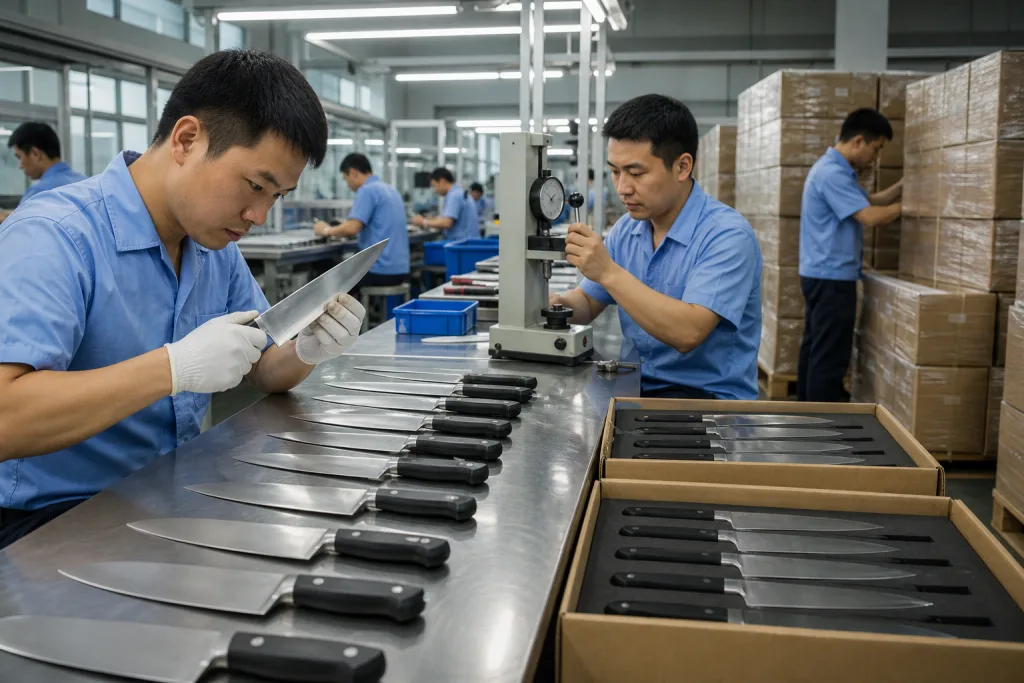
Damascus kitchen knives have to look right on a shelf and cut right on a board. Inspect both. For distributor orders, we normally run AQL 2.5 major / 4.0 minor as the starting point. Major defects mean the shipment cannot pass: loose handle scales found during torque check, cracked pakkawood or G10, wrong logo file or upside-down engraving, unsafe edge chips over the agreed limit, rust spots after wiping, blade warp outside tolerance, incorrect steel mark, or a packaging barcode that fails the scanner. Minor defects are controlled cosmetic issues, such as small Damascus pattern variation, light polishing lines from the grinding line, or box scuffing that stays inside the signed standard.
Put numbers on the drawing before we cut steel. Use blade length ±2 mm, spine thickness ±0.2 mm, logo position ±1.5 mm, handle gap not visible over 0.2 mm, HRC 58-61, edge angle 15-18 degrees per side, and carton drop test from 76 cm when retail packaging matters. QC checks these with a digital caliper, feeler gauge, Rockwell tester, and angle gauge, not by eye. If your file needs ASTM-style packaging checks, REACH documentation for handles, LFGB or FDA food-contact declarations, or BSCI audit files, ask before deposit because the math does not work after packing is finished.
As a Damascus kitchen knife logo engraving manufacturer in China, we prefer a signed golden sample and a one-page inspection checklist over 26 emails with mixed comments from sales, design, and purchasing. The golden sample protects both sides. Your buyer sees the logo depth, handle color, blade finish, sheath fit, and gift box layout in one sample. Our workshop sees what cannot change when the laser engraving jig is set and the grinding line starts bulk work.
For higher-value wholesale programs, book pre-shipment inspection when 80-100% of goods are packed. A standard third-party inspection in China usually costs USD 200-350, depending on location and man-days. That is cheaper than finding 1,200 knives with the wrong logo after the container reaches your warehouse. We have seen this go sideways. Inspection is not paperwork for show; it controls landed cost because rejected goods, rework, repacking, air freight recovery, and missed catalog launch dates all hit your margin.
Frequently asked questions
For standard laser logo engraving on the blade, expect 300 pcs per SKU as a workable starting MOQ. If you need printed retail boxes, custom inserts, barcode labels, or several handle colors, 500 pcs per SKU is more realistic. For a full knife set, each blade shape may have its own MOQ because grinding, polishing, heat treatment, and packaging are different. A 300 pc trial order is fine for one chef knife SKU, but the landed cost will usually be 5-12% higher than a 1,000 pc run because setup, packaging, inspection, and freight are spread across fewer units.
For a simple one-side blade logo, laser engraving normally adds USD 0.12-0.25 per knife at 500 pcs. Larger logos, deep engraving, serial numbers, QR codes, or engraving on both blade and handle can add USD 0.35-0.80 per unit. The landed cost impact is more than the laser fee if the logo requires sampling, special fixtures, or rework after artwork changes. Ask your factory to quote logo engraving as a separate line item so your cost sheet stays clear when you compare FOB, packaging, freight, duty, and warehouse receiving.
Air freight can make sense for samples, launch quantities, or urgent backorders, but it is expensive for boxed knives. A boxed 8 inch Damascus chef knife may add USD 3.00-8.00 per unit by air depending on chargeable weight and destination. Ocean LCL is usually better for 300-1,000 pcs if your launch date allows 25-40 days transit plus customs time. The mistake is choosing packaging first and freight later. Ask for carton size, gross weight, and CBM before approving the box, especially if your distributor margin is below 35%.
For restaurant supply channels, the best packaging is usually protective, barcode-ready, and not oversized. A blade guard plus white box is low cost at about USD 0.20-0.50 per unit, but it may look too plain for premium Damascus. A printed color box with pulp or EVA tray often lands around USD 0.85-1.80 per unit and works well for dealer shelves. Magnetic gift boxes and wooden boxes look premium but can add USD 2.00-5.00 per unit after freight impact. Choose packaging based on sell-through channel, not just photo appeal.
Check the functional and branding points first: steel specification, HRC band, blade straightness, handle bonding, edge sharpness, rust prevention, logo accuracy, barcode, and carton labeling. AQL 2.5 major / 4.0 minor is a practical inspection level for distributor orders. For Damascus knives, also inspect pattern consistency, etching quality, and logo contrast after cleaning and oiling. We recommend approving one golden sample and using it during mass production inspection. A third-party pre-shipment inspection usually costs USD 200-350 in China and is worth it for first orders or new packaging.
Send your Damascus knife cost sheet
Share blade specs, target MOQ, logo artwork, packaging plan, and destination port. We will return a practical FOB and landed cost discussion.
Request a Quote