A promotional knife project looks simple until the logo hits the Damascus pattern, the gift box dieline changes, and the buyer wants the retail launch locked for 200 stores or a national distributor. Making the knife is the easy part. The trouble starts when steel spec, logo position, EAN barcode, carton marks, test reports, and the shipping plan are still “almost confirmed” 14 days before vessel cut-off; we’ve seen this go sideways after QC pulled the sample and found the logo 3 mm too close to the plunge line.
At TANGFORGE in Yangjiang, Zhejiang, China, we run Damascus kitchen knife logo engraving projects for importers, distributors, and promotional product buyers who need repeatable retail quality, not one pretty sample for the meeting room. Our practical launch range is usually 500–3,000 sets per SKU, with 45–60 days production after approved sample and deposit, and blade hardness commonly controlled around 58–60 HRC depending on the steel construction. The grinding line checks blade profile before etching, because once the pattern is opened and the logo is engraved, the math doesn’t work if the buyer suddenly asks to move the mark 8 mm toward the tip.
Start With the Retail Shelf Requirement
A Damascus kitchen knife logo engraving project should start with the sales channel, not the knife drawing. A retail promo in 500 stores does not spec the same as a chef knife sold on a DTC site. We run into this at sample stage: the buyer asks for a hangable box after the dieline is approved, or QC pulls a carton sample and finds no FNSKU label on the master carton. Shelf first. You may need bilingual warnings, a printed insert, retailer carton routing labels, FNSKU labels for marketplace fulfillment, or a case pack that fits a 390 mm warehouse slot. If these details arrive after mass production, the factory can still help, but the math gets ugly: a packaging change that takes 12 days before production can turn into 18 days plus rework after knives are packed.
Before asking a damascus kitchen knife logo engraving factory for a quote, define the product format in commercial terms. Is it a single 8 inch chef knife, a 3-piece gift set, or a knife plus sheath? What target FOB China price do you need? Promotional buyers often write “premium but affordable” on the RFQ. That is the wrong question to ask. A realistic entry retail Damascus chef knife with custom logo engraving may sit around USD 8.50–16.00 FOB depending on blade construction, handle, box, and order volume. On our grinding line, the blade cost is only one part; a 1.2 mm PET insert tray, color sleeve, and 6-piece case pack can move freight volume enough to break the target landed cost.
Decide whether the logo is mainly for brand ownership or for gift value. A small maker’s mark near the heel looks premium, especially when the laser mark is kept around 18–25 mm wide. A large campaign logo across the blade can look like a giveaway item. Neither is wrong, but they sell differently. We’ve seen this go sideways when the buyer approved a clean VG-style blade, then the marketing team added a 60 mm slogan at PO stage. For retail, we normally recommend one controlled logo position, one blade face only, and no heavy copy on the blade. Put legal text, campaign story, QR code, and care instructions on the insert or back of box where print is cheaper and easier to read.
- Confirm channel: retail store, marketplace, distributor, or corporate gifting; each one needs different labels and carton marks.
- Confirm SKU count: one hero item is easier than five weak variants, especially when MOQ is 1,000 pcs per handle color.
- Confirm launch date: work backward from store arrival, not factory finish date; leave 7 days for final AQL checks and carton relabeling risk.
- Confirm target landed cost: FOB, DDP, duty, testing, and packaging are separate decisions, and the buyer should not hide freight inside the knife price.
Choose Damascus Specs Buyers Can Repeat
Damascus is a construction choice, not a single material spec. For kitchen knives, we usually see two routes: stainless Damascus cladding over a defined core steel, or pattern-welded steel ordered for a more traditional blade face. Retail programs need repeatable batches, not one dramatic sample shot under perfect light. If the first 20 PP samples show tight ladder lines but the next 2,000 pcs come out with loose, cloudy patterning, your service team gets the emails even if the knives cut fine. QC pulled a tray last month because 14 blades in a 200 pcs inline check had pattern drift near the heel.
Ask your damascus kitchen knife logo engraving manufacturer to put the core steel, layer count, HRC target, blade thickness, finish method, and tolerance on the PI, not only in a chat message. A workable chef knife spec is 67-layer Damascus cladding with 10Cr15CoMoV core, 58–60 HRC, 2.0–2.3 mm spine thickness at heel, satin or etched finish, plus an edge angle around 15–18 degrees per side. Simple enough. If you need lower cost, say it early. The factory may quote 5Cr15MoV or 7Cr17MoV with a Damascus-style surface, but calling that true layered Damascus is the wrong claim if the cross-section does not support it; we check this with a cut sample and a 10x loupe before mass production.
For promotional product buyers, the handle is where the budget often breaks. Stabilized wood needs moisture control and batch sorting; pakkawood gives steadier color for retail racks; G10 and micarta add grip but raise tooling and sanding time; resin hybrids look strong in photos but can fail color matching across 500 pcs; stainless bolsters add weight and polishing hours. Natural wood sells well, but it varies by batch and needs clear moisture warnings. Pakkawood and G10 are safer for retail volume. At TANGFORGE in Yangjiang, Zhejiang, we run handle color master samples and set a tolerance band before bulk cutting, because the buyer flagged “dark walnut” once after the packing inspector accepted a batch that looked closer to coffee brown under a 6500K light box.
| Spec Item | Retail Launch Recommendation | Why It Matters |
|---|---|---|
| Core hardness | 58–60 HRC | Balances edge holding with lower complaint risk from chipping after home use |
| MOQ per SKU | 500 pcs for simple logo projects | Gives the grinding line enough volume for stable material buying and packaging print setup |
| Blade tolerance | ±0.3 mm on key dimensions | Keeps inserts, sheaths, and boxes fitting after the carton drop test |
| Logo depth | Surface laser, typically 0.02–0.08 mm visual mark | Keeps the logo readable without cutting too deep into the blade face |
| Production lead time | 45–60 days after PP sample approval | Matches the real shop schedule for engraving setup, packing, and final AQL inspection |
Approve Logo Artwork Before Metal Sampling
Logo engraving on Damascus is not like printing on a flat white box. The blade already carries a welded pattern, and that pattern fights thin logo strokes and small text. We have seen a 0.08 mm line disappear after acid etching on a 67-layer blade, even though the PDF looked clean on screen. If your logo uses hairline strokes or a tiny ® mark under 1 mm, it can pass artwork review and still look weak on steel. Stronger laser power is the wrong question to ask. Fix the artwork first.
Send vector artwork in AI, EPS, PDF, or SVG, with fonts outlined and the logo shown at 1:1 actual size. For laser engraving on a Damascus kitchen knife blade, we prefer line gaps of at least 0.15 mm and text height above 1.5 mm if the text must be legible without magnification. Avoid large filled blocks unless you accept a darker heat mark and contrast changes across the Damascus pattern. Our laser tech checks the file on a 27-inch monitor, then the grinding line confirms the placement against the heel with a steel ruler before we run the first blade. If you need a black logo, ask for test pieces because stainless Damascus reacts differently after etching, oiling, and final cleaning.
A good custom damascus kitchen knife logo engraving workflow has three approvals, and each one catches a different failure. First, approve the digital layout with exact distances from the heel, spine, and edge, such as 18 mm from the heel and 9 mm below the spine. Second, approve a metal test or pre-production sample photographed under neutral light, not under the yellow showroom lamp. Third, sign one golden sample for the factory QC team to keep in the sample cabinet. QC pulled the sample on one order last year because the buyer’s PO spelled the brand with one missing letter, and the mockup had copied the same typo. Do not approve only a studio-rendered mockup. Renderings help sales decks, but they do not prove engraving contrast, logo position, or whether the mark survives cleaning after sharpening.
For retail, decide whether to engrave the blade, handle end cap, bolster, or packaging only before metal sampling starts. Blade engraving gives the strongest brand ownership, but it carries the highest cosmetic risk because every scratch around the mark gets noticed during AQL 2.5 inspection. Handle engraving looks good on pakkawood or metal end caps, though it may sit hidden inside a closed shelf box. Box foil stamping or printed sleeves cost less for seasonal campaigns where the same knife is sold to 3 buyers with different branding. We ship faster when the decoration choice is settled early, usually 12 days for approved packaging artwork versus 18 days when the buyer changes from blade engraving to sleeve printing after sampling. A practical damascus kitchen knife logo engraving supplier should protect your launch schedule, not push the most expensive decoration every time.
Build Packaging Around Compliance and Scanning
Packaging is not the last decoration job. For knives, it decides safety, compliance, retailer acceptance, and freight cost. We have seen a 210 mm Damascus chef knife cut through a 350 gsm paper tray after a carton vibration test on the packing bench. A magnetic gift box looks premium, but the math does not work if the master carton cube pushes DDP freight from 12 cartons per CBM to 8. A barcode on a linen-texture sleeve can also fail at the receiving dock; QC pulled 10 sleeves last month and 3 would not scan on a Zebra DS2208.
Start with blade protection. For a single chef knife, we run a tip guard plus edge sleeve, then lock the knife with a molded pulp tray or EVA insert so the handle cannot shift more than 3 mm. If the item is a gift set, shake the box for 60 seconds and run a 1.2 m drop test before mass production. Do it early. Promotional buyers often push back on insert cost, but this is the wrong place to save USD 0.18. A 2.0 mm blade tip can punch through weak inserts after 30 days in a container, and we have opened cartons where the grinding line found the tip already exposed.
Build the retail information layer after the knife is physically safe. For Europe, check REACH expectations for handle materials, packaging inks, and restricted substances. For food-contact claims, LFGB may be requested by German buyers, while FDA food-contact expectations are common in the United States. If the handle uses wood or bamboo, ask about fumigation, moisture content under 12%, and import documents before the PO is signed. If your retailer requires BSCI, ISO 9001, social audit records, or factory photos, collect them during supplier qualification. Booking week is too late; we have seen a 4,800-piece shipment sit 6 days because the buyer flagged a missing audit file.
Barcode and label rules need boring attention. Confirm EAN, UPC, FNSKU, suffocation warning if using polybags, country of origin marking, carton quantity, gross weight, net weight, and master carton dimensions. For Amazon-style programs, label position and scannability can matter as much as the knife. For brick-and-mortar retail, carton marks may need PO number, SKU, destination DC, and case pack. At our China facility, we print and scan 10 sample labels before bulk packaging print; one PO once had “Made in Chian” on the carton mark, and that typo would have blocked receiving even with a perfect knife inside.
Set Inspection Standards Before Production
Quality disputes usually start when the PO says “good quality” but nobody wrote down what a defect is. Damascus kitchen knives need two checks: cutting safety and retail appearance. A bent blade, loose handle, unsafe burr, wrong steel, or unreadable barcode is major. Slight handle grain variation or small Damascus pattern difference can pass if the approved sample shows the same range. Tiny packaging rub marks also need a limit, for example under 3 mm on the back panel only. We’ve seen this go sideways when QC pulled the sample at 4:40 p.m. and the buyer flagged a 2 mm logo shift that was never listed in the inspection sheet.
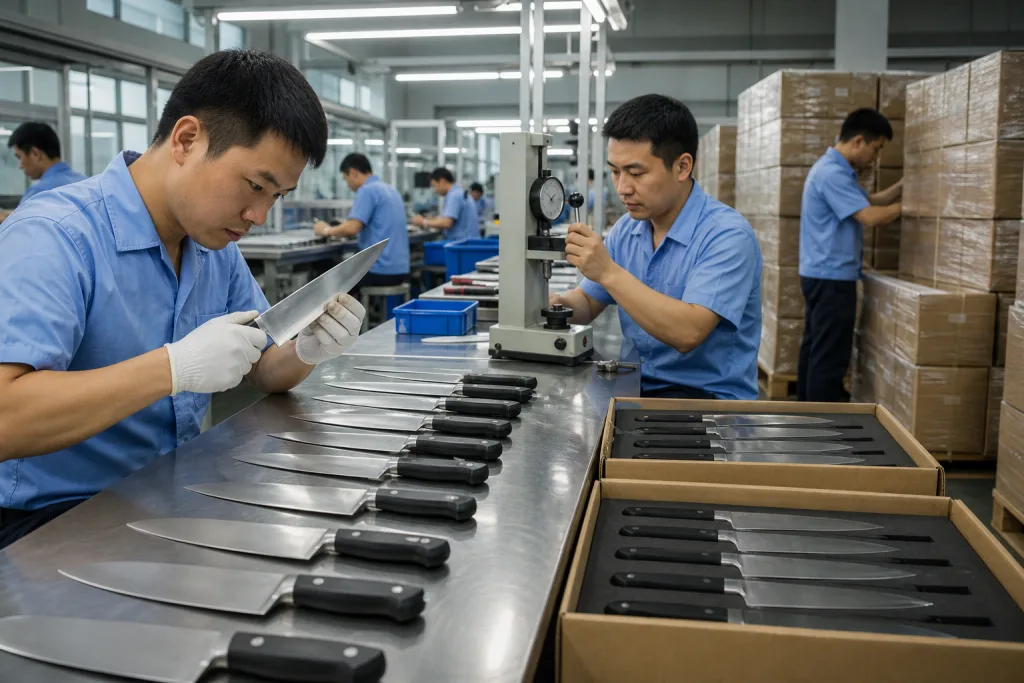
Use a written QC checklist tied to AQL levels. For retail promotional programs, AQL 2.5 for major defects and AQL 4.0 for minor defects is a common baseline. Some retailers require AQL 1.5 major or their own inspection manual. Decide early who pays for reinspection if failure is caused by factory production, late buyer artwork changes, or third-party packaging changes. The math does not work if a 5,000 pcs order waits until final inspection to argue over artwork. A serious damascus kitchen knife logo engraving wholesale project should include inspection photos for blade straightness checked on a flat gauge, logo position measured with a digital caliper, edge protection, carton drop condition, and barcode scanning with the same scanner used on the packing line.
Functional checks should include blade length, total length, spine thickness, handle fit, rivet or bolster finish, edge sharpness, hardness spot checks, and corrosion-risk review after cleaning. On the grinding line, we run spine thickness checks at the heel and tip because one side can drift after polishing. CATRA testing can be arranged for edge retention when the claim justifies the cost, but it is not necessary for every promotional launch. HRC testing is more common and should be done on sample lots without damaging sellable retail units unless you have agreed destructive testing samples. Simple rule: if the buyer wants a 60-62 HRC claim printed on the box, we need the test method and sample quantity written before mass production.
Cosmetic checks need realistic limits. Damascus pattern is not wallpaper; some variation is normal. Pattern contrast should match the approved sample range, logo position should normally stay within ±1.0 mm, and visible scratches near the logo should be rejected because the buyer will look there first. Packaging inspection should include color matching, glue marks, insert fit, leaflet language, barcode scans, and carton compression. Last month one PO had the SKU typed as “DMS-801” on the carton but “DSM-801” on the barcode file, and that kind of typo stops shipment faster than a small handle color difference. At TANGFORGE, our monthly output can reach about 180,000 knives across kitchen, outdoor, pocket, and gift-set lines, but retail engraving orders still need line-by-line QC because one wrong logo can make all units unsellable.
Protect the Launch Calendar and Freight Plan
About 7 out of 10 knife launch delays we see come from calendar mistakes, not production disasters. Buyers count factory production days and miss artwork approval, DHL sample time, color box proofing, LFGB or FDA lab testing, AQL 2.5 inspection booking, vessel cut-off, customs clearance, and retailer appointment windows. For a Damascus kitchen knife logo engraving project, a safe retail launch plan is 90–120 days from first approved specification to warehouse arrival when ocean freight is involved. Air freight can save a 300 pcs urgent batch, but knives are heavy. The math often doesn’t work after the buyer sees the chargeable weight on the forwarder quote.
Work backward from the retail shelf date. If stores need goods by October 1, your distributor warehouse may need them by September 10. If ocean freight takes 30–40 days port to port plus customs and trucking, final inspection may need to happen by late July. That puts production approval around late May or early June, including logo position approval within 0.5 mm on the blade face and handle engraving depth check from the laser machine. Seasonal launches, Father’s Day promotions, holiday gift sets, and Q4 marketplace programs should not be built on best-case shipping. We’ve seen this go sideways.
Decide Incoterms early. FOB Yangjiang or Shenzhen-area port pricing gives experienced importers control over freight. DDP works for smaller promotional buyers, but spell out duty, customs bond, delivery appointments, and who pays retailer chargebacks caused by late delivery. If you need split shipments, define carton labels and PO allocation before packing. Last year a buyer flagged one PO typo after 186 cartons were sealed, and reworking packed cartons on the loading floor cost 2 days plus new outer-carton stickers.
Keep a launch buffer. For first-time custom damascus kitchen knife logo engraving orders, approve one pre-production sample, then hold 5–10 finished mass production samples before full balance payment or release. QC pulled the sample should mean the real retail set: knife, sheath, insert card, barcode, warning label, and color box from the packed goods. These samples let your sales team check packaging, photography, marketplace listing copy, barcode scans, and instructions. They give your customer service team a real product before consumers start asking questions. A reliable damascus kitchen knife logo engraving manufacturer in China should welcome this step because it cuts last-minute confusion.
Use a Practical Supplier Checklist
Choosing a Damascus kitchen knife logo engraving supplier is partly about price, but price alone will not get a retail launch onto the shelf. The factory has to hold the blade grinding, laser marking, box packing, AQL 2.5 inspection, and export paperwork to the same calendar. We run this on a job card, not by memory. A trading company can work for mixed assortment buying, but if the buyer is checking the logo under a 10x loupe and comparing every carton to a planogram, ask who owns the grinding line and who signs the QC checklist. This is the wrong question to ask: “Who is cheapest?” Ask who can repeat the same knife after the first 500 pcs.
For supplier qualification, request business license details, factory photos, audit status, main equipment list, monthly capacity, sample lead time, MOQ, export markets, and recent experience with kitchen knives. Ask for photos of actual laser engraving on Damascus, not only stainless steel samples or Photoshop artwork. QC pulled one sample last month where the logo looked sharp on 3Cr13, then lost contrast on a 67-layer Damascus face after etching. Ask whether they can engrave serial numbers, batch codes, or retailer-specific SKUs if needed. Ask whether they keep a golden sample in the QC room, with the logo position marked in mm from the heel and spine, and use it for every inspection lot.
Commercially, keep the quotation clean. A proper quote should show the knife unit price, logo engraving charge, packaging cost, mold or tooling cost, sample cost, testing cost, and freight estimate if requested. If a supplier gives one blended price with no detail, the math gets messy when your buyer changes from a kraft box to a magnetic gift box or pushes for a lower MOQ. We have seen this go sideways after a PO typo changed “black insert” to “blank insert.” For most promotional retail launches, 500 pcs per SKU is a workable MOQ for simple custom logo engraving, while fully custom handles, new blade profiles, or molded inserts may need 1,000–3,000 pcs to make sense.
TANGFORGE is based in Yangjiang, Zhejiang, China, established in 2008 with about 240 employees. We are not the right fit for every order. If you need 50 pieces next week, a local decorator is probably better. If you need 500–10,000 retail-ready Damascus kitchen knives with controlled logo engraving, packaging, inspection, and export handling, factory production is the safer route. On our floor, the laser file, carton mark, and PO SKU sit in the same production folder before packing starts. The checklist below is simple: approve the real material, approve the real logo on metal, approve the real packaging, inspect against written standards, and ship against the retailer’s receiving rules.
Frequently asked questions
For a standard Damascus chef knife with one laser-engraved logo and existing packaging structure, 500 pcs per SKU is a realistic starting MOQ. If you need a new blade profile, custom handle color, molded insert, or full retail gift box, 1,000–3,000 pcs is more practical because material setup, packaging print, and QC time are higher. Small trial orders below 300 pcs can be possible for sampling or distributor tests, but the unit price usually rises sharply. For promotional product buyers, it is better to launch one strong SKU at 500–1,000 pcs than split the budget across five underdeveloped versions.
Yes, but the logo must be prepared for metal, not just screen viewing. We recommend vector artwork with fonts outlined, minimum 0.15 mm line gaps, and text height above 1.5 mm for readable small copy. Damascus pattern reduces contrast, so very thin lines, gradients, and tiny trademark symbols may not reproduce well. The safest process is digital placement approval, then a real metal engraving sample, then a signed golden sample. For retail projects, we usually advise one logo on one blade face near the heel, because that area is visible, premium, and easier to control within about ±1.0 mm.
A normal timeline is 7–12 days for artwork layout and sample engraving, 10–20 days for full pre-production sample approval if packaging is included, then 45–60 days for mass production after deposit and final approval. Ocean freight to Europe or North America can add 30–45 days port to port, plus customs and inland delivery. For a first custom damascus kitchen knife logo engraving order, plan 90–120 days from confirmed specification to warehouse arrival. Air freight can shorten delivery, but knives are heavy; freight can add several dollars per unit and damage promotional margins.
Use a written inspection checklist with AQL 2.5 for major defects and AQL 4.0 for minor defects unless your retailer requires stricter rules. Major defects should include wrong logo, unsafe edge, loose handle, bent blade, unreadable barcode, wrong packaging, serious rust, and failed carton labeling. Minor defects can include small packaging rubs, limited handle color variation, or minor pattern differences within approved range. Also state measurable tolerances: logo position within ±1.0 mm, blade dimensions within agreed tolerances, HRC target such as 58–60, and barcode scan pass on sampled retail units.
For Europe, buyers often ask about REACH, LFGB for food-contact expectations, packaging material declarations, and sometimes BSCI or social audit information. For the United States, FDA food-contact expectations and Prop 65 review may be relevant depending on materials and state distribution. Retailers may also request country of origin marking, carton labels, UPC or EAN proof, and safety warnings. Do not wait until final inspection to ask for documents. Put the document list in the RFQ and purchase order so the factory can check handle materials, coatings, packaging inks, and test timing before production starts.
Send Your Logo and Launch Date
Share artwork, target MOQ, packaging brief, and retail delivery window. TANGFORGE will review engraving feasibility, cost drivers, and a practical production schedule.
Request a Quote