Damascus kitchen knives sell well on a retail shelf, but they are not grab-and-ship stock. We run the cost sheet from steel grade, handle material, laser logo depth, color box spec, AQL 2.5 inspection, and the export documents needed for customs; one wrong carton mark on a 12 kg master carton can hold the shipment.
At TANGFORGE in Yangjiang, Zhejiang, China, we have seen private label teams lose 2-4 weeks because artwork was approved before anyone checked REACH, LFGB, FDA, carton marks, HS codes, or Amazon FNSKU rules. This is the wrong question to ask: “What is the MOQ?” Ask whether the MOQ, 35-day production lead time, grinding line schedule, and paperwork can fit the launch date, because QC pulled the sample more than once after a buyer flagged a PO typo in the blade logo.
Start With MOQ, Not Catalogue Photos
For a damascus kitchen knife moq lead export documentation project, “what is your best price?” is the wrong first question. Ask this instead: “which part of the knife are we changing?” A laser logo on our current 8 inch chef knife is one job; a new blade profile, new bolster, new handle mold, retail box, barcode label, and test report under your importer name is a different production route. Last month QC pulled a pre-production sample where the PO said “VG10 core,” but the artwork file only said “67 layers”; that one typo held the sample room for 2 days.
As a damascus kitchen knife moq lead factory in Yangjiang, Zhejiang, we split orders into three MOQ levels. Existing blade with laser logo: 300 pcs per SKU is usually workable. Existing blade with custom handle color, private label box, and barcode: 500 pcs per SKU is more realistic. New blade shape, new handle tooling, or exclusive Damascus pattern: expect 1,000 pcs per SKU, sometimes with tooling cost from USD 300-1,200. On the grinding line, even a 1.5 mm change at the spine means a new fixture check, so the math does not work at 80 pcs.
The trap is too many variants. A retail team asks for 6 blade sizes, 3 handles, 2 box designs, and 4 market labels, then wonders why the quote looks messy. That is 144 combinations before steel cutting, heat treatment, or carton marks get discussed. We have seen this go sideways. A cleaner first launch is 3-5 core SKUs: 8 inch chef, 7 inch santoku, 5 inch utility, 3.5 inch paring, and maybe a 2-piece gift set. The buyer flagged a handle color mismatch at 5000K light inspection once; cutting variants early would have saved the rework.
For wholesale planning, ask your damascus kitchen knife moq lead supplier to quote by SKU and by total order quantity. We run 300 pcs per SKU if the total order reaches 1,500 pcs, because material purchase, heat treatment, polishing, and packaging setup can share the same batch window. If your first PO is below 300 pcs per SKU, you are usually buying trader stock, not a controlled private label production run. We ship that kind of order faster, maybe 12 days vs 18 days, but you give up control over handle grain, logo position within 0.5 mm, and export document consistency.
Build Lead Time Around Real Factory Steps
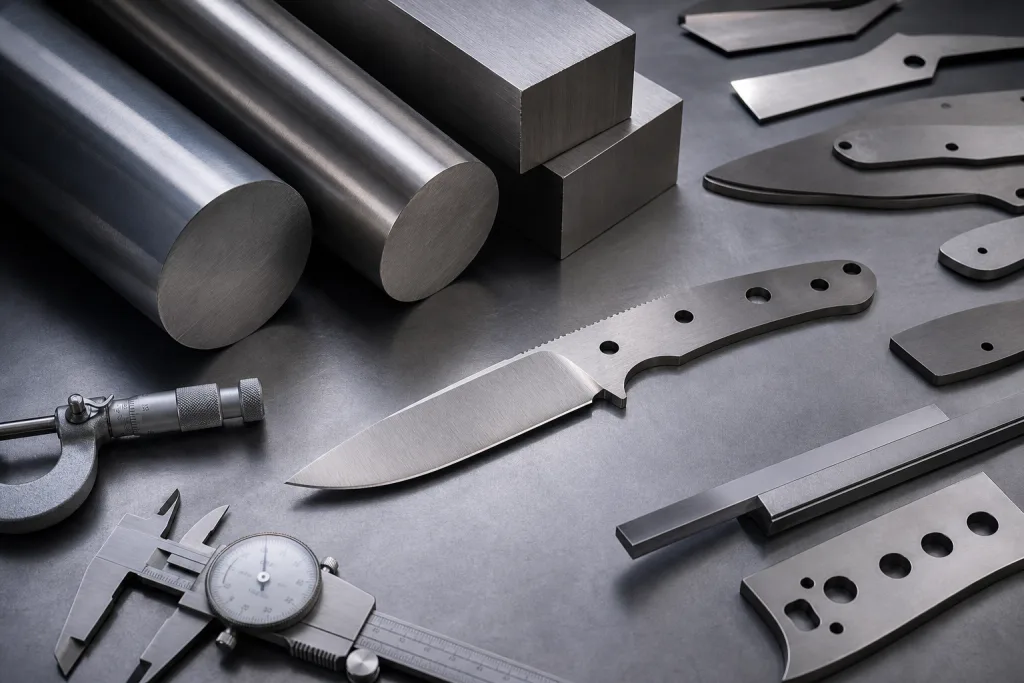
Lead time for custom Damascus knives is not counted from the deposit receipt alone. The clock starts when the spec is firm enough for us to book steel, cut blanks on the laser table, send blades to heat treatment, and freeze the box artwork. If the buyer is still switching from pakkawood to G10, or the gift box dieline is missing the 3 mm bleed, we have not started production. We’ve seen this go sideways.
At TANGFORGE in China, we run 10-18 days for samples and 45-60 days for mass production on a custom damascus kitchen knife moq lead order, counted after sample approval and 30% deposit. Before Q4 retail shipments, add 10-15 days for 6 common bottlenecks: pakkawood blocks, G10 color matching, stabilized wood drying, logo etching plates, EVA tray cutting, and gift box printing. Last October, QC pulled the sample because the handle pin sat 0.4 mm proud after polishing, and that alone cost 2 days.
| Stage | Typical Time | Buyer Checkpoint |
|---|---|---|
| Specification review | 2-4 days | Blade length in mm, HRC target, handle material, logo method, packaging file |
| Sample making | 10-18 days | Edge bite, balance point, satin or etched finish, box fit |
| Material preparation | 7-12 days | Steel lot and handle block batch confirmation |
| Bulk production | 35-45 days | Grinding line photos and defect log by lot |
| Inspection and packing | 3-5 days | AQL report, carton marks, barcode labels |
| Export booking | 3-7 days | CI, PL, BL draft, HS code |
If your launch date is fixed, work backward from the warehouse receipt date, not the day we finish packing cartons. This is the wrong question to ask: “When can the factory finish?” Ask when the goods can reach your 3PL. Sea freight to Europe or North America may take 25-45 days port to port, then customs and inland trucking. Air freight is faster, but the math often fails on knives because chargeable weight, foam inserts, master carton volume, and airport security checks push cost up fast; we ship one 18 kg sample carton by air, not 80 cartons of boxed chef knives unless the buyer accepts the bill.
Specify Damascus Steel Before Price Negotiation
“Damascus” is too loose for a purchase order. Write the steel route down before you talk price: true forge-welded layered steel, san-mai with a named core, etched pattern steel, or printed imitation pattern. We had one buyer flag this after QC pulled the sample and found the “Damascus” pattern wiped lighter after a 3M pad rub test. A serious damascus kitchen knife moq lead manufacturer should answer this in one line, because the route changes cost, HRC, cutting feel, and what you can legally claim on the carton.
For kitchen knives, common hardness is HRC 58-62. Softer than HRC 56 sharpens fast, but the premium retail story is weak. Harder than HRC 62 gets risky if the heat-treatment chart is loose; we’ve seen this go sideways when the grinding line overheated thin tips. Blade thickness for an 8 inch chef knife is usually 2.0-2.5 mm at the spine, tapering toward the tip. For Western retail customers, a 15-18 degree edge per side is common; for Japanese-style positioning, some buyers request 12-15 degrees, but returns climb if end users cut bones or frozen food.
Do not approve a quote without a written steel and construction line. This is the wrong place to save 30 seconds. Use a line like: “67-layer Damascus, 10Cr15CoMoV core, HRC 60±2, etched finish, full tang, G10 handle, 2.3 mm spine.” That sentence beats five glossy photos. It also gives your QA team something to measure when mass production arrives, from Rockwell tester readings to caliper checks on the spine.
Compliance starts with the material list. For EU importers, ask whether food-contact surfaces can support LFGB testing and whether handle materials meet REACH restricted substances requirements. For the US, FDA food-contact expectations apply to materials that touch food, and some retailers ask for California Proposition 65 review. We ship enough mixed-material knife sets to know the certificate folder is not a test plan; match testing to the sales market, SKU finish, and handle material written on the PO.
Export Documents You Should Request Early
Export documentation feels harmless until the container sits at Yantian for 3 extra days. Then nobody asks about the Damascus pattern. For a damascus kitchen knife moq lead export documentation order, request the document list before the 30% deposit, not after mass production starts. We run into this with 300-piece trial orders and 3,000-piece repeat orders: one missing consignee tax ID on the PO can hold the whole file.
The basic export pack should include commercial invoice, packing list, sales contract, bill of lading or airway bill, certificate of origin if required, and insurance certificate if shipping under CIF. For wooden handles or wooden gift boxes, some destinations ask for a fumigation declaration or a statement confirming no solid wood packaging material. If cartons use pallets, confirm whether they are ISPM 15 compliant; QC once pulled a pallet photo because the IPPC stamp was only half visible under the stretch film.
For private label retail, add artwork and label documents to the checklist with real file names, not “final-final.pdf.” Include SKU label, barcode, FNSKU if selling through Amazon, country of origin marking, carton shipping mark, inner carton label, warning label if applicable, and care instruction insert. Knives are sharp consumer products, so your importer may need age restriction wording and safe-use instructions. The buyer flagged it before on a 210 mm chef knife because the insert said “dishwasher safe,” which was wrong for a pakkawood handle.
Do not wait until shipment week to ask for test reports. LFGB, FDA-related food contact testing, REACH screening, and heavy metal checks can take 7-15 working days depending on the lab, and 7 days becomes 12 days fast if the lab asks for a second handle sample. If you need the report under your brand or importer name, confirm that before submitting samples. A generic old report for “kitchen knife” is the wrong document to rely on when a strict retailer or customs broker checks the model photo against the 67-layer Damascus sample.
At TANGFORGE, we keep a shared document tracker with owner, due date, file name, and approval status. Simple works. We ship better when sales, QC, artwork, and logistics all see the same sheet, especially after the grinding line confirms the final blade spec and packing updates from 12 pcs/carton to 24 pcs/carton. The math does not work if purchasing approves the product, logistics books the vessel, and compliance finds the missing document after the vessel has sailed from China.
Quality Control Must Match Retail Risk
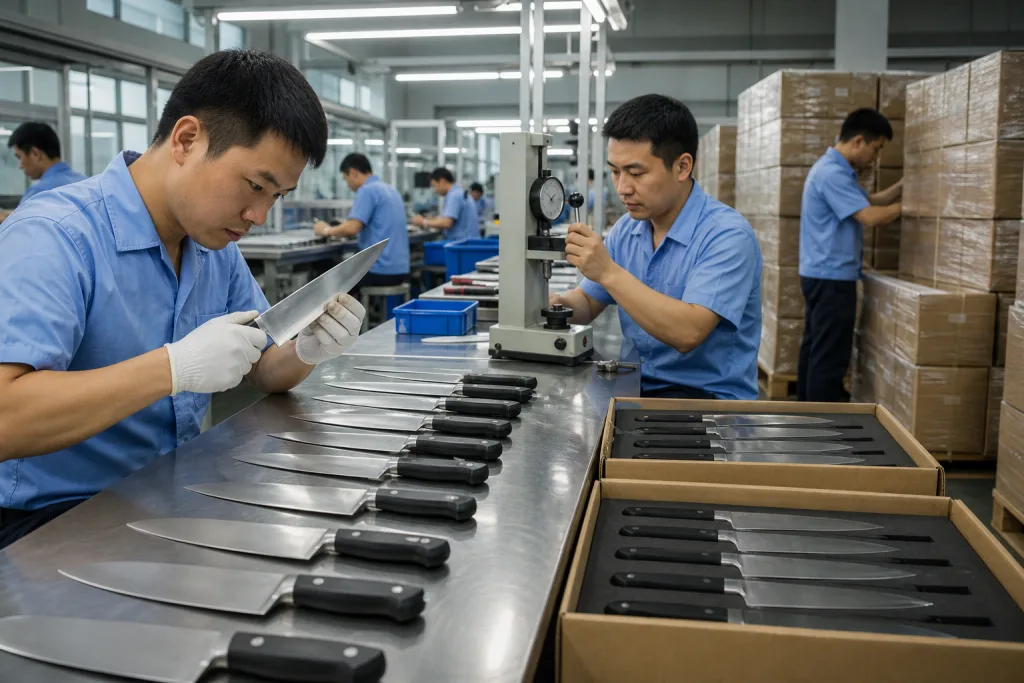
Damascus knives carry more finish risk on a retail shelf than plain satin knives. The acid etch has to show clean depth, the pattern cannot look washed out beside the bolster, and the laser logo needs enough contrast after oil wipe. We see buyers flag this fast. On one 7-inch chef knife run, QC pulled 32 pcs from the grinding line and found 5 blades with a 0.4 mm handle gap and 3 tips leaning off center. If the inspection plan only counts pieces and checks master cartons, it misses the defects customers photograph first.
Set AQL before steel cutting starts. For private label kitchen knives, we run critical defects 0, major defects AQL 2.5, minor defects AQL 4.0. Critical defects include loose handles, cracked blades, sharp burrs outside the cutting edge, broken tips, contamination, wrong material, or unsafe packaging. Major defects include wrong logo, obvious blade warp, large handle gap, poor edge, wrong carton mark, or mixed SKU. Minor defects include small polish marks, slight pattern variation, or small box scuffs within an agreed limit. One buyer once wrote “VG-10 look” on the PO instead of the actual steel grade; the math doesn’t work if QC has no signed defect sheet to judge against.
Write the checks as measurements, not nice words. HRC 60±2 is a range, not a slogan. Blade length tolerance can be ±2 mm. Spine thickness can be ±0.2 mm. Net weight can be ±5%. Carton drop test can follow ISTA-style retailer requirements if your channel demands it. For edge performance, some buyers use CATRA testing, but for most first orders, a controlled paper cut, tomato cut, and visual edge inspection give cleaner control without adding 7 days to the sample stage. Our QC bench uses a Rockwell tester, digital caliper, 500 g scale, and 10x loupe for these checks.
Ask for in-line photos at three points: blade after grinding, handle before final polish, and packed retail unit. Better factories can produce 80,000-120,000 knife units per month, but volume does not replace inspection. We ship containers every month, and we have still seen this go sideways when the retail box photo was approved but the inner tray fit was never checked. In China, a clear defect standard with photos is the cheapest insurance you can buy; 12 marked reference photos beat 18 emails after the goods are packed.
Packaging and Labeling Affect Customs Clearance
Retail private label teams often hand packaging to the design desk. For knives, that is the wrong question to ask. Packaging has to pass customs, warehouse receiving, and blade-safety checks. Last month QC pulled a 210 mm Damascus chef knife sample from the packing table; the blade tip had pushed through a 1.5 mm EVA insert after a drop test. A good-looking magnetic box still fails if the barcode scans at 60%, the tip guard shifts, or the carton mark does not match the packing list.
For each SKU, lock the retail box size, gross weight, net weight, master carton quantity, carton dimensions, and pallet plan before we run printed boxes. These numbers change freight cost and warehouse receiving. A typical 8 inch Damascus chef knife in a gift box may weigh 450-750 g per retail unit depending on handle and packaging. A master carton of 24 pcs can easily reach 14-20 kg; our packing line normally checks this on a 30 kg bench scale before sealing the first carton. If you sell through ecommerce, build single-unit packaging for parcel drops, not just pallet shipment.
Country of origin marking must be visible and consistent. “Made in China” should appear on the product, retail box, or label according to your market and channel requirement. Some importers prefer laser marking on the blade; others use box labels. We have seen this go sideways when a buyer approved “Japanese style” copy, then the retailer flagged the side panel because it read like Japanese origin. Do not imply handmade origin, Japanese origin, or local manufacturing if the knives are produced in Yangjiang, Zhejiang, China. Customs and retailer compliance teams read packaging claims with a ruler in hand.
If you need FNSKU labels, send the final PDF and placement instruction before mass packing. We need the file before the 500 pcs pre-pack check, not after cartons are taped. If you need EAN or UPC barcode verification, test printed boxes before the full run; QC scans 10 boxes from the first bundle using a handheld scanner on the packing bench. For DDP shipments, your supplier or freight forwarder must align labels with customs entry data. A mismatch between SKU description, HS code, and carton mark can delay clearance even when the knife is fine.
Agree Payment and Incoterms Clearly
Payment and Incoterms belong in export control, not just the finance column. On custom damascus kitchen knife MOQ orders, we run 30% deposit and 70% balance before shipment, after the buyer signs off the inspection report. For repeat wholesale programs, 2 out of 10 buyers ask for 20/80, LC at sight, or split payments tied to tooling and mass production, but new private label accounts should budget for 30/70. The math does not work if a first order asks for open credit while we are buying 67-layer steel, G10 scales, inner boxes, and cartons before the grinding line starts.
FOB is the cleaner Incoterm for importers who already have a forwarder. The factory handles China export clearance and loads the goods on board at the named port, usually Shenzhen or Guangzhou for our knife shipments. You control freight and destination customs. EXW looks lower on the PI, but your forwarder must arrange Yangjiang inland pickup, export declaration, and sometimes a truck waiting charge if QC pulls the sample late. DDP looks easy until the buyer asks who is importer of record, who pays duties, and whether their retailer will accept that tax setup.
For kitchen knives, HS code classification changes by market and construction, so do not copy a supplier’s old code from 2021 and hope it passes. Ask your customs broker to confirm it before shipment. The commercial invoice should say the goods plainly: “Damascus stainless steel kitchen knives with G10 handle,” not loose wording like “metal products” or “kitchenware.” We have seen this go sideways when customs flagged 18 cartons because the invoice wording did not match the carton mark and the blade description on the PO.
Before balance payment, ask for packing photos with carton dimensions in mm, final inspection report, carton mark photos, draft commercial invoice, draft packing list, and booking confirmation. Check the small stuff. Last month a buyer flagged one PO typo where “8 inch chef knife” became “8 pcs chef knife,” and QC caught it before the cartons were sealed with 48 mm tape. If anything is wrong, fixing it in Yangjiang takes 1 day; fixing it after arrival in Rotterdam, Hamburg, Los Angeles, or Toronto can burn 12 days vs 18 days depending on the broker queue.
Frequently asked questions
For existing blade shapes with your laser logo, 300 pcs per SKU is a practical starting point. If you need custom handle color, retail box, barcode labels, and inserts, plan on 500 pcs per SKU. For a new blade profile, new handle tooling, or exclusive Damascus pattern, 1,000 pcs per SKU is more realistic. A damascus kitchen knife moq lead wholesale program can sometimes mix 3-5 SKUs if the total order reaches 1,500-2,500 pcs, but each SKU still needs enough volume for stable production and inspection.
A safe plan is 10-18 days for samples, 45-60 days for bulk production after sample approval and deposit, then freight time. Sea freight to Europe or North America often takes 25-45 days port to port, plus customs clearance and inland delivery. If you need third-party LFGB, REACH, FDA food-contact, or retailer packaging tests, add 7-15 working days. For a new retail launch, start the project 100-130 days before your required warehouse date.
At minimum, request the commercial invoice, packing list, sales contract, bill of lading or airway bill draft, and certificate of origin if your broker needs it. For compliance, ask for material declarations, test reports, and food-contact documentation relevant to your market. If wood packaging or pallets are used, confirm ISPM 15 or fumigation status. For private label retail, also require barcode files, carton marks, FNSKU labels if applicable, care instructions, and final artwork approvals before mass packing starts.
Sometimes, but do not assume it. Many retailers require reports that match the exact product material, finish, handle, coating, and importer or brand name. A generic report for “kitchen knife” may be rejected if your order uses a different G10 color, pakkawood, coating, glue, or gift box material. Lab testing normally takes 7-15 working days. If your retailer needs LFGB, REACH, FDA food-contact review, or heavy metal screening, confirm the required standard before the supplier submits samples.
Use AQL 2.5 for major defects and AQL 4.0 for minor defects, with zero tolerance for critical safety defects. Check blade straightness, tip condition, edge burrs, HRC range, handle gaps, rivet finish, logo position, Damascus pattern consistency, retail box print, barcode scan, carton marks, and quantity per carton. For an 8 inch chef knife, agree tolerances such as blade length ±2 mm, spine thickness ±0.2 mm, and HRC 60±2. Include packed-unit inspection because many retail claims come from damaged boxes, not defective blades.
Send Your Damascus Knife Spec for Review
Share blade sizes, target price, packaging, market, and launch date. We will reply with MOQ, lead time, compliance gaps, and export document requirements.
Request a Quote