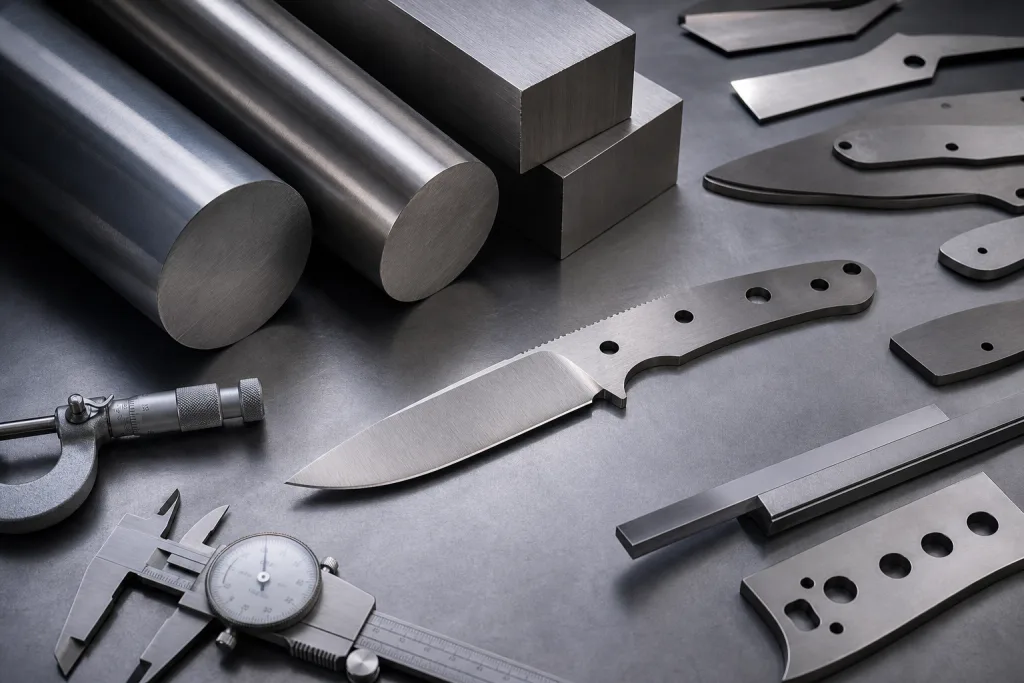
Promotional product buyers choose Damascus kitchen knives because the layered blade looks premium in photos and fits executive gifts, loyalty campaigns, and retail gift sets. But a knife is not a pen. We have seen returns start from small details: 58 HRC blades marked as 60 HRC, a 0.4 mm handle gap, weak edge retention after a rope-cut test, or a missing country-of-origin mark on the gift box. Carton inspection alone is the wrong question to ask.
At TANGFORGE in Yangjiang, Zhejiang, China, we run a custom Damascus kitchen knife order as a manufacturing project, not a logo-printing job. A normal bulk program needs fixed MOQ, workable lead time, signed pre-production samples, inline checks at the grinding line, and final AQL inspection before shipment. Last month QC pulled 32 samples from a 1,200-piece batch and the buyer flagged one typo on the PO versus the blade etching artwork. If you buy from a damascus kitchen knife moq lead supplier, ask for the inspection plan before you pay the deposit.
Start With the Real MOQ
The phrase damascus kitchen knife moq lead quality inspection plan sounds like a spreadsheet line, but it decides whether your campaign leaves our loading bay or turns into a claims file. Start with MOQ. That one number controls 67-layer steel purchasing, handle material cutting yield, grinding line setup, laser file programming, gift box printing, and AQL inspection cost. We run the first cost check from the BOM, not from a sales target.
For promotional buyers, a realistic MOQ for a custom Damascus kitchen knife is usually 300-500 pcs per SKU. If you choose our stock 8-inch chef blade, standard pakkawood handle, laser logo, and neutral gift box, 300 pcs can work. If the PO says custom blade profile, private mold handle, color box, instruction leaflet, insert tray, FNSKU label, and outer carton marks, 500-1,000 pcs is more practical because the math doesn't work below that. Last month one buyer pushed for 200 pcs with a 4-color box; the box setup alone added USD 0.86 per knife.
A damascus kitchen knife moq lead factory should tell you what is driving the MOQ. Sometimes it is not the blade. It is the printed box supplier asking for 1,000 pcs, the resin handle block supplier asking for 200 kg, or the heat-treatment furnace needing a full batch before we can hold 58-60 HRC evenly. At TANGFORGE, our Yangjiang, Zhejiang production team separates blade MOQ from packaging MOQ on the quote sheet, so you can see the real constraint before your buyer signs off.
Be careful with quotes that promise full custom Damascus knives at 100 pcs with retail packaging and a 25-day lead time. We have seen this go sideways. It works only when the factory already has blade blanks, handle stock, and a ready box dieline on the shelf. For a new promotional campaign, use the safer number: 500 pcs per design, 45-60 days after approval, and formal AQL inspection before release. QC pulled one pre-shipment sample last quarter for a 1.5 mm logo shift; catching that before packing saved 38 cartons from rework.
Lead Time Is Built in Stages
Lead time for a custom damascus kitchen knife moq lead order is not one factory clock. It is approvals stacked on top of production. If your brand team takes 12 days to approve the logo position, those 12 days are not buried inside quoted production time; they move the shipment date by 12 days. We see this on the floor when the laser room has the jig ready, but QC cannot release the first logo sample because the PO says “front blade” and the artwork says “left face.”
For a standard Damascus chef knife or santoku promotional gift, we normally plan sample development in 7-15 days, sample transit in 3-7 days by courier, bulk material preparation in 7-12 days, blade production and heat treatment in 18-25 days, handle assembly and finishing in 8-12 days, packaging in 5-8 days, and final inspection in 1-2 days. Sea freight, rail, air, DDP, and Amazon prep are separate lines on the schedule. On our grinding line, a 2.0 mm blade and a 2.5 mm blade do not move at the same speed, so this is the wrong question to ask if the buyer only asks, “Can you ship in 40 days?”
The delay we fight most is not forging. It is artwork. Buyers approve the knife, then miss the color box, barcode, warning label, instruction leaflet, country of origin, or carton shipping marks. For Europe and North America, lock these files before mass packaging starts. QC pulled one 500 pcs order last year because the outer carton mark had “Made in Chian” printed on 42 cartons; reprinting boxes after knives are finished is a clean way to lose 14 days.
| Order type | Typical MOQ | Sample time | Bulk lead time |
|---|---|---|---|
| Stock Damascus knife with laser logo | 300 pcs | 5-10 days | 35-45 days |
| Custom handle and gift box | 500 pcs | 10-15 days | 45-60 days |
| Full gift set with sheath or board | 1,000 pcs | 15-25 days | 60-90 days |
A solid damascus kitchen knife moq lead manufacturer should send a Gantt-style schedule with approval points, not just a nice delivery date. If you receive a one-line promise such as “40 days,” ask what starts the count: deposit date, artwork approval date, sample approval date, or material arrival date. We ship smoother when that date is written on the PI, because the buyer, merchandiser, and packing team are all reading the same clock.
Define the Knife Specification First
Quality inspection works only when the knife spec can be measured. “Premium Damascus chef knife” is not a spec; it is a sales word, and it gives QC nothing to hold in a caliper. A clean PO should state blade length and total length in mm, spine thickness at heel and mid-blade, core steel, cladding type, HRC band, handle material, rivet material, edge angle, logo method, box structure, carton quantity, and pass tolerance. We run into trouble when the buyer sends a mood board but no numbers.
For promotional programs, we normally steer buyers toward a spec the grinding line can repeat. A 200 mm chef knife with 67-layer Damascus cladding, 10Cr15CoMoV or VG10-type core, 58-60 HRC, 2.0-2.3 mm spine thickness, 15-18 degree edge per side, and stabilized wood or G10 handle is easier to control than a thin 63 HRC blade built for a gift budget. Higher HRC is not automatically better. The math does not work if the end user chops chicken bones and then files a chipping claim after 12 days.
Your inspection plan needs tolerance written on the PO. Use numbers such as blade length ±2 mm, total weight ±8 g, logo position ±1.5 mm, handle gap not over 0.2 mm, blade straightness deviation below 1.5 mm, and carton gross weight within ±5%. QC pulled a sample last month where the logo was 3 mm low; without a tolerance line, the buyer and factory spent two days arguing from phone photos. A feeler gauge settles it faster.
For food-contact markets, ask for compliance papers before we cut steel. North American buyers often ask for FDA food-contact declarations for handle coatings or packaging inks. European buyers usually ask for LFGB or REACH statements, mainly for coatings, glues, and printed packaging. A damascus kitchen knife moq lead wholesale order should also define country-of-origin marking. “Made in China” on the box works for some channels, but 4 retail buyers we ship to require marking on the blade, sheath, insert, and outer carton. Confirm it before production; we have seen this go sideways when customs flagged a missing carton mark.
Build AQL Into the PO
Do not let AQL show up only when the third-party inspector walks into the packing area with a caliper and carton checklist. Put it in the purchase order. For most promotional knife programs, we suggest ANSI/ASQ Z1.4, General Inspection Level II, with AQL 2.5 for major defects and AQL 4.0 for minor defects. Critical defects are zero tolerance. For retail, club stores, and online marketplace programs, we have seen buyers tighten major defects to AQL 1.5 after one failed shelf audit. Good call. Vague QC wording is the wrong place to save 3 minutes on a PO.
Define defect categories in plain words. A critical defect means exposed contamination, broken blade, unsafe loose handle, a sharp burr on handle hardware, wrong steel declaration, missing legal warning, or packaging that creates a safety risk. Major defects cover wrong logo position by 2 mm or more, visible blade warp, edge chips, handle cracks, wrong packaging, failed barcode scan, incorrect carton mark, or HRC outside the agreed band. Minor defects are small cosmetic scratches, slight color variation, light box scuffing, or finish marks inside the approved limit. QC pulled one Damascus sample last month because the laser logo was 3 mm off center; the buyer flagged it before we even packed the master carton.
The sample size follows the order quantity. For a 1,000 pc order under General Level II, the inspector may check 80 pcs, depending on the standard table and lot size. At AQL 2.5, the acceptance number is tight; too many major defects fail the lot. This is why inline inspection matters. If final inspection finds 9% handle gaps, the math does not work. Reworking 90 knives after gift box packing takes 18 days instead of 12 days, because the grinding line, handle fitting bench, and packing team all touch the order twice.
At TANGFORGE, our monthly capacity is about 180,000-220,000 knives across kitchen, outdoor, pocket, hunting, tactical, and Damascus lines. Volume helps. It does not replace sampling discipline. A damascus kitchen knife moq lead factory in China should accept your own inspector, SGS, Intertek, Bureau Veritas, QIMA, or your appointed quality agent without drama. We run pre-shipment checks with blade straightness gauge, Rockwell tester, barcode scanner, and 5-carton drop checks when the PO calls for it. If the supplier pushes back on AQL wording, we have seen this go sideways. Treat it as a warning sign.
Inspect Before Final Carton Packing
Final inspection matters, but for knives it is too late by itself. We run three real checkpoints: incoming material inspection with a vernier caliper and visual board, inline checks on the grinding line, and pre-shipment inspection before cartons are sealed. For a new custom damascus kitchen knife moq lead program, add a pilot run review after the first 30-50 pcs are assembled; QC pulled the sample at 42 pcs last month because the handle gap was already showing at 0.35 mm.
Incoming inspection checks steel sheets or billets, handle blocks, rivets, glue, inserts, boxes, labels, and cartons. Damascus patterns shift by batch, so approve a pattern range against one golden sample and two limit samples. Do not ask every blade to look identical. That is the wrong question to ask. Real layered steel has natural variation; reject obvious delamination, pits deeper than 0.2 mm, weak etching, or pattern mismatch against the approved golden sample. We once held 600 blades because the buyer flagged a darker center line after etching.
Inline inspection should happen after grinding, after heat treatment, after handle assembly, and before individual packing. The inspector checks blade straightness on a flat plate, grind symmetry at the choil, HRC readings, edge condition, handle fit, rivet finish, polishing, logo clarity, and cleaning. HRC can be checked by calibrated tester on sample pieces or designated test areas; for finished retail knives, factories often test representative blades to avoid cosmetic damage. On one VG-10 style run, the Rockwell tester read 58 HRC against a 60-62 HRC target, so the heat-treatment lot stayed off packing tables.
Pre-shipment inspection covers finished goods in export cartons. It should verify quantity, assortment, barcode scan rate, FNSKU or SKU label accuracy, carton marks, inner box condition, drop test result, moisture protection, and pallet plan if required. For gift campaigns, we recommend a 100% visual check on logo orientation and box sleeve direction. Small thing. It kills the order. A knife with the logo upside down may still cut well, but it fails as a promotional product; we have seen this go sideways when one PO had “matte black” typed as “matt black” and the carton label followed the typo.
Our Yangjiang, Zhejiang team usually photographs each QC stage and stores inspection records by PO number. That matters when you reorder six months later. Without records, your “same as last time” order becomes guesswork. We ship repeat runs faster when the file has the old AQL 2.5 report, carton mark photo, and the 1.8 mm blade-thickness reading from the last approved sample.
Packaging QC Protects the Campaign
Promotional buyers often spend 80% of the call on the knife and 20% on the packaging. For bulk gifts, 60/40 is the safer split. The recipient opens the box first. The importer checks the carton first. The warehouse scans the barcode first. Last month QC pulled 32 gift-box samples from the packing table; 5 had rubbed corners before we even ran the tape gun. If the packaging fails, nobody gives the blade grind a fair look.
A solid packaging inspection plan starts with structure. Common choices are magnetic rigid box with 1.5 mm greyboard, kraft box with EVA insert, printed sleeve, color box with molded pulp tray, or roll bag set with tip guard. For a single Damascus chef knife, we run a 76 cm carton drop test on corner, edge, and face, then open the box and check blade movement with a 0.5 mm feeler gauge at the tip area. If the blade pierces the insert or shifts inside the box, the design goes back before mass packing. We have seen this go sideways.
For North American fulfillment, check UPC, FNSKU, polybag suffocation warning size, carton dimensions, and case pack count against the PO. One buyer flagged a PO typo where “24 pcs/ctn” became “48 pcs/ctn”; that mistake would have broken their Amazon receiving plan. For European distributors, confirm required languages, recycling symbols, importer address, CE only if genuinely applicable, and REACH-related packaging statements where needed. Do not print compliance marks because they look official. Wrong marks create more trouble than missing ones.
For a damascus kitchen knife moq lead wholesale order, carton strength must match the shipping route. Air shipments can run lighter cartons. Sea freight and DDP delivery need stronger export cartons, moisture control, and desiccant packs when the route sits 28 days door to door instead of 7 days by air. We typically use 5-ply export cartons for heavier knife sets and keep carton gross weight under 18-20 kg unless the buyer approves otherwise; the packing line checks this on a 30 kg platform scale before sealing. A promotional campaign can involve 50-300 cartons arriving at one warehouse. Bad carton design stays in the warehouse team’s memory long after the invoice is paid.
Price, Terms, and Reorder Control
MOQ, lead time, and price sit on the same worksheet. Ask a damascus kitchen knife moq lead manufacturer for 300 pcs with a custom color box, rush delivery, and DDP service, and the quote will not match a standard FOB bulk run. No mystery there. We still pay for the blade stamping die setup, box proofing, incoming 67-layer billet check, final AQL 2.5 inspection, and export handling, but those costs are divided across 300 knives instead of 3,000.
For planning only, a 200 mm Damascus kitchen knife for promotional bulk may land in the USD 8.50-18.00 FOB China range depending on steel core, handle material, finish level, packaging, and order volume. A rigid gift box can add USD 1.20-3.50. A sheath, sharpening card, insert, or branded sleeve adds more once the packing table starts timing the set. Air freight is where the math often breaks: we weighed one 6-piece sample set at 2.85 kg gross, and the buyer flagged the delivered price before we even sent the PI. Check carton weight before promising DDP to your client.
New-buyer payment terms are usually 30% deposit and 70% before shipment after passed inspection. Regular importers with 4-6 repeat orders a year may get better terms after credit review. If you need DDP to the US, Canada, UK, or EU, confirm HS code, duty assumptions, anti-dumping exposure if any, and insurance before the PO is typed. Knives also hit carrier restrictions, especially tactical-looking profiles; we have seen this go sideways when a kitchen santoku was described as “outdoor blade” on a forwarder form.
Reorder control is where a serious damascus kitchen knife moq lead supplier earns its margin. Keep the golden sample, blade drawing, steel batch record, packaging dieline, Pantone references, laser file, AQL report, and approved carton marks in one job folder. TANGFORGE has produced knives in China since 2008 with about 240 employees, and the boring records are what keep reorders stable. QC pulled one reorder sample last season because the PO showed “black pakkawood” while the approved sample was walnut color; that small typo would have cost 12 days vs 18 days on the revised handle material. Reorder work should mean changing quantity and ship date, not rebuilding the knife from memory.
Frequently asked questions
For promotional buyers, the realistic MOQ is usually 300-500 pcs per SKU. At 300 pcs, you should keep the blade shape, handle material, and packaging close to existing factory options. At 500 pcs or more, custom handles, color boxes, laser logos, inserts, and carton marks become easier to manage. If you need a fully custom blade profile, private mold handle, and rigid gift box, plan 1,000 pcs. A factory offering 100 pcs with full customization may be using leftover materials or skipping proper sampling. That can work for a small test, but it is risky for a branded campaign.
For a normal custom Damascus kitchen knife bulk order, plan 45-60 days after final sample and artwork approval. Sample development usually takes 7-15 days, and courier transit adds 3-7 days. More complex sets with sheaths, boards, sharpeners, or rigid boxes can need 70-90 days. Do not count lead time from deposit only. The more accurate starting point is the date when the supplier has approved artwork, confirmed packaging files, received deposit, and locked the golden sample. If you need delivery before a fixed event date, add at least 10-14 days of buffer.
A practical starting point is ANSI/ASQ Z1.4 General Inspection Level II, with AQL 2.5 for major defects and AQL 4.0 for minor defects. Critical defects should be zero tolerance. Major defects include wrong logo, blade warp, handle cracks, failed barcode, wrong box, missing warning label, or HRC outside the agreed range. Minor defects include small cosmetic scratches or slight packaging scuffs within an approved limit. For retail or marketplace programs, some buyers use AQL 1.5 for major defects. Put the AQL terms in the purchase order before production starts.
No, not usually. HRC testing can leave marks, so finished retail knives are normally checked by sampling or by representative test pieces from the same heat-treatment batch. For Damascus kitchen knives, a common target is 58-60 HRC or 60-62 HRC depending on core steel and intended use. Your inspection plan should define the acceptable HRC band and how many blades or test coupons are checked per batch. If the order is large, ask for heat-treatment records and random HRC readings. For promotional knives, consistent safe performance matters more than chasing the highest hardness number.
Before final payment, ask for the passed inspection report, packing list, commercial invoice, carton photos, barcode scan proof, production photos, and material or compliance declarations required by your market. For Europe, REACH and LFGB-related statements may be requested for food-contact parts and packaging. For North America, FDA food-contact declarations may be relevant for coatings or handle materials. If using FOB China, confirm vessel booking details. If using DDP, confirm duty assumptions, consignee details, delivery address, carton count, and insurance. Do not release the balance only because the factory says goods are finished.
Get a Knife QC Plan Before Quoting
Send your target quantity, delivery date, logo file, and packaging idea. We will return MOQ, lead time, FOB pricing, and inspection checkpoints.
Request a Quote