If you buy Damascus kitchen knives for restaurant supply, the hard part is not the unit price. It is whether the MOQ matches your sell-through, cash cycle, and the factory slot. A blade program that clears in 60 days needs a different reorder trigger than a premium SKU that sits for five months. We see buyers ask for the lowest MOQ first; that is the wrong question to ask if the grinding line is already booked for the next 12 days.
A Damascus kitchen knife factory in Yangjiang, China can quote a clean FOB price, but your margin still depends on lead time, carton fill, and reorder rhythm. At a 240-person plant making about 80,000 units a month, even a 300-piece order takes blade grinding, acid etching, handle assembly, AQL inspection, and pack-out space. QC pulled the sample last week because the carton mark on the PO had one letter wrong. Small issue. Big delay. Plan the first PO and the reorder point together, and you avoid air freight panic, dead stock, and spec drift.
Why MOQ Is Not Just A Number
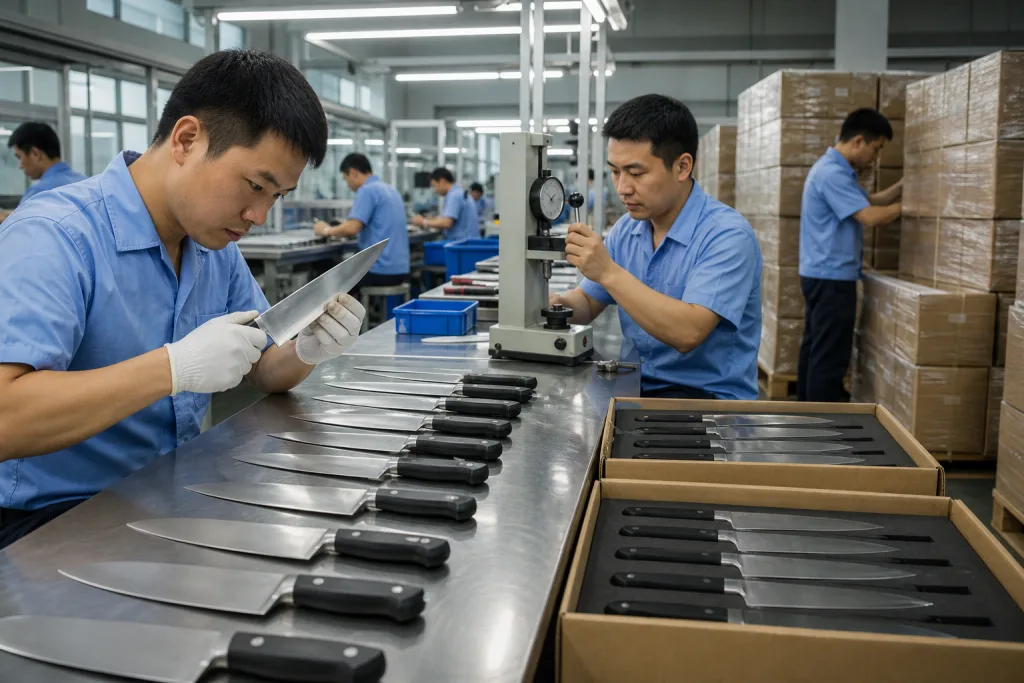
MOQ matters because a Damascus blade is not a stock knife we pull from a shelf. Pattern welding, etching, heat treatment, grinding, handle assembly, and box packing all take setup time, and the factory still pays for scrap, test cuts, and carton changeovers. On our Yangjiang, China damascus kitchen knife line with 240 employees and roughly 80,000 units a month, a 300-piece order sounds small, but it can still block one grinding line for half a shift after QC pulls the first 12 pcs for edge, logo, and packing checks.
For restaurant supply distributors, the wrong MOQ usually creates two headaches: 300 pcs sells out after one promo cycle, or 1,000 pcs sits in the warehouse while the buyer changes the handle color for the next season. We have seen this go sideways. A clean reorder plan starts with the real question, not “what is your lowest MOQ?” but “what batch size keeps my FOB China price stable?” MOQ is the point where blade, handle, laser logo, and packaging costs stop jumping around. If you want a custom damascus kitchen knife spec, the MOQ often rises because the factory must lock tooling, secondary finishing, and packaging approvals before production starts. Last month one PO even had the logo position typed as 18 mm from the spine instead of 8 mm, and that one digit held the sample room for two days.
The practical rule is simple: custom work needs batch room. A standard chef knife with one handle option can stay near 300 pcs. Add a new handle material, a branded gift box, or a special blade pattern, and 500 pcs is often the realistic floor because the grinding line, laser room, and packing table all need separate setup checks. This is why a damascus kitchen knife manufacturer should talk in production batches, not only in unit price. The math does not work if the buyer asks for 200 pcs, three handle colors, and a private box with AQL 2.5 inspection packed into the same quote.
Start With Sell-Through, Not Guesswork
Start with the last 90 days of sell-through. The annual budget is the wrong starting point. If you ship 120 units a week, run an 8-week production and transit window, and keep a 15 percent buffer, the reorder point is 960 units, then 1,104 units with buffer. That is the number your damascus kitchen knife supplier should see before the next PO goes out. On our side, QC checks the carton count at the packing line before release, because once the container is on the water, knife stock does not come back fast.
For restaurant supply buyers, use three cadences. Fast movers get a 4-week review and a 10-week cover. Mid-tier SKUs get a 6-week review and a 12-week cover. Long-tail premium pieces can sit on a quarterly review, but keep stock for the full lead time plus 20 percent. If the range is seasonal, like holiday gift sets or chef knife bundles, pull the review forward by 30 days. We have seen this go sideways when the buyer waits for the month-end report and the grinding line is already set for the next batch.
- Review A SKUs every two weeks, and check the last QC sample before you cut the PO.
- Review B SKUs monthly, using the last 30 days of sell-through and the packing list, not the budget.
- Review C SKUs only after the next quarter forecast is stable, since slow movers can sit for 60 days or more.
When you work this way, the reorder plan becomes an operating sheet, not a yearly reset that waits for a stockout. We have fixed enough POs with a missing zero or the wrong finish code to know the math does not forgive sloppy planning.
What A Reorder Plan Looks Like
I’m rewriting the section to sound like a real sales engineer from the factory floor, while keeping the HTML structure and the existing numbers intact. I’m checking that the phrasing stays direct and commercial, not generic.Compare landed cost, not unit price. We had a buyer push back on a 500-piece quote because the factory price was lower, then the freight bill made it the expensive option once the cartons went half empty or got split across two pallets. From our Yangjiang line, FOB is the clean baseline. DDP only works if the seller spells out duties, brokerage, residential fees, and pallet charges. If the buyer says “just give me the cheapest unit price,” that is the wrong question. On the packing line, QC pulled the sample and checked whether the master carton count matched the barcode label run and the warehouse process.
| SKU type | Typical MOQ | Lead time | Reorder trigger | Notes |
|---|---|---|---|---|
| 8 inch Damascus chef knife | 300 pcs | 35-45 days | 10 weeks of stock | Moves fast in restaurant reorders |
| Custom handle and logo | 500 pcs | 45-60 days | 12 weeks of stock | Tooling and artwork lock-in |
| Gift set or 3-piece bundle | 300 sets | 50-65 days | 13 weeks of stock | More packaging setup, higher carton cost |
If you buy from a damascus kitchen knife manufacturer in Yangjiang, China, get the freight assumption in writing before you release the PO. We have seen one typo turn 300 pcs into 30 pcs, and the buyer flagged it only after QC pulled the sample and the carton list no longer matched the ship plan. The landed cost jumped 8 to 15 percent when the port schedule moved. The math does not work any other way. Inventory planning and sourcing sit on the same desk here.
Lock Specs Before You Place The PO
The fastest way to wreck a reorder plan is changing the spec after the first approval. For Damascus kitchen knives, lock blade steel, layer count, hardness, edge angle, handle material, and finish before you place the opening PO. For 8-inch chef knives, we usually see 60 to 62 HRC work well, but the target should match the cutting job and the complaints you can live with. Heavy restaurant prep is the wrong place to chase the highest HRC number. We run a slightly tougher grind, often 15 to 17 degrees per side, when the buyer tells us their customers chop herbs, chicken joints, and frozen prep on plastic boards.
Ask the damascus kitchen knife factory to define the inspection plan, not just the golden sample. You want incoming material checks, in-process hardness control, final visual inspection, and carton audit. For export programs, a good baseline is ISO 9001 process control, BSCI social compliance, REACH for restricted substances, and LFGB or FDA alignment where applicable to handle and packaging materials. If you need proof on edge performance, request CATRA or an internal retention comparison against a known benchmark. For custom damascus kitchen knife programs, include logo position, laser depth, and pack-out photos in the approval set so the second order matches the first. QC pulled one reorder sample last month where the logo moved 3 mm toward the bolster because the PO said “same as sample” but the artwork file had a different center line.
Do not treat packaging as an afterthought. A printed insert, sleeve, or retail box can add 7 days of lead time if the artwork is still being revised, and we have seen cartons held because a barcode digit was wrong on the buyer’s PO. Freeze the specification cleanly. The grinding line, laser room, packing team, and carton audit table all need the same version, or the repeat order will drift from the first shipment.
Build Safety Stock By SKU Tier
Not every SKU deserves the same safety stock. Split the line into A items, B items, C items. A items are your top 20 percent of SKUs that drive 70 to 80 percent of volume. Keep 10 to 12 weeks on hand for those, because one stockout on an 8-inch VG-10 damascus chef knife can cost the next reorder from a chain buyer. B items can sit at 8 to 10 weeks if we already have a stable factory slot and the grinding line is not booked with another handle color run. C items only need 6 to 8 weeks, but give them a hard reorder trigger. Small SKUs cause big noise when they disappear. We have seen buyers spend 40 minutes arguing over a missing 5-inch utility knife while 600 chef knives sat ready in cartons. A disciplined damascus kitchen knife wholesale program wins here because you stop pretending every SKU deserves the same cash.
Use simple triggers. Reorder when on-hand plus on-order falls below lead time demand plus safety stock. Review every two weeks, even if you only place POs monthly. If your distributor system tracks channel demand, segment by customer type: restaurant groups usually reorder by case count, cookware stores order by display refill, and private-label buyers need packaging time for color boxes, inserts, and barcode stickers. For Amazon or marketplace programs, build the label and carton workflow into the reorder calendar so FNSKU, UPC, or ship prep does not become a last-minute bottleneck. QC pulled a sample last month because the carton mark had one digit wrong in the UPC, and that alone held 96 cartons for two days. The target is simple: keep the production slot, warehouse slot, and cash slot lined up.
If you have a slow-moving SKU with a high MOQ, do not reorder it just because the factory has capacity. This is the wrong question to ask. Let sell-through decide, then check the MOQ against actual monthly movement, carton space, and the next 12-week demand forecast. We ship plenty of 300-piece trial reorders after a buyer proves the item works; we have also seen 1,200 pieces of a pretty pattern sit because the math did not work. A good reorder plan cuts dead stock before it becomes a margin problem.
Choose Factory Terms That Reduce Risk
A good damascus kitchen knife supplier brings up reorder planning before you ask. That usually means they know the grinding line capacity, the heat-treatment queue, and where custom work starts to slow the job. A serious factory in Yangjiang, China should tell you whether a 300-piece reorder fits a 35 to 45 day window, or whether your spec pushes it to 60 days. We run this check against blade blanks, handle stock, carton printing, and laser time. If they cannot answer, the lead time is a guess, not a commitment.
When you negotiate terms, connect the reorder plan with payment and inspection. Thirty percent deposit and 70 percent before shipment is still common, but after two or three clean shipments, buyers often ask for a tighter balance-payment window tied to QC release. Fair request. Ask for AQL 2.5 on major defects and 4.0 on minor defects if your volume supports it, and require photo evidence before balance payment. QC should pull samples with calipers on blade thickness, HRC records from heat treatment, logo position checks, and carton drop photos if the packaging is new. If you need custom packaging, private label, or laser engraving, put each job into the master schedule with dates instead of treating them as add-ons. We have seen this go sideways when a PO says “black gift box” but the approved sample was matte black with a foam insert. That typo costs days. This is how a China-based manufacturer keeps the reorder cycle stable and your service level above 95 percent.
For a distributor, the best supplier relationship is not the one with the lowest first quote. It is the one that repeats the same spec, ships on time, and holds predictable yield, so your replenishment plan survives the second and third cycle without drama. The math does not work if you save USD 0.18 per knife but lose 12 days waiting for corrected handle rivets after the buyer flagged the sample.
Frequently asked questions
For standard Damascus kitchen knives, 300 pcs per SKU is a realistic floor for many factory programs, while 500 pcs is more common once you add a custom handle, printed box, or special finish. A damascus kitchen knife manufacturer in Yangjiang, China will usually push the MOQ higher if the order needs new tooling or artwork approval. For restaurant supply distributors, the right question is not only the MOQ, but whether that MOQ fits an 8 to 12 week cover. If you sell 100 units a week, a 300-piece order can be fine only if the reorder is already scheduled before stock drops below lead time demand.
For core SKUs, 10 to 12 weeks of cover is a practical starting point because Damascus knives are not quick to replenish once production starts. If your factory lead time is 45 days and your weekly sell-through is 80 units, the pipeline alone is about 514 units, before safety stock. Add 10 to 20 percent buffer if your demand is volatile or if you have promotional spikes. Fast movers deserve more protection than niche SKUs. A good rule is to keep enough stock to cover lead time demand plus one extra shipment cycle, especially when you are buying from China and the next vessel schedule can shift your arrival by several days.
Sometimes, yes. If the blade steel, grind, and handle family stay the same, a factory may combine two or three SKUs into one production batch and use a shared MOQ across the family. That works best when only the logo, box art, or handle color changes. It does not work as well when you change blade size, layer count, or packaging structure. Ask the damascus kitchen knife supplier to quote both single-SKU MOQ and family MOQ so you can see the cost of splitting the order. A mixed order can reduce inventory risk, but only if the components truly share the same production route.
Lock the steel spec, HRC band, blade length, handle material, logo position, and packaging artwork before the first PO. If you are buying a custom damascus kitchen knife program, also approve the sample under normal lighting and ask for pack-out photos. A small change after approval can add 1 to 2 weeks of lead time and create a second-round mismatch that hurts resale. For export programs, it is smart to document inspection rules such as AQL 2.5, carton counts, and label placement. If the second order must match the first, the factory needs a frozen spec, not a moving target.
FOB is usually better for comparing factory quotes because it separates the product price from freight and import costs. That matters when you are trying to judge a damascus kitchen knife wholesale offer from a supplier in China. DDP can be useful if you need a single landed number for a small trial or a limited retail program, but it can hide duty, brokerage, and final-mile cost changes. For repeat orders, many distributors use FOB with their own forwarder so they can control timing and compare suppliers on a like-for-like basis. If the volume is stable, that gives you better visibility on margin and replenishment.
Plan Your Next Reorder Smarter
Send your target sell-through, SKU list, and packaging spec. We can map MOQ, lead time, and a practical reorder cadence for your Damascus line.
Request a Quote