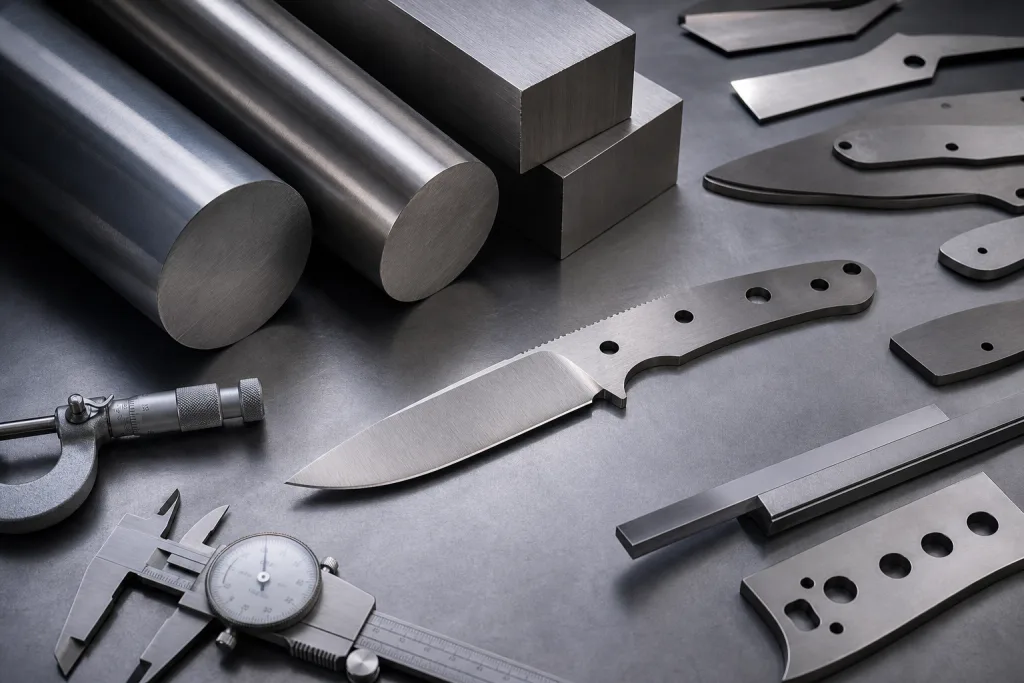
For a Damascus kitchen knife order, sample approval is the point where the buyer decides whether the pattern, grind, balance, and packaging will hold up in mass production. At our Yangjiang factory, we run about 120,000 knives a month with 240 employees, and that scale only helps if the buyer signs off on the right sample, not the prettiest one. QC pulled the sample from the grinding line and checked the edge, choil, and handle fit before it went out.
Private label teams in Europe and North America often lose a week because they approve photos, then the buyer flags an HRC shift, a handle finish mismatch, or logo placement that moves 2 mm at production. The math does not work if the first approval is soft. A damascus kitchen knife order quality sample approval process keeps it tight: one golden sample, one revision sheet, one signoff record, and a clear line on what can change and what stays fixed.
What Sample Approval Must Lock Down
The first approval is not about polish. It is about scope. Your damascus kitchen knife order quality manufacturer should freeze the knife family, blade length, core steel, Damascus layer count, handle material, logo method, box style, and compliance documents before anyone releases a mass production PO. Lock it early. We run this check at the sample bench with a digital caliper, hardness file, and the buyer's marked SKU sheet, because one wrong 8-inch chef knife spec can turn into 1,200 wrong cartons.
A good sample packet usually contains four things: a physical golden sample, a dimension sheet, a material declaration, and photos of the same sample from multiple angles. For custom damascus kitchen knife order quality, I want the buyer to write the tolerance range for blade length, spine thickness, and handle color, such as 203 mm +/- 2 mm, 2.0 mm spine +/- 0.2 mm, and dark walnut within the approved photo set. "Close enough" is a bad buying instruction. The grinding line will not guess your retail standard, and QC pulled the sample more than once because the handle looked red under warehouse light but brown in the buyer's catalog image. If you want a serious damascus kitchen knife order quality supplier, ask for revision numbers on every drawing and a signoff page that names the date, SKU, and person approving it. For wholesale programs, that discipline can mean 12 days of sample correction instead of 18 days of email arguing after packing starts.
The Golden Sample Is The Contract
The golden sample is the one piece the factory must copy. Not a showroom knife. We mark the exact approved unit, seal it in a bag, and keep a retained sample in the QA room or the buyer’s office. If a buyer later flags handle gaps or a different etch tone, that sample settles the argument fast. We had one case where QC pulled the sample off the rack after a PO typo changed the blade length callout by 1 mm; the sample, not the email thread, decided the issue.
In Yangjiang, the better factories tape a checklist to the golden sample: finish level, edge angle, logo depth, bolster shape, and packing inserts. I want photos with a ruler and calipers in frame, plus a clear note on what is cosmetic and what is functional. A 0.5 mm blade length drift can fail the spec; a small polish swirl may pass. This is the wrong question to ask if someone says “close enough.” For wholesale private label programs, one signed sample beats ten emails. If the maker cannot hold revisions on the grinding line, the problem is process, not skill.
Check Steel, Grind, And Pattern
Damascus is where buyers lose money fast. First confirm what you are ordering: real pattern-welded Damascus, a cladded blade with patterned outer layers, or a laser-etched finish. Different goods. Different cost. On our grinding line, the price gap between cladded VG-style stock and etched 3Cr13 can be more than USD 1.20 per 8-inch chef knife at 1,000 pcs. For kitchen use, the core hardness usually sits around HRC 58-61, depending on the alloy and target sharpness. If a supplier promises HRC 63 on a soft, handle-heavy chef knife, this is the wrong question to ask: ask how they will keep the edge from chipping after the buyer's drop test.
Measure the sample in three places and write the numbers on the approval sheet: steel hardness, spine thickness, edge geometry. A practical edge angle for a kitchen line is 15-18 degrees per side, but the final spec depends on retail positioning and how the end user will sharpen it later. We run the Rockwell tester after heat treatment, then QC pulls the sample again after polishing because over-grinding can change the feel even when HRC is still inside range. Ask for a hardness report from the same heat-treatment batch, not a random blade from last month. If the order is for Europe, insist on the material declaration package early so REACH and food-contact review do not turn a 12-day document check into an 18-day shipping delay.
| Checkpoint | Typical target | Buyer action |
|---|---|---|
| Hardness | HRC 58-61 | Reject if outside +/-1 HRC on the signed sample |
| Spine thickness | 2.0-2.5 mm | Measure at heel, midpoint, and 20 mm from tip |
| Edge angle | 15-18 degrees per side | Confirm sharpening jig setting and full burr removal |
| Pattern | Same family, not exact clone | Approve a reference tone range, not one phone photo |
| Handle fit | No visible gap | Check under bright light and press with a fingernail |
If the pattern varies, set the limit before bulk production. Real Damascus has natural visual movement, but the buyer should approve a reference board with 3 to 5 acceptable pattern zones. We have seen this go sideways when the PO only says "same as sample" and the buyer flagged 47 pcs because the etching looked too light near the heel. Give the damascus kitchen knife order quality factory a tone range, a reject photo, and one signed sample. Then we ship what both sides can defend.
Test Edge Retention And Fit
Sample approval needs cutting tests, not caliper readings alone. A Damascus chef knife can look clean at 0.3 mm behind the edge and still skate on tomato skin, or chip when QC pulled the sample for carrot work. We run a fixed bench test: 20 tomato cuts, 20 onion slices, 10 carrot push-cuts, and 10 paper slices. Simple. Repeatable. If the knife is for a premium chef series, add a board test on end-grain wood and check the edge under a 10x loupe for rolling. For any corrosion-resistance claim, leave the blade wet for 30 minutes, dry it, and inspect both sides near the laser logo and heel for spotting.
For retail private label teams, the packaging sample carries the same weight as the blade. Confirm the insert, blade guard, gift box, barcode placement, and FNSKU or retail sticker position before mass production; we have seen a PO with the FNSKU typed one digit wrong, and the buyer flagged it only after carton artwork was ready. If the market requires LFGB, FDA, or specific retailer rules, match the paperwork before the first carton is printed. After sample approval, mass QC can move to AQL 2.5 for major defects and AQL 4.0 for minor defects, but sample approval should be tighter than AQL. This is where the math doesn't work: a knife can pass inspection and still lose the first customer review because the handle has a dry sanding mark or the box print is 2 mm off-center.
Pre-Production Checks Before Mass Run
The pre-production sample should come from the same steel lot, handle material, glue, etching tank setting, and packing table setup planned for mass production. Do not approve a showroom piece with extra hand buffing if the grinding line cannot repeat it. We check this on the bench: blade thickness at heel in mm, handle fit gap, logo depth after etch, and the first carton with the actual barcode sticker. A reliable damascus kitchen knife order quality factory in Yangjiang, China will send pre-production photos, heat-treatment notes, and packaging trial pictures before the PO release.
For custom runs, I usually ask for a 30-100 piece pilot before the full batch. Small run first. It catches print shift, handle color drift, and edge grind variation before we burn through steel and labor. On a real wholesale project, MOQ is often 300-500 pieces per SKU, and lead time is usually 35-45 days after deposit and final sample signoff. If a supplier promises 7 days for a fully custom Damascus line, ask what is already sitting on the shelf. The math does not work for new steel cutting, heat treatment, handle machining, etching, sharpening, inner box printing, and final QC in one week. We have seen this go sideways when the buyer flagged a PO typo on the color code after 200 sets were already packed. The approval file should also include carton drop test results, outer carton marks, and any customs documents the importer will need later.
Common Approval Mistakes To Avoid
The biggest mistake is signing off on a photo and calling it approved. A JPEG will not show 0.3 mm spine drift, edge symmetry, or how the handle meets the bolster at the grinding line. We have seen buyers approve a nice-looking shot, then the first carton lands with a different polish and a 12-day delay while everyone argues over what was actually signed.
The second mistake is mixing sample sets. If the visual sample, functional sample, and production sample are not the same revision, the approval means nothing. QC pulled the sample, checked the blade tag, and found a PO typo on the handle code before shipment; that saved a headache. The third mistake is leaving the Damascus type vague. Real layered steel, cladded steel, and decorative etch do not price the same, and this is the wrong question to ask if the goal is a clean private label order with a damascus kitchen knife order quality wholesaler.
Traceability gets missed too. Your approval set should show the steel spec, batch number, handle material, and packaging code, or you will spend days digging through email when a retailer asks for proof. In China, the better supplier runs sample control like a small production order: one drawing, one BOM, one signoff, one retained sample. That is the standard before we ship 500 or 5,000 pieces.
Frequently asked questions
For a proper first order, approve one golden sample, one retained sample, and one pre-production sample before mass production. If the SKU is complex, ask for a 30-100 pcs pilot run so the factory can confirm finish, edge grind, and packaging on the same line setup. For a custom Damascus kitchen line, I would not move to bulk on a single display sample. A good supplier in Yangjiang, China will accept that discipline because it reduces rework. If the factory pushes you to skip the pilot, you are taking their production risk onto your buyer account.
At minimum, ask for a dimension sheet, BOM, material declaration, hardness report, packaging artwork proof, and a dated signoff page. If the product will touch food, your file should also note LFGB, FDA, or retailer-specific requirements where relevant. For a Damascus kitchen knife order quality manufacturer, I also want the steel batch number and heat-treatment range, usually around HRC 58-61 for many kitchen lines. If the supplier is ISO 9001 or BSCI audited, that helps with process control, but it does not replace the sample record. Paperwork alone is not enough; it has to match the physical sample.
No, not if you are ordering real patterned steel. Damascus has natural visual variation, especially after etching and polishing. What you should control is the family of the pattern, not a pixel-perfect clone. Define 3 to 5 acceptable reference photos, note the layer count or construction method, and call out any unacceptable outcomes such as flat etch, blotchy contrast, or imitation print. If you ordered welded Damascus, the supplier should not substitute a laser-etched blade. That is a material change, not a cosmetic one, and it should trigger a new approval.
Lock the revision before deposit, then require the same steel lot, handle material, logo method, and packaging setup for production. Ask for a pilot of 30-100 pcs and inspect them against the signed golden sample, not against a sales photo. For mass inspection, use AQL 2.5 for major defects, but do not confuse that with sample approval. A sample can be technically within spec and still feel wrong in the hand, so check balance, grip comfort, and edge symmetry. In practice, the buyer who controls revision numbers controls the order.
For a first-time Damascus kitchen knife order, yes, at least for the core risks. Use an independent lab such as SGS or Intertek if your market or retailer asks for it, and budget about 5-10 days for routine testing. The exact package depends on the market: Europe may focus on REACH and food-contact declarations, while some U.S. programs want FDA-related material documentation and retailer compliance files. If the knife has a coated handle or printed packaging, test those too. A lab report does not replace a good sample, but it catches problems a visual check cannot see.
Approve the sample, not the photo
Send the drawing, target HRC, packaging spec, and your required tolerances. We will build the golden sample, then align the pre-production run before you commit to bulk.
Request a Quote