A good Damascus knife looks expensive in photos. That is why weak suppliers hide behind clean patterns, low FOB prices, and one polished sample. For Amazon and DTC sellers, the risk is not one bad knife. It is 1,000 pieces where QC pulls 32 samples and finds blades at 57-58 HRC instead of the promised 60-62 HRC, handles with 0.3 mm gaps, edges that roll after 80 cuts on sisal rope, or color boxes crushed before FBA intake.
This damascus kitchen knife order quality supplier audit checklist comes from our factory-side work in Yangjiang, Zhejiang, China. TANGFORGE has made OEM and ODM knives since 2008, and we have seen buyers ask the wrong question: “Can you make this pattern cheaper?” The math does not work if the supplier cannot show core steel test records, furnace batch logs, AQL 2.5 results, LFGB/FDA documents when needed, and carton labels that match the PO. Last month the buyer flagged one typo in the FNSKU; the grinding line was fine, but shipping still waited 2 days.
Start With Factory Identity Verification
Before you talk patterns, handles, or gift boxes, confirm you are speaking with the factory that controls the order, not a trading desk forwarding screenshots. Trading companies can do honest work, but this is the wrong question to ask: “Can you make Damascus knives?” Ask who owns heat treatment, the grinding line, assembly, and final QC. If the supplier cannot show the production floor, inspection benches, blade racks, warehouse, and business license under the same company name, slow down. We have seen buyers get a clean sample from one shop and bulk goods from another, with 58 HRC blades sold as 60-62 HRC.
Ask for the Chinese business license, export license if applicable, ISO 9001 certificate if claimed, BSCI or Sedex audit if your channel requires social compliance, and 3 recent shipment records with customer names and prices covered. Check the company name, address, and legal representative against the PI; one PO typo in the Chinese name can point to a different entity. A real factory in Yangjiang, Zhejiang, China should explain its process flow clearly: steel arrival, blank cutting, heat treatment, wet grinding, handle fitting, sharpening, AQL 2.5 inspection, and packing. If the answer stays at “premium steel” and “artisan quality,” the buyer should push harder.
For a first video audit, request a live walkthrough, not a pre-recorded marketing clip. Ask the camera operator to walk past blade blank cutting, forge welding or pattern steel sourcing records, CNC or hand grinding stations, handle assembly, sharpening wheels, QC benches, packing lines, and finished goods storage. Then ask for today’s production date, work order number, and 5 random in-process pieces pulled from a tray. QC pulled the sample should mean someone actually used a caliper, Rockwell tester, edge angle gauge, or at least a 3M tape test on the logo print.
At TANGFORGE, a normal OEM kitchen knife MOQ starts around 300 pieces per SKU, while custom Damascus projects with new tooling or exclusive handles often start at 500 pieces. Standard lead time is usually 35-55 days after sample approval and deposit, depending on blade complexity, handle material, and packaging. We run faster on repeat SKUs because the jig, carton dieline, and inspection sheet already exist. If a supplier promises 7 days for a custom 1,000-piece Damascus order, the math does not work; ask which step they are skipping: heat treatment, tempering, handle curing, final sharpening, or carton drop check.
Verify Damascus Steel and Core Construction
Damascus gets stretched too far in wholesale knife buying. We see 3 different products sold under the same word: layered cladding around a cutting core, acid-etched mono steel, and laser-marked pattern stock. On the grinding line, the difference shows up fast under a 10x loupe after the first satin pass. Define the steel build on the PO before price talk, or the math stops meaning anything.
For kitchen knives, we run common builds such as VG10 core with 67-layer cladding, 10Cr15CoMoV core with Damascus cladding, 9Cr18MoV patterned steel, or lower-cost stainless Damascus with no separate premium core. None of these are bad by default. The problem starts when the supplier claim does not match your listing, retail price, or sample in hand. A damascus kitchen knife order quality supplier should send steel mill certificates, incoming material inspection records, and one sample cross-section photo when asked; last month QC pulled a 2.3 mm spine sample where the buyer’s PO said “VG-10 damacus,” typo included, but the factory file only showed patterned 9Cr18MoV.
Be careful with cheap custom damascus kitchen knife order quality offers. A chef knife quoted at FOB USD 5.00 with rosewood handle, gift box, and 67-layer VG10 claim is usually not a real specification. Either the steel is not as stated, the polish is cut short, or the supplier is quoting under cost to catch the 30% deposit. We have seen this go sideways: the buyer flagged black lines fading after 200 pcs passed handle assembly, then the whole lot needed re-etching.
| Audit item | What to request | Buyer risk if skipped |
|---|---|---|
| Core steel | Steel grade, mill certificate, batch number | Wrong listing claim or weak edge retention |
| Layer count | Cladding specification and sample cut photo | Decorative etch sold as real Damascus |
| HRC | Heat treatment log and test report | Chipping below or rolling above target use case |
| Food contact | LFGB, FDA, or REACH documents as needed | Customs or marketplace compliance issue |
For Amazon and DTC sellers, your product page language must match the factory evidence. Do not write 67-layer VG10 if the supplier only confirms Damascus-style pattern. It might sell for 7 days, then come back as returns, 1-star reviews, or a compliance complaint; the buyer flagged this exact issue after AQL 2.5 inspection found 14 blades with shallow etching near the heel.
Audit Heat Treatment and Edge Performance
Heat treatment is where 6 out of 10 Damascus kitchen knife order complaints start. A nice pattern will not save a soft or brittle edge. Your audit needs a written heat treatment spec: temperature range, quench method, tempering cycle, target HRC, and sample test points. For most stainless Damascus kitchen knives, a realistic finished hardness band is 58-62 HRC. Some premium cores can run higher, but this is the wrong question to ask if your customers cut frozen food, chicken bones, or hard squash. We have seen 61 HRC pass the Rockwell tester on Monday, then come back with edge chips after the grinding line pushed the bevel too thin.
Ask how many pieces are tested per batch. A practical control plan is 3-5 HRC checks per furnace batch or per 500 pieces, whichever is stricter. For high-value sets, tighten the count to 8-10 checks if the MOQ and unit price can carry it. The supplier should test near the spine or a controlled flat area, not punch a mark into the visible cutting face. QC pulled one sample last year with a Rockwell dent right above the Damascus pattern; the buyer flagged it before shipment photos were approved. If they outsource heat treatment, ask for the subcontractor name and batch certificate.
Edge performance should not depend on a paper-cutting video. Paper cutting shows sharpness for 5 seconds, not retention after use. Better checks include initial sharpness with a BESS tester, 50-100 strokes through rope or double-wall cardboard, tomato slicing after endurance cutting, and inspection under 20x magnification for micro-chipping. CATRA testing is worth the money for higher-volume programs, but the math does not work for every 300-piece trial order. If you are building a DTC premium line, budget for third-party CATRA or keep retained samples from every lot with the carton mark and PO number taped to the handle bag.
Define the edge angle in writing. Many Western chef knives ship at 15 degrees per side, while heavier outdoor or hybrid knives may use 18-20 degrees per side. If your listing says razor sharp 15-degree edge, your inspection must confirm it with an angle gauge or factory jig record. Short sentence. We have seen this go sideways when the PO said “15 degree,” the artwork file said “razor edge,” and production ran the standard 18-degree jig because nobody locked the spec before mass grinding. You may receive a knife that looks right but cuts like a cheap stamped blade.
Check Handle Assembly and Finish Defects
Handle defects cause returns fast because the customer feels them in the first 10 seconds. In a damascus kitchen knife order quality wholesale program, we inspect the handle with the same weight as the blade. QC pulled 32 pcs from one 1,000 pcs lot last month and found 5 open tang gaps, 3 raised mosaic pins, and 2 cracked pakkawood scales near the rear rivet. Watch for uneven epoxy lines, loose bolsters, rough choil finishing, unstable natural wood moisture, and color drift across a 6-piece set.
Ask the factory how it controls handle material moisture before the scales reach the drilling jig. Natural wood should be stabilized or kept in a controlled range before assembly; we normally check with a pin moisture meter before it goes to the grinding line. Pakkawood and G10 move less, but bad CNC machining or weak bonding still leaves gaps. For Amazon, where buyers zoom photos hard, set limits clearly: no open gap over 0.2 mm, no pin protrusion detectable by fingernail, no glue overflow visible from 30 cm, and no color mismatch outside the approved golden sample range.
Balance matters. So does weight. A 200 mm chef knife that is 30 g heavier than the approved sample feels wrong even when the carton inspection says “pass.” For repeat SKUs, define a weight tolerance such as ±8% and overall length tolerance such as ±1.5 mm. We also check blade thickness at spine, heel height, handle length, and edge curvature against the drawing with a digital caliper, not by eye. If the buyer only asks “does it look okay,” this is the wrong question to ask.
Surface finish has to match the price point and the sales photo. Mirror polish shows hairline scratches after one bad wipe with a dirty cloth. Satin finish hides more, but the grind direction must stay consistent from bolster to butt. Damascus etching must be even from heel to tip, with no cloudy patches near the handle; we have seen this go sideways when acid residue sits under the bolster shoulder. Ask for random inspection photos under neutral lighting, not only sample-room beauty shots. A reliable damascus kitchen knife order quality manufacturer accepts defect definitions before production starts, not after 48 cartons are taped and stacked by the loading door.
Build an AQL Inspection Plan
Do not inspect Damascus knives because the supplier sounds confident on a video call. Use an AQL plan. For most first orders, we set AQL 2.5 for major defects and AQL 4.0 for minor defects under ANSI/ASQ Z1.4 or ISO 2859-1, general inspection level II. Critical defects are zero tolerance. No debate. Examples include broken tips, loose blades, sharp burrs on handle edges, rust, contaminated packaging, incorrect steel marking, or any safety issue. Last month QC pulled the sample with a 0.3 mm burr at the pakkawood handle tail; the buyer said “small issue,” but this is the wrong question to ask when the knife goes into a retail box.
Major defects include wrong dimensions, poor edge sharpness, visible handle gaps, uneven Damascus etching, incorrect logo, wrong barcode, failed carton drop test, or HRC outside the agreed range. Minor defects include small cosmetic scratches under 10 mm, slight color variation against the approved handle swatch, or tiny packaging dents within your approved limit. Write these definitions into the purchase order, not only in WeChat messages. We have seen this go sideways when the PO says “8 inch chef knife” but the chat says 203 mm blade and the grinding line runs 210 mm blanks.
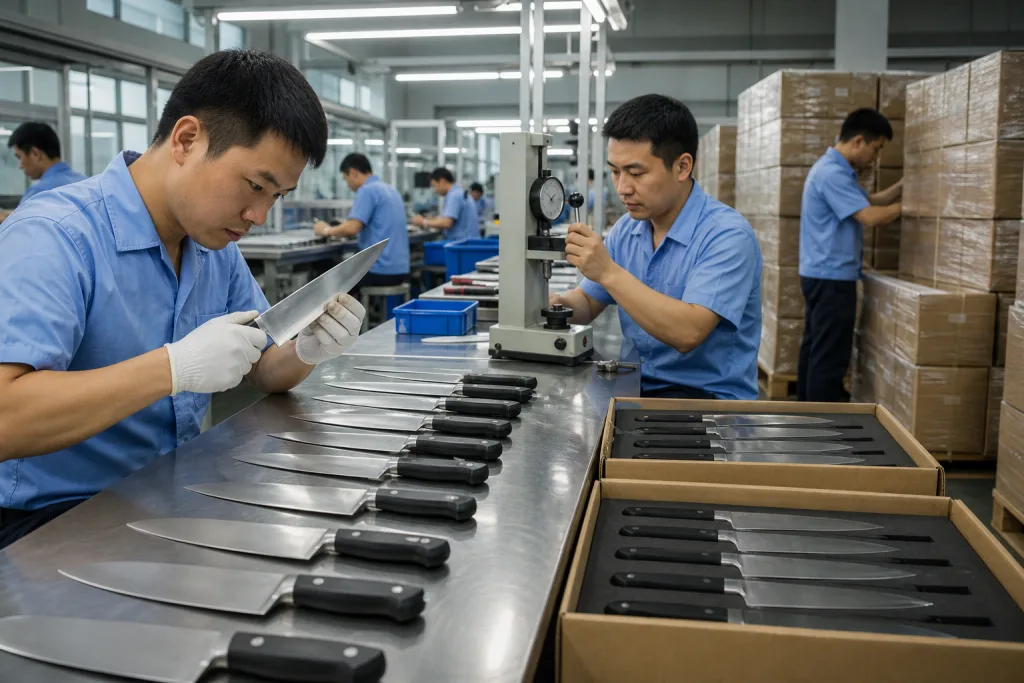
For a 1,000-piece order, general inspection level II usually means a sample size of 80 pieces. At AQL 2.5, the typical accept number is 5 and reject number is 6 for major defects. At AQL 4.0, the accept number is 7 and reject number is 8 for minor defects. Your third-party inspector can confirm the exact code letter based on lot size and standard edition. On our side, we lay the 80 pcs on a stainless inspection table, check blade length with a digital caliper, then pull HRC readings before cartons move to sealing.
Inspection timing also matters. Run first-article inspection after the first 20-50 pieces, in-line inspection at about 30% production, and final random inspection when 100% of goods are produced and at least 80% packed. For custom packaging and Amazon FBA, do not wait until the final day to check labels. The buyer flagged a single FNSKU typo on a PO once, and repacking 1,000 gift boxes took 12 hours in our packing room; fixing a suspended listing or processing returns in the United States costs far more.
Confirm Packaging and Marketplace Compliance
Amazon and DTC sellers need packaging that does 2 jobs: stop the knife from moving and make the unboxing clean enough for a paid order, not a sample-room photo. A Damascus kitchen knife is dense and sharp; an 8-inch chef knife in a rigid gift box usually weighs 420–650 g before the carton. If the EVA insert is cut 2 mm too loose, we’ve seen the blade slide forward, slice the sheath mouth, rub the blade face, or crush one box corner after 18 days at sea. QC pulled the sample. The gift box looked fine on the bench, then failed after 6 drop points. Your supplier audit should cover insert fit, outer carton strength, label artwork, and the compliance papers that the warehouse or marketplace will actually check.
For Amazon FBA, confirm the FNSKU is at least 38 mm x 25 mm, placed on a flat scan face, and printed clean enough for a Zebra scanner to read on the first pass. Check the country of origin mark on both retail box and master carton, the suffocation warning if any polybag opening is over 127 mm, the master carton label layout, and the gross weight against the marketplace limit. This is where buyers get caught. They approve the knife, then the outside carton gets flagged at receiving. For boxed knife sets, we run 5-ply corrugated export cartons, 48–52 ECT if the carton is heavy, with paper angle guards for glossy rigid boxes. Ask for a 76 cm carton drop test or an ISTA-style internal check when the retail price is above USD 60; the grinding line can make a good blade, but the math doesn’t work if 3% of cartons arrive with dented corners.
For food-contact markets, request LFGB for Germany and EU buyers, FDA food-contact confirmation for the U.S., REACH SVHC compliance for EU importers, and a California Proposition 65 assessment if that sales channel is on the PO. We usually attach these documents to the production file before the first 300 pcs pilot run, not after the buyer’s forwarder asks for them. If the handle uses natural wood, check species claims against purchase records and export paperwork. Do not list ebony, rosewood, or rare hardwood names unless the supplier can document them properly; we’ve seen this go sideways when a listing writer used “rosewood look” and the buyer flagged it as a restricted species claim.
Private-label details should be frozen before mass production: logo size in mm with laser depth, etching position from the heel, blade face orientation, UPC or EAN artwork, insert card copy, warranty QR code, and retail box Pantone color. Small stuff matters. One PO typo changed “matte black box” to “mate black box,” and the print shop copied it straight into the dieline proof. At TANGFORGE in Yangjiang, Zhejiang, China, we treat packaging approval as part of the production file, not a late add-on. That stops the common headache where the knife passes AQL 2.5, but the carton fails the marketplace intake check.
Use Samples to Control the Production Lot
Samples are not souvenirs. They are control tools. For a custom damascus kitchen knife order quality program, approve the functional sample, appearance sample, and packaging sample as separate files, not one mixed “OK sample.” The functional sample should lock cutting feel, balance point in mm from the bolster, HRC, handle comfort, and blade geometry; our QC pulled one 8-inch chef knife sample last month because the edge was 0.55 mm before sharpening, too thick for the buyer’s prep-cook test. The appearance sample should lock Damascus pattern contrast, polish level, logo, handle color, and fit. The packaging sample should lock box structure, insert strength, printing, barcode, and shipping marks.
Once approved, seal a golden sample at the factory and keep one in your office. Simple rule. Both should carry the same sample approval date, revision number, and signature or email approval reference; we normally write it on a hang tag and tape it over the box flap so nobody swaps it on the packing table. If you later complain that the production lot looks different, the golden sample gives both sides a fair comparison point. Without it, the argument becomes subjective, and we have seen this go sideways over a handle color that was only 1 Pantone shade off.
For first orders, avoid changing specifications after deposit unless you accept extra cost and a revised lead time, for example 12 days vs 18 days after new material arrives. Changing from pakkawood to G10, from 58-60 HRC to 60-62 HRC, or from plain box to magnetic gift box affects sourcing, machining, QC, and packing. The grinding line cannot treat those as small edits. A responsible damascus kitchen knife order quality supplier will issue an updated quotation and timeline instead of pretending nothing changes; if sales says “same price, same ship date,” the math usually does not work.
Keep retained samples from every shipment for at least 12 months. We run a carton label on each retained set with PO number, SKU, batch date, and AQL 2.5 inspection result, then store it away from the wet polishing area. If you receive a customer complaint about rust, chipping, handle cracking, or logo fading, compare the returned item to the retained sample. This helps you separate factory defect, misuse, storage damage, and isolated transit damage. For a growing Amazon or DTC brand, that evidence beats a friendly promise from sales, especially when the buyer flagged a typo on a PO only after the goods reached FBA.
Frequently asked questions
For a standard private-label Damascus chef knife with existing mold, a practical MOQ is usually 300 pieces per SKU. If you need a new blade profile, custom handle material, exclusive Damascus pattern, or premium gift box, expect 500 pieces or more. Small trial orders below 100 pieces are possible from some suppliers, but unit cost rises sharply and factory control may be less efficient. At TANGFORGE, we normally separate sample cost, tooling cost, and mass production FOB price so you can see what changes when volume moves from 300 to 1,000 pieces.
Ask for the exact construction, not just the word Damascus. A supplier should state the core steel, cladding material, layer count, HRC target, and etching process. Request a steel mill certificate, incoming material record, and photo or video of a cut cross-section if the claim is critical to your listing. For higher-value orders, send one production sample to a third-party lab for composition testing and hardness testing. If the supplier refuses all documentation but offers a very low FOB price, treat the product as decorative Damascus-style unless proven otherwise.
Use ANSI/ASQ Z1.4 or ISO 2859-1 with general inspection level II for normal wholesale lots. For a first 1,000-piece order, AQL 2.5 for major defects and AQL 4.0 for minor defects is a reasonable starting point. Critical safety defects should be zero tolerance. Your checklist should include blade dimensions, HRC records, edge sharpness, handle gaps, logo accuracy, packaging, barcode scan, carton marks, and drop-test results. If the order is urgent, do not skip inspection; ask for in-line inspection at 30% production so defects can be corrected before final packing.
The most common return drivers are dull edges, chipped tips, rust spots, loose or uncomfortable handles, inconsistent Damascus pattern, damaged gift boxes, and product not matching the listing photos. Amazon customers also complain quickly about balance and weight if the knife feels cheaper than the retail price suggests. Many of these issues can be controlled before shipment by using a golden sample, HRC band such as 58-62 HRC, edge-angle check, moisture-controlled handle material, and AQL inspection. Packaging defects are especially costly because customers often buy Damascus knives as gifts.
If you are placing your first order above USD 5,000, hiring a third-party inspector in China is usually worth the cost. A basic final random inspection often costs USD 200-350 depending on location and scope. For a strategic supplier, combine your own video audit with a third-party factory audit and shipment inspection. Your video call checks communication and process understanding; the third party checks documents, production reality, and random goods. For repeat orders with stable results, you can reduce inspection frequency, but keep retained samples and batch records for every shipment.
Send Us Your Damascus Knife Checklist
Share your target price, steel grade, MOQ, packaging, and marketplace requirements. We will review feasibility and return a practical OEM or ODM production plan.
Request a Quote