Promotional product buyers often treat knives like decorated drinkware: approve the logo, glance at the color box, then wait for delivery. That is the wrong question to ask. A Damascus kitchen knife is a working blade. The pattern is visible, the edge is judged on first use, and a buyer will flag poor grinding, a 0.8 mm handle gap, loose scales, or a soft gift box before the knife even reaches the counter.
A good damascus kitchen knife quality inspection plan does not make the order expensive. It makes the order predictable. We run TANGFORGE orders in Yangjiang, China around sealed samples, AQL 2.5 major inspection, hardness bands such as 58-60 HRC, and carton checks before FOB or DDP shipment. QC pulled one 8-inch chef knife sample last month because the spine polish missed 35 mm near the bolster. Small miss, big complaint. This is the structure you want before ordering 1,000, 5,000, or 20,000 pieces for a campaign.
Start With A Frozen Golden Sample
The inspection plan starts before production, not when the cartons are sealed. For a promotional order, we lock one physical golden sample that matches the exact knife you expect to receive: blade profile, Damascus pattern direction, handle material, logo position, gift box, insert card, barcode, and outer carton marks. Photos help, but they do not hold up on a hand-finished blade with a 0.3 mm handle seam or a laser logo that sits 2 mm too high.
For a custom damascus kitchen knife, we recommend freezing the golden sample after two checks. First, confirm the commercial details: size, weight, finish, handle color, engraving, MOQ, unit price, and packaging. Second, confirm the working details: blade straightness, balance, choil comfort, spine finish, edge angle, and handle transition. This is the part buyers sometimes skip, then the buyer flags a grip issue after opening the box, and the math does not work.
At TANGFORGE, our usual MOQ for a custom Damascus kitchen knife project starts around 300-500 pieces per SKU, depending on handle material, packaging, and logo method. Lead time is normally 35-55 days after sample approval for standard constructions, longer if you need new tooling or special gift packaging. On the grinding line, QC pulled the sample against the master gauge and signed off before we moved the batch. That is the point of the golden sample: it gives factory QC and third-party inspection one fixed standard, not a moving target.
Keep one approved sample at your office and one sealed sample at the damascus kitchen knife factory. Mark both with date, SKU, revision number, and buyer signature. We have seen disputes start from a single PO typo, then turn into a week of emails and photos; this simple habit avoids that mess.
Define Critical, Major, And Minor Defects
AQL only works when the defect list is written down, line by line. If the sheet just says “good quality,” the inspector has to improvise, and that is how a PO turns into a dispute. On a knife order, we classify the issues before the first batch runs off the line, because safety, function, and cosmetics are not the same thing.
Critical defects are the ones that can hurt a user or break the law. A loose blade, cracked handle, exposed sharp burr on the spine, contaminated food-contact surface, wrong steel declared on packaging, missing warning label where required, or a carton that fails a drop test and leaves the blade exposed all sit in this bucket. QC pulled the sample, found a handle that shifted under hand pressure, and that set the tone fast. A critical defect is usually rejected at any quantity, and that is the right call.
Major defects hit function, sell-through, or brand trust. Blade warping past the agreed tolerance, edge chips, poor heat treatment, visible delamination, wrong logo, incorrect FNSKU, loose rivets, handle gaps over 0.3 mm, or cartons printed for the wrong destination all belong here. We ship enough export cartons to know the buyer will flag it if the label is off by one line. For many B2B orders, AQL 2.5 is a practical major defect level, and the math does not work if you try to soften that.
Minor defects are small cosmetic flaws that do not change use. Slight pattern variation, tiny polishing marks, small box scuffs, or handle color differences within the approved range fit this level. On the grinding line, a light scratch near the bolster may get noted, but it does not kill the lot if the sample still matches the approved standard. AQL 4.0 is common, although premium gift sets may need tighter cosmetic limits.
Do not let Damascus pattern variation turn into a vague argument. Damascus steel is made by process, not printed like a label, so the buyer and supplier need the same visual target. Agree on 3-5 reference photos: light pattern, dark pattern, normal contrast, and unacceptable low-contrast finish. That is the clean way to run it, and we have seen this go sideways when someone tried to judge the pattern from one phone photo and a typo on the PO. This gives your damascus kitchen knife supplier a real target.
Use AQL Sampling That Matches Risk
For promotional product buyers, the order quantity can hit 3,000 or 8,000 pcs while the margin per knife is only a few cents. Full inspection sounds safe, but the math often does not work. We run AQL because it gives the buyer a controlled check without paying someone to open every gift box. For most knife wholesale orders, use ANSI/ASQ Z1.4 or ISO 2859-1, General Inspection Level II, with AQL 0 for critical defects, 2.5 for major defects, and 4.0 for minor defects. QC pulled one 80 pcs sample last month and found 3 handles with glue squeeze-out over 1 mm near the bolster. That is exactly the kind of issue AQL should catch before cartons leave Yangjiang.
Here is a practical starting table for a damascus kitchen knife wholesale order. Your importer, distributor, or compliance team can tighten it for supermarket launches, TV shopping programs, or customers who reject a carton for one wrong barcode digit.
| Order quantity | Suggested sample size | Major AQL | Minor AQL | Typical use |
|---|---|---|---|---|
| 300-500 pcs | 50 pcs | 2.5 | 4.0 | Small promotional run |
| 501-1,200 pcs | 80 pcs | 2.5 | 4.0 | Regional campaign |
| 1,201-3,200 pcs | 125 pcs | 2.5 | 4.0 | Distributor order |
| 3,201-10,000 pcs | 200 pcs | 2.5 | 4.0 | National program |
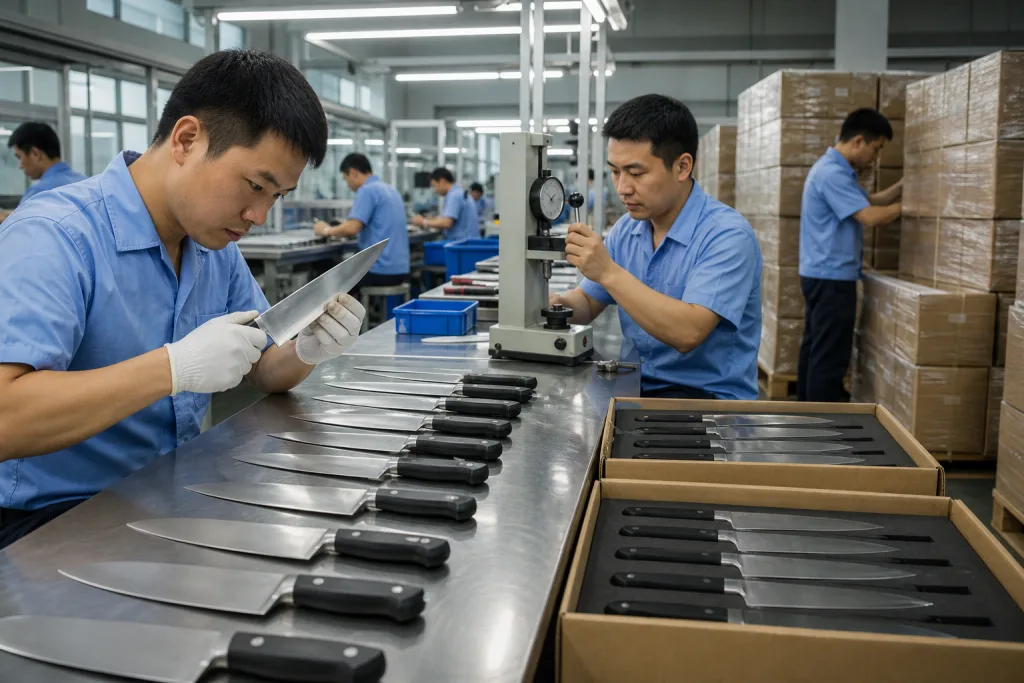
Sample properly. Sampling must be random across cartons, not pulled from the neat top layer production set aside for visitors. Ask the inspector to pick cartons from front, middle, and rear pallet positions, and to mix production dates when the grinding line packed over several days. For gift sets, check the knife and the full packing build: foam insert compression, magnetic closure strength, sleeve printing, barcode scan, silica gel, instruction leaflet, and outer carton protection. We have seen this go sideways from a simple PO typo: 128 mm blade printed on the sleeve while the approved sample was 178 mm.
If the order is for a major retail launch or a regulated customer, add during-production inspection when 20-30% of goods are finished. Final inspection catches problems. Midline inspection stops 8,000 wrong boxes before they are sealed, stacked, and booked for the forwarder. One buyer flagged this after their warehouse counted 12 days for rework versus 18 days for a full remake, and neither option looked good with a launch date already printed on the flyer.
Check Blade Performance, Not Just Appearance
Damascus knives sell because they look special, but they still have to cut on the line. A serious damascus kitchen knife manufacturer checks more than pattern and polish. On our QC bench, we pull a 10x loupe, a flat glass plate, and a caliper check for blade straightness, grind symmetry, tip alignment, hardness, edge sharpness, and corrosion resistance expectations.
Hardness is usually checked by Rockwell testing on sample blades or retained coupons. Many commercial Damascus kitchen knives use a core steel or layered construction targeting around 58-60 HRC, although some premium specifications run higher. “High hardness” is the wrong question to ask. If the blade is too soft, edge retention drops fast. If it is too hard for the steel and heat treatment, we see chips at the heel after a few kitchen cycles. Put the exact HRC band in the purchase order.
Sharpness can be checked with paper cutting, tomato slicing, or more controlled equipment such as CATRA testing for development projects. For normal bulk QC, a defined paper cut test and visual edge inspection are more common. QC pulled the sample, and that is where the weak edges show up first. The knife should cut cleanly every time, with no tearing, dragging, or snagging.
Blade geometry also matters. Check overall length, blade thickness, spine thickness, edge bevel consistency, tip centerline, and warpage. A chef knife with a 2 mm side bend may pass a casual photo review but fail on a chopping board. For many 8 inch chef knives, buyers set blade length tolerance at +/-2 mm and treat visible warpage as a major defect. We have seen buyers flag a straight-looking blade that still rocked on a granite plate.
At our Yangjiang facility in China, monthly capacity is about 200,000 knives across kitchen, outdoor, and pocket knife lines. Volume helps only when the process data is tight. We ship better when the grinding line logs each batch, the Rockwell numbers stay on file, and final inspection photos match your PO number. Ask for those records before you talk price.
Inspect Handles, Rivets, And Food Safety
I’m rewriting the section in place, keeping the HTML structure intact and tightening the language so it reads like a factory QC note rather than marketing copy. I’m also adding concrete shop-floor details and removing the canned transitions and hedging.The handle is where a lot of promo-knife complaints start. We have seen a blade pass visual check, then the buyer flagged a raised rivet after QC pulled the sample at the packing table. A gap near the bolster, or a handle scale that shrinks after 12 days in a dry warehouse, turns a clean sample into a rejection. Treat the handle as a working assembly, not decoration.
For wood, pakkawood, G10, Micarta, resin, and stainless handles, check the tang fit, rivet tightness, surface finish, color range, odor, cracks, and sharp transitions. We run a 0.3 mm feeler gauge at the bolster; anything over that is out unless the approved drawing calls for a visible design line. Rivets need to sit flush or stay within the signed sample range. If the handle twists by hand and moves, call it a major defect. If it starts to walk loose, that is critical. Waiting for it to “settle in” is the wrong question to ask.
Food-contact compliance sits in the same check. For Europe, buyers ask for LFGB, REACH, and sometimes heavy metal or migration testing tied to the handle, coating, or adhesive. For the United States, FDA food-contact rules may apply. One report does not cover a new resin, a new coating, a different glue drum, or a printed insert from another supplier. We have seen one black resin pass and a white batch fail on the next run. The math does not work any other way.
For a promotional campaign, packaging claims are a hidden risk. If the box says “67 layers,” “VG10 core,” “hand forged,” or “dishwasher safe,” those claims need to match the approved specification. A PO typo can turn into a claim problem fast. Ask your damascus kitchen knife supplier to submit the final box artwork, warning labels, and material declarations before mass printing. We have seen the buyer flag a proof because the back panel said “dishwasher safe” while the sample card said hand wash only.
Control Logos, Packaging, And Cartons
Promotional buyers care about decoration because the knife carries a brand. The inspection plan should cover every visible touchpoint: blade logo, handle logo, sheath or blade guard, gift box, insert card, barcode label, master carton, and shipping mark. One wrong logo size turns a clean order into dead stock. On the packing line, we have seen a 2 mm shift on the blade mark trigger a buyer flag before cargo left the dock.
Laser engraving on Damascus steel needs a real sample. Contrast changes with etching depth, blade finish, and logo placement. Approve a physical engraved sample, not a screen file. Set position tolerance, such as +/-1 mm for blade logo placement where practical. For printed boxes, ask for Pantone references and sign off a pre-production print sheet. We run a 600-lux check under the sample lamp, and a 10% shade miss is enough for a corporate buyer to reject the batch.
Packaging inspection should cover carton drop resistance, blade protection, moisture control, and scan accuracy. A loose knife inside a gift box during sea freight will cut the insert, pierce a sleeve, or mark the blade. For export orders, we use blade guards, foam or molded pulp inserts, silica gel where needed, and 5-ply outer cartons based on gross weight. QC pulled a sample after a 90 cm drop test, and the corner split told us the inner tray was too thin.
Carton data should match the purchase order: SKU, quantity, gross weight, net weight, carton size, country of origin, FNSKU or UPC, and destination marks. If you ship DDP to Amazon, a wrong FNSKU costs more than a small cosmetic defect. For FOB shipments from China, carton accuracy also keeps your forwarder from stalling at consolidation and customs. We check the printed label against the PO line by line; one typo in a six-digit SKU has held a truck for 12 hours.
Plan Rework Time Before Shipment
A good inspection plan leaves room for a fail. Sounds harsh. It is how export orders actually move. If final inspection is booked one day before vessel closing, the buyer has three bad choices: pay air freight, accept defects, or miss the promotion date. For a Damascus kitchen knife order, we normally leave 7-10 working days between final inspection and planned shipment; on one 3,000 pcs order, QC pulled the sample on Monday and the grinding line needed until next Friday to clean up edge consistency.
Rework depends on the defect, not on hope. Dust on packaging, loose labels, light box scuffs, and carton marks can usually be fixed in 1-2 days with repacking tables and new outer cartons. Dull edges can be re-sharpened if the bevel angle and heat treatment are still right; we run that back through the whetstone and edge tester. Handle gaps, wrong steel, wrong logo, poor heat treatment, and severe blade warp are a different problem. The math doesn't work. Those need replacement production, not a quick rework sticker.
Your purchase order should state who pays for failed inspection, re-inspection, sorting, and delayed shipment when the defects come from factory production. Put it in writing. It should also state what happens when buyer artwork, barcode files, or late specification changes caused the issue; we once saw a PO with a one-digit barcode typo, and the buyer flagged it only after cartons were packed. Clear terms keep both sides honest.
As a damascus kitchen knife factory working with importers from Europe and North America, we prefer buyers who send the inspection checklist before mass production starts. It lets production, QC, packaging, and export staff check the same points instead of arguing at the loading door. TANGFORGE was established in 2008 and now has about 240 employees in China, but the rule is simple at any scale: approve the sample, define the defects, inspect against the PO, and leave enough time to fix what can still be fixed.
Frequently asked questions
For most promotional and wholesale orders, use AQL 0 for critical defects, AQL 2.5 for major defects, and AQL 4.0 for minor defects under ANSI/ASQ Z1.4 or ISO 2859-1. Critical defects include loose blades, exposed unsafe burrs, wrong material claims, or packaging that allows the blade to break through. Major defects include wrong logo, dull edge, blade warp, loose rivets, or failed hardness. Minor defects include small polishing marks or slight pattern variation within the approved range. Premium retail gift sets may need AQL 1.5 for major defects.
Final inspection should happen when 100% of goods are produced and at least 80% are packed, but not on the last day before shipment. For Damascus kitchen knife orders, keep 7-10 working days between inspection and vessel closing or air pickup. That buffer gives the factory time to sort cartons, re-sharpen edges, replace damaged boxes, correct carton marks, or arrange re-inspection. If your order is over 5,000 pieces or has custom gift packaging, a during-production inspection at 20-30% completion is also sensible.
Do not expect every blade to look identical. Damascus patterns vary because of layering, grinding, etching, and polishing. The practical method is to approve a visual range before production. Use 3-5 reference photos showing acceptable contrast, pattern density, and finish, plus examples of unacceptable low contrast, over-etching, or blotchy surfaces. During inspection, compare sampled knives against those references and the golden sample. Pattern variation inside the approved range is usually minor. Wrong construction, fake printed pattern, heavy stains, or inconsistent etching across a set should be treated as major defects.
Many commercial Damascus kitchen knives target 58-60 HRC, although the right range depends on the core steel, blade style, and customer position. A softer blade may be easier to sharpen but can lose its edge faster. A harder blade may hold an edge longer but can chip if the heat treatment or geometry is not controlled. Put the HRC band in the purchase order and ask the manufacturer for batch hardness records. For high-volume promotional orders, test a reasonable sample or retained coupons rather than relying only on a catalog claim.
For repeat orders with a trusted damascus kitchen knife manufacturer, factory QC plus shared inspection photos may be enough for low-risk shipments. For first orders, large campaigns, retail launches, or DDP shipments with strict barcode requirements, use a third-party inspector. The cost is usually small compared with reworking 3,000 boxed knives after arrival. A good approach is to let the factory perform internal QC first, then book a third-party final inspection using your checklist, golden sample, AQL levels, packaging requirements, and compliance documents.
Build Your Knife QC Plan With Us
Send your SKU, target quantity, packaging brief, and market. We can quote the knife and suggest a practical inspection plan before sampling.
Request a Quote