A Damascus kitchen knife sample can look clean on a buyer’s desk and still miss the mark once freight, gift box, duty, and carton volume hit the quote. For restaurant supply distributors, sample approval is not just about the blade pattern or handle feel. This is the first landed-cost check before you lock 500, 1,000, or 3,000 pieces. We had a buyer flag a PO typo on carton size once, and the math changed fast.
At TANGFORGE in Yangjiang, China, we treat sample approval as cost engineering, not a beauty contest. The grinding line can turn out a custom Damascus chef knife sample at USD 55-120 before courier freight, while production FOB often sits in the USD 14-32 range depending on steel, handle, finish, MOQ, and packaging. You need both numbers early. QC pulled the sample on a 2 mm handle gap last week, and that is the wrong question to ask if you only look at the sample price.
Start Sample Approval With Landed Cost
I’m rewriting the four paragraphs to sound like a factory-side sales engineer, keeping the HTML structure intact and stripping the generic phrasing. I’m also threading in concrete shop-floor details and price-impact numbers so the section reads like it came from a real quotation review.A distributor usually signs off a Damascus kitchen knife sample after checking pattern, weight, and sharpness on the bench. Those three checks are basic. The wrong question is whether the blade looks good. The real one is whether the sample can hit a landed price that still leaves room for packaging, inland trucking, duty, warehousing, and margin. If the file only shows an FOB unit price, you are guessing. QC pulled one sample at the balance scale last week, and the buyer still pushed back because the carton math was missing.
A proper damascus kitchen knife sample approval landed cost breakdown starts before we grind the first blank. Ask the factory for a quote that splits blade steel, handle material, belt-grinding finish, laser logo, box, pull-strength test, and export carton data. We do not need a 40-page deck. We need a line-by-line sheet that shows where a USD 0.35 change starts. On the grinding line, one extra sanding pass can move the number more than a new sales pitch ever will.
A 67-layer VG10 core Damascus chef knife with G10 handle, full tang construction, laser logo, magnetic gift box, and sleeve does look right for premium restaurant retail. For a working-kitchen channel, that box is the wrong place to spend. We have seen it add USD 1.80-2.60 per unit and push carton volume high enough to raise freight on the pallet. A kraft box with a molded pulp insert keeps the knife safe at USD 0.65-1.10, and QC can still pass the drop test after 1.2 m.
In Yangjiang, China, our sales engineers put sample cost, production FOB, MOQ, estimated carton size, and courier cost into the same approval file. That gives you a landed-cost model before artwork is locked, which is the only moment it matters. We run that sheet against the actual carton gauge and tape test, not a sales promise. One PO typo on carton count can swing the landed number. If your shelf price is fixed at the chain level, the design has to fit the math.
Typical Cost Lines Buyers Miss
A Damascus knife sample price sits above production price because we are making 1-3 pcs outside the normal line. The billet may be cut from small-batch steel, the CNC operator may adjust the handle program by 0.2 mm, the grinding line may stop for hand finishing, and QC still has to pull the sample for logo, edge, and balance checks. That is not overcharging. The math is different when one knife carries the setup time.
For a custom damascus kitchen knife sample approval, budget separate lines for sample making, logo setup, packaging mockup, courier freight, and sometimes mold or fixture cost. If we use an existing blade profile and handle shape, sample lead time is usually 7-12 days after artwork approval. If the buyer asks for a new blade profile, new handle contour, or private mold packaging tray, 15-25 days is more realistic; we have seen a tray cavity change from 24.5 mm to 26 mm add 4 days because the sample knife sat too tight.
The easiest way to lose control is to approve the knife first and packaging later. Bad sequence. Restaurant supply distributors sell through catalogs, online listings, and sales reps, so the box has to protect the edge, carry barcode data, and survive warehouse handling. A knife that ships safely in a rigid sample box may need a different insert for mass production; QC once flagged 6 loose tips after a drop test because the paper sleeve looked fine on the desk but failed in the master carton. Ask for carton drop test expectations, inner carton quantity, master carton quantity, gross weight, and CBM.
Check compliance cost early. For North America, buyers may ask for FDA-related food-contact declarations for handle and packaging materials. For Europe, REACH and LFGB documentation may be needed depending on the component. If your distributor requires BSCI, ISO 9001 documentation, or AQL 2.5 final inspection, put those requirements in the sample approval file, including the report name and test lab if they have one. Adding them after production starts creates delays we can avoid; the buyer flagged it once when the PO said “LFGB handle” but the approved sample file only listed “food safe packing.”
Sample To Production Cost Table
This table gives the planning band we use on the floor for a mid-market Damascus chef knife program. We check steel grade, blade length, handle material, finish tolerance, order quantity, exchange rate, and freight market before we quote. If the buyer wants sample approval to show the real landed cost, this is the sheet to start with. On the grinding line, one 8 inch piece can move from a clean satin pass to extra hand work in 20 minutes, and the price follows that shift.
| Cost item | Sample stage | Production planning range |
|---|---|---|
| 8 inch Damascus chef knife | USD 55-120 per sample | USD 14-32 FOB per unit |
| Laser logo setup | USD 20-50 per logo | Usually included after MOQ |
| Gift box or rigid box | USD 20-80 mockup | USD 1.20-3.80 per unit |
| Kraft box with insert | USD 10-35 mockup | USD 0.60-1.20 per unit |
| Express sample freight | USD 35-90 for 1-3 knives | Not used for bulk shipment |
| Final inspection | Internal QC included | AQL 2.5 or buyer standard |
For production, TANGFORGE usually quotes semi-custom Damascus kitchen knives from 500 pieces per SKU, with 1,000 pieces per SKU preferred when packaging is fully customized. Our Yangjiang factory runs about 180,000-220,000 knives per month across kitchen, pocket, outdoor, and Damascus lines, so basic capacity is not the issue. The real choke points are late artwork, unclear packaging specs, and changes after the pre-production sample. On the carton line, one typo on a PO can hold the whole batch for a day.
A serious damascus kitchen knife sample approval manufacturer should also tell you when a sample detail will not scale well. Some hand-polished finishes work on 50 samples, then turn uneven at 5,000 units. Some highly figured natural wood handles look good on a desk, but they bring moisture variation, color sorting, and higher reject rates. For restaurant supply, consistency beats drama, and this is the wrong question to ask if the buyer keeps pushing for a one-off look. QC pulled the sample under a 5000K light box, and that is where the mismatch usually shows up.
MOQ And Specification Choices
MOQ is not a supplier safety blanket. It comes from 420J/10Cr coil buying, G10 sheet yield, grinding line setup, inner box printing, and QC hours on the bench. For damascus kitchen knife sample approval wholesale projects, we have seen the carton factory set the real floor: the knife line could run 300 pieces, but the rigid box MOQ started at 500.
If you use a standard blade profile, stock G10 or pakkawood handle, laser logo, and our existing box structure, 500 pieces per SKU is workable. Add a new blade shape, custom bolster, special resin color, printed sleeve, barcode sticker, FNSKU label, and custom insert, and 1,000-2,000 pieces is the cleaner number because each change needs tooling, sample matching, and one more QC checkpoint. For a set of 3 knives, confirm whether MOQ applies per knife, per set, or per total program; buyers have flagged this after a PO typo, and the math does not work if 500 sets quietly becomes 1,500 knives.
Steel choice changes landed cost and approval risk. A common commercial option is VG10 core Damascus at 60 +/- 2 HRC, often sold as 67-layer Damascus. Another option is 10Cr15CoMoV core with Damascus cladding, which usually prices better for wholesale programs. For restaurant users, edge retention and rust control beat a fancy pattern name; QC pulled one sample last month because the Rockwell tester read 57 HRC on the heel, and the buyer was right to reject it.
Choose handle material by sales channel. G10 is stable and tough for professional kitchens, though it costs more than basic pakkawood; we run it when buyers care about dishwasher abuse claims, even if we still advise hand washing. Pakkawood gives a warmer look at lower cost, but specify moisture resistance and finish tolerance, such as no open glue line over 0.2 mm. Natural wood needs tighter incoming inspection, and we have seen this go sideways on replenishment orders because color variation across 12 cartons did not match the approved sample board.
Packaging And Freight Planning
Packaging is where 7 out of 10 landed cost sheets get bent out of shape. A damascus chef knife is long, sharp, and 220-280 g before the buyer adds the magnetic gift box. Add a 1.5 mm greyboard box, EVA foam, printed sleeve, EAN sticker, and 2 g desiccant bag, and the master carton jumps from 0.036 CBM to 0.061 CBM on our packing bench. Freight charges follow carton size, not your retail story. Air, sea, and DDP courier all punish empty space.
For restaurant supply distributors, we run practical packing first: PP edge guard, anti-rust paper, clear barcode face, 5-layer export carton, and enough print quality for a catalog photo. If the knife ships B2B to kitchens, the luxury box often does not pay back. The chef throws it away. If it sits as a premium counter item or a 3-piece gift set, then the box can earn its place. The wrong question is, "Which package looks best?" Ask which package survives the drop test and still leaves margin after freight.
Before final approval, ask your damascus kitchen knife sample approval supplier for unit net weight, packed unit weight, inner carton quantity, master carton quantity, master carton dimensions, gross weight, CBM, and HS code estimate. We usually send a packing photo with the tape measure across the carton, because one typo on a PO can turn 54 x 32 x 28 cm into 54 x 32 x 38 cm and change the quote. With those numbers, your forwarder can compare sea freight, air freight, and courier. For launch orders under 300 kg, air freight is fast but the math can hurt. For replenishment, sea freight usually wins if you plan 35-50 days door-to-door depending on destination and season.
Confirm Incoterms before the sample is signed off. FOB China port is clean for importers who already have a forwarder. DDP is easier for smaller distributors, but QC cannot inspect the customs assumptions; you need duty, VAT, clearance fee, and local delivery written into the quote. We have seen this go sideways when the buyer flagged a "cheap" DDP line after accounting found a missing VAT charge. A low DDP number without clear assumptions is not a purchasing strategy; it is a bill waiting for the next email.
Inspection Before You Approve Bulk
The approved sample becomes the production reference, so write down specs we can measure with a caliper, scale, Rockwell tester, and barcode scanner. Photo approval is weak. We record blade length, blade thickness at heel and spine, total length, handle thickness, finished weight, hardness range, logo position from the bolster in mm, packaging dimensions, and the visual limit for the Damascus pattern, such as no blank-looking area over 8 mm on the blade face.
For Damascus kitchen knives, we usually check hardness at 58-62 HRC, depending on steel and price position. Too soft means edge complaints after a few weeks. Too hard means chips, especially from restaurant users who hit bone, frozen food, or stainless prep tables. We see it. Edge angle also needs a number on the sample sheet. Many chef knives sit around 15 degrees per side; for club-store or rental-kitchen programs, we run 17-20 degrees per side because the math favors fewer returns over a slightly sharper first cut.
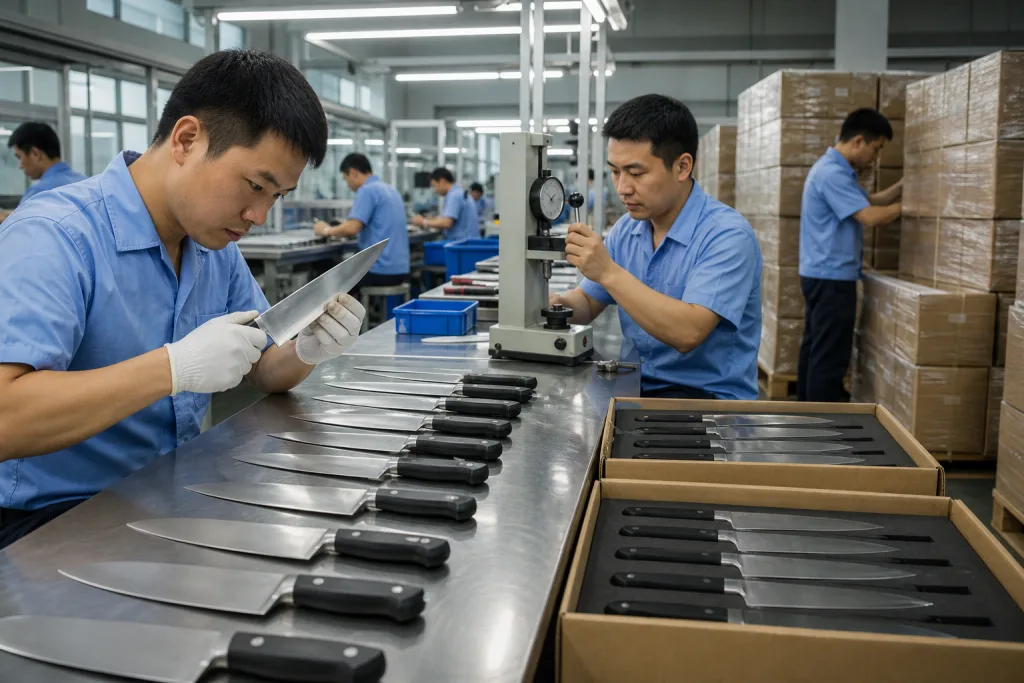
QC should cover blade straightness, tip alignment, grind symmetry, handle gap, rivet finish, burr removal, logo clarity, edge sharpness, corrosion spots, packaging scuffs, and barcode scanability. On one 300-piece pilot run, QC pulled 11 samples and flagged 2 handles with a 0.4 mm gap after polishing dust showed under the scale. For production, AQL 2.5 for major defects and AQL 4.0 for minor defects is common, though stricter buyers may set their own limits. If your customer requires CATRA sharpness testing or ASTM-style packaging checks, say it before quotation, because adding it after the PO makes the schedule and cost go sideways.
At TANGFORGE, our internal workflow in Yangjiang, China, is sample approval, pre-production sample when needed, incoming material inspection, in-line checks, final random inspection, and packing audit. Plain process. It should be. On the grinding line, we compare the bulk pieces against the signed sample, not against memory or a phone photo, and the packing audit checks carton marks, inner box fit, barcode scan, and the typo that somehow still appears on one buyer's PO every season. Reliable knife sourcing is mostly boring controls repeated until the shipment matches what you approved.
How To Compare Supplier Quotes
I’m rewriting the section in place, keeping the HTML structure intact and tightening the language so it reads like a factory-side sales engineer wrote it. I’m also folding in concrete production details and cleaner cost language where the draft was generic.When three factories quote the same Damascus kitchen knife, they are often quoting three different builds. One may use a VG10 core, another may use a 10Cr series core, and a third may price pattern-welded steel with thin paperwork. One quote includes the box, one leaves out the sleeve, and one assumes no third-party inspection. Put every quote into the same landed cost format first. QC pulled one sample last week and found a 0.3 mm spine mismatch; that is the kind of detail that changes the real cost.
A good damascus kitchen knife sample approval manufacturer answers technical questions directly: steel core, cladding type, HRC target, heat treatment process, handle material grade, blade thickness tolerance, MOQ, sample lead time, production lead time, carton data, and compliance documents. If the supplier avoids these details, the low price is the wrong question to ask. We had a buyer flag a sample because the handle cap was 2 mm off, and the price moved more on that change than on the steel itself.
For planning, many restaurant supply distributors use a simple formula: FOB unit price + packaging upgrade + inland freight allocation + ocean or air freight allocation + duty + customs/broker fees + warehouse handling + target margin. You can build this in a spreadsheet in 20 minutes if the inputs are real. The math does not work when someone guesses freight from last quarter; on a 500-piece order, one extra $0.18 per unit is $90 gone before the cartons leave the packing line.
TANGFORGE was established in 2008 and has about 240 employees across production, engineering, QC, and export support. We are opinionated about sample approval because we have seen buyers sign off on a polished blade, then find the landed wholesale price misses the catalog by 8% or 12%. The better path is slower at the start: confirm the sample, the box, the carton, and the cost model together. On our export desk, a typo on a PO once turned a gift box into a brown box, and that small line change moved the whole quote.
Frequently asked questions
For a custom Damascus kitchen knife sample approval project, budget USD 55-120 per knife before freight if you need a chef knife with Damascus cladding, branded handle, and logo. Express freight to Europe or North America usually adds USD 35-90 for 1-3 knives. A packaging mockup can add USD 10-80 depending on whether it is a kraft box, printed sleeve, or rigid gift box. If you use an existing blade and box, cost stays lower. If you request new tooling, special handle color, or a custom molded insert, sample cost and lead time both increase.
For semi-custom Damascus kitchen knives, a practical MOQ is usually 500 pieces per SKU when using an existing blade profile, standard handle material, laser logo, and standard packaging. For fully custom work, 1,000 pieces per SKU is more realistic because steel purchasing, handle preparation, packaging printing, and QC setup need volume. Gift sets may have different rules, so confirm whether MOQ is counted per knife, per set, or per total order. At TANGFORGE in Yangjiang, China, we prefer to discuss MOQ together with packaging because box suppliers often set their own minimums.
If artwork and specifications are clear, a Damascus kitchen knife sample usually takes 7-12 days using existing components. New blade profiles, custom handles, special finishes, or custom packaging can move the timeline to 15-25 days. After you approve the sample and pay the production deposit, bulk lead time is commonly 35-55 days depending on MOQ, packaging, factory loading, and inspection requirements. Add another 25-50 days for sea freight to many European or North American destinations, or less for air freight at a higher landed cost.
Freeze the specs that affect performance, cost, and repeatability: steel core, Damascus layer description, blade length, blade thickness, total weight, handle material, HRC range, edge angle, logo size and position, packaging structure, barcode location, carton quantity, and inspection standard. For many Damascus kitchen knives, 58-62 HRC is a workable target, but the exact band depends on steel and user profile. Also define visual tolerance for the Damascus pattern because every blade will not look identical. A signed sample without measurable specs leaves too much room for argument during final inspection.
FOB is usually best if you already have a freight forwarder and import process. It keeps the supplier responsible up to the China port and gives you control over ocean freight, customs clearance, and delivery. DDP can be useful for small trial orders, but you need a clear breakdown covering duty, VAT or sales tax assumptions, customs clearance, and local delivery. For landed cost planning, compare both. A low FOB price can lose to a higher FOB supplier if packaging volume, carton weight, inspection failure rate, or freight assumptions are worse.
Send Your Damascus Knife Cost Target
Share target FOB price, MOQ, packaging style, destination, and sample deadline. Our Yangjiang team will return a practical sample approval and landed cost plan.
Request a Quote