Promotional product buyers often sign off a good-looking Damascus knife sample, then find the 3,000 retail sets do not behave like that one bench-made piece. The buyer flagged it too late: pattern contrast changed after etching, one handle had a 0.35 mm gap, the logo sat 2 mm high, and the gift box insert rubbed the blade tip. Put the limits in writing before the PO moves to the grinding line.
At a Yangjiang, Zhejiang knife factory, we run sample approval as commercial risk control, not a photo swap. TANGFORGE has produced OEM and ODM knives in China since 2008, with about 240 employees and monthly capacity around 180,000 mixed knives. For Damascus kitchen knives, the approval file should tie your artwork, steel specification, AQL 2.5 inspection, and shipment deadline to one signed standard; otherwise the math does not work when QC pulled the sample on day 12 and the vessel closes on day 18.
Why sample approval needs inspection limits
A Damascus kitchen knife sample approval quality inspection plan starts with one plain rule: the approved sample is not shelf decoration. It is the bulk order contract you can hold in your hand. For promotional product buyers, that matters when the end customer is ordering a holiday gift set, loyalty program item, retail bundle, or corporate premium. The knife has to look like a paid upgrade, pass basic safety checks, and land with the right branding. QC pulled one 8-inch chef knife sample last month where the blade looked fine, but the logo film was applied on the wrong side before etching.
The common mistake is approving a sample by appearance only. Looks good. Ship it. Then the mass order shows the details nobody wrote down: the blade is 1.2 mm thinner than expected, the handle rivets sit proud, the etched logo is 3 mm lower than the approved PDF, or the gift box foam lets the knife move after a 1.2 m drop test. These are not strange defects. They come from a loose approval standard. We have seen this go sideways when a buyer says “Damascus pattern OK” but never confirms spine thickness, handle flushness, or box fit.
For a damascus kitchen knife sample approval factory, a usable sample file includes drawings, photos, measurement points, steel grade, HRC range, finish requirement, logo artwork, packaging dieline, and defect limits with the actual inspection method. At TANGFORGE in Yangjiang, Zhejiang, China, our QC team usually keeps one sealed golden sample in the inspection room and one matching sample is sent to the buyer. Each has a sample tag with order number, date, material, revision number, and sign-off person. We run this because the grinding line, logo room, and packing team all need the same reference, not three different screenshots from a chat thread.
You do not need a 40-page quality manual for every promotional order. You need a controlled approval file. If your PO says only “same as sample,” the factory has too much room to decide what “same” means. That is the wrong question to leave open. If your PO says blade length 203 mm +/-1.5 mm, HRC 58-60, handle gap under 0.2 mm, logo position +/-1 mm, and AQL 2.5 major, everyone knows where the line is. One buyer once flagged a PO typo where 203 mm became 230 mm; catching that before pre-production saved the order from a full remake.
Build the approval specification sheet
I’m rewriting the section as factory-side specification language, keeping the HTML structure intact and tightening the phrasing so it reads like someone who ships samples and handles QC pushback every week.Your spec sheet needs to be short enough for production, QC, and sales to use on the shop floor. If it turns into a 20-email trail, nobody trusts it. For a damascus kitchen knife sample approval manufacturer, a clean two-page sheet beats a stack of comments with three different answers. Split it into product construction, branding, packaging, compliance, and inspection. If it runs past that, it stops getting used.
For the knife itself, list blade type, length, thickness, steel, HRC, handle material, full tang or welded bolster construction, edge angle, surface finish, and acceptable tolerance. We run this check at the grinding line because buyers often write “Damascus” and leave the core vague. That is the wrong question to ask. State whether you want VG10 core with layered cladding, 67-layer stainless Damascus, 73-layer construction, or patterned welded steel for decorative use. For kitchen knives sold in Europe and North America, we ship more stainless Damascus because corrosion claims are easier to manage after delivery.
For branding, include the logo file name, engraving method, size, position from blade heel or handle end, and color if the mark is printed on packaging. QC pulled the sample after etching more than once and the contrast changed with blade polish. A 20 mm wide logo may look sharp on a plain satin blade and weak on a busy Damascus pattern. Approve it on the real blade, not just on a mockup.
For packaging, define the gift box material, insert type, warning card, care card, barcode, country of origin marking, carton dimensions, and carton drop test level. We also need to know whether Amazon FNSKU, retail UPC, or customer SKU labels go on the box or the master carton. The buyer flagged a barcode under the flap before, and receiving rejected the case at the warehouse. A clean box is not enough if the scan fails.
The spec sheet should end with revision control. Use Rev A, Rev B, or dates, and print the rev code on the sample card. If you switch handle wood from pakkawood to G10 after sample approval, the old sample no longer sets the standard. We have seen this go sideways on a PO with one typo, and then everyone argues over which sample counts. Keep the version clear.
Set AQL levels before production starts
AQL inspection works best when the factory and buyer lock defect categories before we cut bulk billets. For a damascus kitchen knife sample approval supplier, AQL is not decoration on a PDF report. It decides shipment release, rework scope, and who pays when QC pulled the sample and found a 0.35 mm handle gap after 800 sets were already packed.
For most wholesale promotional knife orders, we run AQL 0 for critical defects, AQL 2.5 for major defects, and AQL 4.0 for minor defects. Critical means stop shipment: loose blade, cracked handle that affects safety, exposed tip through packaging, wrong steel against the PO, or food-contact contamination. Major defects hit saleability or the buyer's artwork approval, such as wrong logo, blade warp above limit, failed sharpness target, handle gap over limit, missing care card, or mixed SKU in one carton. Minor defects are controlled small issues: fine polishing lines under normal light, slight color difference in natural handle material, or box scuffs inside the agreed limit. The buyer once flagged a 2 mm logo drift on a black pakkawood handle; the math does not work if we argue that after laser marking 3,000 pieces.
| Inspection item | Suggested limit | Defect class |
|---|---|---|
| Blade length | Approved spec +/-1.5 mm | Major if outside |
| Blade hardness | 58-60 HRC for typical VG10 core Damascus | Major if outside |
| Handle gap | Under 0.2 mm visible gap | Major above limit |
| Logo position | Approved position +/-1 mm | Major if obvious |
| Gift box scuff | No tear, dent, or stain over 5 mm | Minor or major |
The inspection sample size depends on order quantity and inspection level. Most of our export buyers use ANSI/ASQ Z1.4, General Inspection Level II. For a 3,000-piece order, that usually means 200 pieces inspected. At AQL 2.5, the acceptance number is 10 major defects and rejection number is 11. Set it early. Do not negotiate these numbers after defects appear, because by then the cartons are sealed, the carton marks are printed, and the inspector is holding a caliper at the packing table. Put the AQL levels in the PO or quality agreement.
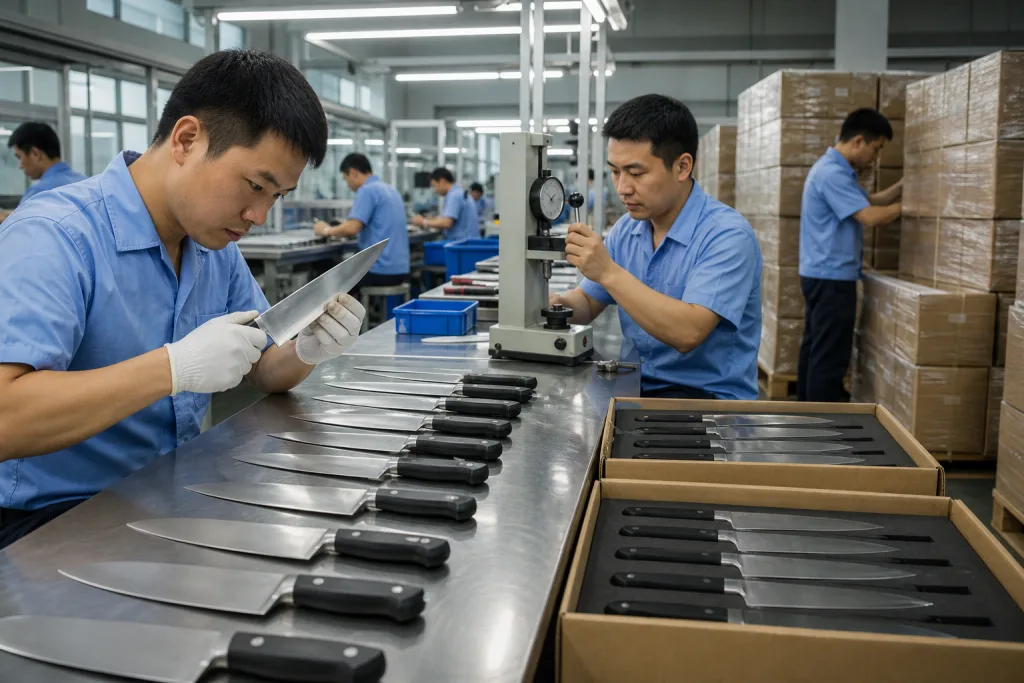
AQL does not replace process control. It is the final gate. A serious factory still checks incoming steel, signs the first-piece sample, measures blade profile on the grinding line, verifies heat treatment, checks assembly fit, and runs final inspection before your third-party inspector arrives. We have seen this go sideways when the PO only says "same as sample" and nobody writes the 58-60 HRC target or the 0.2 mm handle gap limit.
Inspect Damascus pattern and blade geometry
Damascus appearance is half craft, half process control. Do not ask for every blade to carry the same pattern line; with real layered steel, that is the wrong question to ask. Ask for clear contrast, no dead gray patches, no rough over-etching, and no pattern drag from uneven belt grinding. On the sample, we shoot both blade faces under 5500K white light, then QC pulls one close-up near the heel and one near the tip so the buyer can see whether the acid etch is clean, not just pretty under catalog lighting.
The blade geometry matters more than the pattern. A catalog buyer may love the surface, but the end user judges the knife in the first 30 seconds on an onion. Check straightness on a flat plate, measure spine thickness with a digital caliper, and compare heel height against the approved drawing. Tip alignment and edge symmetry should be checked against the centerline, not guessed by eye. For an 8 inch chef knife, a common spine thickness range is 1.8-2.5 mm depending on design. If the sample is 2.0 mm and bulk production becomes 2.8 mm, the knife feels heavy and cheap in hand even if the Damascus pattern looks strong. We have seen this go sideways when a PO said “same as sample” but the drawing missed the spine tolerance.
Sharpness needs one repeatable check. CATRA testing is best for serious retail programs, but most promotional orders we ship use controlled paper cut and tomato skin cut checks at the sample table. If you want a number, ask for BESS testing at sample stage and random bulk checks. A sensible factory can run internal edge consistency checks with the same test media and the same operator; not every order needs a full lab report. The grinding line should also record the final belt grit, because 800 grit vs 1200 grit at the edge can change the bite even when the knife passes a quick paper cut.
Hardness needs discipline. For many stainless Damascus kitchen knives with VG10 core, 58-60 HRC is a practical band. Chasing a higher number does not always work for promotional markets; chipping claims rise when users cut bone, frozen food, or glass boards. Ask the factory to record the heat treatment batch number and random Rockwell readings. At TANGFORGE in China, we run HRC records by production lot, and QC marks the Rockwell test points before packing. One mixed heat treatment batch can turn into a costly after-sales problem, especially when 3,000 sets have already left Yangjiang port.
Check handle, assembly, and food-contact details
Handle inspection is where 7 out of 10 bulk complaints start. The blade may pass at first glance, then QC slides a 0.15 mm feeler gauge under the pakkawood scale and the gift set suddenly looks low grade. Your damascus kitchen knife sample approval wholesale plan should lock handle material and finish in writing: pakkawood, G10, Micarta, stabilized wood, walnut, olive wood, or stainless steel. Natural wood needs a wider color band than G10; for walnut, we normally accept 3 shade groups after oiling. If your customer expects every handle to match one catalog photo, do not pick a variable natural material unless the PO includes pre-sorting cost. The math doesn't work.
Assembly checks should cover tang alignment, handle scale fit, rivet flushness, bolster transition, end cap finish, and balance point. Use a straightedge on the spine, a fingertip over each rivet, and a quick wipe with a white cloth to catch glue bleed near the bolster. For a chef knife, many buyers prefer the balance point around the bolster or 10-25 mm forward, depending on blade style. Not a law. Still useful. If the sample feels right, record the weight on the approval sheet. A tolerance of +/-8% is usually workable for mixed natural materials; tighter limits can add sorting cost once the grinding line and assembly bench start running bulk.
Food-contact compliance is a practical buyer issue, not paperwork decoration. For Europe, ask whether the materials can support LFGB or EU food-contact requirements. For the United States, FDA food-contact suitability is usually requested for kitchenware. If you use colored coatings, printed boards, or unusual handle resins, check REACH, PAHs, and heavy metal concerns before the deposit is released. We have seen this go sideways: one black resin handle failed a lab screen 6 days before packing, and the buyer flagged every carton label for rework.
The care card should be approved with the sample, not written after packing. Damascus kitchen knives should be hand washed and dried quickly. Dishwashers, soaking, acidic food residue, and poor storage can cause spotting or corrosion, even on stainless Damascus. We print this on a 90 x 55 mm insert card and ask QC to pull the sample box before mass packing, because one typo in care wording on a PO can turn into 3,000 wrong cards. You cannot control every end user, but clear care language in the box cuts claims.
Control packaging, cartons, and retail labels
For promotional product buyers, packaging is part of the product, not an afterthought. The gift box is often the first thing the recipient sees, and the warehouse team only cares whether the labels scan cleanly. A damascus kitchen knife sample approval supplier should send 1 full packed sample, not a loose knife wrapped in bubble bag. Approve the knife, blade guard, EVA insert, and printed items with the gift box, master carton, and outer labels as one packed set. We have had buyers approve the blade in the showroom, then flag a 2 mm box gap after QC pulled the sample from the packing table.
Knife packaging must protect the product and the people handling it. Simple rule: the tip cannot punch through the insert, gift box, or carton during vibration. If the knife has a sheath, check retention by turning it tip-down 10 times. If it uses a blade guard, confirm the inner edge does not scratch the etched Damascus surface after repeated removal. For premium promotional sets, a magnetic box or rigid drawer box looks good, but the math does not work if the board is too thin; we normally ask for carton compression and drop test results before we run bulk cartons.
Barcode and labeling errors are painfully common. Approve UPC, EAN, FNSKU, customer SKU, country of origin, carton quantity, gross weight, net weight, and carton dimensions before mass printing. No guessing here. If the order ships DDP to an Amazon prep center or distributor warehouse, label position can matter as much as the knife spec. We once saw a PO with the correct SKU but one digit wrong on the FNSKU artwork, and that turned a clean production run into 2 days of relabeling at the packing line.
We normally recommend a packaging pre-production sample before bulk packaging purchase. It adds about 3-5 days, but it stops the factory from printing 3,000 boxes with an old logo, wrong compliance mark, or a carton label that scans at 60% because the barcode was resized. For a typical 2,000-5,000 piece Damascus kitchen knife order from Yangjiang, Zhejiang, packaging confirmation can become the slowest approval step if the buyer’s brand team changes artwork late. Lock the dieline before the steel goes into final finishing.
Use a clear approval and shipment timeline
A realistic timeline protects your launch date. For a custom damascus kitchen knife sample approval, run 10-18 days after artwork and material confirmation. If the order needs a custom mold, a new handle material, a printed gift box, or lab testing, add 5-12 days. Bulk production usually takes 35-55 days after deposit and sealed sample approval for ordinary wholesale volumes. We see buyers ask for 7 days all the time; the math does not work. On the grinding line, QC still has to check blade thickness, edge finish, and handle fit before we ship, and that takes time. For seasonal programs, book steel earlier, especially before Chinese New Year.
The approval path should be written into the order. First, approve drawings and artwork. Second, approve a physical knife sample. Third, approve the packed sample. Fourth, approve a pre-production sample if anything changes after the first round. Fifth, run in-process checks and final AQL inspection. Sixth, release shipment after the inspection report and commercial documents are correct. We keep the sample tray labeled with the PO number, because one wrong sticker can send the whole order sideways.
For FOB orders, confirm port, carton marks, and forwarder booking. For DDP orders, confirm HS code, duty responsibility, delivery address, appointment rules, and insurance. Damascus kitchen knives can trigger extra questions because customs officers may ask for material description, intended use, and product photos. A buyer once flagged a typo in the consignee name, and the truck sat for a day. Clean documents reduce delay. That is the part that gets ignored until the booking slips.
A good damascus kitchen knife sample approval manufacturer will not push you to approve a vague sample just to start production faster. Speed matters, but unclear approval usually costs more time later. Ask the factory to send the final QC checklist before production starts. If the checklist matches your spec sheet, golden sample, packaging proof, and AQL plan, you have a workable control system. QC pulled the sample at 60-62 HRC, measured the edge again, and the buyer stopped arguing. That is how a promotional knife order moves from attractive sample to repeatable bulk shipment without turning every carton into a surprise.
Frequently asked questions
Approve at least 2 sealed golden samples: 1 stays with you and 1 stays at the factory QC room. For a higher-risk promotional program, approve 3 samples so your third-party inspection company can also hold one. The sample tag should show order number, revision, steel, handle material, logo version, packaging version, and approval date. If you change any important item, such as handle material, logo size, box insert, or HRC band, issue a new revision instead of relying on the old sample.
For most B2B promotional orders, use Critical 0, Major AQL 2.5, and Minor AQL 4.0 under ANSI/ASQ Z1.4 General Inspection Level II. Critical defects include unsafe assembly, exposed blade tips through packaging, and wrong food-contact material. Major defects include wrong logo, blade warp outside limit, failed hardness band, cracked handle, missing care card, or incorrect SKU label. Minor defects include small cosmetic polishing marks or slight box scuffs within the approved tolerance. Put the AQL levels in the PO before production starts.
Check blade length, thickness, straightness, Damascus contrast, HRC, edge sharpness, handle fit, rivet finish, logo position, weight, balance, and packed presentation. For a typical VG10 core Damascus chef knife, 58-60 HRC is a practical range. Logo position should usually be held within +/-1 mm from the approved artwork location. If the product is for Europe or North America, ask about LFGB, FDA, REACH, or other material support depending on your selling market and handle construction.
A normal Damascus kitchen knife sample takes about 10-18 days after artwork, material, and packaging direction are confirmed. Bulk production usually needs 35-55 days after deposit and final sealed sample approval. Add 7-14 days if you require custom gift boxes, lab testing, special handle material, or retailer-specific labels such as FNSKU. Before Chinese New Year or peak Q4 promotional seasons, book capacity earlier because steel, packaging, and heat treatment schedules fill quickly in Yangjiang, Zhejiang and other China knife production areas.
No serious factory should promise every Damascus blade will match the approved sample line for line. Real layered Damascus has natural pattern variation after forging, rolling, grinding, polishing, and etching. What you can control is the acceptable range: pattern visibility, contrast, no dead gray areas, no over-etched roughness, and no obvious mismatch between left and right sides. The golden sample should represent the approved quality level, while your inspection checklist should define which variations are acceptable and which become minor or major defects.
Send Your Knife Sample Spec
Share your drawing, target MOQ, packaging brief, and inspection standard. Our Yangjiang team will review the sample approval risks before quoting production.
Request a Quote