Damascus kitchen knives sell on looks, but the paperwork is where private label programs start to slip. We have seen a buyer approve a 60 HRC sample, print that number on the carton, then push back when the bulk lot came in at 56 HRC on the Rockwell tester. The math does not work. That gap changes edge retention claims, warranty wording, customs descriptions, and whether the buyer trusts the next shipment.
At our Yangjiang factory, the job is more than forging, grinding, and polishing. For export orders, we run steel traceability sheets, heat-treatment records, inspection reports, food-contact declarations, carton marks, HS codes, and label files that match the actual goods down to the 0.1 mm callout on the drawing. TANGFORGE has handled OEM and ODM knife programs since 2008, with about 240 employees and monthly output planned around custom kitchen, chef, pocket, outdoor, tactical, and Damascus knives. QC pulled the sample on the line, and this is the wrong question to ask if the paperwork does not line up with the blade.
Why HRC Claims Need Paperwork
Hardness is not a footnote for the spec sheet. On a private label Damascus kitchen knife, HRC becomes a shelf claim, a QC limit, and sometimes the first line in a buyer complaint. If your carton, Amazon listing, and instruction card say 60 HRC, the factory must show where that number came from and which samples were tested during production.
Most Damascus kitchen knives we ship for retail use layered cladding over a named core steel. The cutting edge comes from the core steel and heat treatment; the pattern is not doing the cutting. A normal commercial spec might read 10Cr15CoMoV core at 60+/-2 HRC, VG10 core at 60+/-1 HRC, or 9Cr18MoV core at 58+/-2 HRC. If the spec only says “Damascus steel, high hardness,” the math doesn't work. You have not ordered a controlled knife. You have ordered a nice-looking blade with a future argument packed inside the carton.
A serious damascus kitchen knife steel hardness manufacturer should record the steel grade, furnace batch, quenching temperature range, tempering cycle, and HRC test results. You do not need the full heat-treatment recipe, but you do need enough paperwork to prove the goods match the approved sample. QC pulled the sample for one buyer last year and found 57 HRC on a blade marked 60 HRC; the carton claim became the problem, not the knife itself. At TANGFORGE in Yangjiang, China, private label kitchen knife MOQs usually start from 300-500 pieces per SKU depending on handle and packaging, and production lead time is commonly 35-55 days after deposit and artwork approval. That is enough time to control hardness properly if the HRC band is locked before the grinding line starts.
The painful cases usually start with late changes. A buyer approves a sample at 60 HRC, then changes handle material, blade thickness, laser logo depth, or shipment date, but the technical PO still says nothing. We've seen this go sideways. Your best protection is boring: put the HRC band, steel grade, test method, and rejection rule directly in the PO and product specification.
Define Steel, Core, And Hardness Together
Damascus kitchen knife steel hardness export documentation should start with a clean material definition. “67-layer Damascus” is not enough. It tells you the build style, not how the edge will cut. Your file should name the core steel, outer cladding, target HRC, blade thickness, heat treatment status, and surface finish. On the shop floor, QC pulled the sample and checked the heel on the Rockwell tester. That number matters more than the pattern photo.
For retail private label programs, we tell buyers to split marketing language from factory language. Marketing can say “67-layer Damascus pattern with a hard cutting core.” Factory papers should say something like “67-layer Damascus cladding with 10Cr15CoMoV core, target 60 HRC, acceptance 58-62 HRC.” The second version is easier to inspect and harder to argue with. We have seen a buyer flag a PO that said only “Damascus knife 67L,” and the mismatch dragged out approval for 12 days.
Here is a practical sourcing table you can use when comparing a damascus kitchen knife steel hardness supplier. We run this against the sample report from the grinding line before we release bulk.
| Specification item | Typical export setting | Buyer risk if missing |
|---|---|---|
| Core steel | 10Cr15CoMoV, VG10, AUS-10, 9Cr18MoV | Performance claim cannot be verified |
| Target hardness | 58-60 HRC or 60-62 HRC | Bulk goods may drift from approved sample |
| Test location | Near heel, mid-blade, or sample coupon | Factory and inspector test different areas |
| Inspection level | AQL 2.5 major, AQL 4.0 minor | Subjective pass or fail argument |
| Food-contact file | LFGB, FDA, or declaration by material | Retail compliance review may stop launch |
Custom damascus kitchen knife steel hardness should match the knife’s price and the way the buyer will use it. A 62 HRC edge holds sharpness well, but it can chip faster when someone cuts frozen food or twists through bone. A 58-60 HRC chef knife is usually more forgiving for mainstream retail. The wrong question is “what is the highest hardness you can make?” We have seen that math fail on a 3000-piece run, and the warranty team pays for it when the first inspection finds chips near the tip.
Hardness Testing Before Shipment
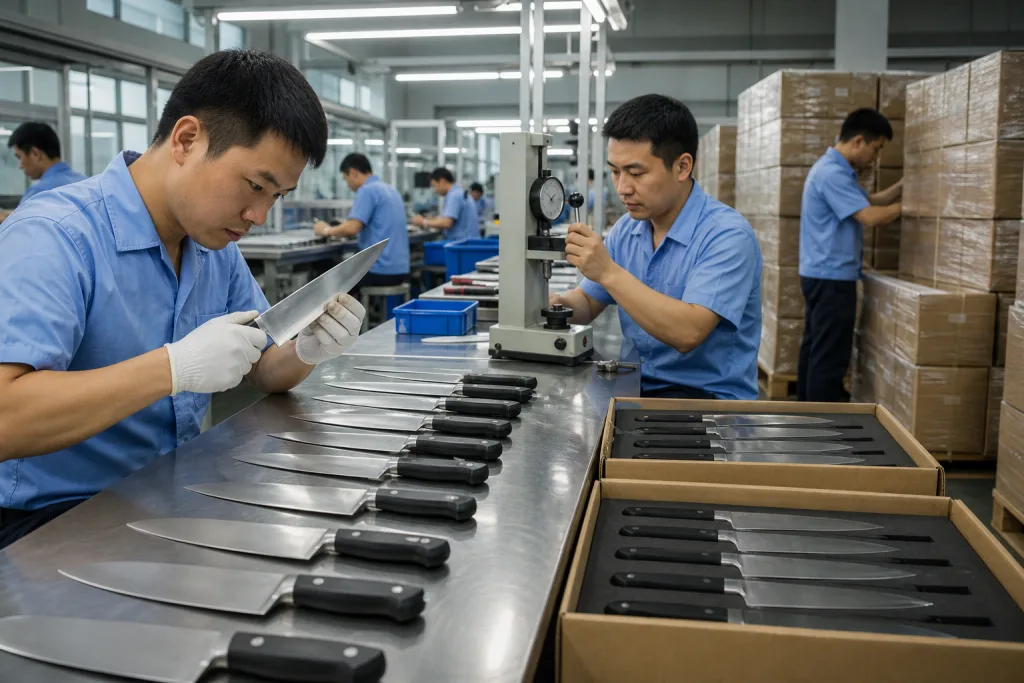
Hardness testing cannot wait until the container is sealed. By then, the choices are ugly: rework, discount, or a sailing date pushed from 12 days to 18 days. We run it in this order: sample confirmation, pilot production check, in-line heat treatment check, final inspection, then retained sample filing. For custom Damascus knives, we want at least three HRC checkpoints on the order file: approved sample, first mass-production batch, and final random inspection. QC pulled one chef knife sample last month after tempering and caught 58 HRC against a 60-62 HRC target. Good catch. Bad timing, but still before packing.
The usual method is Rockwell C testing, reported as HRC. Test position matters on finished blades because the diamond cone leaves a mark, and nobody wants an indentation sitting on a polished Damascus face. Some factories test sacrificial blades from the same heat treatment batch. Others test near the tang, heel, or another non-critical area hidden by the handle profile. Both methods can work if they are written into the PO before production. If your third-party inspector tests the blade face and the factory tested a cut-off coupon, we have seen this go sideways fast.
A practical HRC report should include item number, PO number, production date, steel grade, heat treatment batch, target range, measured values, tester model, calibration status, and operator sign-off. For a 1,000-piece wholesale order, a buyer may request random hardness checks on 5-13 pieces depending on risk level and order history. For a new damascus kitchen knife steel hardness factory, use the higher side until 3-5 shipments are stable. One small detail: ask for the tester model, not just “HRC OK.” Our lab uses a bench Rockwell tester with a calibration sticker, and that sticker date has saved more than one inspection argument.
Do not trust a beautiful sample by itself. This is the wrong question to ask: “Does the sample look good?” A sample may be ground slowly on the belt, hand-finished by the senior worker, and heat treated in a small batch of 20 blades. Bulk production has more variation on the grinding line, especially when 8-inch chef knives and 5-inch utility knives share the same furnace schedule. If the approved sample is 61 HRC and bulk production averages 57 HRC, your customer will feel the difference in edge retention even if the knife looks identical. Write the acceptance band as a range, for example 59-61 HRC, not a single number with no tolerance.
At TANGFORGE, our export team normally keeps signed sample cards, inspection photos, and batch records with the order file. It is not glamorous work. It is the folder we open when a buyer asks why carton 37 has a different batch date, or when a customs broker wants the steel grade matched to the invoice line. We ship cleaner when the paperwork follows the blade from heat treatment to final carton sealing.
Documents Your Retail Team Should Request
For private label buyers, export documentation works like a checked BOM. If one file says VG10 at 60 HRC and another file says “stainless steel kitchen knife,” your compliance team will stop the folder, often when the container is already waiting at Yangjiang port. We have seen one PO typo, “VG-01” instead of “VG-10,” hold a 1,200-piece order for 3 days. Build one controlled document folder for each SKU or family before shipment from China.
The basic pack should include the proforma invoice, purchase order, signed product specification, approved artwork, packing list, commercial invoice, bill of lading or airway bill, certificate of origin if needed, and inspection report. For Damascus kitchen knives, add steel declaration, heat treatment or hardness report, food-contact declaration, and packaging material declaration when your market asks for them. Simple list. Hard to fake later. On our side, QC pulls the hardness sheet from the Rockwell tester record, not from a sales spreadsheet, because buyers will ask where the 60 HRC number came from.
For Europe, buyers usually ask about LFGB, REACH, and sometimes German food-contact wording if the knives go into retail chains. For the United States, FDA food-contact language and Prop 65 review can come up based on handle material, coating, printing ink, and packaging. For wood handles, discuss moisture content, fumigation status, and whether the wood species creates CITES concerns. Most standard pakkawood, G10, PP, ABS, stainless steel, and paper packaging routes are workable, but the declaration still needs to say the right material. We once had a buyer flag “natural wood” on a carton mark when the approved spec said pakkawood; the math does not work if the label and test report describe two different handles.
The document names should match. Use the same SKU, blade size, steel description, HRC range, handle material, logo method, and carton quantity across all files. If your package says “Japanese Damascus steel” but the factory declaration says “Chinese 10Cr15CoMoV Damascus cladding,” your retailer may flag it. Keep origin language factual. A knife manufactured in Yangjiang, China should not be presented as made somewhere else because the steel style sounds premium. This is the wrong question to ask: “Can we make it sound more Japanese?” Ask whether the wording can pass a retailer file check at 4 p.m. on a Friday.
Ask your damascus kitchen knife steel hardness supplier to send draft export documents 5-7 days before shipment. That gives your forwarder and compliance team time to catch HS code, consignee, FNSKU, carton mark, and country-of-origin issues before goods leave the factory gate. We run this check against the final carton label PDF and packing list; catching a wrong carton quantity at 48 cartons is cheap, catching it after loading costs 12 days vs 18 days on the next available sailing.
Labeling, Packaging, And Claim Control
Packaging is where a small technical mistake becomes visible to every buyer. Once the retail box says “62 HRC,” “VG10,” “hand forged,” “food safe,” or “67 layers,” we need a file behind each line. The printer will print it. Your brand has to defend it when a retailer asks for the HRC report or when QC pulled the sample and found the box copy did not match the test sheet.
For damascus kitchen knife steel hardness wholesale orders, build the claim matrix before artwork approval. We run one sheet for the box, insert card, barcode label, online listing, and master carton, then match each sentence to a proof file. “60+/-2 HRC” points to the hardness report from the Rockwell tester. “10Cr15CoMoV core” points to the steel declaration or mill certificate where available. “LFGB compliant handle” points to the material test or supplier declaration. “Made in China” points to the commercial invoice and certificate of origin if needed. This is not paperwork for fun; we have seen a 3 mm typo on a PO hold packing for 2 days.
Carton marks need to work on the warehouse floor. A clean export carton label usually shows item number and product description on the first line, quantity per carton, gross weight, net weight, carton size, country of origin, PO number, and carton sequence. For Amazon or marketplace channels, your team may need FNSKU labels, suffocation warnings for polybags, and retail-box barcodes that scan at Grade B or better. Confirm label position with packing photos before mass packing. The buyer flagged it once when the barcode sat across a box crease.
Be careful with “hand forged.” Most modern Damascus kitchen knives pass through industrial forging or rolling, CNC profiling, belt grinding on the grinding line, and hand finishing at the edge. If each blade is not individually hand forged in the traditional way, say “Damascus layered steel blade” or “hand finished edge.” The wrong question is whether the wording sounds premium; the right question is whether your retailer can approve it without a compliance fight.
At our Yangjiang factory, packaging approval sits inside quality control, not decoration. A wrong HRC claim on 5,000 boxes costs more than a late email asking for one corrected PDF, especially after the cartons are sealed with 48 mm tape and stacked for final AQL 2.5 inspection.
Inspection Criteria For Damascus Knife Orders
Hardness is one check, not the whole job. We had a batch on the grinding line hit the target HRC and still get held because the edge wandered 0.3 mm, the handle had a 1 mm glue line, and the blade carried a bow. For a Damascus kitchen knife, the knife has to pass function, look, and safety in the same carton. Otherwise the buyer will flag it, and the math does not work.
For a 1,000-piece private label run, AQL 2.5 for major defects and AQL 4.0 for minor defects is a clean starting point. Critical defects stay at zero. We do not argue about a broken tip, a loose handle, sharp burrs on the spine or bolster, contamination, wrong logo, wrong steel claim, wrong country-of-origin label, or unsafe packaging. Major issues include blade warp beyond agreed tolerance, poor handle fit, visible glue gaps, deep scratches, incorrect HRC range, barcode failure, or carton shortage. Minor issues include small polishing marks, slight color variation in natural wood, or minor retail box scuffs within agreed limits.
For blade geometry, write the numbers in mm and degrees. A 200 mm chef knife might specify blade length 200+/-3 mm, spine thickness 2.0+/-0.3 mm at heel, edge angle 15+/-2 degrees per side, and handle rivet flushness within 0.2 mm. Damascus pattern contrast should be checked against the approved golden sample under normal light, not in the polishing room where the finish can hide a cloudy pattern.
Cutting performance can be checked with paper slicing, tomato cutting, or rope/cardboard tests for internal evaluation. If you need lab-grade edge retention data, CATRA is the more structured route, but it adds cost and days. We do not push CATRA on every order; it makes sense for a premium launch or when the buyer pushes back on a performance claim. Photos matter. Require inspection photos of blade face, edge, spine, handle joint, logo, packaging, carton mark, and HRC test record. When your damascus kitchen knife steel hardness manufacturer knows the exact inspection standard before production, the shipment ships cleaner.
How To Brief A Factory Correctly
A good factory brief is short, specific, and hard to misread. For a custom damascus kitchen knife steel hardness order, send one technical sheet per SKU, not one mixed PDF for 12 models. Include blade drawing or reference photo, size in mm, steel construction, target HRC, handle material, logo method, finish, packaging, compliance market, MOQ, target FOB price, and inspection standard. If you need DDP pricing, give the destination country, postcode, carton estimate, and delivery channel. FOB Yangjiang or FOB Shenzhen is a different discussion from DDP Germany or DDP California, because the carton size and last-mile rule change the math.
Price depends on steel, blade size, handle, finish, packaging, and order quantity. A simple private label Damascus chef knife does not cost the same as a gift-boxed 5-piece set with magnetic closure, laser logo, custom insert, and retail barcode labels. For planning, 7 out of 10 custom kitchen knife programs we quote start at 300-500 pieces per SKU, with sample lead time around 7-15 days after drawing and logo confirmation. Bulk lead time is often 35-55 days; before Chinese New Year, plan 55 days instead of pretending 35 days will hold. The grinding line needs the confirmed edge spec before we run the first batch.
Do not hide the sales channel. This is the wrong question to dodge. A knife for a specialty retailer, supermarket promotion, online marketplace, or chef supply distributor may need different packaging strength, barcode rules, warranty language, and compliance files. Tell the factory whether the goods go to the EU, UK, US, Canada, or mixed markets. That affects LFGB, FDA, REACH, Prop 65 review, carton marks, and sometimes importer labeling. We have seen QC pull a finished carton because the PO said "US market" but the artwork carried EU recycling marks only.
Choose a damascus kitchen knife steel hardness supplier that is willing to discuss trade-offs. If you ask for 62 HRC, ultra-thin edge, low price, fast delivery, and zero chipping complaints, a responsible factory should slow the discussion down. The math does not work. Better to adjust the HRC band, edge angle, or steel choice before mass production than to explain returns later. On one 8-inch chef knife, changing the edge from 12 degrees per side to 15 degrees per side cut chipping complaints without touching the retail look.
TANGFORGE works from Yangjiang, China with export coordination for buyers in Europe and North America. Send the steel target, HRC range, packaging files, and destination market early. A clean brief helps the factory quote honestly, build the right sample, and prepare documents that survive your retailer’s compliance desk. Small details matter: QC pulled one sample last month because the logo file was 0.4 mm off-center on the blade face.
Frequently asked questions
For mainstream retail, 58-60 HRC or 59-61 HRC is often a practical range because it balances edge retention with lower chipping risk. Premium VG10 or 10Cr15CoMoV core Damascus knives are commonly specified around 60+/-2 HRC. Avoid writing only “60 HRC” with no tolerance. Also specify where and how the hardness is checked, because finished blades cannot always be tested in the same visible area without leaving a mark.
It depends on your retailer and price level. For many private label orders, a factory steel declaration plus heat treatment and HRC report is accepted. Some larger retailers or regulated programs may ask for a mill certificate, especially if the packaging names a specific core steel such as VG10 or 10Cr15CoMoV. Ask before sampling. If the order is only 300 pieces, full mill paperwork may be harder to obtain than for a 3,000-piece production run.
Check the commercial invoice, packing list, carton marks, inspection report, hardness report, steel declaration, packaging artwork, barcode files, and any LFGB, FDA, REACH, or Prop 65-related declarations your channel requires. The item number, steel description, HRC range, handle material, quantity, and country of origin should match across files. Ask for drafts 5-7 days before shipment so your forwarder can review HS code, consignee details, and shipping terms before goods leave China.
Yes, but only if both claims are supported. “67-layer” should match the blade construction or supplier declaration, and “62 HRC” should be written as a tested range if production varies, such as 60-62 HRC or 61+/-1 HRC. If your bulk inspection shows 58 HRC while the box says 62 HRC, you have a claim problem. Keep the approved sample, HRC report, and packaging claim matrix in the same order file.
For private label Damascus kitchen knives, a realistic MOQ is often 300-500 pieces per SKU for an existing blade shape with custom logo and packaging. Fully custom tooling, special handle materials, or gift sets may require 1,000 pieces or more. Sample lead time is commonly 7-15 days, and bulk production often takes 35-55 days after deposit and artwork approval. Holiday seasons in China can add 10-20 days, so confirm capacity early.
Send Your Damascus Knife Compliance Brief
Share your steel grade, HRC target, packaging claims, destination market, and order quantity. We will check the factory route, documents, MOQ, and lead time before sampling.
Request a Quote