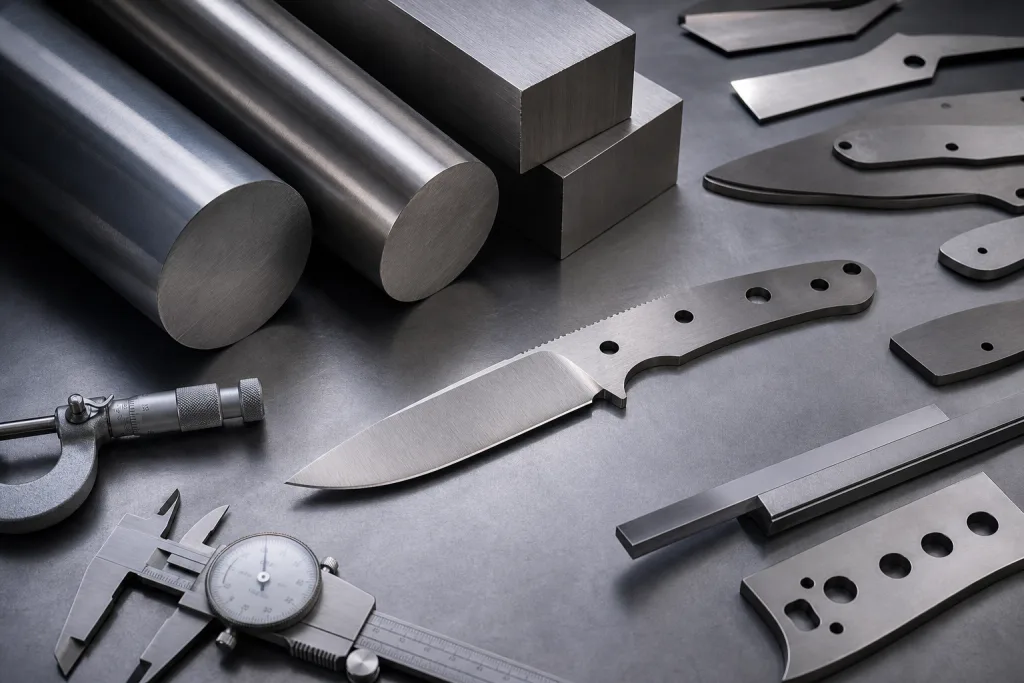
Damascus kitchen knives sell on the pattern and the gift-box look, but the margin is made behind the blade. Core hardness, box structure, and logo method decide chipped tips, return rate, and whether your customer sees a USD 18 knife or a USD 32 knife. We run this check before quoting: blade HRC target, handle finish, insert fit, barcode position, and master carton drop risk. If you buy from a Yangjiang, China factory, the knife spec and box spec need to match from day one.
Private label makes this sharper. A 58-60 HRC blade gives more forgiveness on edge impact; a 61-62 HRC blade holds the edge better but punishes weak packing, especially when the tip has only 3 mm clearance inside the insert. QC pulled a sample last month where the PO said black EVA, but the buyer’s artwork file showed white molded pulp. Small typo. Big delay. A serious Yangjiang, China supplier should give you the hardness target, packaging dieline, and production schedule before first order approval. If they cannot, the math does not work: you are buying a nice sample with a logo, not a controlled retail product.
Start With The Core Hardness
Damascus sells first with its pattern. The user judges it on the board. For most private-label kitchen knives, the number we watch is core hardness, not layer count. 58-60 HRC is the safer range for home cooks and light prep staff because the edge comes back faster on a 1000 grit stone and forgives a bad chop into chicken bone or a bamboo board corner. For a higher shelf price, 60-62 HRC can hold the edge longer, but the heat treat has less room for sloppy work; we run the Rockwell tester before polishing, and QC pulls samples again after the grinding line cools down. Ask for 64 HRC on a gift-set chef knife and the math does not work.
As a damascus kitchen knife steel hardness factory, the manufacturer should spell out the working recipe: core steel grade, cladding steel, heat-treatment target, tempering window, spine thickness in mm, edge angle, final HRC, plus the packing method used after inspection. A pretty blade pattern cannot rescue a weak temper. A serious damascus kitchen knife steel hardness manufacturer checks hardness before the etch finish, then checks again before packing; last month one buyer flagged 60-62 HRC on the PO while the carton sticker said 58-60 HRC, so we held 312 pcs until the report matched. If the blade is for slicing or fine prep, we can grind it thinner, but the box needs a tip guard, edge sleeve, and a tighter EVA slot than a heavy-duty chef knife. Design and packaging meet right there.
Choose Packaging That Protects Margin
Retail packaging is not decoration. It is cost control. It hits the product price, carton cube, container loading, and claim rate. For importers and retail programs, the right pack is the one that passes handling and still looks sharp when the customer opens it. We usually see 3 workable choices for Damascus knives: a rigid gift box for higher-ticket sets, a printed folding carton with paper pulp or EVA insert for volume orders, or a sleeve with inner tray when the buyer wants a cleaner shelf look without paying gift-box money. If the blade is polished or the Damascus pattern has strong contrast, a window box can sell the knife before the customer touches it, but the edge must be locked with a sleeve, tip guard, or molded insert. QC pulled one sample last season where the 8 inch chef knife shifted 6 mm inside the box and cut the PET window during transit. That claim was avoidable.
| Pack style | Typical use | Estimated unit cost | Buyer note |
|---|---|---|---|
| Rigid gift box | Premium retail and gifting | USD 0.70-1.80 | Best for sets, stronger shelf value, but watch carton weight |
| Printed folding carton | Wholesale and e-commerce | USD 0.18-0.55 | Lowest freight cost, clean space for barcode and warning text |
| Sleeve plus tray | Mid-market private label | USD 0.35-0.90 | Good cost-to-presentation ratio when MOQ is above 1,000 pcs |
| Mailer carton | Amazon and DDP shipments | USD 0.25-0.80 | Must fit FNSKU, carton marks, and drop testing |
If you sell through Amazon or a fulfillment center, build the carton around FNSKU and scannable labels from day one. Do not add them after artwork approval. The math does not work. A 2 mm barcode shift or glossy lamination over the label area can slow receiving, and the buyer will flag it before they praise the Damascus pattern. For wholesale, the inner pack matters more than the shelf carton because distributors often rework outer cases, mix SKUs, or add local stickers. A damascus kitchen knife steel hardness supplier in China should quote the knife, insert, sleeve, master carton, and drop-test requirement together. We run the grinding line and packing line under the same order sheet for a reason: if the knife spec says 60-62 HRC but the PO has a typo on box size, margin disappears in rework.
Use Logos That Survive The Finish
Logo placement on Damascus knives should follow the finish, not the buyer's ego. Laser engraving on the blade is still the safest choice for most orders because it cuts clean on 58-60 HRC steel and does not rely on ink sticking to an oiled surface. On a polished or satin blade face, we run a shallow 0.03-0.05 mm laser mark so the brand looks sharp without stealing space from the Damascus pattern. If the blade has a heavy wave, shrink the logo to 8-12 mm wide and move it toward the heel; otherwise the eye fights the pattern and the mark looks messy. QC pulled this sample before. For handle branding, pad print, hot stamp, or a molded mark often beats forcing every logo onto the blade.
Private label packaging should carry part of the brand job too. A clean front panel and a readable model code often sell better than a big logo burned into the steel. The barcode matters. We have seen buyers flag a 0.4 mm barcode line spread after lamination, and that delayed shipment by 6 days. Use the box for the product story, care instructions, and compliance marks; keep the knife logo simple and permanent. If you need custom damascus kitchen knife steel hardness work for Germany or the US, approve the logo size, print color, and carton language before mass production. Changing artwork after the first printed run is where the math doesn't work: 2,000 cartons, 2,000 labels, and a grinding line waiting for packing space.
Write A Spec Sheet Buyers Can Audit
I’m rewriting the prose to sound like a factory-side sales engineer: tighter, more specific, fewer filler phrases, while keeping the HTML structure and the existing spec numbers intact.A spec sheet beats a 20-email back-and-forth. If you are buying damascus kitchen knife steel hardness wholesale, state the target HRC, blade length in mm, spine thickness, handle material, edge angle, finish, and the exact pack format. QC pulled the sample with a 0.02 mm micrometer and checked the spine against the drawing. Ask one more thing too: where the knife sells. Retail shelves, Amazon FBA, distributor stock, and promo gifts all force different carton sizes and label positions. This is the wrong question to leave vague; a buyer flagged it on the last PO because the barcode sat on the wrong panel.
| Spec item | What you should ask for | Why it matters |
|---|---|---|
| Hardness | 58-60 HRC or 60-62 HRC target | Sets edge life and chip risk |
| Blade thickness | 1.5-2.2 mm depending model | Changes cutting feel and carton clearance |
| Packaging | Gift box, folding carton, or mailer | Controls freight cost and shelf look |
| Compliance | REACH, LFGB, FDA-ready materials if needed | Reduces import and market access risk |
| Inspection | AQL 2.5 with photo report | Defines acceptance before shipment |
Ask for the carton size, gross weight, and master carton pack count before sample approval. Those numbers decide whether your shipment lands at a sane cubic meter rate or gets kicked into air freight. We run a tape measure on the packing line, and a 2 mm gap can throw off the carton count fast. A factory with ISO 9001 controls should hand over a spec sheet and a packing list draft without making you rebuild the job from scratch. The math does not work if the box spec is still guessed.
Price The Full Program, Not The Knife
About 6 out of 10 new buyers underprice packaging because they stare at the blade cost first. Wrong question. In a custom Damascus kitchen knife order, the blade carries the grinding, heat treatment, and handle fitting work, but the box, insert, barcode label, carton print, and shipper protection decide whether the product reaches the shelf clean. For a private label run, packaging can add USD 0.35-1.80 per set, and the gap comes from real choices: rigid box with EVA insert, foam sleeve, or simple folding carton. QC pulled one sample last month where the knife was fine, but the inner tray rubbed the handle during a 60 cm drop test. The math does not work if you save USD 0.22 on the box and take claims after arrival.
At a 240-employee knife factory in Yangjiang, China, we run custom packaging at a realistic MOQ of 500 pcs per SKU, with sample lead time around 7-10 days and bulk production around 30-45 days after artwork and deposit are approved. Complex carton art needs another week, sometimes because one barcode digit or color code on the PO is typed wrong. It happens. For FOB pricing, steel, handle, and finish still move the quotation, but packaging can change landed cost more than switching a small blade detail. DDP buyers also need to price barcode compliance, carton dimensions, and extra drop protection for ecommerce, especially when Amazon-style shipping turns one outer carton into the real test.
If you are buying wholesale, ask the supplier to quote two clear packs first: standard retail pack and premium gift pack, with the blade-only price shown as a control line. That side-by-side quote beats fighting over USD 0.05 on the first sample. We have seen this go sideways when the buyer approves a beautiful knife, then rushes a weak carton two weeks before shipment.
Check Compliance Before You Print
Check compliance before you print cartons, not after the shipment leaves the port. We run this check at the proof stage because fixing a wrong claim on 20,000 boxes costs time and money. For Europe, the buyer usually asks for REACH-oriented material declarations; for food-contact orders, LFGB or FDA support may also be needed, depending on the handle, coating, and ink set. A solid factory should show ISO 9001 process controls, a BSCI or similar social audit when the importer asks for it, and traceable incoming material records. If the blade, handle, or packaging uses coatings, inks, magnets, or adhesives, those items need to be named in the file. QC pulled the sample on one order after the buyer flagged a missing ink declaration on the carton mockup. That was the right call.
Inspection has to cover more than appearance. Ask for hardness reports, blade edge checks, logo position checks, barcode scans, and carton drop tests. AQL 2.5 is normal for general defects, but we tighten it on blade damage, wrong artwork, or missing inserts because the math does not work once a buyer rejects a pallet. If you need proof of cutting performance, a supplier may show CATRA data or internal cutting tests, but verify the test method, not just the score. In our packing room, a 2 mm barcode shift once caused a full relabel on 600 boxes. That is the kind of detail that saves a claim later. Good factories do not hide behind the word premium; they show the documents, the samples, and the packing photos.
Brief Your Supplier Correctly
A good RFQ cuts out guesswork. Send one file for the blade model, one for the box structure, and one for logo placement. Put the target market, sales channel, and compliance standard in the same brief. If you are working with a damascus kitchen knife steel hardness supplier, say whether the knife is a gift item, a chef tool, or a retail private label line, because the pack tone changes fast. A gift box can take heavier print; a warehouse pack needs data first and decoration second. On our line, the buyer flagged a 3 mm logo shift before QC released the carton proof, and that saved a reprint.
Ask for a sample sequence: blade sample, printed box proof, packed sample, then master carton proof. That order catches the usual misses before mass production starts. If the seller cannot issue a dieline, a hardness target, and a packed sample photo set, the program is not under control yet. The math does not work any other way. We run the same check on every first order, and the projects that stay clean are the ones where the buyer, the designer, and the production team lock the same carton, the same HRC band, and the same label file before the first run begins.
Frequently asked questions
For most retail kitchen programs, start with 58-60 HRC if you want easier sharpening and lower chip risk. If your brand is positioned as a premium slicing tool, 60-62 HRC can work, but you need tighter heat-treatment control and better edge protection in the pack. Above 62 HRC, the knife becomes less forgiving in daily home use and transit damage matters more. Ask the factory for the target range, not just one number, and request a hardness report from the batch. A good supplier in Yangjiang, China should also tell you the steel core, tempering range, and edge angle.
A practical MOQ for custom Damascus kitchen knife packaging is often 500 pcs per SKU, especially if you want printed cartons, inserts, and barcode labels. If you need rigid gift boxes or multi-piece sets, the MOQ can move higher, usually 1,000 pcs or more for the printed pack. Samples are usually separate and can be ready in 7-10 days if the artwork is final. For wholesale buyers, it is smart to ask for two price levels: one for 500 pcs and one for 3,000 pcs, because the packaging unit cost drops quickly once the print run gets larger.
Do both, but use each for a different job. Laser engraving on the blade is usually the cleanest logo method because it survives handling and looks precise on hard steel. Use the box for the product name, model code, care text, barcode, and market-specific information such as FNSKU, UPC, or EAN. If the Damascus pattern is strong, keep the blade logo small and place it where it does not fight the pattern. For premium gift sets, a subtle blade mark plus a strong printed box usually sells better than a large logo on the steel face.
For Europe and North America, ask for material declarations that support REACH, LFGB, and FDA-facing requirements where relevant. If the factory has ISO 9001 or BSCI, request the current certificates and check the scope. Also ask for hardness records, inspection photos, and packing records with carton counts. For the packaging itself, confirm that inks, adhesives, and inserts are suitable for the target market. If you plan to ship through Amazon or a fulfillment center, make sure the cartons and labels are scannable before the pallet leaves China.
Separate the quote into blade, handle, packaging, and shipping. On a custom program, packaging can add USD 0.35-1.80 per set, which is enough to move your margin if you are building a mid-market retail line. Ask for FOB and DDP options so you can compare factory pricing against landed cost. Keep carton size efficient, because oversized boxes create cubic freight waste. If you are buying from Yangjiang, China, ask for a packed sample before bulk approval and make sure the master carton count matches your warehouse or Amazon receiving plan.
Build Your Private Label Knife Spec
Send your target HRC, box style, and logo file, and we can turn it into a production-ready Damascus knife package with controlled cost and export-ready labeling.
Request a Quote