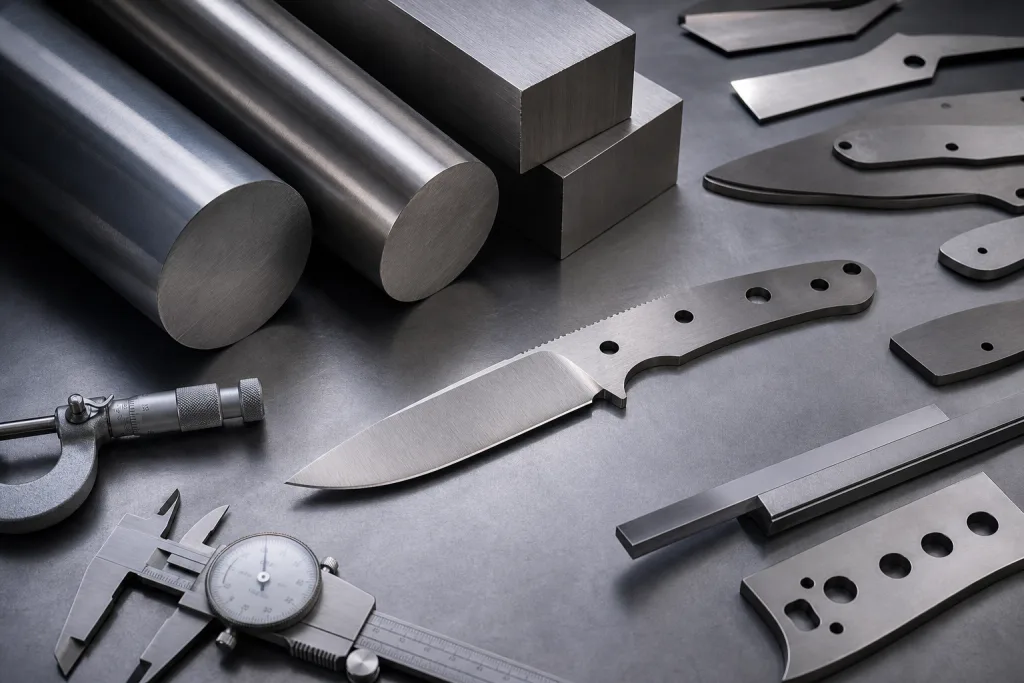
A Damascus knife looks good on a shelf. That is only half the job. If the steel hardness is off by even a few HRC points, we see edge complaints, chips, returns, and a buyer asking why the first carton failed before the promo season even started. On our grinding line, QC pulled the sample and the knife looked fine at a glance, but the hardness reading told the real story.
For promo buyers, the risk is tighter because the knife ships with a logo, gift box, barcode, insert card, and a fixed ship date. A damascus kitchen knife steel hardness retail launch checklist keeps the launch sellable, compliant, and repeatable. From Yangjiang, we ship these programs with HRC, finish tolerance, packaging tests, and AQL 2.5 locked before deposit. The buyer flagged a PO typo on day one once, and that kind of mistake turns into a week of noise. Check it early. The math does not work any other way.
Start With The Retail Use Case
Before you talk about custom damascus kitchen knife steel hardness, lock down what the knife has to survive in the customer’s hands. A retail chef knife sold as a premium tool faces a different failure mode than a Christmas promo set that just needs to clear the buying season. The buyer watches perceived value; the cook watches edge feel, rust spots, and whether the knife inspires confidence on day one. We had a buyer flag a carton artwork typo on a 2,000-piece launch once, and that was the right lesson: finish, story, and actual use case all need to match.
For most Damascus kitchen knives, 58-60 HRC is the practical retail target. At that range, the edge holds through normal prep work, and the blade still has enough toughness for real kitchens. Go to 61-62 HRC and the spec sheet looks stronger, but chip complaints rise fast if the heat treatment, edge angle, and user guidance are not aligned. This is the wrong question to ask if the launch is retail. On the grinding line, we see the same pattern: a sharp-looking number means nothing if QC starts pulling samples for micro-chipping after a few board cuts. For promo buyers, I would ship a stable 59 HRC knife with clean packaging before I chased a hard number that creates warranty noise.
Separate the core steel from the Damascus cladding. Many kitchen Damascus knives use a hard cutting core, such as 10Cr15CoMoV, AUS-10, VG-10 type steel, or similar stainless core material, with layered cladding outside. The hardness that matters for cutting is the core, not the decorative layers. A serious damascus kitchen knife steel hardness manufacturer should state the core steel, cladding type, target HRC range, and test method clearly on the quotation or technical sheet. We check that with the Rockwell tester before release; if the PO says one thing and the sample label says another, the math does not work.
Define Hardness Before Sampling
Sampling without a hardness target burns about 10-14 days before anyone notices the problem. We have seen a buyer approve a clean Damascus pattern from photos, then QC pulled the mass-production sample on the Rockwell tester and got 56 HRC instead of the expected 59 HRC. Looks passed. Cutting did not. Set hardness as an early commercial point together with blade length in mm, handle material, carton pack method, and FOB price; otherwise the math doesn't work once 1,000 pcs are already on the grinding line.
Before sample payment, ask the damascus kitchen knife steel hardness factory for the target HRC band, steel certificate or material declaration, and heat-treatment control record from the furnace batch. For retail programs, we run hardness as a range, not one neat number. A PO saying 59 HRC looks tidy, but production has tolerance after quenching, tempering, straightening, and final grinding. Write 58-60 HRC. It gives QC a real inspection line and keeps both sides away from arguments over one Rockwell point.
| Knife Type | Common Core Steel | Retail HRC Target | Buyer Note |
|---|---|---|---|
| 8 inch chef knife | 10Cr15CoMoV / AUS-10 type | 58-60 HRC | Good retail balance; check 3 pcs per batch after heat treatment |
| Santoku knife | VG-10 type / 10Cr15CoMoV | 58-61 HRC | Thin edge can chip if the buyer asks for 12 degree grinding |
| Utility knife | 9Cr18MoV / AUS-10 type | 57-60 HRC | Works for gift sets; keep the MOQ and barcode label tied to the same spec |
| Budget Damascus look | Etched stainless pattern | 54-56 HRC | Not true layered Damascus; call it patterned stainless on the PO |
If a damascus kitchen knife steel hardness supplier refuses to discuss HRC, or only says the knife is "sharp," slow down. This is the wrong question to ask at sampling: factory sharpness after belt grinding lasts through the first demo, not through repeated home use. Hardness, edge angle, and steel chemistry decide the complaint rate after shipping. We have seen buyers flag this only after a 500 pc trial order, when the return photos already showed rolled edges.
Check The Sample Like A Retail Buyer
A sample is not a souvenir. It is the control reference for the retail launch. On the grinding line, we check the pre-production piece against the spec sheet before it leaves Yangjiang: blade finish, balance, edge feel, handle fit, logo placement, packaging, barcode, and the instruction insert. Then we check the details retail buyers complain about three weeks later, not the shiny parts.
For hardness, ask for the actual HRC reading and the test point. On kitchen knives, Rockwell testing can leave a small indentation, so we often test sample blanks, the spine area, or retained production coupons. That is fine if it was agreed upfront. A certificate with no lot number, no test location, and no link to your order is the wrong question to ask. It does not protect you.
For a Damascus retail launch, keep one approved sample at your office and one at the factory in Yangjiang, Zhejiang. Both should carry a sample approval label with the item number, version, date, packaging code, and hardness target, plus a signature or seal. We have seen this go sideways when sales approved one knife, production followed a different drawing, and the buyer flagged a third version buried in an old email thread.
Test the user-facing basics too. Slice paper, cut tomato skin, chop herbs, and see whether the knife wedges in dense food. QC pulled the sample if the edge was off by 0.5 mm at the heel. A clean Damascus pattern does not save a thick edge. For a chef knife, many retail programs run an edge angle around 15-18 degrees per side, depending on steel and market position.
Lock Packaging, Labels, And Compliance
Promotional buyers often put the knife first and the box second. Retail buyers do not get that shortcut. A Damascus kitchen knife in a gift box has to survive handling, sit straight on shelf, scan on the first pass, and clear the import rules in the destination market. One missing FNSKU, a soft inner tray, or the wrong country-of-origin mark will stall a launch faster than a blade complaint. We have seen a buyer flag a single typo on the PO and hold the whole carton release.
For Europe, check REACH and LFGB where they apply, especially for handle coatings, printing inks, food-contact declarations, and packaging materials. For the United States, FDA food-contact expectations, California Proposition 65 review, and correct labeling may apply depending on the sales channel. If your customer wants BSCI, ISO 9001, Sedex, or a social audit, confirm the factory status before you quote the program, not after the PO lands. QC pulled the sample on one run because the ink spec was off by 2 mm on the sleeve, and that kind of miss is expensive.
Your packaging checklist should cover gift box material, EVA or pulp tray, blade guard, instruction leaflet, warning label, barcode, SKU sticker, master carton marks, and the drop-test requirement. For e-commerce or club retail, the cartons usually need heavier board, corner protection, and labels that scan clean at the warehouse gate. For Amazon-style routing, FNSKU placement and carton content accuracy are not small details. We run a 1.2 m drop test on the master carton, and if the barcode prints too light, the buyer flags it on the first inbound check.
At TANGFORGE in Yangjiang, China, a typical custom Damascus kitchen knife program may start from 500-1,000 pieces per SKU, depending on blade, handle, logo, and packaging. A normal lead time is 45-60 days after sample and artwork approval. If your retail launch date is fixed, put packaging approval on the same calendar as blade approval. Waiting on artwork for 7 days can push the ship date out by 12 days, and the packing room will not wait for the grinding line.
Set Inspection Rules Before Mass Production
Inspection cannot sit on the PO as “check quality.” Put numbers on it. For damascus kitchen knife steel hardness wholesale orders, we set checkpoints for incoming steel, heat treatment, grinding, handle assembly, polishing, logo, packaging, and final carton inspection. On a 3,000 pcs private-label run, QC should see the steel coil label before cutting and pull blades after the furnace, not only after the gift boxes are sealed. Custom handle color, laser logo, and retail sleeve artwork add risk, so final inspection alone is the wrong question to ask.
We normally run AQL 2.5 for major defects and AQL 4.0 for minor visual defects, with zero tolerance for critical safety issues such as loose handles, cracked blades, exposed sharp points through packaging, or incorrect blade steel. Define major defects in plain terms: HRC outside agreed range, uneven bevel, serious handle gap over 0.3 mm, wrong logo position, rust, blade warp above agreed tolerance, broken gift box, unreadable barcode, or incorrect carton quantity. We have seen a buyer flag 48 cartons because the carton mark said “8 inch chef knive.” Small typo. Big delay.
For Damascus pattern, be realistic and specific. Layered steel will not show identical lines on every blade. That is the product. Heavy pattern mismatch between left and right side, cloudy etching, black stains, over-polished patches, or pattern loss near the edge should be classified before production starts. Photos work better than long emails here. Build a small defect photo board with “acceptable” and “not acceptable” examples, then keep it beside the polishing bench and the grinding line.
Hardness testing should be lot-based. Test 3-5 pieces or coupons per heat treatment batch, depending on order size and risk. We use the Rockwell tester before handle assembly because finding 56 HRC after packing 1,200 knives is a bad day. If a batch fails HRC, do not fix the schedule by polishing and packing faster. The supplier should quarantine the lot, identify the cause, and report whether rework or replacement is possible.
Price The Program With Real Variables
Damascus kitchen knife pricing is not blade length plus box. The real cost sits in core steel, layer construction, blade thickness, grinding time, handle material, surface finish, logo process, packaging, inspection, and shipping term. A damascus kitchen knife steel hardness supplier can quote a low FOB price, but if the steel grade is written as “Damascus” with no core listed, the 350gsm color box crushes in the drop test, and QC only checks appearance, the risk has just been moved to your warehouse. We have seen this go sideways.
For a promotional retail program, ask for a quotation that splits the knife, packaging, logo, insert, and testing cost. Then the comparison is honest. Laser logo on blade usually saves 2-3 days against deep etching or a metal badge on the handle, and it avoids one more fixture on the grinding line. A basic color box costs less than a rigid gift box with magnetic closure, but the math does not work if your buyer wants a premium shelf price and the carton corners arrive soft. Pakkawood and G10 are easier to control; resin, Micarta, and stabilized wood can add lead time and more compliance review.
Shipping terms matter too. FOB China is clean if you already run your own forwarder. DDP suits some smaller promotional buyers, but confirm duties, customs responsibility, and final delivery address limits before the PO is signed; one buyer once flagged a DDP quote because the ZIP code was for a remote warehouse, not the head office. For knives, courier and air shipment need checking because some carriers treat blades as restricted goods. Sea freight is slower, but for 1,000 pieces or more, we ship it with fewer surprises.
Do not negotiate hardness as a price discount. Wrong question. If you need lower cost, adjust box structure, handle material, blade thickness, or MOQ. Heat treatment control is not the place to save USD 0.20 and then explain returns after QC pulled a sample at 2 HRC under spec.
Approve The Launch File, Then Produce
The cleanest retail launches we ship start with one locked launch file. Fancy is not the point. Complete is. Put the approved drawing, steel specification, HRC range, blade dimensions in mm, handle material, logo artwork, packaging dieline, barcode, carton marks, inspection standard, compliance documents, shipping term, delivery date, and approved sample photos in one file. We also add a photo of the signed PP sample beside a caliper reading, because QC pulled the sample twice last year after a buyer changed 2.3 mm spine thickness to 2.0 mm in a later email. That file becomes the working reference for purchasing, factory production, quality control, and your customer service team.
Before deposit, ask your damascus kitchen knife steel hardness manufacturer to confirm capacity by process, not by sales talk. A factory may be able to produce 80,000-120,000 mixed knives per month, but your specific Damascus program still depends on heat treatment slots, grinding workers, handle supply, and packaging lead time. Heat treatment is the tight spot. If your launch needs 5,000 gift sets before a retail promotion week, reserve the furnace schedule, the grinding line, and the color box booking in writing. We have seen this go sideways when the buyer approved the artwork fast but left the EVA tray 6 days late.
For final pre-shipment review, check four documents together: final inspection report, packing list, commercial invoice, and photo set of packed cartons. Match SKU, quantity, carton size, gross weight, and carton marks line by line. If selling into retail distribution, add barcode scan proof and carton drop test photos. If selling through a marketplace warehouse, check FNSKU and carton label placement against the platform’s current requirements. Small thing, big pain: one PO typo on a 13-digit barcode can hold 300 cartons while everyone argues about who pays the relabeling labor.
A Damascus kitchen knife works as a promotional product because it photographs cleanly, feels premium in hand, and gives buyers stronger shelf value than a plain printed gift. Still, hardness alone is the wrong question to ask. The launch only works when hardness, compliance, packaging, and inspection are controlled in the same production file. A good China supplier will lock that before the first batch goes onto the production line, not explain HRC drift or crushed color boxes after the container is already on the water.
Frequently asked questions
For most retail chef knives, santoku knives, and utility knives, specify 58-60 HRC for the cutting core. This range gives a good balance of edge retention and toughness for normal home kitchen use. You can request 60-61 HRC for a higher-positioned product, but only if the steel, heat treatment, and edge angle are controlled. For promotional product buyers, 58-60 HRC is usually the safer commercial choice because it reduces chipping complaints while still supporting a premium claim. Always write the HRC range into the purchase order and inspection standard.
Ask the supplier to identify the core steel and cladding structure. Real Damascus kitchen knives normally have a hard cutting core with layered stainless cladding on both sides. A cheaper product may use etched or laser-marked pattern on a standard stainless blade; it can look similar in photos but should not be sold as layered Damascus. Request close-up sample photos, material declaration, and, for larger orders, a retained blade blank or factory process photos. If your retail claim says Damascus, your file should support that claim clearly.
A realistic MOQ is usually 500-1,000 pieces per SKU for custom Damascus kitchen knives, depending on blade model, handle material, logo process, and packaging. If you need a fully custom blade shape, private mold handle, rigid gift box, or special steel, MOQ may move higher. For first launches, many buyers start with one chef knife or a 2-piece set rather than five SKUs. That keeps sample approval, inspection, and inventory easier to control while you test retail demand.
Use AQL 2.5 for major defects and AQL 4.0 for minor defects as a practical baseline. Critical safety defects should be zero tolerance. Major defects should include HRC outside range, loose handle, cracked blade, severe rust, wrong logo, unreadable barcode, warped blade, broken packaging, or wrong carton quantity. For Damascus knives, define acceptable and unacceptable pattern variation with photos before production. A final inspection should also include carton count, drop test status, barcode scan, and packed product photos.
Plan 45-60 days for production after sample, artwork, and packaging approval. Sampling may take 10-20 days depending on steel, handle, and gift box requirements. Add time for compliance review, barcode setup, carton label approval, and ocean freight if you are shipping volume. If your retail event has a fixed date, start the project at least 90-120 days ahead. Rushed timelines often force compromises on packaging, inspection, or shipping cost, and those are exactly where knife launches become expensive.
Build Your Damascus Launch File With Us
Send your target price, MOQ, artwork, market, and launch date. We will review hardness, packaging, inspection, and production timing before quoting.
Request a Quote