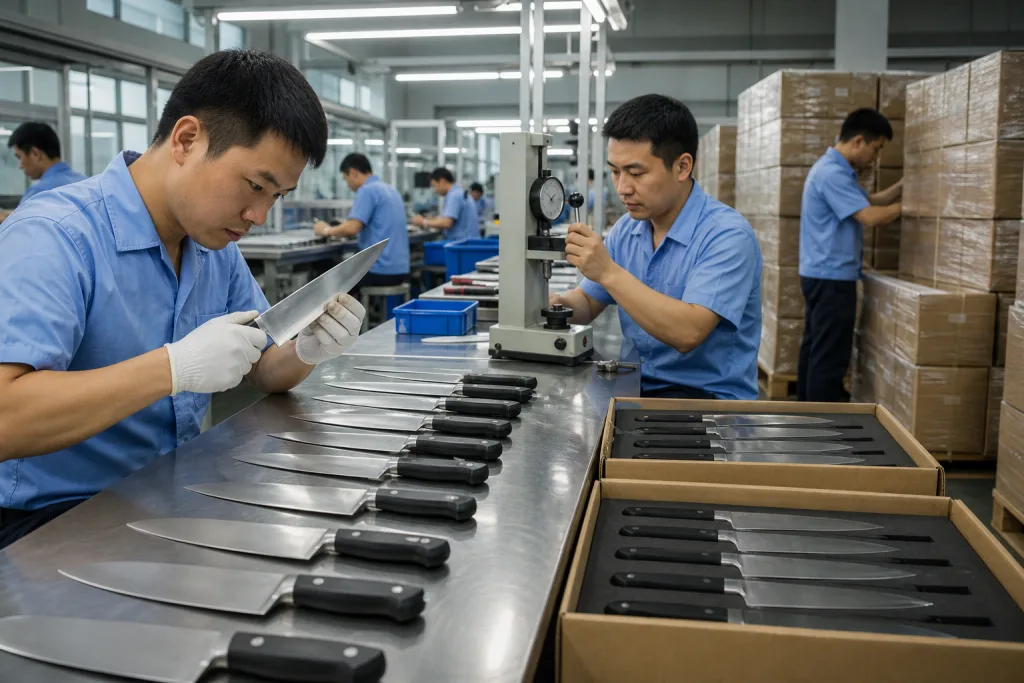
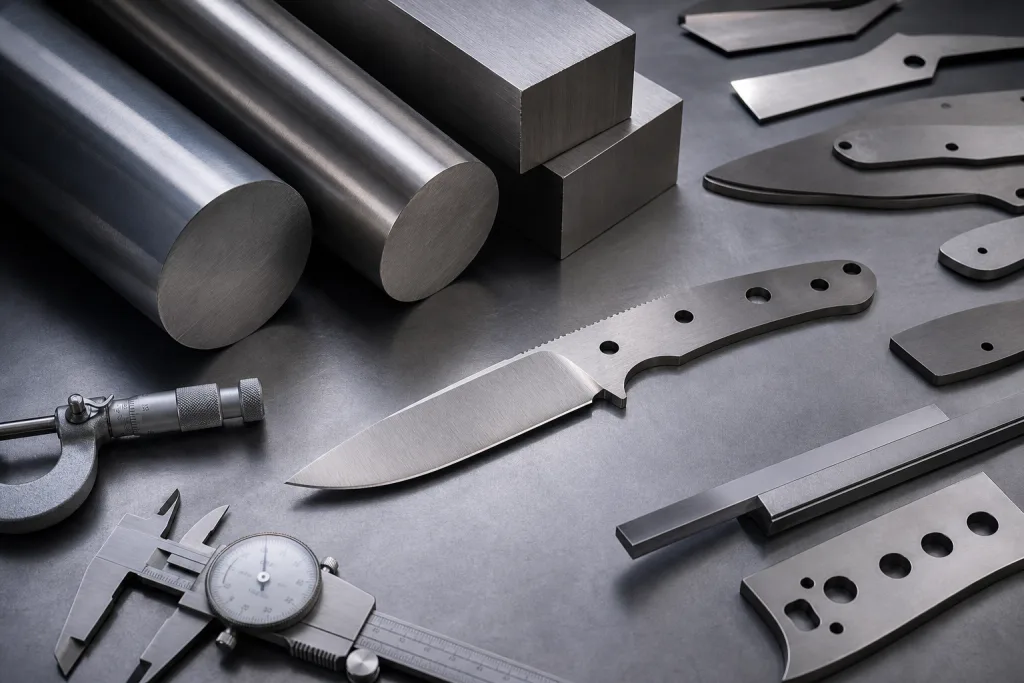
For a custom damascus kitchen knife, HRC is not decoration on the spec sheet. It decides edge bite, chip complaints, heat-treatment rework, retail reviews, and whether PO #2 cuts like PO #1. Last month QC pulled 20 blades from a 500-piece lot after the Rockwell tester showed drift, then three tips chipped during the A4 paper-cut and 18 mm board-drop checks.
At our damascus kitchen knife factory in Yangjiang, Zhejiang, China, buyers often ask for “the hardest possible blade.” Wrong question. For kitchen knives, we run a workable hardness band, hold the furnace log within 6°C, and mark the same Rockwell test point 25 mm from the heel. The math doesn’t work if 62 HRC sounds sharper in catalog copy but adds 8% rework on the grinding line.
Why HRC Matters More Than Marketing
Hardness is measured on the Rockwell C scale, written as HRC. On a kitchen knife, it tells us how well the edge resists rolling after prep work. HRC is not the whole cut. Edge thickness behind the bevel and the final sharpening angle still decide how the knife feels on a board; we have seen a blade pass 60 HRC on the bench Rockwell tester, then drag through onions because the edge was left at 0.35 mm before final sharpening.
A Damascus kitchen knife usually has hard core steel, with softer patterned layers forge-welded outside. The core cuts. The Damascus cladding gives the pattern and supports the blade, but it will not save a weak core. If the core runs soft, the edge rolls fast and the buyer sends the same line in WhatsApp: “does not stay sharp.” If the core runs too hard, we see micro-chips after frozen food, hard squash, chicken joints, or glass board use; QC pulled one 62 HRC sample last year with chips visible under a 10x loupe.
For a kitchenware brand, maximum hardness is the wrong question to ask. Ask for repeatable hardness inside a working band. A damascus kitchen knife manufacturer can make one clean sample at 61 HRC. The math doesn't work if the production lot of 2,000 pcs drifts outside 60±1 HRC, bends after quenching, or creates a 9% polishing rejection on the grinding line. We have seen this go sideways.
At TANGFORGE in Yangjiang, Zhejiang, China, our normal premium kitchen knife output is planned around repeat production, not show-off lab numbers. For 8 out of 10 OEM lines, we specify 58-61 HRC and test 5 blades per heat-treatment lot with a Rockwell tester before final sharpening. That band gives solid edge retention for premium retail, while still leaving room for practical sharpening and warranty control when we ship repeat orders; one buyer once pushed for 63 HRC on a 3,000 pcs PO, and we pushed back before the quench tank made the decision for him.
Practical Hardness Bands by Steel
The hardness target has to match the core steel. Damascus cladding sells the look; the core decides the HRC window we can hold after quench and temper. We run Rockwell checks on the C-scale tester before final grinding, usually after the second temper at 180-200°C, and the indenter mark stays near the heel where it will be hidden by the handle. If QC pulls 5 blades and the core comes back 56 HRC, the 67-layer pattern will not save the knife. A treated 10Cr15CoMoV or VG10 core beats a shiny blade where the PO only says “premium Damascus.” We’ve seen this go sideways.
For damascus kitchen knife wholesale programs in Europe and North America, the safe spec fits on one PO line. Ask for the core steel grade and target HRC with tolerance. Then lock blade thickness in mm, edge angle per side, and a named corrosion test, such as 24-hour salt spray or your own carton-label soak check. Last month a buyer flagged 2 quotes for the same “Damascus chef knife”; one was 2.0 mm at the spine with 10Cr15CoMoV, the other was 1.6 mm with no core grade shown. Same product name. Different knife. The math does not work if retail expects the same cutting feel.
| Core steel | Typical target HRC | Buyer use case | Comment |
|---|---|---|---|
| 10Cr15CoMoV | 59-61 HRC | Premium retail chef knives | Common VG10-equivalent grade in China supply chains; we usually test it before handle assembly so soft blades do not reach polishing |
| VG10 | 60±1 HRC | Higher-positioned Japanese-style lines | Good edge retention, but the tempering window is narrow; 1 bad furnace batch can push complaints fast |
| 9Cr18MoV | 57-59 HRC | Mid-premium Damascus appearance lines | More forgiving on the grinding line and usually lower cost, especially for 1,000 pcs trial orders |
| AUS-10 | 58-60 HRC | Balanced chef and santoku knives | Good choice when the buyer cares about sharpening feel; stones bite cleaner than on harder powder-core SKUs |
| Powder steel core | 61-63 HRC | Specialty premium SKUs | Higher price, tighter heat-treatment control, smaller mistake margin; we slow the belt speed on finish grinding |
Do not approve a quote that only says “Japanese Damascus steel” or “high carbon stainless steel.” That is catalog language, not a purchase spec. If repeat orders matter, write the HRC band into the purchase order and ask the damascus kitchen knife supplier to confirm the test method plus sampling frequency, such as 3 blades per 500 pcs or your agreed AQL check. QC should record the Rockwell tester reading on the inspection sheet; a tick mark beside “hardness OK” is not enough. Small detail, big claim risk. The wrong question is “does it look like Damascus?” Ask what the core tested after heat treatment.
Heat Treatment Is the Real Specification
HRC is the result. Heat treatment makes it. On our floor, the number printed on the certificate matters less than the furnace chart for that batch: set temperature, soak time, quench tank temperature, and tempering cycle. We run a stainless Damascus kitchen blade through a controlled hardening furnace, log the quench tank at 10-minute intervals, add sub-zero or cryogenic treatment when the steel grade calls for it, temper by cycle, straighten on the press, then send it to grinding, polishing, and final sharpening. Small miss, big trouble. Move the furnace controller by 10°C and the blade will tell you later, often at the edge.
The hard part for buyers is plain: heat-treatment defects rarely show on a video call. A blade can look clean, slice A4 paper, and still carry uneven hardness across the lot. Bad quenching gives warped blades; QC pulled one 8 inch chef sample last month with a 2.1 mm tip lift after cooling, and the fixture gauge caught it before packing. Overheating cuts toughness. Weak tempering leaves a hard edge that chips when the buyer tests frozen chicken or a bamboo board. Grinding heat is the quiet one. If we see a blue mark near the edge after a 240 grit belt, that heat-treated zone is already suspect.
For OEM work, “What HRC can you make?” is the wrong question to ask. Ask how we control the process and what records ship with the batch. We check furnace temperature logs with batch numbers, tempering cycle sheets, HRC test results, and rejection notes from straightening or polish inspection. If you order 1,000 pcs of an 8 inch chef knife, test at least 3-5 blades per heat-treatment lot and record readings near the heel, middle, and tip area where geometry allows. Thin blades need common sense. We usually test on a prepared flat surface or a coupon from the same batch, because punching a Rockwell mark into saleable goods makes no sense.
At TANGFORGE, a normal OEM Damascus kitchen knife project takes about 45-60 days after golden sample approval, depending on handle material, packaging, and inspection workload. We have had buyers ask us to save 5 days by pulling heat treatment forward; the math does not work. We have seen this go sideways. Those 5 days can come back as 38 warped blades in a 1,000 pcs lot, uneven mirror polish, or edge complaints after shipment. If your launch date is fixed, put the heat-treatment window into the PO calendar instead of asking the grinding line to chase a shortcut.
How Hardness Affects Edge Geometry
Hardness and edge geometry need to sit on the same spec line. We see trouble when a buyer asks for 61 HRC with a 10 degree per side edge: the booth sample cuts A4 paper clean, then chips when a home user twists through a chicken joint. QC pulled one 210 mm sample last season with micro-chips after only 6 cuts on a bamboo board, checked under a 20x loupe. A 58 HRC blade with an 18 degree per side edge gives more safety margin, but this is the wrong question if the buyer wants a premium Damascus knife that slides through tomatoes without crushing the skin.
For Western kitchenware brands, we quote 14-16 degrees per side for chef knives in the 58-61 HRC range, then adjust santoku and utility patterns based on blade height, return records, and the buyer's warranty target. The grinding line checks the angle with a digital goniometer, not by eye. For Japanese-style slicing knives, 12-15 degrees per side works when the carton copy says careful use and no bones in plain English. For cleavers and butcher knives, thin angles fail in real kitchens, so we run 18-22 degrees per side and pull the HRC target down a little.
Blade thickness changes the whole result. A common 8 inch Damascus chef knife may use 2.0-2.5 mm spine thickness at the heel, tapering toward the tip, and our caliper check is taken 10 mm above the heel before handle assembly. If you want a thin laser-style blade, straightness control must be tighter, with fewer than 2 mm visible warp over the blade length, and the warranty policy has to match the user. Thin, hard, cheap. Pick two. We have seen this go sideways: clean pre-production samples, then 3% blade warp and edge chipping in mass production after the polishing jig was changed.
Your specification should describe the kitchen use, not just the steel name on the PO. If you sell to serious home cooks, a 60 HRC VG10 core with a 15 degree per side edge is a solid balance, and we can hold that on a 300 pcs MOQ run if the heat-treatment lot stays together. If your channel includes gift sets for general consumers, 58-60 HRC with a stronger edge cuts returns; one buyer flagged 27 chipped knives from a 1,200 pcs launch after insisting on a thin edge for supermarket customers. The best damascus kitchen knife manufacturer asks these questions before quoting because the right HRC depends on the customer profile, board material, and how much after-sales pain your team can absorb.
Inspection Points Buyers Should Require
Put hardness on the inspection checklist, but do not let it carry the whole order. QC has already rejected blades with a tip line bent 1.5 mm on the granite plate, a 0.3 mm glue gap caught by the feeler gauge, a laser logo sitting 2 mm off center, and a wire burr still hanging after the grinding line signed off. HRC is one reading. Not the whole knife. Your QC sheet needs cutting test numbers and hands-on checks for the parts the buyer sees first when the knife comes out of the gift box.
For export orders, 8 out of 10 buyers we work with start at AQL 2.5 for major defects and AQL 4.0 for minor defects. That works, but define critical, major, and minor defects before we run bulk steel through heat treatment at 1,050°C. For knives, critical defects mean loose handles, cracked blades, exposed sharp points through packaging, serious rust, or incorrect steel marking. Major defects mean visible blade warp, poor sharpening, wrong logo, handle gaps, deep scratches, or hardness outside the agreed tolerance. Minor defects are small polishing marks or color variation that still matches the approved sample range. We have seen this go sideways when a PO says “same as sample” and the approved sample photo has no close-up of the bolster seam.
- Hardness: confirm target HRC and tolerance, such as 60±1 HRC, and write the test position clearly: blade face, spine area, or cut-off test coupon.
- Edge: check burr removal with paper or tomato cutting, then record bevel consistency and the sharpening jig angle, for example 15° per side.
- Straightness: inspect the spine and cutting edge line against a flat reference; use a 0.5 mm feeler gauge when the buyer wants a hard rejection limit.
- Handle fit: check rivets and tang exposure, then check the glue line for moisture gaps; QC pulled samples last month where one rivet stood proud by 0.2 mm.
- Surface finish: compare Damascus pattern contrast and etching depth to the golden sample under the same 6000K inspection lamp used for pre-shipment photos.
- Packaging: verify barcode and FNSKU where needed, then check carton drop resistance and corrosion protection, with VCI paper or oil spec if sea freight takes 35 days.
If you need LFGB, FDA, REACH, or California Proposition 65 support, tell the factory before material purchase. Asking after polishing is the wrong question. The math does not work. Compliance testing can touch steel grade, handle resin, coating, anti-rust oil, glue, ink, and inner tray material. Plan it at quotation stage; remaking 3,000 pcs after inspection kills the margin when cartons are packed and the buyer flags the missing oil report.
Cost, MOQ, and Specification Trade-Offs
Hardness specs change cost, but buyers often look at the wrong line on the quote. Moving from 58 HRC to 60 HRC adds almost no cost when our 10Cr15CoMoV batch and vacuum heat-treatment route are already coming out at 59-60 HRC. Asking for 62 HRC is a different job. QC pulled 20 pcs from a 300 pcs pilot run last month; 4 tips needed straightening, 3 blades lost 0.2 mm more on the grinding line, and the warranty risk went up. That HRC number is the wrong question to ask. The real cost is holding 60-62 HRC batch after batch while keeping toughness and a clean Damascus face after ferric chloride etching.
For a custom damascus kitchen knife, realistic MOQ comes from the parts list, not from a sales slogan. At 300 pcs per model, we usually need existing tooling, handle stock on the rack, and a blade shape already running on the grinding line with a 2.0 mm spine blank. Change the blade profile or open a new handle mold, and MOQ usually moves to 600-1,000 pcs per SKU. Add a custom gift box or exclusive Damascus pattern, and the math gets tighter because the box supplier also asks for MOQ, often 1,000 boxes per print run. FOB pricing varies by spec, but stainless Damascus chef knives for brand programs often land around USD 9-28 per piece before premium packaging, testing, and special finishing. A USD 11 knife with a new mold, 62 HRC target, and retail gift box usually does not work.
Watch quotes sitting far below the market for the same spec. We have seen this go sideways. The shortcut is usually not one thing: a thinner core steel plate that saves weight, steel substitution hidden behind soft wording like “Japanese steel,” heat treatment pulled short to save furnace time, shallow etching that looks flat after washing, cheaper handle material with resin voids, or inspection reduced to a quick visual check. Photos will not show it. After 30 days in a home kitchen, the buyer flags edge rolling or rust spots near the logo; in one return case, our caliper check found a 0.35 mm handle gap that should have failed under AQL 2.5.
At our China factory, we run around 180,000-220,000 knives per month across kitchen, outdoor, pocket, hunting, tactical, and Damascus categories. That capacity helps repeat programs when we ship the same SKU every 45 days, but capacity does not fix a loose spec. Send blade thickness in mm, target HRC, handle material grade, logo position, packing method, and inspection standard; one PO we received listed “G10 black” in the artwork file but “wood handle” on the order sheet, and production stopped for 2 days while the buyer confirmed. Small typo. Big delay. A sharp purchase sheet helps a damascus kitchen knife supplier quote honestly and keep production consistent.
Writing a Better Purchase Specification
A good purchase specification is short, measurable, and difficult to dispute. It should not read like a retail listing. “Premium hand-forged Damascus chef knife with excellent sharpness” might sell on Amazon, but our QC team cannot verify it with a caliper or Rockwell tester. We had one PO last year with “sharp enough” typed in the blade column; the buyer flagged edge complaints 23 days after shipment, and nobody could prove which standard failed. Bad wording costs money.
For a Damascus kitchen knife program, start with the blade. State the knife type and blade length, then add total length, spine thickness in mm, core steel, Damascus layer count if it affects costing, target HRC, edge angle, surface finish, logo method, and corrosion test requirement. Lock the handle details after that: material, tang construction, rivet count, balance point if your customer checks it, and packaging. Put compliance and inspection standard at the end. We run the grinding line from the blade drawing, not from sales adjectives; a 2.0 mm spine and a 2.4 mm spine become different knives once the #240 belt hits steel.
A practical line might read: “8 inch chef knife, 67-layer stainless Damascus, 10Cr15CoMoV core, 60±1 HRC, 2.2 mm spine at heel, 15 degree per side edge, full tang G10 handle, laser logo, individual magnetic gift box, AQL 2.5 major / 4.0 minor, LFGB food contact report required.” That one sentence gives your damascus kitchen knife factory enough data to quote, set the MOQ, and mark the inspection points on the traveler sheet. QC pulled a sample like this last month and checked HRC, spine thickness, logo position, box magnet pull, and edge burr under a 10x loupe before packing. No guessing.
If you are new to OEM sourcing, ask for two sample versions instead of arguing steel theory for 3 weeks. Test 59 HRC and 61 HRC versions with the same blade geometry, then cut 2 kg tomatoes, 10 m rope, 20 cardboard strips, plus onions and chicken cartilage if your market sells to heavy home cooks. Wash and dry them 20 times. Let your team sharpen them on the stone they already use. The best spec is not the hardest number on paper; this is the wrong question to ask. Pick the hardness that fits your brand promise and the return rate your margin can absorb, because we have seen 62 HRC look good in a catalog and go sideways after 500 units hit customer kitchens.
Frequently asked questions
For most premium retail kitchen knives, 58-61 HRC is the safest commercial range. If the core steel is VG10 or 10Cr15CoMoV, 60±1 HRC is a strong default for chef knives, santoku knives, and utility knives. It gives good edge retention without becoming too brittle for normal home use. Higher hardness, such as 62-63 HRC, can work for specialty slicing knives or powder steel cores, but you need tighter heat-treatment control, thinner usage instructions, and a more careful customer base. For gift sets or mass retail channels, 58-60 HRC often reduces chipping complaints.
Yes, but do not rely on a certificate alone. Ask the damascus kitchen knife supplier to provide batch HRC results, heat-treatment lot numbers, and the testing method. For a 1,000 pc order, a practical minimum is several readings per heat-treatment lot, supported by final inspection reports. HRC testing on finished thin blades can leave marks, so factories may test on prepared areas, sample blades, or representative coupons. Your purchase order should state the target, for example 60±1 HRC, and the action if readings fall outside range. A certificate is useful only when linked to real production batches.
No. Higher HRC usually improves resistance to edge rolling, but it can reduce toughness if the steel and heat treatment are not designed for it. A 62 HRC blade with poor tempering may chip faster than a 60 HRC blade from a controlled process. Edge angle, blade thickness, core steel, quenching, tempering, and grinding heat all matter. For kitchenware brands selling to normal consumers, a balanced 59-61 HRC specification often creates fewer warranty issues than chasing the highest number. Your goal is repeatable cutting performance over thousands of units, not a single impressive sample.
If you use an existing blade profile and standard handle materials, many OEM factories can start around 300 pcs per SKU. If you need a new profile, custom handle tooling, special Damascus pattern, private-label box, or exclusive finish, expect 600-1,000 pcs per SKU. At TANGFORGE in Yangjiang, Zhejiang, China, typical lead time is 45-60 days after sample approval for many Damascus kitchen knife projects. Testing, LFGB or FDA reports, custom packaging, and peak-season capacity can add time. Always confirm MOQ by SKU, not by total order quantity.
Normalize the specification first. Ask every damascus kitchen knife manufacturer to quote the same core steel, HRC band, blade thickness, handle material, logo method, packaging, inspection level, and trade term such as FOB or DDP. A USD 3 difference may be completely reasonable if one quote includes VG10 core, G10 handle, AQL inspection, and custom packaging while another uses vague steel and basic cartons. Also compare sample consistency, response quality, compliance support, and willingness to document heat treatment. The cheapest quote is risky if the factory cannot define hardness tolerance and inspection method.
Send Your Damascus Knife Hardness Spec
Share your target steel, HRC band, blade drawing, handle choice, and order quantity. Our export team will review manufacturability and quote realistic OEM options.
Request a Quote