EDC pocket knife design problems almost never start on the CNC line. They start in a soft spec sheet: “good action,” “premium feel,” “black handle,” “strong lock.” We have seen 6 buyers use those same words and mean 6 different parts: ceramic ball detent, 58-60 HRC blade, Type III hard anodizing, 1.2 mm liner lock spring, 30 kg spine-pressure check, or a pocket clip that does not shred denim after 200 pulls. The grinding line cannot fix loose words.
Lock the use case before tooling. Then freeze the blade steel and heat-treat target, lock and pivot stack, handle material, clip position, and screw size. At TANGFORGE in Yangjiang, China, we run into the same pattern every season: a buyer saves 3 days on specifications, then loses 30 days on rework after QC pulled the sample and found blade centering off by 0.6 mm on the digital caliper. A disciplined spec sheet costs less than a second mold. We have seen this go sideways.
Start With the Carry Job
Lock the carry job before you argue about steel grade. A warehouse worker opening 80 cartons per shift needs a different edge, tip, and handle swell than a hunter or a premium EDC collector. We had one buyer ask for “strong outdoor feel” on a 2.5 mm spine sample, then reject it after the carton-cutting test dulled the fine tip at 200 cuts. Wrong starting point. Once the job is loose, every later spec becomes personal taste, and the sample room loses half a day resetting the belt grinder and checking another mockup.
Put one main use case and one backup use case on the pocket knife spec sheet. Keep the wording plain: “urban package opening and light utility,” “outdoor food prep and rope cutting,” or “glove-friendly tactical carry.” Then tie that use case to dimensions, not mood-board words. On our sample table, we mark blade length, spine thickness, closed length, clip position, and target weight in mm and grams before the grinding line touches steel. Simple sheet. Fewer arguments.
- Urban EDC: 70-80 mm blade, 2.5-3.0 mm spine, 95-110 mm closed length, deep-carry clip. We run this spec when the buyer wants pocket comfort and fast carton work, and QC checks the clip bite with a 1.2 mm denim pocket test.
- Outdoor utility: 80-95 mm blade, 3.0-3.5 mm spine, stronger tip, handle thickness above 12 mm. QC pulled one 11.4 mm handle sample last season because it twisted under wet-glove testing on the bench vise.
- Gift or retail display: give the visual finish and box spec more weight than one-hand speed. The buyer flagged a PO once because “black box” was typed, but the approved sample had kraft paper.
Blade length also changes legal and retail exposure in Europe and North America. About 7 out of 10 importers we quote ask for a sub-3 inch blade, usually around 74-76 mm, because it fits more sales channels. Not universal law. A commercial limit. If you want a 90 mm blade, name the market that will take it before we cut the first liner on the wire EDM.
At our Yangjiang factory, we build pocket knives from compact 65 mm slip joints to 100 mm tactical folders, but the best EDC knife OEM projects start with a narrow user definition. “For everyone” usually gives you a knife too thick for office carry, too small for outdoor work, and too costly for promo orders. We have seen this go sideways: 3 revised samples, 18 days lost instead of 12, and a carton of handles sitting by the CNC because the buyer changed the carry job after tooling.
Lock Blade Geometry and Steel Together
Blade shape, grind, steel, heat treat, and edge angle belong on the same signed drawing. We still see buyers pick D2 because the retail page sounds tougher, then ask for a thin slicer grind, low rejects, and promo pricing. Wrong question. The math does not work until the edge geometry and hardness band are fixed. Last month QC pulled 12 D2 samples at 61 HRC from the grinding line; 3 showed micro-chips after rope cutting because the edge was taken down too thin on the #400 belt.
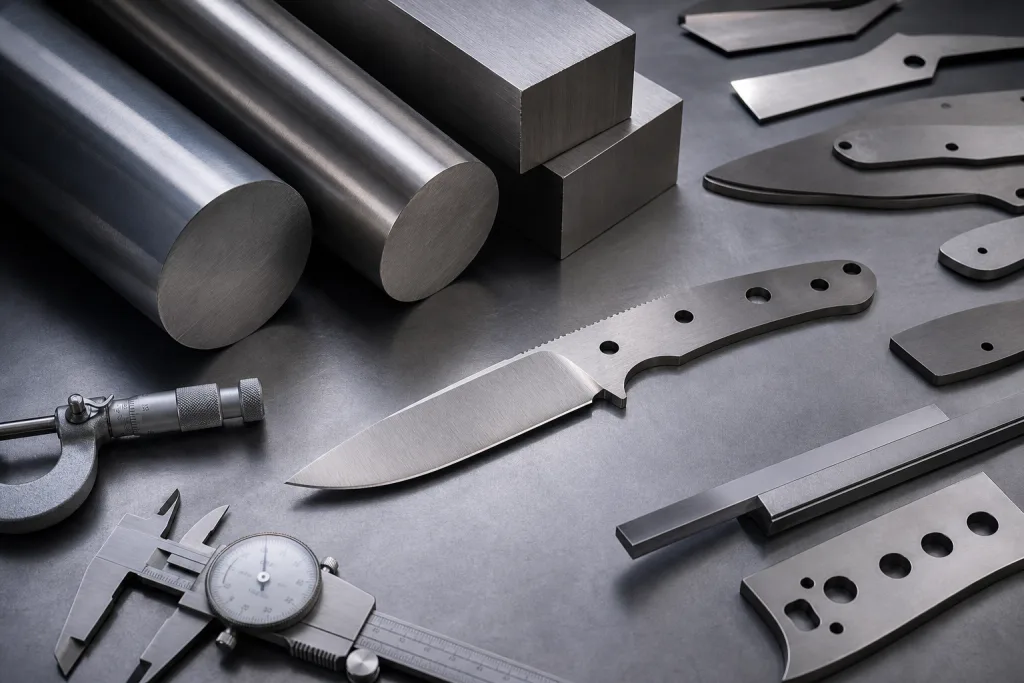
For a mainstream EDC pocket knife design, lock the blade length and spine thickness first. Then put grind type, point style, edge angle, and target hardness on the PO. Do not write “factory standard” unless our easiest setup is acceptable. We run that phrase as 3.0 mm spine stock, standard satin, and the house edge unless the drawing says otherwise. One buyer flagged it after tooling because their Amazon photo showed a slimmer point than the approved CAD.
| Steel | Typical HRC | Use Case | Buyer Note |
|---|---|---|---|
| 3Cr13 | 52-54 | Entry promo | Lowest cost option, acceptable for giveaway knives and basic blister packs |
| 8Cr13MoV | 57-59 | Mass retail EDC | Stable choice for 5,000 pcs retail runs when price and edge holding both matter |
| 9Cr18MoV | 58-60 | Better stainless EDC | Cleaner upgrade for humid or coastal markets with fewer rust complaints |
| D2 | 60-62 | Outdoor and enthusiast EDC | Higher wear resistance, less stainless, needs tighter edge geometry control |
| 14C28N | 59-61 | Premium stainless EDC | Good toughness with stronger corrosion resistance for higher-ticket programs |
A tanto point looks strong, but the transition line needs steady handwork on the belt grinder. A full flat grind cuts well. On 2.5 mm stock, it can make the blade feel light in the buyer’s hand, and that “weak” comment usually comes back after the sales sample is already photographed. Hollow grind is sharp out of the box, but the wheel mark shifts when the operator pushes speed. For bulk orders, confirm 5 pcs of destructive or semi-destructive test samples before mass production if the project uses a new steel or blade geometry. We have seen this go sideways after 1,000 pcs were already sharpened.
Specify edge angle as a range, such as 18-22 degrees per side, not one fantasy number. Put the surface finish on the same PO line: satin with grit target, stonewash time, black oxide thickness, titanium coating color code, or bead blast media size. Coatings change tolerances around the pivot hole and lock face. They are not just cosmetic. On one 8Cr13MoV run, black coating added about 0.02 mm at the lock contact, and assembly had to lap the lock face before the blade would seat cleanly.
Choose the Lock Before the Handle
The lock is the working core of an EDC folder. It sets safety, action feel, liner layout, tooling cost, and the handle shape we can build without cheating the drawing. Freeze the lock before handle styling. Inside a 1.5-3.0 mm handle cavity, the liner relief needs room, the spring path needs clearance, the stop pin needs a hard seat, and the washer or bearing pocket cannot crash into the thumb access cutout. We usually catch the mistake on the CNC fixture drawing before the first T1 sample, when the fixture pin blocks lock bar travel by 0.4 mm.
For private label EDC orders, liner locks still make the best commercial sense. The cost works. Users understand them. We can run stainless steel liners with G10 or Micarta scales on the same assembly bench, and aluminum or FRN only needs different screw torque and scale handling. Frame locks feel more premium, but lock bar tension needs tighter control after stonewash or bead-blast; QC pulled one 200-piece pilot run last year because 37 pcs had sticky lock after tumbling. Button locks sell well now, but they add a button, spring, plunger fit, extra assembly time, and more rejection points at final inspection. Slip joints fit some European channels. If the buyer wants a hard-use lock, this is the wrong question to ask, because a slip joint has no positive lock.
Put measurable lock requirements into the pocket knife spec sheet. We run cleaner samples when the target says blade centering within +/-0.3 mm from handle center, no vertical blade play under normal hand force, opening force sample range checked on 5 pcs, lock engagement percentage, and release force measured with a small push-pull gauge. For liner and frame locks, 30-50 percent initial lock engagement across the tang width is a normal buyer-approved range. Too early feels unsafe. Too late leaves no wear-in life. The grinding line cannot fix that with a quick polish after heat treat.
Decide the opener at the same time. Thumb stud and flipper tab are the common export choices; nail nick works for traditional channels, oval hole needs IP clearance, and assisted mechanism brings legal checks market by market. Do not add assist just because the sample room action feels snappy. We have seen this go sideways when a PO said "manual flipper" but the artwork file showed an assist spring, and the buyer flagged it two days before mass production. In China production, every extra moving part means assembly sorting; at 10,000 pcs, a 0.15 mm spring tolerance issue can turn a 12-day assembly schedule into 18 days.
Set Handle, Clip, and Ergonomics Limits
Handle design is where a brand can show its face, but the drawing needs hard stops. Lock handle length, handle thickness, scale material, liner thickness, screw spec, clip position, texture depth, plus the tolerance band before tooling starts. We run the first handle check with Mitutoyo calipers at the CNC bench, then mark the sample bag with the actual reading, not the CAD number. A 1 mm change in handle thickness can force new T6 screws, longer stand-offs, a different clip bend angle, and a revised blister or EVA insert.
For an everyday carry knife, pocket behavior matters as much as hand feel. Desk feel is not enough. QC pulled one sample last year with 0.8 mm texture peaks on G10; the buyer flagged denim wear after 200 draw tests. A handle that feels excellent in hand can tear jeans, print too much in the pocket, or catch on the seam when drawn. We have seen this go sideways. Deep milling and aggressive G10 texture look rugged online, but they bring complaints in urban EDC channels. For balanced carry, 7 out of 10 buyers we quote choose 110-125 mm closed length and 11-14 mm handle thickness, then hold finished weight inside 90-140 g.
Material choice affects price and shelf position. G10 is stable and familiar, with enough grip for most EDC programs; we run it often because sheet yield is predictable at MOQ 1,000 pcs. Micarta feels warmer, but color and fiber pattern shift from sheet to sheet; we rejected 34 scales in one lot because the left and right sides did not match under the inspection lamp. Aluminum gives clean CNC styling, but anodizing color matching needs signed control samples, not just a Pantone note on email. Stainless handles are strong and economical, but weight climbs fast. Carbon fiber overlays look premium, though full carbon structures need tighter machining control and sharper cutters on the grinding line.
Clip specification deserves its own line. Confirm carry direction, left or right hand setup, reversible or fixed layout, screw count, clip material, and finish code. We had one PO say “black clip” while the artwork showed stonewashed, and that typo held packing for 2 days. A reversible clip sounds simple, but it adds threaded holes, visible plugs, and sometimes a weaker scale layout. If your retail price is under USD 25 FOB, reversible carry is often the wrong place to spend cost; the math does not work after screws, tapping time, plugs, and extra QC checks.
Translate Specs Into Cost Decisions
An EDC pocket knife design has to hit landed cost, not just look clean in a 3D rendering. We see the same RFQ about 9 times a month: D2 blade, ceramic bearings, titanium coating, Micarta, deep-carry clip, printed color box, and 600 pcs MOQ, then a target price built for 8Cr13MoV with flat G10. The math doesn't work. On our costing sheet, a liner change from 1.2 mm to 2.0 mm adds steel weight and stamping pressure; one extra CNC pass on the handle can move the quote before the sample room puts blade blanks on the cutting table.
For China OEM production, FOB price follows the spec. Rough bands still keep both sides honest. An entry stainless handle knife often sits around USD 3.00-5.50 FOB at volume. A solid 8Cr13MoV liner lock with G10 usually lands around USD 6.00-10.00. A D2 blade with Micarta, bearings, and better packaging moves into USD 11.00-18.00 or higher, mainly from machining minutes, reject rate, and carton cost. Damascus, titanium, and complex CNC handles climb fast because the grinding line runs slower, QC checks hairline marks under the bench lamp at 600 grit, and rejected scales do not polish back into profit.
MOQ is not a sales trick. It comes from material purchasing, machining setup, coating batch, packaging print, and logo process. At TANGFORGE, typical MOQ for a custom EDC knife OEM model is 600-1,200 pcs, while new tooling or customized handle molds may need a bigger commitment. If you need 300 pcs for market testing, start from an ODM base model and lock blade marking, handle color, clip finish, and packaging dieline before artwork release. We had one PO where the buyer typed “black stonewash” for the blade but “satin” in the artwork file; QC pulled the sample before packing, but that mismatch still burned 2 days.
Lead time is cost too. For a normal new OEM folder, plan 7-10 days for technical drawing after specs are frozen, 35-45 days for first samples, 5-10 days for sample revisions if minor, and 45-60 days for bulk production after approval and deposit. Air shipping saves calendar days, but we have seen it go sideways: one buyer saved 12 days vs 18 days by air, then paid more freight than the bearing upgrade they spent 3 calls negotiating. Price the full route first. Cutting the clip finish or blade steel to cover freight is the wrong question to ask if retail customers feel it on the first open.
Write QC Criteria Before Sampling
Sampling without QC criteria buys you a clean sample and almost no cover. One master on the grinding line can hand-tune 6 samples until the detent clicks right, then 3,000 pcs bulk shows the stack-up: blade grind drifting 0.3 mm, liner stamping burrs at the lock cut, pivot holes off by 0.08 mm, heat treatment spread outside the HRC band, coating too thick around the thumb stud, final assembly pressure changing from bench to bench. We see it in the first tray. Do not ask whether the factory is “good.” Wrong question. Write what passes and what gets rejected before we cut tooling.
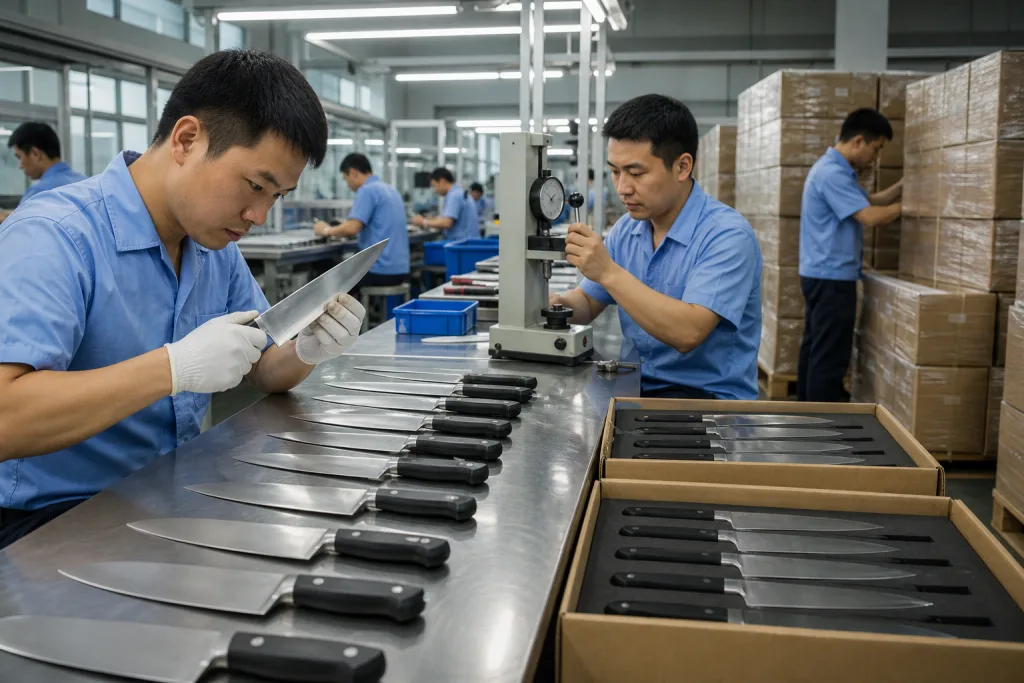
For EDC folders, the inspection sheet needs dimensions, appearance, action, lock safety, sharpness, hardness, and packing, but each line needs a number or a signed sample reference. We run 150 mm digital calipers on blade length, handle width, closed length, clip position, and pivot screw height; QC pulled the sample last month because the pocket clip sat 1.5 mm higher than the signed drawing. Use AQL where it belongs. Around 8 out of 10 importers we ship for use AQL 2.5 for major defects and AQL 4.0 for minor defects, with critical defects set to zero tolerance. Critical defects include lock failure, exposed sharp burrs on handle edges, cracked blades, unsafe assisted mechanisms, or wrong steel.
Good targets can be checked at a bench. Blade hardness stays inside the approved HRC band. Blade centering stays within the agreed tolerance. Opening and closing should feel smooth, with no gritty washer drag after 20 cycles. No screw stripping at normal torque on the Wiha driver, no blade rubbing the liner, no lock slip under the agreed spine pressure test. Simple works. For sharpness, 20 out of 20 pcs should pass the agreed paper cut test if that is your standard. Higher-end programs can request CATRA data, but CATRA testing adds cost and usually pushes sampling from 12 days to 18 days. We have seen this go sideways when the PO says “sharp enough” and the buyer flags 40% of bulk during incoming inspection.
Lock compliance early, before cartons are printed and warehouse dates are booked. For EU buyers, REACH affects coatings, handle materials, and packaging inks; our lab once caught a black coating issue before shipment because the test request named finish code BK-02 while the PO showed BK-03. That one typo would have held 186 cartons at final release. For food-contact positioning, LFGB may apply if the knife is marketed for picnic or outdoor food prep. For US channels, FDA food-contact language may apply to certain packaging claims. ISO 9001 and BSCI documents help retailer onboarding, but they do not replace product-level inspection with gauges, torque drivers, hardness testing, and a signed defect list.
Freeze the Tooling File Properly
The last pre-tooling decision may look like paperwork, but it decides who pays when the first T1 sample comes back wrong: what is frozen, line by line? Our tooling release pack needs 2D drawings with tolerances, 3D files, a bill of materials, finish codes, logo artwork, packaging dielines, inspection criteria, and the signed quotation. Put blade spine thickness, pivot diameter in mm, screw spec, clip position, and surface finish code on the drawing face, with callouts the CNC room can read without asking sales. No guessing. We had one PO where “SW” meant stonewash to the buyer and satin wash to the trading office. QC pulled the sample under a 6000K bench lamp, and that argument cost 9 days.
Version control matters. Name files clearly, such as “Model X blade D2 stonewash V3 approved 2026-03-15.” Mark old files obsolete. Keep one decision maker on your side. Four people sending comments after tooling starts is how a 12-day adjustment turns into 18 days. We see this on pocket clip holes at least 6 times a season: the designer wants the clip 2 mm higher, the importer wants lower carry, the brand owner approves both by email, and the CNC fixture is already cut. The buyer flagged it late. Too late.
Before paying a tooling deposit, ask for a design for manufacturing review. A practical factory engineer should flag thin liner walls, clip screw locations with weak thread bite, lock geometry that risks early engagement, coating build-up around the pivot, and any part that will need slow hand fitting at the grinding line. This is the wrong question to ask: “Can you make it?” Most factories can make 20 pieces. The better question is whether we can hold lock-up, blade centering, and handle gap across 3,000 pieces under AQL 2.5. At our Yangjiang, China operation, this review is standard because our monthly capacity of about 300,000 knives only works when production drawings stay stable.
Tooling changes are sometimes unavoidable, mainly on a new lock structure or an unusual handle shape. Do not pay for preventable changes. If the core EDC pocket knife design is frozen before tooling, the sample stage checks the build instead of teaching everyone what the drawing forgot. We have seen this go sideways: one buyer changed the backspacer radius after the mold trial, and the math did not work because the anodizing rack and carton insert had already been approved. That small handle change became a new fixture, a revised insert sample with a 0.5 mm clearance check, and 14 extra days.
Frequently asked questions
A complete pocket knife spec sheet should include open length, closed length, blade length, blade thickness, steel grade, target HRC, grind, edge angle, lock type, pivot system, washer or bearing choice, handle material, liner thickness, clip position, screw type, finish, logo method, packaging, inspection standard, and compliance requirements. For example, “D2, 60-62 HRC, 82 mm drop point, 3.2 mm spine, satin finish, liner lock, ceramic bearings, black G10, tip-up right-hand clip” is much more useful than “premium EDC knife.” Add tolerances where function matters, such as blade centering, lock engagement, and handle thickness.
Choose OEM when the knife shape, lock feel, blade profile, handle design, or brand positioning must be unique. OEM makes sense when your first order can support 600-1,200 pcs per model and you can wait roughly 35-45 days for first samples. Choose ODM when you need faster launch, lower development cost, or a 300-600 pcs test order. With ODM, you can usually customize steel, finish, logo, handle color, clip, and packaging without new tooling. For a new EDC brand, an ODM launch followed by OEM development is often the more controlled path.
There is no single best steel. For price-sensitive retail, 8Cr13MoV at 57-59 HRC is practical and familiar. For a stronger enthusiast message, D2 at 60-62 HRC offers better wear resistance but needs clearer corrosion guidance because it is not fully stainless. For wet or coastal markets, 9Cr18MoV or 14C28N may be better choices. The steel should match the retail price, sharpening expectation, warranty policy, and user education. A USD 8 FOB knife and a USD 18 FOB knife should not carry the same promise.
For a new EDC folder, expect 7-10 days for drawings after the spec sheet is complete, then 35-45 days for first samples depending on tooling complexity. If the first sample needs minor changes, add 5-10 days. If the change affects lock geometry, handle mold, or blade stamping, it can add 15-30 days or require new tooling cost. Bulk production usually takes 45-60 days after sample approval and deposit. The fastest way to protect lead time is to freeze the lock, blade, handle, and clip before tooling starts.
Use a written inspection plan, not only a golden sample. A common starting point is AQL 2.5 for major defects, AQL 4.0 for minor defects, and zero tolerance for critical safety defects. Critical issues include lock failure, cracked blade, wrong steel, exposed burrs that can cut the user, and blade contact with the handle during closing. Check HRC against the approved range, confirm blade centering, test opening and closing action, inspect screw torque, and verify packaging labels, barcodes, and FNSKU if needed for marketplace fulfillment.
Send Your Pocket Knife Spec Sheet
Share your target price, drawings, steel preference, MOQ, and market. Our engineers will review the design before you commit to tooling.
Request a Quote