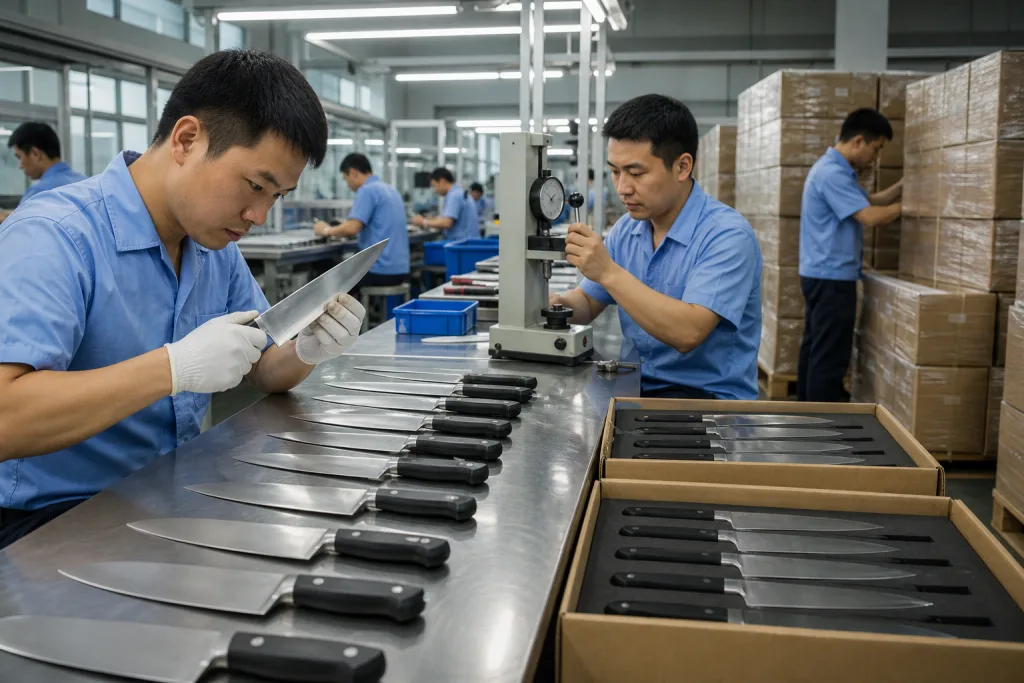
Fillet knives look simple on a catalog page, but we see 6 sourcing mistakes for every 10 outdoor knife RFQs. A blade that feels right in the sample room can come back banana-shaped after heat treatment if the 1.8 mm spine is pushed too thin. A soft TPR handle can feel safe dry, then slip during a wet soap test. The sheath is another trap. QC pulled one ABS sheath sample last month where the tip punched through the inner carton after a 12-day sea-simulation stack test.
If you are a fillet knife importer buying from a fillet knife factory China supply base, lock the boring details before artwork: steel grade, blade thickness, HRC band, edge angle, handle material, sheath fit, carton drop test, labeling, and inspection level. We run these as outdoor tools first, not kitchen accessories. That is the right call. At TANGFORGE in Yangjiang, Zhejiang, China, most claims start with wet grip or rust spots, not sharpness, and the buyer usually flags it only after the first 3,000 pcs hit retail shelves.
Start With Use Case, Not Catalog Photos
The first sourcing question is not whether the fillet knife looks premium. The right question is what fish it cuts, who sells it, and who holds it. A 6 inch freshwater fillet knife in a blister pack for a mass retailer is not the same build as a 9 inch saltwater knife going to a boat accessory distributor. Last month a buyer sent us one catalog photo and wrote “same style” on the RFQ; we quoted it, but QC had no blade thickness, handle hardness, or sheath fit target to inspect against. That goes sideways fast.
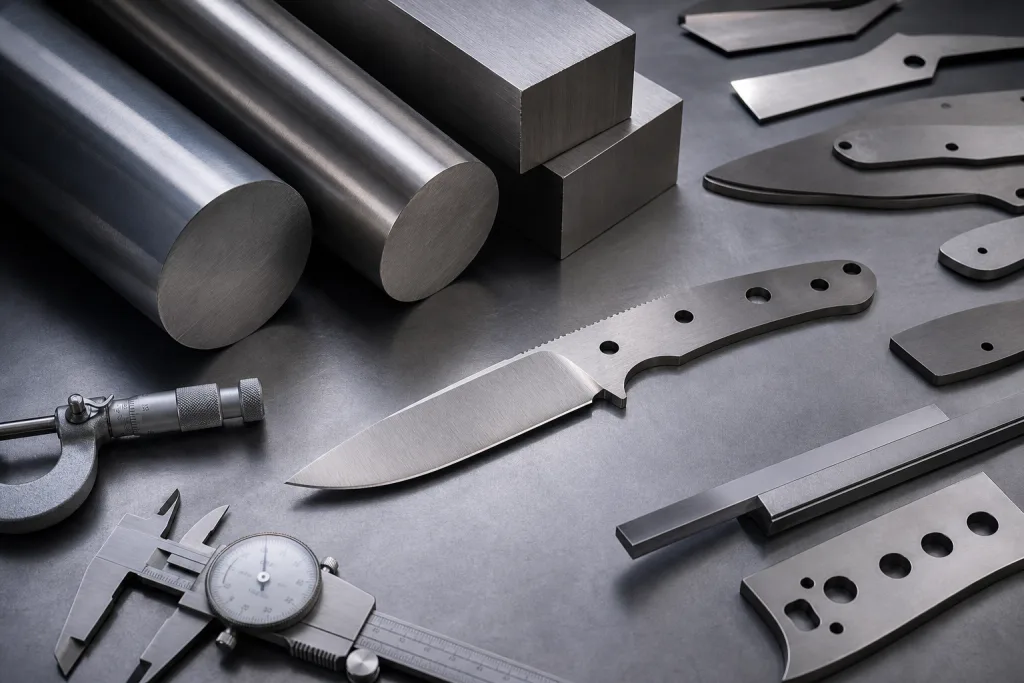
For a custom fillet knife program, lock blade length, flexibility, handle grip, sheath style, and retail price target before the logo talk starts. Flex is where importers miss money. Too soft and the knife feels like a giveaway item. Too stiff and the customer might as well buy a utility knife. We run the first check with a digital caliper at the grinding line, usually around 1.5-2.2 mm on flexible patterns, then confirm distal taper, steel grade, and the heat-treatment curve. “Flexible” is not a spec.
A useful buyer brief should include:
- Blade length: 5, 6, 7.5, 8, or 9 inch, measured from tip to handle front; QC pulled one sample last week that was 6 mm short because the PO did not say where to start measuring.
- Blade thickness: 1.5-2.2 mm for most flexible fillet knives, checked at heel, middle, and 20 mm behind the tip.
- Target market: freshwater panfish, saltwater deck use, fishing kit, camping set, or retail replacement knife, because each one pushes a different handle and sheath choice.
- Compliance: REACH for EU, FDA/LFGB food-contact expectation where relevant, plus packaging labeling rules for the destination market.
- Sales channel: Amazon FBA master carton, distributor bulk carton, club pack, or peg-hook retail, with barcode position and hang-hole size marked before artwork approval.
At TANGFORGE in Yangjiang, Zhejiang, we ask these questions before quoting because a late change from 2.0 mm to 1.6 mm blade stock can move the MOQ from 1,000 pcs to 3,000 pcs and add 12 days vs 18 days to sampling and re-tooling. The buyer flagged this once after the sheath mold was already cut; the math did not work.
Blade Steel and Heat Treatment Choices
Fillet knives sit in fresh water, salt, fish oil, and often a tackle box nobody opens for 3 weeks. Corrosion resistance usually beats maximum edge life for importers. Still, “stainless steel” on a PI is too loose. Write the steel grade, target HRC band, blade thickness in mm, and finish requirement; our QC team checks the first lot with a Rockwell tester and a 24-hour salt-spray cabinet before packing.
We run 3Cr13 and 420J2 for price-driven kits, 5Cr15MoV for steady private-label orders, and 7Cr17MoV or 440A when the buyer wants a cleaner edge on a better outdoor line. 420J2 resists rust and sharpens fast, but the edge will roll sooner. 5Cr15MoV is the safer middle choice for 80% of fillet knife programs we quote. 7Cr17MoV and 440A hold better, but the grinding line has to watch blade thickness; a 1.8 mm fillet blade behaves nothing like a 2.4 mm blade after heat treatment.
| Steel | Typical HRC | Buyer Fit | Risk to Watch |
|---|---|---|---|
| 420J2 | 52-54 | Entry retail, fishing kits | Edge retention complaints after 2-3 trips |
| 3Cr13 | 53-55 | Low-cost OEM programs | Uneven mirror polishing near the tip |
| 5Cr15MoV | 55-57 | Mainstream private label | Rust spots if passivation time is cut short |
| 7Cr17MoV | 56-58 | Better outdoor line | Too stiff when blade stock runs thick |
| 440A | 56-58 | Premium value range | Higher scrap if belt grinding burns the edge |
Do not chase high HRC just to make the spec sheet look tougher. This is the wrong question to ask. A fillet knife at 60 HRC sounds good in a catalog, but it can lose the flex a fisherman expects when trimming around ribs. QC pulled one 5Cr15MoV sample last season at 59 HRC, and the buyer flagged it as “too board-like”; for our China production lines, 55-57 HRC gives steadier flex, fewer cracked tips, and fewer after-sales photos from wet docks.
Handle, Sheath and Grip Details
In our after-sales log, about 7 of 10 fillet knife complaints start away from the cutting edge: wet hands slipping on the handle, sheaths rattling in the carton, hairline cracks near the butt, or blister card damage after sea freight. Asking only about blade steel is the wrong question to ask. The handle has to sit right in a wet palm, wash clean after fish oil, and bond tight to the tang. On a 20,000 pcs order, a small handle material change can move the unit cost faster than a 1 mm blade thickness change.
PP and TPR overmold handles are the usual choice for value and mid-range programs. We run TPR around Shore A 55-65 when the buyer wants wet grip, but bad compound control shows up fast: rubber smell, oily surface, or color drift between cavities on the injection machine. ABS gives a harder, cleaner retail look, but it slips more when the hand is wet. G10, micarta, pakkawood, and rubberized textured handles fit higher-end fillet knife OEM work; the catch is MOQ and tooling cost, often 3,000 pcs per color before the math works.
Ask the factory to state the handle process on the spec sheet: injection molded, overmolded, riveted, glued, or hidden-pin assembly. We have seen this go sideways when a PO says “full tang” but the sample room sends a hidden tang sample with two fake rivets. If the knife is full tang, the exposed steel needs clean polishing and passivation, with no black residue on a white cloth wipe. If it is hidden tang, QC should run pull-force and twist checks on a simple torque jig, because wet outdoor use works the joint harder than a dry kitchen test.
The sheath needs the same level of checking. PP sheaths keep cost down and wash clean, while nylon sheaths look more like fishing gear but can trap moisture against the blade after a saltwater trip. Kydex-style sheaths hold tighter, though tolerance control gets fussy if the blade tip varies by even 0.5 mm. For distributor orders, we check retention after 10 insertions, upside-down holding for 30 seconds, and a carton vibration test on the packed master carton. Simple test. A loose sheath can turn into a safety complaint before the consumer cuts the first fish.
MOQ, Pricing and Lead Time Reality
A realistic fillet knife MOQ starts with the parts you change. If you take our existing blade, existing handle, laser logo, and standard color box, we can usually run 300-600 pcs for a trial order; QC still pulls 13 pcs for size and logo position before packing. Change the handle color, print the sheath, add a retail clamshell, or ask for a new blade profile, and 600-1,200 pcs per SKU is the safer planning number. New injection tooling needs a bigger commitment because the mold shop has to cover setup, Pantone color matching, and first-article checks on the caliper.
FOB China price is driven by steel, blade length, handle build, sheath, packaging, and inspection level. A basic 6 inch 420J2 fillet knife with PP handle and simple sheath may sit around USD 2.80-3.80 FOB. A 7.5 inch 5Cr15MoV knife with TPR grip, cleaner polishing, retail card, and sheath may land around USD 4.20-6.50 FOB. Premium steel, double injection handles, Kydex-style sheaths, or gift packaging can push the price beyond USD 8.00; the math does not work if a buyer asks for that build at USD 3.90, and we have seen this go sideways at the grinding line.
At TANGFORGE, our outdoor knife capacity is about 180,000-220,000 units per month across mixed models. Capacity is not stock. First orders usually need 7-12 days for sample preparation, 3-7 days for buyer approval, and 45-60 days for mass production after deposit and final artwork. Repeat orders can often run 30-45 days if steel, handle resin, sheath, carton size, and artwork stay unchanged; one PO typo on “matte black” versus “black” once cost a buyer 5 extra approval days.
Be careful with quotes far below the market. The saving often comes from 1.5 mm steel instead of 1.8 mm, soft heat treatment, skipped passivation, weak 5-ply cartons swapped for 3-ply, or no real AQL inspection. We ship knives, not surprises. QC pulled one fillet knife sample last season with orange rust spots near the heel after a 24-hour salt spray check, and that is the cost importers only see after returns start.
QC Risks Importers Should Control
For fillet knives, a normal visual check misses too much. Put function checks in the purchase order and the QC checklist, down to edge pull, handle gap, sheath retention, and barcode scan. AQL 2.5 for major defects and AQL 4.0 for minor defects is common for consumer knife shipments, but 3 of our supermarket buyers now ask for tighter sampling on private-label orders. Define critical, major, and minor defects before steel cutting starts; we have seen this go sideways when the PO says “standard quality” and QC pulls the sample after packing.
Critical defects should include exposed sharp edges outside the blade, cracked handle, loose blade, unsafe sheath retention, wrong labeling for destination market, and severe rust. Major defects should include blade warping beyond an agreed limit, poor edge grinding, wrong HRC, loose rivets, handle gaps, sheath splitting, and incorrect barcode or FNSKU label. Minor defects can cover polishing marks under 3 mm, color variation inside the approved swatch, or small packaging scuffs that do not break retail presentation. Be strict here. One buyer flagged a 13-digit EAN typo on the PO after 1,200 cartons were labeled, and the relabeling cost more than the inspection.
For blade straightness, check the spine and edge line under the same LED bench light, not just by hand feel. We run a flat glass plate and 0.3 mm feeler gauge on flexible blades when the buyer sets a straightness limit. For HRC, confirm 3-5 pieces per batch or per heat-treatment lot, depending on order size. For corrosion, salt spray testing gives cleaner paperwork, but a simple 24-hour wet cloth test on production samples still catches weak passivation. For edge performance, CATRA works for formal programs; most importers we ship use controlled paper cut, fish-skin simulation, or rope cut comparison against the approved sample.
Do not let inspection happen only after cartons are sealed. That is the wrong place to find a bent blade. Inline inspection after grinding and polishing catches warped blades before handles are assembled, when the grinding line can still sort or rework them. Final random inspection then checks packaging, quantity, carton strength, labels, and overall workmanship; on one 3,000-piece order, QC pulled the sample before sealing and found 18 cartons with mixed sheath colors.
Packaging, Compliance and Logistics Checks
Fillet knives are 150–230 mm long, thin at the tip, and usually packed with a PP sheath, so the pack has to protect the customer’s hand and the carton wall. We’ve seen this go sideways: QC pulled a 7-inch sample after the drop test and the tip had punched through the inner blister by 6 mm. Moisture is the other quiet problem. If the knife goes into a sealed polybag while the blade is still damp from cleaning, rust freckles can show up before the shipment reaches Europe or North America.
For retail, we run blister card, clamshell, color box, kraft box, or hanging sheath card based on the buyer’s peg-hole and shelf plan. For e-commerce, ask a harder question: can it survive parcel sorting, not just look good in photos? If you ship to Amazon, confirm FNSKU placement, suffocation warning for polybags where needed, carton weight limits, and barcode scan quality; one buyer flagged a 13-digit EAN that scanned on our Zebra scanner but failed at their warehouse gate. For distributors, master cartons need stacking strength, usually export-grade K=A or similar corrugated board when a 24–36 carton pallet load gets heavy.
Compliance depends on market and claim. If the knife is sold for food contact, EU buyers usually ask for LFGB or food-contact declarations on handle and packaging materials; REACH paperwork is standard for EU distribution. US buyers may request FDA-related food-contact assurance for materials, plus state-specific packaging restrictions. If the handle uses rubberized TPR, check phthalate and PAH risk before mass production, because the math doesn’t work if 3,000 pcs are already packed and the lab report fails. Printed inks can also trigger heavy-metal checks for retailer compliance, and our packaging desk now marks ink type on the PO after one supplier typed “matte lamination” as “metal lamination.”
For logistics, confirm HS code with your broker, Incoterms, carton dimensions, gross weight, and whether you are buying FOB, CIF, DAP, or DDP. New importers often stare at the unit price and miss volume weight; this is the wrong question to ask when a clamshell makes the carton 52 × 38 × 46 cm instead of 45 × 32 × 28 cm. A bulky clamshell can add more landed cost than upgrading from 3Cr13 to 5Cr15MoV, and we ship enough mixed knife orders to see that mistake about 2–3 times a month.
How to Brief a Fillet Knife Factory
A clean RFQ saves 2-3 weeks. Do not ask a fillet knife factory China supplier for “best price” and expect a useful quote. Send a one-page spec and target annual volume, even if it is only 6,000 pcs. Then we quote the real build, not a cheap catalog shape that gets corrected after sampling. We see this go sideways when the buyer approves a 1.8 mm blade on WeChat, then the PO says 2.0 mm and nobody catches it until QC pulls the sample. Yangjiang makers and Zhejiang trading offices may show similar profiles, but steel control, heat treatment, polishing belts, and final QC are not equal.
Your RFQ should state blade length, steel grade, thickness, HRC, finish, edge angle, handle material, sheath type, logo method, packaging type, test requirements, destination country, and expected first order quantity. Add target retail price or landed cost if you have it. We run the quote differently for a USD 9.99 retail blister pack than for a USD 24.99 gift box with EVA insert. A serious factory will not be offended. It lets us pick the right construction instead of adding cost where the math does not work, like mirror polishing a knife that will ship in a PVC sheath and get rubbed in transit.
For fillet knife MOQ discussion, split trial order from stable program. A factory may support 500 pcs for market testing, but custom color TPR handle, printed sheath, and retail packaging can push component MOQ to 1,000-3,000 pcs. That MOQ often comes from the handle injection shop or color masterbatch supplier, not the knife factory. We had one buyer flag this after deposit because his Amazon test plan was only 300 pcs per color. Wrong question to ask. Ask which parts are stock, which parts need new tooling, and which parts have supplier MOQ before you lock the color card.
Before deposit, request a golden sample, signed specification sheet, artwork proof, carton layout, inspection standard, and production timeline. Keep it practical: blade 180 mm, thickness 1.8 mm at spine, 54-56 HRC if that is your agreed range, carton drop test height 76 cm if required. If you are building a private-label outdoor line, keep approved samples sealed and labeled. When the batch arrives, compare against that sample first. Simple works. It prevents arguments over loose words like “sharp,” “flexible,” or “premium,” especially when the grinding line changed from a 400# belt to a finer polish during mass production.
Frequently asked questions
For a standard model with laser logo and simple packaging, a practical fillet knife MOQ is often 300-600 pcs per SKU if the factory has materials available. For custom handle color, printed sheath, retail card, or private-label packaging, plan 600-1,200 pcs per SKU. If new injection molds are required, the economic MOQ may move higher because tooling, color matching, and component supplier minimums must be covered. For a first order, ask the factory to separate sample cost, tooling cost, unit price, and packaging MOQ so you can see what is driving the number.
For most importers, 5Cr15MoV at about 55-57 HRC is a sensible mainstream choice. It gives better edge holding than very soft entry steels while keeping reasonable corrosion resistance and flexibility. 420J2 can work for low-cost kits where easy sharpening and rust resistance matter more than edge life. 7Cr17MoV or 440A can be used for a better outdoor line, but the blade thickness and heat treatment need tighter control. Do not choose steel only by brochure value. Ask for actual HRC testing, passivation process, and production sample cutting checks before approving mass production.
A basic 6 inch fillet knife with 420J2 or similar steel, PP handle, simple sheath, and bulk or basic card packaging may quote around USD 2.80-3.80 FOB China. A better 7.5 inch model using 5Cr15MoV, TPR grip, polished blade, fitted sheath, and retail packaging is more commonly around USD 4.20-6.50 FOB. Premium handle materials, Kydex-style sheaths, gift boxes, or tighter inspection can push the price above USD 8.00. Always compare quotes against the same blade thickness, HRC, packaging, and QC terms.
The most important checks are blade straightness, HRC, edge consistency, corrosion resistance, handle bonding, sheath retention, and packaging safety. AQL 2.5 for major defects and AQL 4.0 for minor defects is a common starting point, with critical safety defects set at zero tolerance. For HRC, test several pieces from each heat-treatment lot. For corrosion, use passivation checks and at least a short wet cloth or salt exposure test on production samples. For sheaths, test repeated insertion and upside-down retention. These checks catch problems that normal visual inspection often misses.
For an existing model with logo and packaging customization, sample preparation usually takes 7-12 days, followed by buyer approval. Mass production normally takes 45-60 days after deposit, final artwork, and sample approval. Repeat orders can often be shorter, around 30-45 days, if steel, handle material, sheath, and packaging are unchanged. New molds, custom colors, special packaging, or third-party lab testing can add 10-30 days. Build your timeline from the approval date, not the first RFQ date, because unclear specs and slow artwork approval are common causes of delay.
Send Your Fillet Knife RFQ
Share blade length, steel, handle, sheath, packaging, MOQ target, and destination market. We will review the build and quote a realistic OEM route.
Request a Quote