A fillet knife looks simple until the first 500-piece shipment lands with blades that are too stiff, tips taking a permanent set after a 30 mm bend test, handles turning slick in wet hands, or sheaths slicing the inner carton. QC pulled a sample like this last season; the buyer flagged 14 retailer complaints in week one. This goes sideways fast.
At TANGFORGE in Yangjiang, Zhejiang, China, we see the same sourcing gap on about 7 of every 10 new fillet knife RFQs: buyers send a blade length and logo file, but no working fillet knife quality checklist. The spec sheet should lock steel grade and HRC, blade flex with a clear mm test, edge angle, handle grip material, sheath retention force, salt-spray target, packing method, inspection level, and fillet knife MOQ before tooling starts. “Make it flexible” is the wrong question to ask; the grinding line needs numbers, not adjectives.
Start With the Use Case
Before you ask a fillet knife factory China supplier for price, pin down what the knife must cut. Freshwater trout, salmon sides, tuna loins, bait prep, dock use, kayak kits, and fish-plant trimming pull the blade in different directions. We had one buyer ask for a “universal” fillet knife, then reject the 6 inch flexible blade because it folded too much on salmon ribs. Fair pushback. A 6 inch flexible blade that feels right on trout can feel underbuilt on salmon, while a 9 inch stiff blade for larger fish annoys a weekend angler cleaning panfish. On the grinding line, we check this first with a digital caliper at the spine, usually around 1.6-2.2 mm depending on the pattern.
Your first buyer spec should define blade length, spine thickness, flex class, tip profile, edge type, handle material, sheath type, and target retail channel. Better yet, attach a target sample and write the flex note in plain words: “tip bends 25-30 mm under hand pressure” beats “good flexibility” every time. If you sell into outdoor chains in North America, the knife may need clamshell packaging, UPC labels, and carton drop resistance; the buyer will flag a cracked blister before they talk about edge retention. If you sell to European importers, REACH, LFGB, food-contact declarations, and FSC paper packaging can matter more than display hooks. We once saw a PO typo list “PP handle” while the approved sample used TPR overmold. QC pulled the sample before mass production, luckily.
For most custom fillet knife projects, we push for three approved samples: flexible, medium-flex, and stiffer. This is the wrong question to ask: “Which one looks best?” Cut fish, or at least run a controlled substitute like chilled pork skin and cardboard strips, then decide. Do not just bend the blade on a desk. At our Yangjiang, Zhejiang facility, a normal development cycle is 10-15 days for existing blade shapes and 25-35 days when new handle tooling is involved. The math is simple: waiting those days costs less than receiving 3,000 knives with the wrong flex and arguing over who owns the rework.
Blade Steel, HRC and Edge Geometry
Fillet knives sit in rinse water, salt, fish blood, and alkaline wash chemicals, so corrosion resistance beats headline hardness. Chasing HRC for a premium label is the wrong question to ask. We have seen 60 HRC thin tips come back with 2-3 mm chips after the buyer’s field team worked around rib bones. Too soft is no better; QC pulled one 53 HRC sample from the grinding line that sharpened fast but rolled after 6 salmon.
For fillet knife OEM orders, common stainless options include 3Cr13, 420J2, 5Cr15MoV, 1.4116, 7Cr17MoV, 8Cr13MoV, and 10Cr15CoMoV. For a value retail program, 5Cr15MoV at 55-57 HRC is workable, and we run it often for 1,200-3,000 pc supermarket orders. For a stronger mid-market knife, 1.4116 at 55-58 HRC or 8Cr13MoV at 56-58 HRC gives better edge life without making the blade fussy. For a premium Japanese-style line, 10Cr15CoMoV at 58-60 HRC can work, but the tip cannot be ground like a kitchen slicer; we usually keep a little more meat in the last 20 mm after the buyer flagged broken tips in trial use.
Specify edge angle per side, not just “sharp.” Most fillet knives perform well at 14-17 degrees per side. A sharper 12-13 degree edge looks great in CATRA-style testing, but we have seen it go sideways on charter-boat users cutting through scales and pin bones. We normally check initial sharpness, burr removal, heel-to-tip edge consistency, and grind symmetry during in-process QC with a 10x loupe and angle gauge. If you want a black coating, titanium color, or stonewash finish, define coating adhesion and salt-spray hours as well, because cosmetic finishes can hide 0.2-0.4 mm grinding scratches until the knife is wet.
MOQ, Pricing and Lead Time Reality
Fillet knife MOQ is the wrong question to ask if the spec is still loose. The number moves with steel grade, handle resin, Pantone color, sheath mold, logo process, and carton style. We often get a PO asking for 300 pcs split into six colors; on the floor that means six handle batches, six grinding-line setups, six label checks, and six AQL files. QC pulled one sample last season where the blue TPE handle missed the approved chip by Delta E 1.5. Low MOQ looks friendly on paper, but the math does not work when every color becomes its own small job.
At TANGFORGE in China, we run standard private-label fillet knives at 600 pcs per SKU when the blade mold, sheath mold, and retail packaging are already open. For a custom fillet knife with a new TPE handle texture or proprietary sheath, 1,200-3,000 pcs is the cleaner range because the mold trial, resin color test, and first-article inspection all need room. Our outdoor knife capacity is about 80,000-120,000 units per month, but a 2.0 mm flexible blade with hand touch-up on the grinding line moves slower than a stiff camping blade.
| Project type | Typical MOQ | FOB range | Normal lead time |
|---|---|---|---|
| Stock blade, laser logo, polybag | 300-600 pcs | USD 2.80-4.20 | 25-35 days |
| Private-label knife with sheath | 600-1,200 pcs | USD 4.20-6.80 | 35-50 days |
| Custom handle color and retail box | 1,200-2,000 pcs | USD 5.50-8.50 | 45-60 days |
| New mold, premium steel, gift set | 2,000-3,000 pcs | USD 7.50-12.00+ | 60-75 days |
Ask for FOB Yangjiang from the factory gate, FOB Shenzhen with inland trucking shown, and DDP with duty, freight, and local delivery broken out. DDP helps smaller importers compare landed cost, but we have seen this go sideways when a quote hides compliance charges or the PO spells “ShenZhen” one way while the forwarder books another. Get the line items clean before deposit. It saves arguments later.
Handle Grip and Sheath Safety
A fillet knife gets used with wet hands, fish oil, gloves, or cold fingers. Grip is safety. Smooth ABS looks clean in a catalog photo, then turns slick on a dock; we had one EU buyer flag this after a 30-second wet-glove test on a 120 grit brushed handle. TPE with a light pebble texture works well, and PP plus TPR overmold is a safe choice when the soft layer is 1.5-2.0 mm thick. Textured nylon and rubberized handles also pass better in use, not just in photos. If you choose wood, stabilized pakkawood, or G10 for a premium line, define the surface finish, then soak the sample for 2 hours and check swelling, color bleed, and grip feel.
Handle inspection should cover molding defects like flash over 0.2 mm, sink marks near the tang, color deviation against the approved swatch, bonding strength, odor after bagging, and centerline alignment to the blade. For two-shot handles, ask the factory to cut open 2 samples after trial production; QC pulled one last year where the TPR peeled from the PP core with a utility knife, and that batch would have gone sideways at AQL 2.5. For riveted full-tang designs, check rivet height with a caliper and reject handle scale gaps over 0.3 mm. Gaps hold water. Retailer inspectors notice them fast.
The sheath needs the same seriousness as the blade. A cheap sheath scratches the edge, cuts the user, loosens during truck vibration, or fails a 1 m carton drop. Specify retention force if the design allows it; on our line, 18-25 N usually holds the knife in the sheath but still lets the user pull it out with one hand. Drainage holes reduce rust complaints, especially for saltwater customers, and the hole should be at least 3 mm so fish scales do not block it. Belt clips and thumb ramps are fine, but this is the wrong place to chase fancy shapes if the plastic wall drops below 1.8 mm. The math does not work in cold-weather testing.
QC Risks Buyers Usually Miss
Most fillet knife defects do not look dramatic on a QC table. They show up in the hand: uneven flex, a blade wave you can see against a 300 mm steel ruler, a tip sitting 1.5 mm off center, a spine polished so much it loses thickness, a sheath that lets the knife rattle, a logo with heat shadow, or an edge that cuts paper at the heel but tears near the tip. We have seen this go sideways when the PO only says “good quality.” Write these points into the purchase order and the inspection checklist.
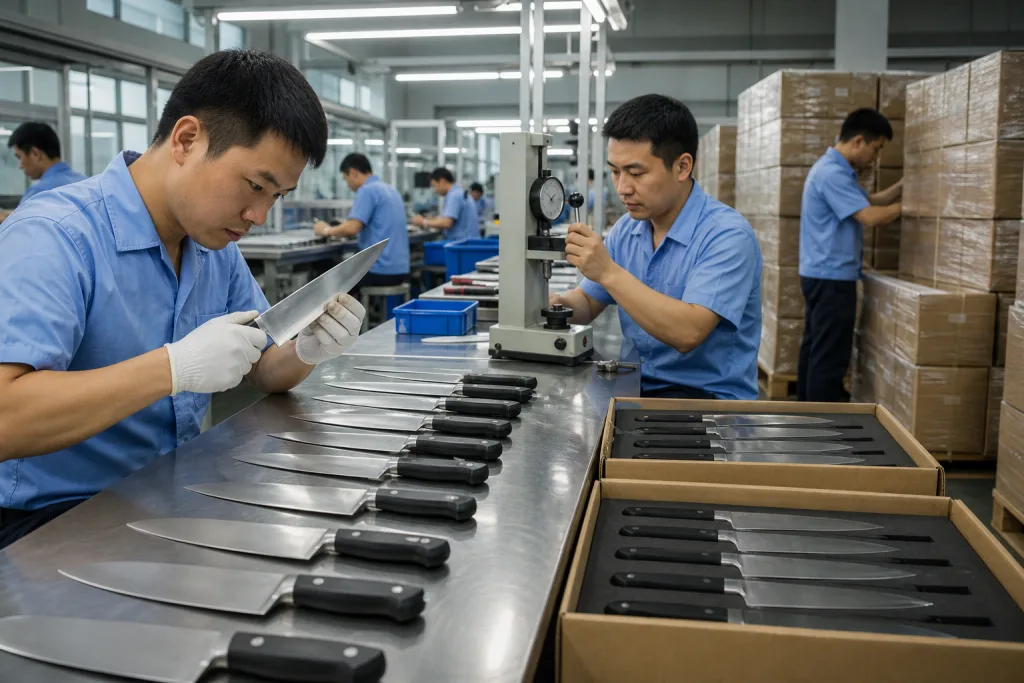
Your approved golden sample should carry real measurements: blade length tolerance, spine thickness at the heel and mid-blade, handle weight, balance point from the bolster in mm, logo position, edge finish, and sheath fit. Do not approve a beauty sample only. That is the wrong question to ask. Ask the factory to keep one signed sample at the grinding line, keep one for your inspection agency, and send one to your office; when production starts, QC should pull the first-off pieces and compare them against that same sample before mass grinding continues. We run this check before lunch on day one, not after 3,000 pcs are already edged.
For pre-shipment inspection, we normally see buyers use general inspection level II with AQL 2.5 for major defects and AQL 4.0 for minor defects. Critical defects should be zero tolerance. Critical defects include broken tips, exposed sharp edges on the sheath, loose blades with handle gap over 0.3 mm, contaminated packaging, and incorrect safety warnings. Major defects include poor edge sharpness, blade warping, handle cracks, wrong HRC, wrong steel, and failed logo adhesion after 3M tape pull. Minor defects include small polishing marks, slight color variation within the signed color chip, and retail box scuffs inside the approved limit. If your customer is a large outdoor distributor, confirm their inspection manual before production, not after goods are packed; last season one buyer flagged a PO typo on steel grade only after cartons were sealed, and the math did not work.
Compliance, Packaging and Label Control
Fillet knives touch food, so compliance is part of the product spec, same as blade thickness or 56-58 HRC hardness. For the EU, we usually see 4 requests on the buyer checklist: LFGB food-contact testing, REACH SVHC screening, PAHs testing for TPR or rubberized handles, and packaging heavy metal compliance. For the US, FDA food-contact expectations and California Proposition 65 review depend on the handle material, coating, and even the black ink on the header card. Marketplace orders need FNSKU labels, suffocation warnings, carton labels, and barcode scannability checked before shipment. QC scans 10 retail packs with a Zebra scanner; we have seen one Amazon order get flagged because the PO showed “FNSKU” but the artwork used a UPC.
Packaging should be tested like a paid component. A blister card shows the blade well, but PET can crack below 5°C if the sealing edge is thin. A magnetic gift box looks better on shelf, but the math doesn't work for every importer: it adds about 120-180 g per set and fails fast if the EVA insert does not lock the sheath. Ask for a packed sample with the final label, carton mark, desiccant, instruction leaflet, and barcode before mass packing starts. Then run a 1 m drop test on the export carton. Simple check. After the drop, QC pulled the sample and looked for 3 problems: sheath movement, blade tips cutting the inner tray, and crushed retail box corners.
At our China factory, we prefer final packaging artwork before pilot production, not after the grinding line has finished the first 300 pcs. Changing a warning line or barcode after cartons are printed can delay delivery by 7-10 days; for one seafood distributor, a missing “hand wash only” line cost 9 days because the carton supplier had to remake plates. If your customer needs BSCI, ISO 9001 records, material declarations, or test reports, put those documents on the order checklist with due dates. We ship smoother when the PO lists the exact file names, test standard, and responsible contact instead of a loose note saying “send certificates later.”
A Practical Purchase Order Checklist
A purchase order should kill guesswork. If it only says custom fillet knife, stainless steel, black handle, we already know where it goes wrong on the shop floor. Sales reads one thing, the grinding line reads another, and final QC pulls a sample that nobody wants to approve.
Put the commercial terms next to the knife specs. List SKU number, blade length in mm, overall length, steel grade, target HRC band, surface finish, spine thickness tolerance, edge angle, handle material, Pantone color, logo method, sheath material, packaging, carton quantity, barcode rules, compliance tests, inspection standard, delivery term, and payment term. If you need spare parts, retail displays, instruction sheets, or multilingual warnings, put each one on its own PO line. Last month a buyer typed 170 mm on the drawing but 7 inch on the PO, so we froze the order until the caliper check matched one size.
For QC, use pass/fail wording. Example: blade tip must return to center after manual flex test; no visible gap over 0.2 mm between handle and tang; sheath must retain knife during normal inversion; edge must cut standard paper cleanly from heel to tip; logo position tolerance plus or minus 1 mm; HRC test 3 pcs per batch. QC pulled the sample with a 0.35 mm tang gap, and that single number settled the argument faster than “premium finish” ever would.
A good fillet knife OEM partner should push back when the spec is risky. Ask for thin steel at 60 HRC, mirror polish, soft TPR handle, printed retail box, and 300 pcs MOQ, and the math does not work. We have seen this go sideways: the buyer flagged blade warp after polishing, then wanted 12 days lead time instead of the realistic 18 days. Pick the 2 features that sell the product, then we run the rest for stable production.
Frequently asked questions
For a new brand, a realistic fillet knife MOQ is 600-1,200 pcs per SKU if you use an existing blade shape and handle mold. If you need a new handle mold, custom sheath, special color, or printed retail box, expect 1,200-3,000 pcs. Some factories can offer 300 pcs, but the unit price is usually higher and color control can be weaker because material batches are small. If you want to test the market, start with one blade length, one handle color, and one packaging format. Splitting 1,200 pcs into four colors often creates more cost and QC risk than it solves.
There is no single best steel. For value retail, 5Cr15MoV at 55-57 HRC is a sensible choice because it is stainless, affordable, and easy to sharpen. For mid-market outdoor brands, 1.4116 or 8Cr13MoV at 56-58 HRC usually gives better edge retention without becoming too brittle. For premium projects, 10Cr15CoMoV at 58-60 HRC can work if the blade geometry is controlled carefully. For saltwater use, do not chase hardness only. Ask for salt-spray expectations, passivation, proper polishing, and a sheath with drainage. A good steel choice still fails if heat treatment and grinding are inconsistent.
Approve flex with physical samples, not only drawings. Request at least three blade versions with different spine thickness or taper, then test them on real fish or a consistent cutting substitute. Measure spine thickness at the heel, middle, and near the tip, and record those numbers on the golden sample sheet. During production, the factory can check thickness with calipers and compare flex manually against the signed sample. For larger orders, add a tip recovery check: bend the blade within a defined safe range and confirm it returns to center without permanent set. Keep the test practical, repeatable, and written in the PO.
Most importers use general inspection level II with AQL 2.5 for major defects and AQL 4.0 for minor defects. Critical defects should be zero tolerance. Critical issues include broken tips, loose handles, exposed sharp sheath edges, wrong product, mold contamination, and unsafe packaging. Major defects include failed sharpness, wrong HRC, blade warp, handle cracks, poor sheath retention, rust, wrong barcode, and incorrect logo. Minor defects include small polishing marks, slight color variation, or minor box scuffs within the approved sample range. If your retailer has its own manual, send it to the factory before deposit payment.
Yes, but treat each SKU separately for MOQ, QC, and packaging. A fillet knife, hunting knife, bait knife, and pocket knife may share a brand, but they use different steels, heat treatment targets, edge angles, sheaths, and inspections. Combining them can help with freight and carton planning, especially for FOB China or DDP shipments, but it does not remove setup costs. If you want a mixed outdoor program, ask for a project quotation by SKU and a consolidated shipping plan. For a first order, keep the assortment tight: two fillet lengths plus one outdoor fixed blade is easier to control than eight new SKUs.
Send Your Fillet Knife Spec for Review
Share your target price, MOQ, blade length, steel, handle idea, and market. Our engineering and export team will flag risks before sampling.
Request a Quote