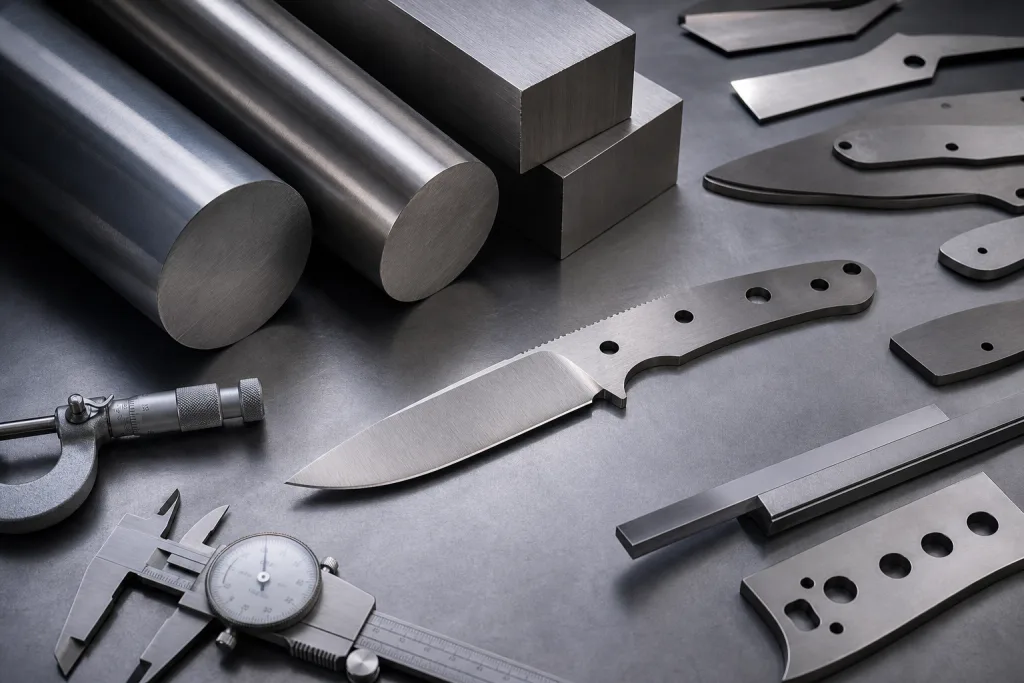
A folding chef knife looks simple on a catalog page. The landed cost is not blade plus handle. For restaurant supply distributors, the real number usually has 9 cost lines: mold or laser-cut tooling, MOQ, carton CBM, insert tray weight, AQL 2.5 inspection, freight mode, duty, relabeling, and the rework bill when a 0.3 mm liner gap turns into returns.
At TANGFORGE, we manufacture kitchen, outdoor, pocket, tactical, and Damascus knives in China for global brands and distributors. Our Yangjiang production network and Zhejiang export team see this on real POs: one buyer pushed the FOB price down by USD 0.42, then gave back USD 0.68 per piece because the gift box was 18 mm too tall and pushed the carton from 12 kg to 15.6 kg. We run the grinding line, we ship the cartons, and we have seen weak specs go sideways. A proper folding chef knife landed cost breakdown should start before QC pulls the first pre-production sample.
Start With The Actual Product Spec
A folding chef knife is not a chef knife with a hinge bolted on. The cost sits between kitchen-knife production and pocket-knife assembly. We run blade grinding, lock fitting, pivot screw assembly, food-contact cleaning, then a second QC pass for blade centering and lock-up. On our line, QC pulled 32 samples from a 1,200 pcs trial order because 6 blades rubbed the liner after carton drop testing. That is where the money goes: cutting geometry, lock safety, assembly time, inspection time, and packaging that stops open tips from chewing through inner cartons.
Before you ask a folding chef knife factory for pricing, write the spec in numbers. Use mm. “8 inch style” is too loose; we have seen buyers mean 180 mm, 195 mm, and 210 mm on the same PO. A clean distributor spec is 180-200 mm blade length, 2.2-2.8 mm spine thickness, 58-60 HRC for 5Cr15MoV or 56-58 HRC for 420HC-type stainless. If you want 8Cr13MoV, 9Cr18MoV, or VG10 clad steel, say it before sampling. Heat treatment, grinding loss, and reject rate move the quote, and the math does not work if steel grade changes after the first sample set.
The folding system changes both cost and buyer confidence. A liner lock costs less and pocket-knife users understand it. A frame lock feels stronger, but it often needs thicker stainless or titanium-scale construction; our caliper check on one OEM sample showed 1.5 mm scale stock where the buyer’s drawing called for 1.8 mm. A slip joint can fit legal limits in some markets, but kitchen cutting pressure is the wrong place to gamble on weak spring tension. For restaurant supply distributors, we recommend a liner lock or strong back-lock style when the knife is sold as a working tool, not a camping novelty.
Packaging belongs in the knife spec, not in a later email thread. A simple color box with EVA insert may add USD 0.45-0.90. A rigid magnetic gift box can add USD 1.20-2.40 and increase carton cube by 30-60%. Looks good on a retail shelf. For restaurant supply channels, we have seen this go sideways: one buyer flagged a 19 kg master carton because the gift box pushed the cube up and forced 12 cartons per pallet instead of 18. These buyers care about function, barcode accuracy, and low damage rate more than fancy unboxing.
Typical FOB Cost Ranges
FOB is still the first number buyers put in the spreadsheet, so here is the plain range. For a standard stainless custom folding chef knife made in China, we normally see USD 5.80-13.50 per unit at 1,000-5,000 pcs. If a quote lands under USD 5.80, the math usually does not work: basic 3Cr steel, thin color box, no drop test, or a plan to add cost later through tooling, sampling, or change orders. QC pulled one sample last month with a 0.35 mm blade wobble after lock-up; that knife looked cheap on the PI, then failed the buyer’s opening test.
At TANGFORGE, we run about 180,000-220,000 units per month across kitchen, outdoor, and pocket knife lines, depending on season and product mix. Folding chef knives assemble slower than fixed kitchen knives because the pivot screw, stop pin, lock bar, and blade centering all need hand checking on the bench. Think pocket knife scheduling, not stamped kitchen knife scheduling. A normal lead time is 35-50 days after sample approval and deposit. If you need custom steel marking, private label packaging, FNSKU labels, or pre-shipment inspection, give the line another 3-7 days; rushing the last week is where we see carton marks, wrong barcode stickers, and PO typos like “8Cr13Mov” printed on 2,000 boxes.
| Cost Driver | Common Choice | FOB Impact Per Unit |
|---|---|---|
| Blade steel | 5Cr15MoV, 58-60 HRC | Base price |
| Upgrade steel | 8Cr13MoV for sharper positioning; 9Cr18MoV when corrosion resistance matters | +USD 0.60-1.80 |
| Handle | G10 for grip, pakkawood for kitchen styling, stainless when the buyer accepts extra weight | +USD 0.30-2.20 |
| Lock system | Liner lock or back lock | +USD 0.40-1.50 |
| Logo | Laser engraving on blade | +USD 0.05-0.18 |
| Packaging | Color box with insert; manual added when the market needs warnings or care instructions | +USD 0.45-1.20 |
These figures are not blanket promises. A folding chef knife manufacturer has to quote from your final drawing, tolerance notes, packaging file, and order quantity. Still, the table is a good first filter. If your retail channel needs a USD 19.99 shelf price, do not ask for premium steel, thick G10, gift-box packaging, and a tight AQL 2.5 inspection in the same build; we have seen this go sideways at the costing desk. A USD 49.99 folding culinary knife for outdoor cooking and mobile chefs gives more room for a cleaner grind line, better lock feel, and packaging that survives a 760 mm carton drop test.
MOQ And Tooling Are Margin Decisions
MOQ is not a factory rule; it is a margin control point. We run folding chef knife wholesale orders at 300 pcs when a buyer insists, but the math often fails because blade setup, pad printing, AQL inspection, and carton handling get divided by too few units. The grinding line still needs the jig set and first-piece check. For a custom folding chef knife, 1,000 pcs per SKU is a cleaner starting point. If you ask for a new handle mold, special blade profile, or exclusive lock hardware, 2,000-3,000 pcs is the number we would quote without pretending the unit cost will stay soft.
Tooling comes down to what you want changed. Laser logo and a private label box usually need no hard tooling; QC pulled samples last month with a 35 mm logo and standard tuck box, and the PO moved straight to pre-production. A new handle scale shape can require CNC programming charges of USD 150-500, depending on complexity. Stamping dies, injection molds, or custom liners can run from USD 800 to more than USD 3,000. If your annual volume is 10,000 pcs, tooling usually pays back. If your trial order is 500 pcs, keep the platform standard and spend the money on the visible brand parts first.
Restaurant supply distributors should buy by master carton logic, not just by unit price. If your customer orders in cases of 12 or 24, ask your folding chef knife supplier to pack that way from day one. We ship this pattern often: individual box, inner carton of 6 or 12, master carton of 48 or 72, then a pallet plan for ocean shipment. Repacking in your warehouse can cost USD 0.15-0.50 per unit in labor, and barcode mistakes are not rare; one buyer flagged a single digit typo on a PO barcode after 6 cartons were already relabeled.
Cash flow is where we have seen this go sideways. Most China knife factories work on 30% deposit and 70% balance before shipment for new buyers. Some long-term customers negotiate better terms, but building your first landed cost model on open account terms is the wrong question to ask. Deposit timing, sample approval, inspection date, and sailing schedule decide when the knives become sellable stock; a 12-day sample delay can easily push an 18-day sailing into the next vessel window.
Packaging Can Make Freight Expensive
About 7 out of 10 new buyers first check the knife unit price and miss the packaging freight bill. For folding chef knives, the box changes the shelf look and the carton math. A slim kraft box might weigh 70-100 g. A rigid box with foam, sleeve, magnet, and a printed manual often lands at 220-350 g; our packing bench weighs it on a 0.1 g scale before we quote. Multiply that by 3,000 pcs and you may add 500-800 kg of chargeable weight, or lose container space because the master cartons cube out before they hit the weight limit.
For restaurant supply distributors, we usually run a strong color box with a molded paper tray or EVA insert, plus a clean barcode panel and country-of-origin text large enough for warehouse scanners. It must survive a 1.0 m drop test on the packed master carton; QC pulled one sample last month where the liner lock punched through a thin tray after corner drop. If you sell through ecommerce or marketplace channels, apply FNSKU or UPC labels at the factory, not after arrival in your 3PL. For commercial kitchens and supply houses, scannability and stack height beat luxury packaging. The buyer flagged this once: beautiful black box, unreadable barcode.
A practical carton target for a folding chef knife is under 0.025-0.035 cbm per 48 pcs for compact packaging, depending on blade length and box design. If your packaging pushes the carton to 0.05 cbm per 48 pcs, the math doesn't work; ocean freight and warehouse space will eat the margin quietly. Ask for a packing simulation before mass production. We send unit box size in mm, inner carton size, master carton size, gross weight, net weight, and estimated cbm per 1,000 pcs; the packing line checks it with a tape measure, not just a CAD drawing.
We are slightly opinionated here: do not approve packaging artwork before checking carton economics. In Zhejiang and Yangjiang export projects, we have seen attractive boxes add more cost than the steel upgrade the buyer rejected; one PO even had the box size typed as 35 mm instead of 350 mm, and production stopped for half a day. Decide the selling channel first. Wholesale distribution needs efficient cartons. Retail gift channels can justify larger boxes. Mixed channels may need two packaging options under the same knife SKU, but plan that before MOQ and production scheduling, or the grinding line waits while packaging catches up.
Freight, Duty, And Incoterms
After FOB is agreed, landed cost still needs a second pass. For North America and Europe, we usually quote against five lanes: air express for sample cartons, air freight for small pilot orders, LCL ocean for mixed pallets, FCL ocean for full containers, or DDP service when the buyer has no broker yet. Air express fits samples and urgent pilot lots under 200-300 pcs, but we have seen it add USD 4-9 per unit when the gift box reaches 285 mm and the carton is charged by volume weight. LCL ocean works for 1,000-3,000 pcs, usually 18-28 days port to port versus 4-7 days by express. FCL starts to make sense when we ship folding chef knives together with kitchen knife sets or outdoor knife SKUs; the loading team can stack about 42-48 export cartons per CBM after QC tapes the master carton.
FOB keeps the line clean. We handle production, export packing, China port delivery, and the booking handover; your forwarder handles ocean freight, insurance, customs, duty, and inland delivery. DDP feels easy for a first order, and we get why buyers ask for it, but the math can get muddy fast because duty classification, fuel surcharge, and last-mile handling may sit inside one flat rate. We have seen this go sideways when a buyer compared our DDP quote with another supplier’s FOB quote and missed USD 0.65 per pc in local delivery. If you are building a serious distributor program, run DDP for the first 500-1,000 pcs if needed, then move to FOB once repeat volume is clear.
Duty depends on HS classification, destination country, blade construction, and whether the goods are entered as kitchenware or as folding/outdoor knives. This is the wrong question to leave to the factory. Ask your customs broker before placing the PO, because one word on the product description can change the entry; last month a buyer flagged “camping knife” on a draft invoice and asked us to revise it to the broker-approved wording. For 8 out of 10 new importers we speak with, a 0-12% duty assumption is safer than modeling duty as zero. Add customs brokerage, ISF for the U.S. where applicable, port fees, insurance at around 0.3-0.5% of cargo value, and inland trucking from the CFS or port.
A basic landed cost formula is: FOB unit cost + packaging if quoted separately + international freight per unit + duty + customs/broker fees + inspection + inland delivery + warehouse receiving. On a USD 8.50 FOB folding chef knife, we often see landed cost reach USD 10.80-12.80 under normal ocean planning, and air can push it past the buyer’s wholesale margin in one shipment. QC pulled one 120 pc pre-shipment sample where the PO had “individual color box” but the buyer’s cost sheet used bulk pack; that typo alone added USD 0.28 per unit before freight. Build the folding chef knife landed cost breakdown before you promise wholesale pricing to restaurant supply customers.
Quality Checks That Prevent Returns
A folding chef knife gives you more places for trouble than a fixed blade chef knife. It still has to cut cleanly, but the lock, pivot, screws, handle, and edge all need their own checks. We have seen this go sideways. On one 3,000 pcs order, QC pulled the sample after the pivot showed 0.8 mm side play on a feeler gauge, even though the blade finish looked fine. If your QC checklist only says “check appearance,” you are not controlling the product.
For distributor orders, we recommend AQL 2.5 for major defects and AQL 4.0 for minor defects, unless your channel requires stricter inspection. Major defects should include lock failure, blade play beyond the agreed tolerance, loose T6/T8 screws, cracked handle, rust spots, wrong logo, unsafe burrs, and carton labeling errors. Minor defects can include small cosmetic scratches within an agreed limit, such as one 3 mm hairline mark outside the logo area. Define this before production, not during final inspection. The buyer once flagged a PO typo that said matte handle while the approved sample was satin, and that small line stopped packing for 2 days.
Useful factory checks include HRC testing by batch, edge angle verification, sharpness sampling, salt spray testing for stainless performance, pivot open-close cycle testing, lock engagement testing, and carton drop testing. For 7 out of 10 folding chef knife programs we run, an edge angle around 15-18 degrees per side is practical. Too thin looks good in a demo, then comes back chipped after restaurant staff cut squash or work on plastic boards all day. The grinding line checks the angle with a digital angle gauge, and QC records HRC readings before the cartons move to final inspection.
Compliance also belongs in landed cost. For food-contact products, ask for LFGB or FDA-related material declarations depending on your market. For Europe, REACH attention is needed for handle materials, coatings, adhesives, and packaging inks. If your customers ask for BSCI, ISO 9001, or social compliance documents, ask early, not after the vessel booking is made. TANGFORGE’s Zhejiang export office coordinates documentation, while production partners in Yangjiang, China handle process control and inspection checkpoints. Good paperwork does not fix a bad knife, but missing paperwork can hold a good knife at the warehouse for 12 days vs 18 days when the buyer’s compliance team rejects the file name or test report date.
Build A Distributor Margin Model
Landed cost matters only when it leaves enough room for the way you sell. A restaurant supply distributor might push the same folding chef knife through rep books, a dealer price sheet, an ecommerce SKU, or a contract bid for 48-store rollout. Each one eats margin in a different place. If your landed cost is USD 11.50 and your wholesale price is USD 17.00, you have USD 5.50 gross room before warehousing, 6% sales commission, returns, freight allowances, and dead stock. Thin math. We have seen buyers approve a nice sample, then the buyer flagged the quote because the carton CBM made free freight wipe out the promo margin.
A practical model should carry at least 2-3% reserve for defects and returns, even when the factory runs clean. QC pulled the sample last week and found 2 loose pivot screws in 80 pcs, not a disaster, but still a cost once it lands in your warehouse. Add domestic freight allowance if you offer free shipping above a case quantity. Add marketing cost if your reps need sample sets in 12 territories. Add 1-2% for currency movement if you quote customers 90 days before replenishment. If the knife is seasonal, include inventory carrying cost because folding chef knives move better around outdoor cooking and gift periods than in slow February weeks.
Here is a simple working example. FOB China price: USD 8.40. Ocean freight and insurance: USD 0.75. Duty and customs: USD 0.80. Inspection and documentation: USD 0.18. Inland delivery and warehouse receiving: USD 0.55. Landed cost: USD 10.68. If you sell wholesale at USD 18.50, gross margin is 42.3% before domestic selling costs. If packaging expansion increases freight by USD 0.50 and rework adds USD 0.25, margin drops quickly. On the packing bench, a 32 mm wider gift box can change the master carton from 24 pcs to 18 pcs, and that is where the math goes sideways.
The better folding chef knife supplier protects this model instead of chasing the lowest FOB number. Ask for alternate quotes: standard color box against premium magnetic box, 1,000 pcs against 3,000 pcs, 5Cr15MoV against 8Cr13MoV, FOB against a DDP estimate with port and ZIP code shown. We run these comparisons before tooling artwork because a PO typo like “DDP LA” instead of “DDP warehouse” can hide 4 charges. With those checks, you decide like a distributor, not like a buyer staring at one unit price.
Frequently asked questions
For a standard platform with private label logo and custom box, expect 1,000 pcs per SKU as a practical MOQ. If you need a new handle profile, special liner, exclusive lock part, or upgraded steel, 2,000-3,000 pcs is more realistic because setup, CNC programming, and QC time increase. Some factories may accept 300-500 pcs, but unit cost, packaging cost, and freight cost usually become unattractive. For restaurant supply distributors testing a new category, we often suggest starting with one strong SKU at 1,000 pcs rather than three weak SKUs at 500 pcs each.
A normal FOB China range is about USD 5.80-13.50 per unit, depending on steel, blade length, handle, lock system, finish, packaging, and order quantity. A basic 5Cr15MoV folding chef knife with simple color box may sit near the lower-middle range. Upgrading to 8Cr13MoV, G10 or pakkawood handle, tighter pivot tolerances, and premium packaging can push the price above USD 10.00. If a quote is far below USD 5.80, check whether it includes proper heat treatment, food-contact packaging, logo, cartons, and final inspection.
DDP can be useful for a first trial because it gives one delivered price and reduces the learning curve. The downside is limited visibility. You may not clearly see duty, freight, customs brokerage, and destination handling. For orders under 1,000 pcs, DDP may be acceptable if you are validating demand. Once you order 3,000 pcs or combine multiple knife SKUs, FOB is usually better because your forwarder can optimize LCL or FCL ocean freight. Serious distributors should build landed cost from FOB plus real logistics data, not rely only on bundled delivery quotes.
The core checks are HRC testing, blade sharpness, edge angle, pivot smoothness, lock engagement, blade play, screw torque, handle cracks, rust inspection, and carton drop testing. For a working folding chef knife, an HRC band of 58-60 for 5Cr15MoV is common, while other steels need their own target. Use AQL 2.5 for major defects and define lock failure, loose pivot, wrong logo, and unsafe burrs as major issues. If selling in Europe or North America, also request food-contact and material documentation such as LFGB, FDA-related declarations, and REACH attention where relevant.
Packaging affects three costs at once: material cost, labor cost, and freight cube. A simple color box may add USD 0.45-0.90 per unit, while a rigid gift box can add USD 1.20-2.40. More importantly, bulky packaging may increase cbm by 30-60%, which raises LCL ocean cost and warehouse space. For restaurant supply distributors, compact cartons, clear barcode placement, and strong inserts usually beat oversized luxury packaging. Ask your factory for master carton dimensions, gross weight, and cbm per 1,000 pcs before approving artwork.
Get A Landed Cost Quote
Send your target blade size, steel, packaging, MOQ, and destination port. We will return FOB options and practical freight-planning notes.
Request a Quote