Folding chef knives do not move like a standard 20 cm kitchen knife. Different math. If you sell to restaurant supply dealers, culinary schools, mobile chefs, outdoor cooking retailers, or gift channels, lock the reorder plan before you sign off the logo artwork; we have seen a buyer approve a 300-piece PO, then ask why the second batch needed 18 days instead of 12 days after the grinding line had already switched to another model.
At TANGFORGE in Yangjiang, China, we see this go sideways about 6 times a quarter: buyers order custom folding chef knife logo engraving at 300 pieces, sell out faster than forecast, then miss a seasonal reorder because steel grade, handle material, color box, and laser engraving setup were not frozen. QC pulled one sample last month with the logo 1.5 mm off center, and the buyer flagged it after photos were already sent. The wrong question is “what is the lowest MOQ?” Ask how MOQ, logo process, and inventory cadence work together before the PO is released.
Why MOQ Drives the Whole Program
For restaurant supply distributors, MOQ is not just a factory rule. It fixes how much cash sits in stock, how many 12-knife inner boxes become full export cartons, how early barcode labels need artwork approval, and how much replacement buffer you keep for bent clips or scratched handles. Start the folding chef knife logo engraving MOQ reorder plan from monthly sell-through, not from the lowest number a supplier quotes. That is the wrong question to ask. Last month a buyer flagged a 48-carton first order because their warehouse slot only held 36 cartons.
For a new private label folding chef knife, a practical first production order is usually 500 pcs per blade shape and logo. Below 300 pcs, we still set the laser engraving file, clamp the blade in a jig, run the grinding line, machine the handle scales, print packaging, and pull AQL samples for final inspection. The setup does not become half-price just because the PO is small. Simple math. That is why 100 pcs samples feel expensive, while 500 pcs starts to look normal once the laser table and CNC fixture are already occupied.
At TANGFORGE in Yangjiang, China, our regular custom knife production capacity is about 180,000-220,000 units per month across kitchen, outdoor, pocket, and Damascus categories. Folding chef knives are more technical than fixed kitchen knives. The pivot screw torque, liner lock bite, blade centering gap, and edge angle need to land together; QC pulled one sample last week for a 0.6 mm off-center blade, even though the logo looked clean. If you push the MOQ too low, you save cash on day one and risk uneven reorders later. We have seen this go sideways.
A distributor should separate the numbers clearly: 20 pre-production samples for sales reps to show key accounts, a 500 pcs pilot order with retail packaging and barcode labels, then 1,000 pcs repeat orders after the SKU proves sell-through. That structure gives your sales team stock to test without making the factory rebuild the program every time. We run cleaner repeat orders when the PO says “same logo, same carton mark, same blade finish” instead of a fresh typo on the engraving spec.
Logo Engraving Choices and Cost Control
Logo engraving looks simple on a product page, but it changes the way we run the order on the floor. A folding chef knife logo engraving factory needs the vector file, engraving position, logo size in mm, depth request, and the exact surface: blade, handle, bolster, clip, or packaging. For restaurant supply distributors, blade engraving is still the safer choice because the mark is visible after display, survives washing, and is easy to repeat on the next 3,000 pcs reorder. QC pulled one sample last month where the PO said “left face,” but the PDF showed right face. That one typo cost 2 hours at the laser station.
Laser engraving is the cleanest choice for most wholesale programs. We run it on stainless steels such as 5Cr15MoV, 7Cr17MoV, 8Cr13MoV, 9Cr18MoV, AUS-10, and VG-10 clad blades. On satin blades, the mark usually lands grey to dark grey after wiping with anti-rust oil. On coated blades, the laser cuts through the coating and gives a bright contrast. Deep etching can be done, but the math often does not work for MOQ 500 pcs because cycle time jumps from about 6 seconds to 14 seconds per blade, and thin logo lines start showing uneven depth under the 10x loupe.
For custom folding chef knife logo engraving, keep the logo between 18-35 mm wide on the blade unless the blade face is large. Small text under 1.2 mm height looks weak after cleaning, oiling, and carton vibration during sea shipment. If your brand mark includes a registered symbol, send two files: one with the symbol and one without. We usually push back on the symbol for compact blades; it fills in visually, and the buyer flags it later even when the artwork was approved. Better to check it on a 1:1 paper print before we cut the laser jig.
Engraving cost stays low when the order is locked before sampling. On typical wholesale orders, laser logo cost may add about USD 0.08-0.25 per pc, depending on mark size and cycle time. The bigger cost risk is not the laser head. It is rework from unclear artwork, late barcode changes, or moving the logo after the golden sample is approved. We have seen this go sideways: 1,200 finished blades had to be re-polished because the buyer changed the mark from blade center to heel after packing insert approval.
Useful MOQ and Lead Time Benchmarks
Ask for numbers at RFQ stage, even before the final CAD drawing is locked. A folding chef knife logo engraving manufacturer should quote MOQ by steel grade with target HRC, handle material with color tolerance, packaging style, and whether we run an existing ODM model or cut new OEM tooling. If the supplier writes only “MOQ negotiable,” ask for the cost ladder; otherwise the buyer flags it later when 300 pcs and 1,000 pcs land on the same unit price.
Use this table for first-pass distributor planning. It is not a universal price list, but it matches how a China knife factory builds capacity on the grinding line, laser room, packing bench, and carton print order.
| Program type | Suggested MOQ | Typical lead time | Best use |
|---|---|---|---|
| Existing model with blade laser logo | 300-500 pcs | 30-45 days | Market test or catalog add-on SKU |
| Existing model with custom handle color | 500-1,000 pcs | 45-60 days | Distributor private label reorder item |
| Custom packaging plus logo engraving | 1,000 pcs | 50-70 days | Retail-ready wholesale launch |
| New blade or handle tooling | 2,000-3,000 pcs | 75-100 days | Exclusive program with repeat orders |
For a folding chef knife logo engraving supplier, the slow part sets the ship date. Custom G10 color chips need approval, stabilized wood blanks need moisture checks, Damascus billets need prep time, magnetic gift boxes need print proofing, and FNSKU carton labels must match the PO exactly. We have seen this go sideways from one wrong digit on an Amazon barcode, so send barcode rules, mixed-carton instructions, and retail packaging files before quotation.
For most restaurant supply distributors, the clean starting point is an existing or lightly modified folding chef knife at 500-1,000 pcs. At 800 pcs, we can batch laser engraving, handle assembly, and final AQL checks without waiting for new tooling. The math does not work well at 100 pcs if you need custom boxes, sales rep samples, and dealer stock, but this MOQ gives you a sane reorder path after the first sell-through report.
Build the Reorder Cadence Backward
Build the reorder plan from the stockout date, not from a panic email. We see buyers wait until stock falls under 10%, then push us for “urgent” production on a folding knife program. Bad timing. Even with blade blanks on the rack, the job still needs pivot assembly, liner lock testing at the bench, 800-grit edge sharpening, laser logo engraving, oiling, carton packing, and AQL 2.5 inspection.
A workable trigger is to reorder while you still have 45-60 days of inventory cover. If China production lead time is 45 days and ocean freight plus customs takes 25-35 days, the math does not work if you wait until the last month. DDP air freight can save the calendar, but we have seen freight eat 12-18% of margin on a heavy folding chef knife order packed in 12 kg export cartons.
Here is a simple example. You sell 300 pcs per month through restaurant supply dealers. Your first order is 1,000 pcs. Hold 50 pcs for warranty claims and sales samples, so sellable stock is 950 pcs. That gives you a little over 3 months of cover if the forecast is right. Place the reorder when stock is around 500 pcs, because the next 1,000 pcs can take 60-80 days from PO release to warehouse arrival; last April, QC pulled 9 pcs from a reorder because the engraved logo sat 1.5 mm off-center.
Do not run the second order like the first order. The first order carries artwork confirmation, golden sample approval, packaging proofing, and compliance checks if your buyer asks for them. A repeat order moves faster only when the spec is frozen. At TANGFORGE, repeat production for a locked folding chef knife program is commonly 35-50 days, provided we reserve steel coils, G10 or pakkawood handle material, and printed boxes early; we have seen this go sideways when a PO typo changed “black handle” to “brown handle.”
Inventory Planning for Distributor Channels
Restaurant supply distributors sell through several paths: dealer replenishment after monthly stock checks; online B2B orders tied to case-pack pricing; rep sample kits for field sales; culinary school programs with semester intake; seasonal promotions built around outdoor cooking or holiday gift sets. Each path moves stock at a different speed. We have seen a folding chef knife sit at 40 pcs per month for 8 weeks, then jump to 360 pcs in 10 days after a chef association mailer went out. QC pulled the sample carton on that run because the barcode scanner at the packing bench read the old SKU.
Separate inventory into three buckets with names your warehouse team can use. Live selling stock is what dealers can order today. Committed stock covers dealer programs, school preorders, or promo reservations already on the sales sheet. Protected stock stays off the sales screen for warranty, rep samples, and replacement cartons. Selling every unit looks efficient. The math does not work. We have seen this go sideways when a dealer reported 18 crushed master cartons and the distributor had zero clean replacements because the last 72 pcs had already shipped.
For a new folding chef knife logo engraving wholesale SKU, we run the first allocation at 85% sellable, 10% sales and dealer samples, 5% warranty buffer. For natural wood handles, push the buffer to 7% or 8% if the order is under 1,000 pcs, because grain color and handle shade create more after-sales emails. QC checks those handles under a 5500K inspection lamp, and buyers still flag “too dark” or “too red” on repeat orders. G10 and stainless handle scales are easier to hold within tolerance, with fewer color arguments.
Match inner carton quantity to how dealers actually order. If dealers buy 12 pcs, pack 12 pcs per inner carton. If they buy six, make six. Small detail. Big warehouse effect. On one reorder, switching from loose mixed cartons to 12 pcs inners cut repacking from 18 minutes to 7 minutes per 100 pcs. Ask your folding chef knife logo engraving manufacturer to print item number and PO number on the top line, carton quantity beside the barcode, gross weight and net weight near the shipping mark, and country of origin in the same position on every master carton. The buyer flagged one PO typo last year, and that single digit held 240 cartons at receiving.
Quality Checks Before Every Shipment
A folding chef knife is a cutting tool before it is a logo item. We have seen buyers push hard on engraving depth, then ignore lockup, heat treatment, edge holding, or blade play; that is the wrong question to ask. Put the inspection rules on the PO before we cut steel. For distributor orders, we run AQL 2.5 major and AQL 4.0 minor, with critical defects rejected at 0, and QC pulls samples with a caliper, lock test jig, and edge paper test before packing.
Checkpoints need to match how the knife will be used. Blade hardness should match the steel grade, not a catalog slogan. For 5Cr15MoV, a common band is 55-57 HRC. For 8Cr13MoV, 57-59 HRC is normal. For 9Cr18MoV or AUS-10, 58-60 HRC is common when the heat treatment is controlled. On the grinding line, we check HRC with the Rockwell tester, then assembly checks blade centering within 0.8 mm, smooth opening, solid lock engagement, no vertical blade play, and no burrs around the liner where a thumb can catch.
For logo engraving, inspect the position against the approved golden sample. A practical tolerance is often within ±1.0 mm from the approved golden sample. The laser jig matters. If the blade finish shifts from satin to stonewash, the mark shade will change a little, but crooked logos, double shadows, and incomplete letters should fail. If you require LFGB, FDA food-contact declarations, REACH screening, or California Prop 65 documentation, ask before production; the paperwork is not the same for every steel, coating, oil, or G10 handle batch.
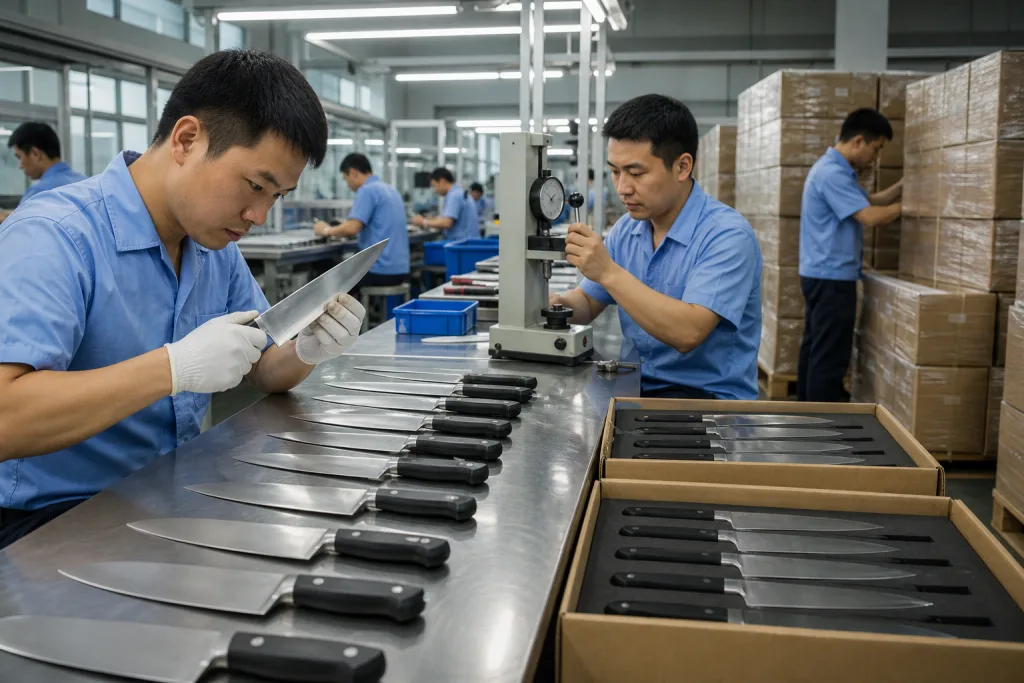
China factory QC should not replace your own incoming inspection, but it cuts down the surprises that burn reorder timing. At TANGFORGE in Yangjiang, we run in-process checks during blade grinding, assembly, sharpening, laser marking, and final packing. QC pulled one folding sample last month with a 0.25 mm liner gap after riveting, and the buyer flagged the same issue on photos before shipment. For folding knives, lock function deserves 100% checking because one unsafe knife can cost more than the entire inspection fee.
Lock the Specification for Reorders
The best reorder plan is boring. Same steel and HRC band. Same handle material, logo file, packaging dieline, barcode, carton mark, and inspection checklist. If the first 1,000 pcs sells through cleanly, do not change five items on the second PO unless customer returns or dealer notes prove the change is needed. We’ve seen this go sideways: one buyer switched from black G10 to walnut on a reorder, then QC pulled the sample because the engraved logo looked 30% lighter on the darker grain.
Build one specification sheet with blade length in mm, closed length, open length, blade thickness, edge angle, steel grade, hardness, handle material, pivot type, lock type, engraving location, packaging, unit weight, carton quantity, and approved sample photos. Keep one approved golden sample at your office and one at the China factory. Six months later, that sample beats a 38-email chain. On our side, we tag the sample box with SKU, PO number, and date; even a typo like “matte balck handle” on a PO gets caught faster when the sample is sitting on the QC desk.
For a folding chef knife logo engraving supplier, stable reorders also make cost easier to hold. Steel prices, exchange rates, and freight can move, but repeatable production cuts scrap on the grinding line. If you expect quarterly reorders, tell the factory early. We run blade blanks, screws, pivots, handle scales, and boxes with better timing when demand is visible; 12 days for prepared components is normal, while a cold restart can push closer to 18 days.
A practical reorder rhythm for restaurant supply distributors is quarterly PO review with 2-3 months rolling forecast. You do not need to overcommit, but share expected volume by SKU. If your first order is 1,000 pcs and monthly sell-through reaches 400 pcs, move the second order to 1,500 or 2,000 pcs instead of repeating the same shortage. The math doesn’t work if the reorder lands after stock hits zero. That is how a custom folding chef knife logo engraving program becomes a stable wholesale item instead of a one-time promotion.
Frequently asked questions
For an existing model with blade laser engraving, 300 pcs is sometimes possible, but 500 pcs per logo is the more practical MOQ for B2B buyers. At 500 pcs, setup cost, engraving jigs, packaging labels, and QC time are spread more reasonably. If you need custom handle color, retail box printing, or barcode labeling, expect 500-1,000 pcs. For new tooling, 2,000-3,000 pcs is more realistic. A restaurant supply distributor should also hold 5% extra stock for warranty and sample replacement, so do not plan sellable inventory from the full purchase quantity.
If the specification is locked, a repeat order usually takes 35-50 days for production at our Yangjiang, China factory. Add freight time separately: express or air DDP may take 7-15 days, while ocean freight to Europe or North America commonly needs 25-40 days depending on port and customs flow. If you change steel, handle material, packaging, or engraving position, treat it as a semi-new order and allow extra sample approval time. Reorder when you still have 45-60 days of inventory cover.
For folding chef knives, laser engraving is usually better than surface printing because it is permanent, clean, and resistant to washing and handling. Printing can work on boxes, sleeves, or some handles, but blade printing is easier to scratch. Laser engraving also keeps unit cost predictable, often around USD 0.08-0.25 per pc depending on logo size and cycle time. The main rule is to send a clean vector file and approve the exact location on a golden sample before mass production starts.
For distributor programs, reorder when inventory reaches 45-60 days of forecast demand. If you sell 300 pcs per month, place the next PO when stock drops to about 500-600 pcs, not when it drops below 100 pcs. This gives enough time for production, inspection, export paperwork, freight, and warehouse receiving. If your sales are seasonal, increase the safety stock before Q4, culinary school purchasing periods, or promotional campaigns. Folding knives require more assembly checks than fixed blades, so emergency production is not a good plan.
Use AQL 2.5 for major defects, AQL 4.0 for minor defects, and 0 tolerance for critical safety defects. Define critical issues clearly: failed lock engagement, severe blade play, cracked handle, exposed burrs, wrong steel, wrong logo, or unsafe edge damage. Also list the HRC band, such as 57-59 HRC for 8Cr13MoV or 58-60 HRC for AUS-10. For folding chef knives, ask for 100% lock function checking before packing. Logo position should normally stay within ±1.0 mm of the approved sample.
Plan Your Next Folding Knife Reorder
Send your target MOQ, logo file, monthly forecast, and packaging needs. TANGFORGE will quote a practical production and reorder plan.
Request a Quote