A folding chef knife looks simple on a quotation sheet. It is not. You are buying a blade, a liner lock, food-contact handle material, inner box, master carton, and export paperwork under one SKU. If the lock gap is 0.3 mm too loose or the blade comes in at 54 HRC instead of the agreed hardness, QC will pull the sample before the buyer even sees the carton.
At our Yangjiang, China factory, 7 out of 10 quotation delays start with an RFQ that leaves holes: blade steel is named, but HRC is missing; the handle is copied from a photo, but no thickness tolerance is listed; the gift box looks premium, but nobody mentions the 80 cm carton drop test. We run into this every month. Chasing the lowest FOB number is the wrong question to ask if the quote hides tooling, MOQ, packing spec, or lead time risk.
Start with a comparable RFQ
Send the same photo to five suppliers and ask for “best price,” and you will get five quotes you cannot line up. We see this weekly. One folding chef knife moq lead factory quotes 3Cr13 at 52 HRC with a 0.18 mm nylon pouch. Another quotes 5Cr15MoV at 56 HRC, a 4.0 mm pivot screw, stainless liner, printed color box, and 5-layer export carton tested from 80 cm. The low number is not always a win. It often means the supplier left cost outside the quote, and we have seen this go sideways when QC pulled the pre-shipment sample and the buyer flagged loose blade play.
A clean RFQ should specify the blade length in mm, open length, folded length, blade thickness, steel grade, target HRC, grind type, edge angle, handle material, lock type, pivot hardware, surface finish, logo process, packaging, quantity, delivery term, and inspection standard. Add tolerances where you can, such as blade thickness 2.5 mm ±0.2 mm or edge angle 15° per side. For kitchenware brands, state the target retail channel. We pack differently for outdoor specialty stores than for a kitchenware chain in Germany or the United States, especially when the buyer asks for LFGB files, barcode placement, and a 600 mm carton drop test report.
Do not hide your target order quantity. If you need 3,000 pcs for the first launch and 10,000 pcs per year after testing, say it in the RFQ. A folding chef knife moq lead manufacturer can then spread mold, jig, and packaging setup costs across the real program, not just the trial PO. If you ask for 300 pcs but want 5,000 pcs pricing, the math doesn't work. On our side, the grinding line still needs the same blade fixture, and the color box supplier still charges plate setup even if the first run is only 12 cartons.
For custom folding chef knife moq lead discussions, attach a simple specification table. Rough is fine. Even if your design is not final, the table prevents mistakes like “black G10” becoming black PP handle on the proforma invoice, a typo we caught on one PO before tooling. A factory in Yangjiang, China will usually respond 12 days faster when your RFQ looks like a production file instead of a mood board, because engineering can check the pivot stack, liner thickness, and MOQ before sales sends the price.
Understand realistic MOQ levels
MOQ is not a punishment. It is the break point where we can buy steel sheet, book the grinding line, set blade and handle fixtures, run QC, and still leave margin after cartons and labor. For folding chef knives, the MOQ changes fast: stock model, logo plus box, or a new lock mechanism with a different handle profile. The wrong question is “what is your lowest MOQ?” Ask what work the MOQ actually covers.
For an existing folding chef knife with stock tooling, we usually run 500 pcs per model for laser logo and standard packaging. The laser room only needs one logo program and one positioning jig. If you need custom color handles, printed retail boxes, or FNSKU labels, 1,000 pcs is the cleaner level because packaging plates, color matching, and label checks take separate time. For a new handle mold, new liner geometry, or a blade shape that needs dedicated fixtures, 2,000-3,000 pcs may be needed to spread tooling and engineering cost. We have seen buyers ask for 200 pcs with new G10 texture and a changed liner lock; the math does not work.
| Program type | Typical MOQ | Common setup cost | Best use case |
|---|---|---|---|
| Stock model, logo only | 300-500 pcs | USD 50-150 logo setup | Market test with one blade finish, one logo position |
| Stock model, custom packaging | 500-1,000 pcs | USD 120-400 artwork/plate cost | Private label launch with printed box and barcode control |
| Custom handle color/material | 1,000-2,000 pcs | USD 300-800 material and fixture setup | Brand color or handle material change after sample approval |
| New design with tooling | 2,000-5,000 pcs | USD 800-3,500 tooling | Long-term exclusive SKU with dedicated mold and assembly checks |
If a folding chef knife moq lead supplier promises 100 pcs MOQ with full customization and a low price, check the details. QC pulled one sample last year where “custom” meant a 22 mm laser logo on a stock knife and a sticker on a white box. That is fine for a small test. It is not OEM development, and it will not protect your SKU from another buyer using the same body.
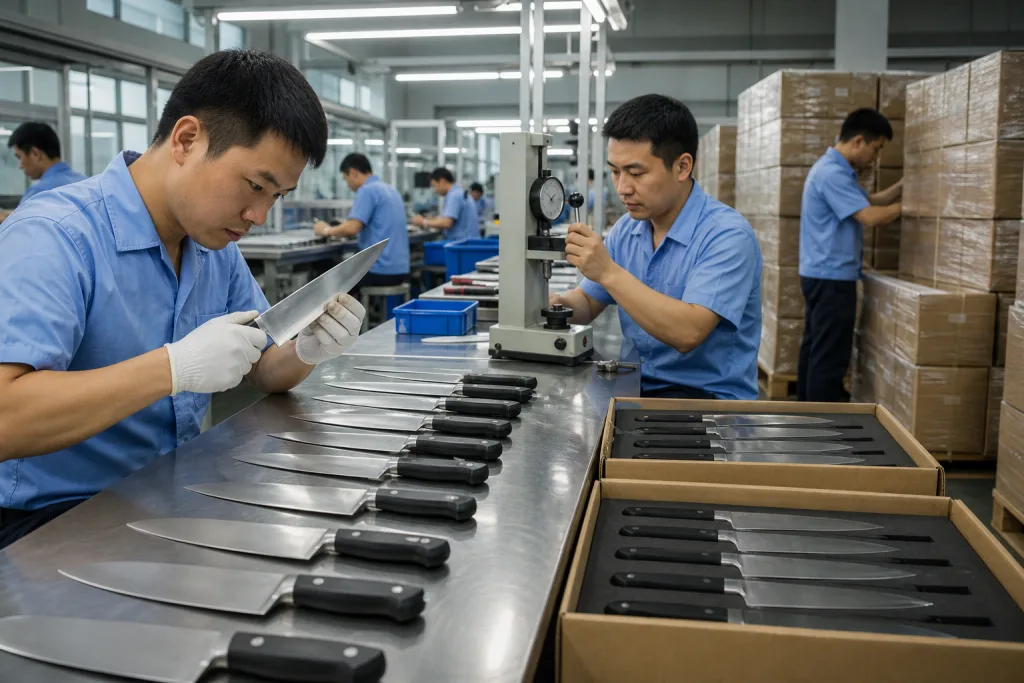
At TANGFORGE, our normal custom knife MOQ sits from 500 pcs for simple private label work to 2,000 pcs or more for new mechanical structures. We run about 180,000-220,000 knife units per month across kitchen, pocket, outdoor, and Damascus categories, but small folding chef knife orders still need dedicated setup time, inspection flow, and packaging space. Even a 500 pcs run needs blade thickness checks at the caliper station, lock-up inspection, and carton label confirmation; one PO typo on “matte black” versus “black stonewash” can stop packing for half a day.
Lead time depends on approval speed
Buyers ask us, “What is your lead time?” Fair question, but it is the wrong question to ask before approvals are locked. We start counting after sample approval, deposit, artwork confirmation, and material confirmation. Before that, both sides own the calendar. The grinding line cannot cut final steel when the PO still shows “about 58 HRC,” the logo position moves 6 mm, or the color box file is still named “final_final.ai.”
For a stock folding chef knife with logo only, we run sample preparation in 7-12 days. For custom handle material, adjusted blade profile, or special finish, samples often take 15-25 days because the CNC operator needs a signed drawing and the polishing room needs one approved surface standard. If a new mold or CNC fixture is required, plan 25-40 days for development sampling. Bulk production is normally 35-60 days after approval, depending on order quantity and packaging work; a 3,000 pcs logo order moves faster than a 12,000 pcs set with insert card, EVA tray, and bilingual box.
Kitchenware brands should add buffer for lab testing and pre-shipment inspection. REACH, LFGB, or FDA food-contact tests may take 7-15 working days depending on the lab and test scope. If your importer requires carton drop test or barcode scan check, book it at least 7 days before the planned vessel closing date. We have seen this go sideways: QC pulled the sample at AQL 2.5, the barcode scanned as the old SKU, and the vessel slot was gone before the buyer approved the sticker change.
Do not negotiate lead time by asking the supplier to “try faster.” Remove blockers. Approve the artwork in one round. Provide Pantone numbers, not screenshots from a phone. Confirm whether the delivery term is FOB Ningbo, FOB Shenzhen, EXW Yangjiang, or DDP warehouse. If you need Amazon or marketplace packaging, send the FNSKU and suffocation warning early, then lock carton weight limit and master carton dimensions before we cut the carton knife die.
A strong folding chef knife moq lead wholesale program is built backward from your launch date. If you need goods in a US warehouse by October 1, ocean freight, customs clearance, inland trucking, and inspection can consume 35-45 days. The math does not work if production finishes in late September. We ship mid-August for that plan, because one random customs exam or one 2 mm carton dimension correction can eat the week you thought you still had.
Break the quote into cost drivers
Price talks get cleaner when the cost sheet is visible. A folding chef knife price is not one magic factory number. We build it from blade steel, heat treatment, grinding, handle material, lock and pivot hardware, labor, surface finishing, packaging, scrap rate, inspection, overhead, and margin. On one 3,000 pcs order, QC pulled the sample after the grinding line found 0.35 mm blade play at the pivot; if the buyer only pushes the total down by USD 0.40, the factory has to take that money from a part you may never see.
Steel choice moves the quote, but this is the wrong question to ask by itself. 3Cr13 is cheaper and easier to process, with modest edge retention. 5Cr15MoV or 7Cr17MoV works better for kitchen use when heat treated correctly, usually around 55-58 HRC depending on the design. D2 or VG-10 style programs cost more and punish weak cleaning design around the folding structure. We run Rockwell checks on 5 pcs per heat-treatment batch; for kitchenware brands, stain resistance and easy maintenance beat chasing the highest HRC number.
Handle cost can jump fast. PP or ABS keeps the price low, G10 feels stronger and more premium, pakkawood gives the kitchen look but needs moisture control, and stainless handles add weight plus polishing time. A folding chef knife also needs stable pivot tolerances. Cheap pivot hardware can cause blade play, poor centering, or uneven opening. Consumers spot that in 3 seconds. We have seen this go sideways when a buyer approved a 0.08 mm washer change to save USD 0.06, then flagged 14% off-center blades during pre-shipment inspection.
Packaging hides real money. A plain white box may cost USD 0.15-0.30. A printed rigid box with EVA insert can add USD 1.20-2.50 or more. If your quote comparison skips packaging, the math doesn't work. Last month, one PO had “gift box” typed with no paper gsm, no insert drawing, and no barcode position; our packing table stopped the sample because the EVA slot was 2 mm too tight for the folded knife.
Ask each folding chef knife moq lead manufacturer to split the optional items: upgraded steel, upgraded box, pouch, spare screws, instruction leaflet, barcode labels, and inspection certificates. Better yet, ask for a 2-column quote with base spec and add-on cost per item. We ship cleaner orders that way. On a 1,200 pcs trial order, this can show whether a quote is low because the factory is efficient or because the supplier left out the pouch, spare T6 screws, or AQL 2.5 inspection cost.
Negotiate price without cutting quality
The best price negotiation is specific. “Your price is too high” gives the factory nothing to check. “Supplier B quoted USD 4.82 FOB for 1,000 pcs, 5Cr15MoV, 56±2 HRC, G10 handle, printed box, AQL 2.5; can you review the pivot hardware and packaging cost?” starts a real costing review. Last month QC pulled a 1,000 pcs sample order where the buyer flagged a 0.3 mm gap at the pivot, and we found the screw spec was driving both cost and assembly time.
Use the levers that change the BOM. Push quantity per color or per model first. Moving from 500 pcs to 1,000 pcs usually cuts cost better than asking for a blind 8% discount, because the grinding line runs with fewer changeovers. Packaging is another clean target: if your channel does not need a full retail box, a printed sleeve or kraft box saves about USD 0.40-1.00 per unit. Keep one blade steel across several SKUs so we can buy strip steel in a larger lot, and skip surface treatments that add rejects, such as dark coating on edges that still need hand polishing.
Payment terms are negotiable, but the math must work. For first orders, 30% deposit and 70% before shipment is common. After 2-3 stable orders, some factories will discuss 30/70 against bill of lading copy or partial credit for established importers. Ask for 60-day credit on the first order and the risk goes back into the unit price. We have seen this go sideways when a PO had one typo in the consignee name and the final 70% sat for 12 days while the cartons were already booked.
Tooling cost can sometimes be spread into the unit price. Instead of paying USD 2,000 tooling upfront, you can ask to split it across the first 5,000 pcs as USD 0.40 per unit. That helps cash flow. Clarify ownership before we cut steel on the CNC mold, because exclusive tooling and shared tooling are not the same deal. If you require exclusive tooling, put that into the purchase agreement.
Do not trade away heat treatment control, lock safety, or final inspection to save a few cents. This is the wrong question to ask. A folding chef knife works close to fingers, food, and countertops, so poor lock engagement or blade play turns into returns fast. On one inspection, QC found 7 pcs with side play over 0.5 mm after the drop test; saving USD 0.25 per knife would not cover a 6% return rate.
Check compliance and inspection terms
For kitchenware brand owners selling in Europe and North America, compliance is part of the unit price, not a document you chase after packing. We have seen a USD 0.06 handle coating change turn into a retest request because the buyer flagged food-contact claims on the color box. Blade steel, handle material, coating, ink, glue, pouch fabric, and packaging can all trigger customer requirements. For food-contact positioning, ask before sampling whether LFGB, FDA, or migration testing is needed. For EU sales, REACH and packaging material rules can also apply. If the knife includes wood or bamboo, confirm moisture control, fumigation requirements where applicable, and carton ventilation; our QC room uses a pin moisture meter and rejects bamboo scales above 12% before assembly.
Inspection standards need to sit inside the PO, not in a WhatsApp message 3 days before loading. We usually run AQL 2.5 for major defects and AQL 4.0 for minor defects, with critical defects not accepted. Define critical defects in plain words: lock failure, loose blade, cracked handle, sharp burrs outside cutting edge, wrong steel, wrong logo, rust, contamination, or unsafe packaging. For folding knives, functional checks should include opening/closing action, blade centering, lock engagement, pivot screw tightness, edge sharpness, and handle gap. QC pulled 125 pcs from one 5,000 pcs order last month and found 7 pcs with off-center blades; without the written AQL line, that argument would have gone sideways.
Ask for measurable tolerances. This is where buyers save time. Blade thickness may be 2.0 mm ±0.15 mm. HRC may be 56±2. Closed length may be ±1.0 mm. Edge angle may be 15-18 degrees per side depending on the design. Without tolerances, both sides argue from opinion, and that is the wrong question to ask. On the grinding line, a 0.2 mm blade thickness drift is easy to see with a digital caliper, but nobody can inspect “premium feel” on a report.
Factory audits matter because some retail channels will not open the vendor file without the right papers. ISO 9001, BSCI, or customer social audits can influence which supplier is acceptable for your retail channel. Not every capable Yangjiang factory has every certificate, and not every certificate means clean production every Tuesday morning. If your customer requires BSCI or ISO documentation, confirm it before sampling. We once had a buyer approve the knife sample, then stop the order because their PO line had “BSCI required” typed in small notes on page 4; the math does not work after molds and packaging plates are paid.
For pre-shipment inspection, book after at least 80% of goods are packed and 100% are finished. If your inspection agency arrives while cartons are still being packed, the result is weaker. At TANGFORGE in China, we prefer buyers to send a final inspection checklist before mass production starts, not after goods are waiting for shipment. We ship cleaner when the checklist includes carton drop test height, barcode scan method, spare screw count, and photo angles for the open knife. One buyer sent the checklist 18 days after production started; the same checklist before cutting material would have cost us 12 days less.
Build a quote comparison sheet
A quote comparison sheet keeps buying meetings honest. We run this as one grid: quantity and MOQ, sample cost and sample time, bulk lead time, steel and HRC, handle material, lock type, packaging spec, testing, FOB port, payment terms, tooling fee, and inspection standard. Add landed cost, not just FOB price. This is the wrong question to ask if the buyer only asks, “Who is cheaper?” Ocean freight, duty, broker fees, inland trucking, DDP service fees, and warehouse receiving charges can move a quote by USD 0.18 to USD 0.65 per knife. On our side, QC also adds a line for actual carton size in cm because one PO once showed 48 pcs per carton, while the packing bench could only fit 36 pcs without crushing the printed box.
If Supplier A is USD 5.10 FOB and Supplier B is USD 4.75 FOB, Supplier B looks better on the first screen. The math does not work if Supplier B asks for 3,000 pcs MOQ, charges USD 1,200 tooling, leaves out LFGB testing, and needs 70 days production. That may miss your launch window. If Supplier A accepts 1,000 pcs, 45 days lead time, AQL 2.5 inspection, and finished retail packaging, the higher unit price may be the safer first order. We have seen this go sideways when the buyer saved USD 0.35 per unit, then lost 18 days waiting for a revised liner lock sample from the grinding line.
When you go back to suppliers for negotiation, show the gaps clearly. Do not forward another factory’s full quotation. Say the benchmark: “Our target is USD 4.90 FOB at 1,000 pcs with 5Cr15MoV, G10 handle, printed box, 45-day lead time, and AQL 2.5. Please advise whether you can meet this without changing materials.” That sounds like a buyer who has done the work. The supplier also gets less room to quietly switch the handle from G10 to ABS, which QC pulled on one counter-sample at 2.8 mm handle thickness instead of the agreed 3.2 mm.
For a custom folding chef knife moq lead project, keep one approved golden sample at the factory and one in your office. Sign and date both. Photos help, but physical samples settle disputes faster. If you approve a sample with smooth opening and clean blade centering, mass production should match it within agreed tolerances. We normally tape the signed sample in a PE bag, mark the PO number on the blade sleeve, and let QC compare the first 20 pcs from assembly before full packing starts.
The right supplier will not always be the cheapest. The right supplier gives you a controlled path from prototype to repeat wholesale orders, with clear MOQ, stable lead time, and prices that still make sense after real inspection. We ship repeat orders cleaner when the quote sheet already locks the steel grade, HRC range, box artwork, barcode position, carton mark, and AQL 2.5 standard before the deposit lands.
Frequently asked questions
For a stock folding chef knife with your logo, 300-500 pcs can be realistic if the factory already has material and tooling. For private label packaging, plan 500-1,000 pcs. For custom handle color, special material, or adjusted blade shape, 1,000-2,000 pcs is more realistic. A completely new folding structure or exclusive mold often needs 2,000-5,000 pcs, plus tooling cost. If a supplier offers 100 pcs with full customization, check whether it is only laser engraving on an existing model.
For existing models, bulk production usually takes 35-45 days after sample approval, deposit, and packaging confirmation. For custom folding chef knives with new handle material, new fixtures, or special packaging, 45-60 days is more realistic. Sampling can add 10-25 days, and lab testing such as LFGB, FDA, or REACH can add another 7-15 working days. If you ship by ocean to North America or Europe, add 30-45 days for freight, customs, and inland delivery.
For B2B wholesale, simple folding kitchen knives may start around USD 3.00-4.50 FOB at higher quantities using economical steel and basic packaging. Better 5Cr15MoV or 7Cr17MoV versions with stronger pivot hardware, G10 or pakkawood handles, and printed retail boxes often land around USD 5.00-9.00 FOB, depending on quantity and finish. Premium steel, complex CNC handles, rigid gift boxes, or Damascus-style blades can go higher. Always compare the steel, HRC, packaging, inspection level, and FOB port before judging price.
Yes, but you need to give the factory a reason. You may accept stock materials, use an existing handle color, combine several logos into one production run, or pay a small setup fee. Some factories will reduce MOQ from 1,000 pcs to 500 pcs for a first trial if the design is simple and the buyer shows a realistic repeat plan. For new tooling, MOQ is harder to reduce because the factory must recover engineering time, fixtures, scrap, and setup cost.
A practical starting point is AQL 2.5 for major defects and AQL 4.0 for minor defects, with zero tolerance for critical safety issues. Critical defects should include lock failure, blade play beyond agreed tolerance, cracked handles, rust, wrong steel, loose pivot screws, unsafe burrs, and contamination. Add functional checks for opening action, lock engagement, blade centering, sharpness, logo position, packaging, barcode scanning, and carton marks. For first orders, a third-party pre-shipment inspection is worth the cost.
Send Your Folding Chef Knife RFQ
Share drawings, target MOQ, packaging plan, and launch date. TANGFORGE will return a factory quote with lead time, tooling, materials, and inspection terms.
Request a Quote