A folding chef knife is not a giveaway pen with a blade screwed on. It has a pivot, lock bar, food-contact blade, edge spec, and retail pack that all have to pass the same buyer file. We have seen this go sideways over small items: 0.3 mm side play at the pivot, a lock that failed after 300 open-close cycles, barcode artwork placed on the carton flap instead of the back card, or a handle color that matched the photo but not the approved Pantone chip.
At TANGFORGE in Yangjiang, Zhejiang, China, new buyers often ask for the lowest folding chef knife MOQ, lead time, and price before they ask how the knife will sit on shelf. This is the wrong first question. We run roughly 180,000 knife units per month across kitchen, outdoor, pocket, and custom lines, but a clean retail launch still needs locked artwork, confirmed carton marks, blade hardness targets such as 56-58 HRC, and a signed sample before the grinding line starts. A 500 pcs trial order can ship in about 35 days; custom handle color, blister tooling, or a late PO typo can push that closer to 52 days.
Start with the real launch date
The first question is not unit price. It is the shelf date or the date the buyer’s warehouse must receive stock. A folding chef knife moq lead retail launch checklist only works when we count backward from the sales date. Asking “how fast can you ship?” is the wrong question to ask; on the packing table, even a missing barcode sticker can hold 38 cartons for another day.
For a normal promotional product program, we run this working calendar: 5-10 days for initial quotation and specification alignment, 10-18 days for sample making, 3-7 days for sample review and revisions, 30-45 days for mass production, 5-10 days for inspection and export handling, then 25-40 days for ocean freight to Europe or North America. Air freight cuts transit to 5-10 days, but the math often does not work on a retail knife. Last month QC pulled the sample after the grinding line because the blade tip was 1.5 mm off the approved drawing.
About 7 out of 10 buyers tell us they need goods in eight weeks. Fine, but only under tight conditions: existing factory mold, approved packaging artwork, stocked steel, stocked handle material, and payment released without bank delay. A new handle shape, new lock structure, custom pouch, or Pantone-matched retail box can push the timeline to 75-100 days. We have seen this go sideways when a PO had “black G10” in one line and “wood handle” in the artwork note.
At TANGFORGE in Yangjiang, Zhejiang, China, our export sales engineers usually ask for the launch channel first: online marketplace, retail shelf, corporate gift, subscription box, or outdoor event. Each channel changes the checklist. Amazon needs FNSKU control and carton labels placed within the scanner window. Retail chains ask for 1.2 m drop testing and warning labels more often than importers expect. Corporate gift buyers usually push us harder on logo position, foam insert fit, and presentation box corners than on edge retention data.
Set MOQ by SKU, not total order
MOQ gets misread on POs every month. When a folding chef knife moq lead factory quotes 2,000 pcs, it usually means 2,000 pcs per SKU, not 2,000 pcs split across four handle colors, three logos, and two box designs. Each SKU needs its own grinding setup, heat treatment batch, handle cutting program, assembly jig, laser file, packaging print file, and QC record. We once had a buyer send “2K total, 8 styles” in the remarks column; the math does not work when the grinding line must change blade finish and the packing team must switch barcode labels every 250 pcs.
For promotional product buyers, MOQ comes down to the number of changes you ask the factory to run. A stock folding chef knife with your laser logo and neutral carton may start around 500-1,000 pcs. A private label version with printed color box is more often 1,000-2,000 pcs. Custom G10 texture, special blade coating, new blade shape, or molded insert packaging usually pushes the order to 2,000-5,000 pcs because sampling, color matching, and fixture setup all add labor. Damascus or premium powder steel versions can need higher MOQ because raw material buying is less flexible; QC pulled one sample last season where the blade lot was short by 0.3 mm at the heel, and we had to hold packing until the replacement batch passed.
| Program type | Typical MOQ | Usual lead time | Notes |
|---|---|---|---|
| Stock knife with logo | 500-1,000 pcs | 25-40 days | Works best when the event date is fixed |
| Private label color box | 1,000-2,000 pcs | 45-60 days | Timing depends on artwork approval and barcode check |
| Custom handle or coating | 2,000-5,000 pcs | 60-90 days | Needs sampling, color control, and coating adhesion checks |
| New mold or mechanism | 5,000+ pcs | 90-120 days | Needs tooling, trial assembly, and lock reliability testing |
A solid folding chef knife moq lead supplier should show tooling cost, sample cost, unit cost, and packaging cost as separate lines. Ask for it. If every charge is buried inside one low FOB price, we have seen this go sideways: thinner liners, loose pivot screws, rushed AQL 2.5 inspection, or cartons changed without buyer approval.
Define the knife specification tightly
A folding chef knife is a hybrid product, and this is where we see briefs get loose. Buyers want chef-knife cutting feel with a folding outdoor-tool body. The math can go sideways fast. If we grind the blade to 1.6 mm behind the spine, the tip and folding safety margin take the hit; if we leave it at 3.2 mm, tomatoes crush instead of slice. On our grinding line, QC checks the first 12 pcs with a digital caliper before the batch moves to handle fitting.
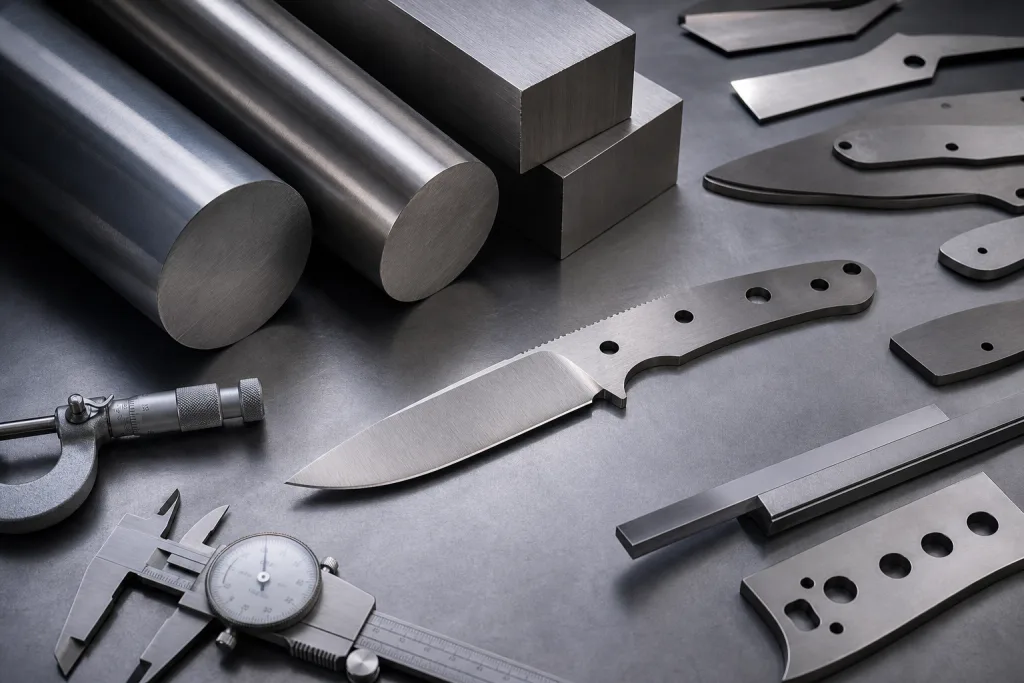
For 80% of retail-ready folding chef knife projects we ship, a blade length of 120-160 mm works. Blade thickness usually sits between 2.0 mm and 2.8 mm, depending on steel and grind. A hardness band of 56-58 HRC is safe for mainstream stainless steels such as 5Cr15MoV or 420HC. For 8Cr13MoV, 9Cr18MoV, AUS-10, or VG-10 class materials, 58-60 HRC is common, but only if the heat-treatment log matches the target and the edge angle is not too aggressive. QC pulled one 9Cr18MoV sample last month at 61 HRC; the edge chipped after 40 board cuts, so we rejected that tempering batch.
Before asking a folding chef knife moq lead manufacturer for a final quote, lock the spec sheet. At minimum, define blade steel, blade length, blade thickness, surface finish, edge angle, lock type, pivot screw type, handle material, logo method, packaging structure, warning label, and target retail price. Better still, add tolerances such as blade thickness ±0.1 mm, logo position ±0.5 mm, and carton drop-test requirement. If these stay open, 6 suppliers will quote 6 different knives, and the lowest price tells you nothing. We once had a PO typo that changed “satin” to “stonewash”; the buyer flagged it only after the pre-production sample arrived.
For promotional programs, I prefer simple builds that survive retail handling: stainless steel blade, liner lock or frame lock with clean engagement, G10 or stabilized wood handle, satin finish, and a plain edge. Coatings look good in renderings, but they scratch during assembly unless the standard is written down with photos and an AQL 2.5 inspection point. This is the wrong place to chase a fancy look. On the packing table, black-coated blades show every rub mark from the EPE tray, and returns start when shoppers see silver lines near the spine.
Check retail packaging before production
Packaging is where 3 out of 10 promotional knife launches lose a week. The folding chef knife can pass opening-force and lock checks, then sit in our finished-goods area because the color box barcode will not scan, the PET insert leaves 4 mm of tip movement, or the warning label was left off the artwork. QC pulled the sample, scanned it with a Zebra DS2208, and the EAN failed. Treat packaging as part of the knife.
Start with the sales channel. For a retail shelf, confirm the hang tab size, window position, anti-theft tie hole, and country-of-origin text before we cut the box mold. For e-commerce, use the right outer carton strength; a 5-ply K=A carton survives courier handling better than a thin display carton. For a premium promotional gift, a magnetic box or EVA pouch can work, but the blade still needs a locked internal position with no free travel. Sharp steel moving loose in a box is asking for a claim.
Ask your folding chef knife moq lead wholesale partner for the packaging dieline before sample approval. Your designer should place the logo at 1:1 scale, barcode with a quiet zone, FNSKU if Amazon needs it, importer address, material claims, warning text, age statement where required, and disposal marks backed by documents. We run dieline checks on a 300 dpi printout with 3 mm bleed, because a 2 mm artwork shift can put the barcode across a box fold. For Europe, do not print food-contact icons or eco claims unless the files support them. For the United States, check state warning rules such as Prop 65 when coatings, handles, or printed inks trigger review.
Master carton labels should show SKU, PO number, packed quantity per carton, gross weight, net weight, carton size, country of origin, and the buyer’s destination label format. If you need mixed cartons, say it before packing instruction approval, not after mass production starts. We have seen this go sideways: the buyer flagged a PO typo showing 24 pcs per carton while the approved carton held 12 pcs, so the packing team had to relabel 180 cartons and reopen 15 for inspection. The math does not work when mixed-carton rules arrive at the loading dock.
Build compliance into the quote
Compliance should be priced into the quote, not chased 7 days before shipment. It changes steel grade, surface finish, laser marking, carton text, and sometimes where you can sell the knife. A folding chef knife touches food, so we check stainless composition and surface cleanliness before the grinding line starts mass work. On one 8-inch sample, QC pulled the blade after polishing because black compound stayed inside the pivot gap. The handle also contacts food during washing or prep on some designs, so do not treat it like decoration.
For North America, buyers ask for FDA food-contact suitability, ASTM-related packaging or performance references, and state warning language. For Europe, LFGB and REACH come up early. If the product uses wood, check treatment method and moisture control; we usually keep incoming wood at 8-12% moisture before CNC shaping. If it uses plastic, resin, coating, or adhesive, ask for test history on the same material and color. A lab report from an old SKU helps, but it does not cover your exact folding chef knife. We have seen this go sideways when a buyer changed from black G10 to red resin and assumed the old report still passed.
At TANGFORGE, we tell B2B buyers to budget third-party testing for new retail SKUs. Simple rule. The cost is small next to a rejected container sitting at port. Depending on test scope and lab, expect roughly USD 300-1,500 per SKU or material group. If you launch 4 handle colors, the lab can ask for separate pigment or coating checks. One buyer flagged the testing fee as “optional” on the PO; that is the wrong question to ask when the retailer’s compliance team will block the item code without a report.
Factory audits matter for buyers placing 3,000 pcs and above. BSCI, ISO 9001 procedures, metal traceability, grinding records, heat treatment logs, and final inspection reports reduce repeat-order risk. They cannot fix a poor lock design or a blade that chips at the tip. They show whether the factory can run the same knife again on the next purchase order, with the same HRC target, pivot screw torque, edge angle, and carton label format. We ship better when the audit file matches the actual production bench, not just a clean folder in the meeting room.
Inspect function, not only appearance
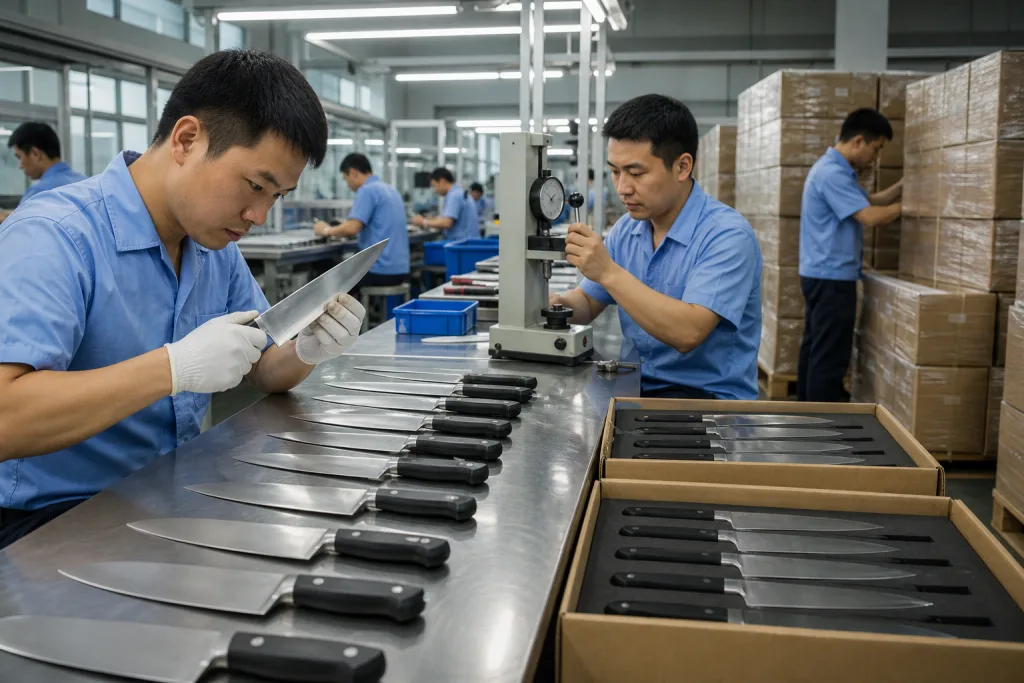
A folding chef knife can pass a photo review and still come back from retail with complaints. We check function first. On the assembly bench, QC opens 32 samples per lot with a thumb push, then checks lock bite, blade centering, liner rub, and screw torque with a T6 driver. The edge must stay even from heel to tip, not thick near the heel because the grinding line rushed the last 20 mm. Handles need clean edges: no burrs at the scale joint, no loose pivot screw, no oil mark around the liner.
For mass production, put the inspection standard on paper before the PO is signed. AQL 2.5 for major defects and AQL 4.0 for minor defects is a solid starting point for promotional and retail programs. Critical defects get zero tolerance. We classify lock failure, exposed blade in closed position, broken tip, serious rust, wrong steel, missing warning label, and unsafe packaging as shipment blockers; one buyer flagged a missing “folding blade” warning sticker after 3,000 pcs were already packed, and the rework ate 2 days.
Use checks the inspector can measure, not wording like “good quality.” Blade hardness should be checked by batch, such as 56-58 HRC or 58-60 HRC depending on the steel, with the HRC tester record attached to the QC file. Blade thickness can allow a tolerance such as ±0.15 mm. Logo position can use ±1.0 mm if the artwork is small; we once saw a 1.8 mm logo drift on black G10 scales because the pad-printing jig was not locked. Carton weight should match the packing list within a set range, for example ±0.5 kg on a 12 kg master carton. If you have a target sharpness level, ask the factory to confirm CATRA testing or agree on a cutting test before production starts.
Pre-shipment inspection should happen after at least 80% of goods are packed and 100% are completed. For a tight retail launch, run inline inspection around 20-30% production. This is where the math saves you: fixing 600 pcs with wrong logo color takes 1 day, while reworking 6,000 pcs after final packing takes 4-5 days and usually pushes the vessel booking. We’ve seen this go sideways when the PO had “matte black box” typed as “mate black box,” so QC pulled the sample early and caught the printing plate before mass boxing.
Lock the commercial terms early
A retail launch checklist has to lock payment terms, freight responsibility, and reorder timing before the grinding line starts. We have seen 6 launch delays in one quarter, and none came from the CNC grinder or heat-treatment oven. The usual problems were late deposits, incoterms written as “FOB China” with no port, missing 38 mm side shipping marks, or a buyer changing from 24 pcs to 12 pcs per carton after QC pulled the packed sample.
For first orders, we usually run 30% deposit and 70% balance before shipment after inspection. FOB China ports work well for importers with their own forwarder, and we normally quote FOB Shenzhen or FOB Guangzhou so the handover point is not fuzzy. DDP is fine for promotion buyers, but write down the full scope: duty rate, customs clearance party, delivery to one named warehouse, appointment fee, remote area charge, and tax handling. A DDP price that is USD 0.18 lower per knife can still be bad buying if the truck booking or customs paperwork is weak.
Reorders need a separate calendar. If your first run is 2,000 pcs and retail sell-through is strong, the second order still may need 35-50 days production unless the factory keeps material on hand. Ask whether the folding chef knife moq lead factory can reserve 3Cr13 or 5Cr15 steel, 350 gsm color-box paper, handle scales, or semi-finished blades after heat treatment. We usually need a rolling forecast or a small deposit for this. Fair enough. Without it, the math does not work when 8 other buyers are also asking for the same black G10 handle material.
Before you issue the PO, confirm the SKU list, final sample status, unit price, MOQ, lead time, packaging file version, inspection standard, spare parts policy, incoterm, shipping method, carton dimensions, and claim process. We once had a PO typo showing “matte balck handle,” and the buyer flagged it only after the color box was plated for printing. That is the wrong time to ask. A capable folding chef knife moq lead supplier in China will not push back on this level of detail because it protects the buyer, the factory, and the shipment record under AQL 2.5.
Frequently asked questions
For a simple logo program, 500-1,000 pcs may be possible if the folding chef knife uses an existing mold and standard packaging. For custom folding chef knife moq lead projects with private label color box, expect 1,000-2,000 pcs per SKU. If you need a new handle texture, custom coating, special steel, or molded insert, 2,000-5,000 pcs is more realistic. New mechanism or new tooling can require 5,000 pcs or more. Always ask whether the MOQ is per design, per handle color, per logo, or total order.
For an existing design with logo engraving and approved artwork, plan 45-60 days after deposit and sample approval. For private label retail packaging, 60-75 days is safer. A new mold, special blade finish, or custom handle material can push the project to 90-120 days. These numbers exclude ocean freight, which often adds 25-40 days to Europe or North America. The biggest timing risk is usually not blade production; it is late artwork approval, unclear compliance labeling, or repeated sample changes.
Sometimes, but not always. If you order 2,000 pcs of the same knife and only change handle color, a factory may accept 1,000 pcs per color or even 500 pcs per color if materials are available. If each color has a different box, barcode, logo, or insert, it becomes a separate SKU and the MOQ may apply separately. Mixed colors also increase packing and inspection risk. For a first launch, two colors are easier to control than five.
Use AQL 2.5 for major defects and AQL 4.0 for minor defects, with zero tolerance for critical safety defects. Check lock engagement, blade centering, opening and closing action, edge sharpness, burrs, rust, logo position, packaging safety, barcode readability, carton labels, and quantity. For steel hardness, request batch readings such as 56-58 HRC or 58-60 HRC depending on the specification. If the order is important, inspect at 20-30% production and again after packing.
FOB is best if you already have a forwarder and import process. It gives you more control over freight and customs costs. DDP is convenient for smaller promotional buyers, but confirm duty, customs clearance, tax handling, warehouse delivery, appointment fees, and insurance. For retail launches, landed cost is the number that matters. A USD 0.20 cheaper knife can become more expensive if carton size is inefficient, duty code is wrong, or air freight is needed because the schedule was unrealistic.
Send your launch brief for a factory review
Share target retail price, quantity, sales market, packaging needs, and launch date. TANGFORGE will reply with MOQ, lead time, and practical specification options.
Request a Quote