A folding chef knife is not a standard line item for most restaurant supply distributors. It crosses kitchen cutlery and outdoor prep, so sell-through jumps around. We have seen 300 pcs move in 10 days for a grill promotion, then the same black G10 handle version sit for 42 days after the display changed. Buy too light and the buyer flags stockouts. Buy too deep and your cash gets stuck in slow SKUs.
At TANGFORGE in Yangjiang, Zhejiang, China, we see this every season: buyers ask for custom folding chef knife designs, then reorder like it was a one-off promo. That is the wrong way to run it. A clean MOQ and reorder plan should be set before the first purchase order, tied to factory lead time, color or handle variants, carton quantity, AQL 2.5 inspection, and your distributor sales velocity. Last month QC pulled the sample because the PO said “walnut handle” but the approved sample card showed pakkawood; small typo, 12 days lost.
Why MOQ Drives Reorder Risk
MOQ is not just a factory rule. It sets your unit cost, SKU spread, inspection bill, and whether the next shipment moves by sea or by expensive air freight. For a folding chef knife, MOQ sits above a basic stamped kitchen knife because we run more parts on the line: blade, pivot, liner or frame, lock, screws, washers or bearings, handle scales, clip if used, pouch or sheath, and retail packaging. QC also checks blade centering with a 0.2 mm feeler gauge, not just sharpness.
As a folding chef knife manufacturer, TANGFORGE normally recommends 600 pcs per model for a semi-custom order using existing tooling, and 1,000-1,500 pcs when the buyer wants a new handle mold, special blade profile, private-label box, or color-matched accessories. A 300 pc trial is sometimes possible, but the FOB price often rises 15-30% because setup, jigging, and inspection time do not shrink in the same proportion. The grinding line still needs fixture changeover, and QC pulled the sample batch even when the PO was only 300 pcs.
Restaurant supply distributors should not look only at the first MOQ. That is the wrong question to ask. Ask what the second and third reorder MOQ will be. Some factories quote a low opening order, then push higher reorders because material suppliers will not split small lots of G10, pakkawood, 5Cr15MoV, 8Cr13MoV, or 1.4116 steel. We have seen this go sideways when a buyer approved a 500 pc launch, then found the next handle scale lot required 1,200 pcs minimum.
A better approach is to build the folding chef knife moq reorder plan around your expected monthly sell-through. If you expect to sell 250 pcs per month through restaurant supply dealers, a 1,000 pc first order gives around four months of stock. With a 45-60 day production lead time and 25-35 day ocean transit to North America or Europe, you cannot wait until month three to reorder. Trigger the next PO as soon as stock falls below about 650 pcs. Simple math. One buyer once sent the reorder PO with the old black handle code still on it, and that typo cost 6 days before we could book material.
Set the First Order Quantity
The first order should test sell-through, not fill your warehouse with dead colors. For restaurant supply distributors, we usually start with 1 core folding chef knife size, 1 steel grade, and 2 handle options tied to real dealer orders. Six colors look nice in a catalog mockup; the math does not work unless your dealers have already committed. We have seen this go sideways: black sold out in 12 days, red and green still sitting after 90 days, and the buyer flagged the cash tied up in slow cartons during reorder review.
For a custom folding chef knife, the blade is usually 160-190 mm when open, with a folded length around 110-130 mm. Common steel options are 5Cr15MoV at HRC 55-57 for value programs, 8Cr13MoV at HRC 56-58 for better edge retention, and 1.4116 or AUS-8 for buyers who need stronger European or North American positioning. If your distributor catalog sells mostly to working kitchens, do not overspec the steel if the target FOB must stay under USD 8.50-12.50. On the grinding line, a 5Cr15MoV sample at HRC 56 with a clean 18-20° edge often passes kitchen testing better than a pricier steel with poor heat treatment.
Here is a realistic launch structure for a folding chef knife wholesale program from China:
| Program type | Suggested MOQ | Typical FOB range | Best use |
|---|---|---|---|
| Stock design, logo laser | 600 pcs | USD 5.80-8.20 | Dealer test order |
| Custom handle color and box | 1,000 pcs | USD 7.20-11.50 | Distributor catalog SKU |
| New blade or handle tooling | 1,500-3,000 pcs | USD 9.50-16.00 | Private label launch |
Do not turn every cosmetic detail into a new SKU. If you need two handle colors, keep the same blade, lock, box, carton, barcode layout, and manual, with only the handle color code changed on the PO. Small thing. It matters. We once caught a PO typo where “BK” and “BL” were swapped, and QC pulled the sample before packing because the carton mark did not match the barcode file. Keeping the folding chef knife factory on one production setup cuts line changes and gives your inspection team a cleaner AQL 2.5 sampling plan.
Build Reorder Timing Backwards
Most stockouts start with the same mistake: the buyer counts only production days. Wrong question. A real reorder clock starts before the grinding line sees the blade blank: PO confirmation, deposit receipt, steel and G10 or wood handle purchasing, CNC cutting or stamping, heat treatment, grinding, assembly, edge sharpening, cleaning, packing, pre-shipment inspection, export booking, port handling, ocean freight, customs clearance, then domestic delivery. Last month QC pulled 32 pcs from a folding chef knife lot because pivot screws were 0.15 mm off spec, and that alone cost 2 extra days.
For TANGFORGE in Yangjiang, Zhejiang, standard lead time is usually 45-60 days after deposit and artwork approval for repeat orders. New OEM projects can take 75-100 days including samples and packaging confirmation. Our monthly capacity is about 300,000 knife units across kitchen lines, folding knife assembly, outdoor SKUs, and Damascus finishing work, but capacity is booked by steel grade, handle material, process route, and inspection lane. A folding knife with tight pivot tolerance cannot jump onto a kitchen knife line; we run its pivot fit on a separate bench with a 0.05 mm feeler gauge.
If you import from China to the US East Coast, Europe, or Canada by sea, add 25-40 days for freight and clearance depending on season. If your distributor network needs 14 days to receive cartons, relabel barcodes, split dealer allocations, and ship out, the reorder clock is already past what 6 out of 10 first-time buyers expect. We ship FOB Shenzhen or Ningbo often, and the buyer flagged this exact problem when their warehouse needed 18 days instead of 12 days because the PO had one SKU digit typed wrong.
A practical reorder calculation looks like this: if you sell 250 pcs per month, and total replenishment time is 90 days, you need at least 750 pcs to cover demand during replenishment. Add 20-30% safety stock for dealer promotions, late vessel schedules, and inspection holds. That means your reorder trigger should be roughly 900-975 pcs if the monthly sell-through is stable. For a 1,500 pc opening order, you may need to reorder after selling only 500-600 pcs. It feels early. The math does not care, and we have seen this go sideways when AQL 2.5 inspection finds carton drop damage on 3 master cartons right before booking.
Restaurant supply buyers often want to wait for cleaner sales data. Fair pushback, but the factory calendar will not wait. Chinese New Year, National Day, and peak Q3 export bookings can add 10-25 days. Build those dates into your folding chef knife moq reorder plan, especially if your selling season is spring catering or Q4 gifting. On our side, once the heat-treatment oven schedule is full for 7Cr17 or 440C blades, a late 800 pc reorder does not slide in neatly.
Control SKU Count and Variants
SKU discipline protects margin faster than another finish option. We can build 30+ folding chef knife variants on the same grinding line, but your first catalog should not carry them all. For distributors, every extra SKU needs a barcode, a warehouse slot, ERP setup, dealer notes, product photos, and spare-part control. Last month QC pulled a sample where the blade label said “8Cr13MOV” on the PO but “8Cr13MoV” on the carton mark; one small variant error held 12 cartons at final inspection.
The dangerous first order is three steels, four handle materials, two blade finishes, and two packaging formats. That is 48 combinations before you have reorder data. We have seen this go sideways: black G10 sells through in 21 days, wood handle sits for 64 days, satin beats blackwash, and the gift box adds 18% carton cube without lifting dealer reorders. The buyer flagged the freight cost only after our packing team measured the master carton with a tape at 52 x 38 x 31 cm.
A cleaner launch is one blade steel, one blade finish, two handles, and one box. If the product sells, add the next handle or finish on the second or third PO. This is the right way to ask the factory for support; chasing a full color board on day one gives nice samples and bad stock aging. We run the pilot on one screw set and one liner drawing, so assembly can check pivot tension with the same Torx driver across the order.
Good first-order structure
- Blade: 180 mm open chef profile, 8Cr13MoV, HRC 56-58.
- Handle: black G10 and dark pakkawood, using the same liner, pivot, and screw spec.
- Packaging: one color box with a 35 x 20 mm blank area for FNSKU or EAN label.
- Branding: laser logo on blade, with box logo only if the MOQ covers plate cost.
- Carton: 48 or 60 pcs per master carton, so warehouse staff can count by carton instead of opening trays.
Plan replacement parts before the deposit. Folding knives need screws and pivots; clips or bearings depend on the design. If every variant uses different hardware, the math does not work for after-sales. For restaurant supply distributors, we usually ship a 1-2% spare screw and pivot kit allocation, packed in a small PE bag with the same item code QC uses on the inspection sheet.
Price the Reorder, Not Just Launch
A low first FOB price can hide trouble if it is built on leftover 5Cr15MoV coil, old carton stock, or a packing idea that never passed the packing table. Ask the folding chef knife factory to quote the launch order and the reorder price at 600 pcs, 1,000 pcs, and 3,000 pcs. We run this on one sheet with blade steel, handle, pouch, box, and carton CBM separated. The buyer sees the real ladder. Your sales team can set dealer margin without guessing.
For 8 out of 10 folding chef knife wholesale programs we review, packaging and QC are priced too light. A retail box, insert card, desiccant, warning label, barcode label, and master carton can add USD 0.45-1.20 per unit, and the carton thickness alone can change the quote by USD 0.08. If you require a nylon pouch, add another USD 0.60-1.50 depending on fabric and stitching. Amazon Business and large dealer platforms usually bring FNSKU, suffocation warning, carton labels, and drop-test packaging into the job. We have seen this go sideways when the PO says “color box” but the buyer meant a 350 gsm printed box with EVA insert.
Inspection cost belongs in landed cost. Not later. AQL 2.5 for major defects and AQL 4.0 for minor defects is common for commercial cutlery, but folding knives need extra function checks on the QC bench. QC pulled the sample with a 0.18 mm handle gap last month, and the buyer flagged lock feel before artwork approval. Check lock engagement and blade centering with clear pass limits, then check opening resistance, pivot play, edge burr, handle gap, logo position, carton barcode, and rust protection. If 200 pcs fail lock or pivot checks, the math does not work: rework hours, a missed vessel, and dealer backorders all hit the reorder.
Reorder price also moves with steel, handle material, and RMB exchange rate. China steel prices and exchange rates can move between POs, even on the same SKU. A practical quotation validity is 15-30 days. If your reorder plan is annual, ask for a supply agreement with price review rules instead of pushing for a fixed price for 12 months. This is the wrong question to ask if the factory has no way to hold coil cost; a serious folding chef knife supplier ships better when the commercial terms match the real cost structure.
Quality Specs That Protect Reorders
Reorders are won or lost by consistency. A dealer may let a small handle radius change pass on the launch order, but batch 2 cannot feel like a new knife. QC pulled a reorder sample last May where the liner lock sat 0.6 mm proud, and the buyer flagged it before we even checked the carton label. The sample photo did not save that order. The spec sheet did.
For a custom folding chef knife, set measurable standards before mass production starts. Blade thickness might be 2.2-2.8 mm depending on design. Edge angle might be 15-18 degrees per side, checked on the grinding line with an angle gauge, not guessed by eye. HRC should have a target band, for example 56-58 HRC for 8Cr13MoV, and we run the Rockwell tester on pre-production blades before assembly. Folded length, open length, handle thickness, lock type, screw material, surface finish, logo size, and logo position need to sit in the PO or approved sample file, with tolerances such as ±0.3 mm where the buyer cares.
Food-contact compliance also matters. For Europe, ask about LFGB and REACH where applicable. For North America, FDA food-contact expectations and Prop 65 labeling may be relevant depending on the materials and sales channel. If the handle uses wood, confirm moisture control and coating; our moisture meter usually needs the scale material held around 8-12% before CNC shaping. If the handle uses colored G10, micarta, or plastic, confirm color fastness and odor control, because we have seen a buyer reject 600 pcs after opening the inner polybag and smelling solvent.
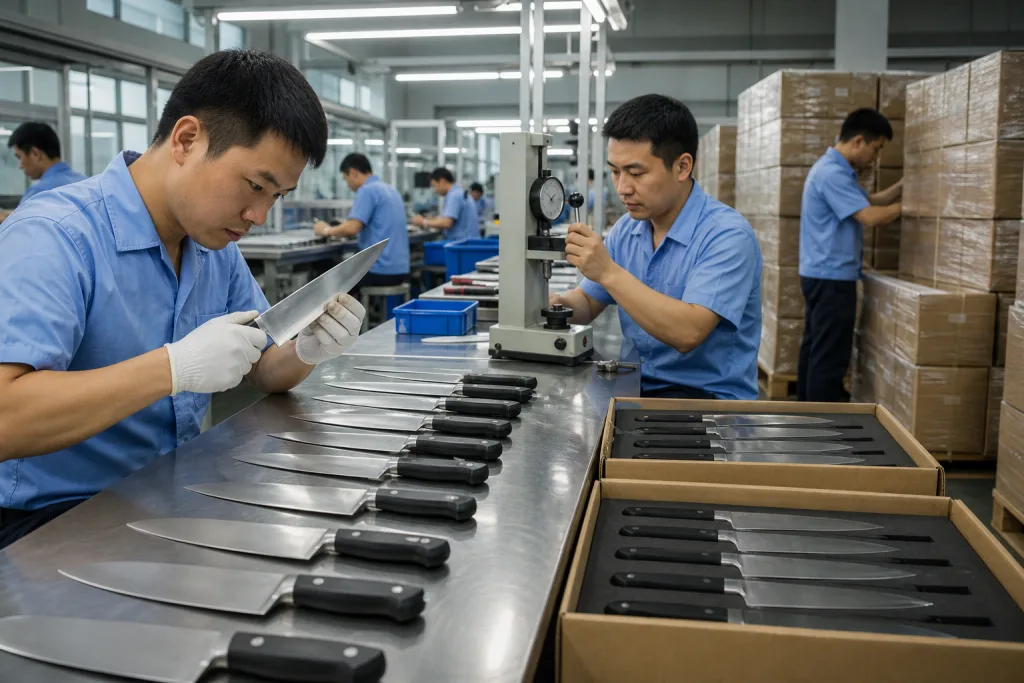
At TANGFORGE in Yangjiang, Zhejiang, China, our export QC team uses incoming material checks, hardness testing, assembly inspection, edge sharpness checks, and final random inspection. For higher-volume distributor programs, we run agreed AQL levels, carton drop checks, barcode scans, and lot traceability when the PO calls for it. AQL 2.5 on function and appearance is common, but the right level depends on MOQ, retail price, and failure risk. We are not fans of vague words like “good quality.” The math does not work. You need numbers, tolerances, and signed samples.
One practical point: keep a golden sample from each approved batch. When the reorder comes, compare new production against the golden sample for blade action and handle color, then check edge feel, laser marking, and packaging shade under the same light box. We ship one sealed reference sample to some distributors and keep one in our QC room with the batch card. This avoids arguments caused by memory, monitor color, or a sample that was quietly modified after approval.
Use Forecasts the Factory Can Act On
A forecast does not have to be perfect. It has to be usable. If you tell a folding chef knife factory “maybe 10,000 pcs this year,” we cannot book 3Cr13 or 5Cr15 steel, handle scales, or assembly slots on the grinding line with any confidence. Give us quarterly ranges instead: 2,400-3,000 pcs in Q1, reorder trigger at 900 pcs, preferred ship month in March. That is the kind of forecast our production planner can put into the whiteboard schedule.
For example, a distributor might open with 1,200 pcs, then repeat 1,200 pcs every 10-12 weeks once sell-through reaches 250-300 pcs per month. If a dealer promotion is coming, show the promotion month and the expected lift. A 20% promotion lift can pull the reorder date forward by three or four weeks. We have seen this go sideways when the buyer sent the PO after the promo flyer was already printed, and QC pulled the sample while cartons were still missing the new barcode.
Send packaging and label requirements early. Restaurant supply distributors usually ask for inner carton labels, pallet labels, country-of-origin marking, EAN or UPC, plus customer item numbers printed exactly as their warehouse system reads them. These jobs are not hard, but a late label change can park 48 finished cartons in the packing room for 3-5 days. Last month a PO typo changed “folding chef knife” to “folding chiefs knife,” and the buyer flagged it after the carton artwork was already plated.
A workable B2B rhythm is simple: monthly sell-through report from you, rolling 90-day forecast to the factory, reorder PO when stock hits the trigger, and final artwork freeze 30 days before packing. If your company uses DDP, confirm duty code and destination warehouse rules before production finishes, then send delivery appointment requirements with the PO. If you buy FOB Yangjiang or Shenzhen, match booking dates to inspection timing. The math does not work if the vessel closes on Friday and AQL 2.5 inspection is booked for the same morning.
The best folding chef knife moq reorder plan is boring on purpose. It runs fewer SKUs, clear MOQ tiers, realistic lead time, and the same QC checkpoints every reorder, including blade lock check, edge grind review, and carton drop test. We ship better repeat orders when the buyer accepts this discipline. Chasing 9 colors on a 600 pcs reorder sounds flexible, but the factory-floor reality is split materials, slower packing, and more chances for mixed labels.
Frequently asked questions
For a practical B2B program, expect 600 pcs for a stock folding chef knife with laser logo, 1,000 pcs for custom handle color and private-label box, and 1,500-3,000 pcs for new tooling. Smaller quantities may be possible, but FOB price can increase 15-30% because setup, inspection, and packing work remain almost the same. If you want stable reorder pricing, ask for MOQ tiers at 600, 1,000, and 3,000 pcs before approving samples.
Work backwards from total replenishment time. For repeat folding chef knife orders from China, use 45-60 days for production plus 25-40 days for ocean freight, customs, and domestic receiving. If you sell 250 pcs per month, you need 750 pcs just to cover a 90-day replenishment window. Add 20-30% safety stock. In that case, reorder when inventory falls near 900 pcs, not when only 200 pcs remain.
Usually yes, but do it carefully. A 1,000 pc MOQ split into two colors at 500 pcs each is manageable if the blade, liner, screws, packaging, and barcode structure stay the same. Splitting into four colors at 250 pcs each creates more material waste, color matching work, and inventory risk. For a first distributor launch, two handle options are enough. Expand after you have 3-4 months of sell-through data.
Check more than blade sharpness. A folding chef knife needs stable lock engagement, centered blade, controlled pivot resistance, no side-to-side play, clean edge without burrs, correct HRC, smooth handle fit, and accurate laser logo. For 8Cr13MoV, a common target is HRC 56-58. For inspection, use AQL 2.5 for major defects and add function tests for lock, opening action, and blade centering. Keep approved golden samples for reorder comparison.
Start with FOB unit price, then add packaging, inspection, freight, duty, customs brokerage, warehouse handling, and possible relabeling. A retail box and labels may add USD 0.45-1.20 per knife; a pouch may add USD 0.60-1.50. Ocean freight and duty vary by destination and HS code, so do not set dealer price using FOB alone. For restaurant supply distributors, model margin at 600, 1,000, and 3,000 pc reorder levels.
Plan Your Folding Knife Reorder Program
Send your target MOQ, monthly sales forecast, steel preference, and packaging needs. We will quote launch and reorder tiers with realistic lead times.
Request a Quote