Packaging is where 7 out of 10 folding chef knife projects lose margin. The knife passes QC, but the E-flute box dents after a 1.2 m drop test, the EVA insert rubs the black blade coating, the EAN-13 barcode scans at grade D, or the retail hook hole sits 8 mm off the buyer’s planogram.
If you are building a kitchenware brand, specify folding chef knife private label packaging at the same time as blade steel and handle material. At TANGFORGE in Yangjiang, Zhejiang, China, we see the same problem on the factory floor: the buyer approves a sharp custom folding chef knife, then sends carton artwork 12 days before shipment instead of the 18 days our printing supplier needs. QC pulled the sample, found the insert was 0.6 mm too tight, and the math did not work once re-proofing and delayed cartons were added. A packaging brief is not decoration. It is a purchasing control document.
Define the retail job first
A folding chef knife does not sell like a fixed chef knife. The blade moves, the lock or slip joint needs a clear safety note, and the gift angle is stronger. On the shelf, the box must answer 4 questions before the shopper touches the knife: blade length in mm, folding method, drawer or camping-kit safety, and food-contact status. We once had QC pull a sample because the carton said “8 inch chef knife” but the actual cutting edge measured 178 mm, not 203 mm. Small detail. Big argument.
Before you ask a folding chef knife factory for box pricing, decide where the knife will be sold. Amazon FBA needs barcode position, 1.2 m drop-test strength, carton labels, and FNSKU accuracy. Specialty kitchen stores need a clean shelf face, a hang hole that will not tear, anti-theft visibility, and product photos that match the real handle color under store lighting. Outdoor retailers often ask for stronger blister or window protection. Distributor catalogs care more about master carton marks and SKU coding than a fancy window box. We have seen this go sideways when a buyer approved a gift box first, then their warehouse flagged the missing outer-carton PO code.
At TANGFORGE, our normal OEM planning range for this category is 1,000-5,000 pcs per SKU, with 35-55 days mass production after deposit and approved samples. If your project is 500 pcs, we usually recommend a standard magnetic box or kraft box with a printed sleeve or label. The math does not work for full custom printing at that volume; one buyer paid for 3,000 printed boxes and used only 640 after the handle color changed. We run sleeve labels on small batches because the packing table can switch artwork in 20 minutes without stopping the knife assembly line.
A good brief should include blade length in mm, folded length, open length, net weight, steel grade, HRC band, handle material, logo position, sales channel, target retail price, and packaging dimensions. Better still, send the carton requirement and barcode file with the first PO. If you provide only a logo file and say “make it premium,” the factory will guess, and this is the wrong question to ask. Guessing costs days here: one dieline change, one printed proof, and one EVA insert adjustment can turn 12 days of packaging setup into 18 days before mass packing starts.
Choose packaging format by MOQ
There is no universal package for a custom folding chef knife. Match it to MOQ, retail price, freight lane, and the damage rate your buyer will tolerate. A USD 9 FOB promo knife does not belong in a USD 1.80 rigid box; the math doesn't work. A USD 38 FOB Damascus folding chef knife also should not go into a thin white tuck box, because QC pulled 12 samples last month and found 3 with corner crush after the 76 cm drop test.
Most kitchenware brand owners we ship for choose from four formats: plain kraft box with sticker, printed tuck-end carton, magnetic rigid box, or EVA zipper case with sleeve. For folding knives, we check blade tip protection before artwork sign-off. Small detail. If the folded knife has more than 2 mm of movement inside the insert, the tip or pivot area can rub through 350 gsm paperboard during 30 days at sea, and the buyer flagged this exact issue on a Germany PO in March.
| Packaging format | Typical MOQ | Approx. unit add-on | Best use |
|---|---|---|---|
| Kraft box plus label | 500 pcs | USD 0.25-0.55 | Test orders, wholesale bundles |
| Printed color carton | 1,000 pcs | USD 0.45-0.95 | Retail shelves and online sets |
| Magnetic rigid box | 1,000-2,000 pcs | USD 1.20-2.80 | Premium gifting, higher MSRP |
| EVA zipper case | 1,000 pcs | USD 1.60-3.50 | Outdoor kitchen, travel, chef kits |
| Blister or clamshell | 3,000 pcs | USD 0.75-1.50 | Mass retail with hanging display |
These are factory-side estimates, not fixed quotes. Paper price, magnet diameter, EVA density, Pantone coverage, and booking week all move the number. In Yangjiang, Zhejiang, China, packaging suppliers can turn samples in 5-7 days when the dieline is clean and the material callout is confirmed. If you switch from matte lamination to soft-touch coating after proof approval, we run a new proof cycle, and delivery often shifts from 12 days to 18 days.
For folding chef knife wholesale programs, carton efficiency matters more than buyers expect. Ask your folding chef knife supplier for inner carton and master carton dimensions before you approve the retail box. We check this with a tape measure on the packing table, not from a pretty 3D render. A box that looks strong but wastes 18 percent of carton volume will cost more in ocean freight and DDP delivery than the upgraded paper saves, and we've seen this go sideways on 1,000 pcs trial orders.
Logo methods on knife and box
Private label is not just a logo on the lid. On a folding chef knife, we usually mark the blade face and either the handle scale or the color box, depending on where the buyer wants the brand seen first. The wrong question is “which logo is cheapest?” A cheap mark that rubs off after 200 strokes in QC costs more when the buyer flags it during carton inspection.
Laser engraving on the blade is our safest method for stainless steels such as 5Cr15MoV, 8Cr13MoV, 9Cr18MoV, AUS-10, and VG-10 core laminated steel. We run it on the fiber laser after final polishing, then QC checks position with a 0.1 mm scale ruler against the approved drawing. Setup is usually one artwork file and one fixture, so repeat orders are fast. For a black coated blade, laser marking exposes the base metal and gives clear contrast, but lines under 0.2 mm disappear or look broken after coating thickness changes.
Pad printing works on handles and boxes when the logo needs color. It is not our first choice for a grip area. We run 3M tape testing and 500-cycle rub testing on printed handle logos, especially on G10, FRN, coated aluminum, and pakkawood. Embossed metal badges look better in photos, but assembly has less tolerance. If the badge is off-center by 0.5 mm, the buyer notices before checking blade sharpness.
- Blade laser logo: best for wear resistance, with small MOQs from 500 pcs and low repeat cost after the fixture is made.
- Handle engraving: works on wood, G10, stainless, and aluminum scales, but depth must stay controlled so the grip does not feel rough.
- Box foil stamping: good for gift packaging, but thin strokes and large solid blocks can fail on textured paper.
- Printed sleeve: lets 6 SKUs share one common box while the sleeve carries model name, barcode, and importer details.
As a folding chef knife manufacturer, we prefer to approve logo placement on a physical pre-production sample, not only a 3D rendering. We have seen this go sideways. The pivot screw, thumb hole, nail nick, and grind line all fight for the same 35 mm of blade space. QC pulled one sample where the PDF looked centered, but the bevel reflection made the logo look 2 mm too high under the inspection lamp.
Artwork files and compliance marks
Packaging delays usually start before the folding chef knife reaches our packing table. In the last 12 private label box jobs we ran, 7 were held because the artwork file was not ready for print. Send AI or PDF vector artwork, CMYK color values, outlined fonts, barcode at scannable size, bleed of at least 3 mm, and the dieline on a separate layer. A JPG logo copied from a website will fail when our prepress guy opens it on the CTP workstation.
For Europe and North America, compliance marks need the same discipline as blade inspection. The knife itself may need food-contact documentation depending on the material and market. Packaging claims must match the test reports in your file. Printing 'dishwasher safe' on a folding knife with a pivot and wooden handle is the wrong fight to start; we have seen buyers flag rust around the 2.5 mm pivot screw after sample washing. Printing 'German steel' without traceable steel origin can also get the shipment rejected by a distributor.
Common packaging marks include country of origin and importer name or address when required, plus SKU, barcode, FNSKU for Amazon, batch code, warning text, recycling symbols, and material claims. For kitchen knives, buyers ask for LFGB and FDA food-contact statements, REACH, RoHS for coatings or metal accessories where relevant, and Prop 65 review for California sales. Not every knife needs every document. The packaging should match the sales market, not a copied PO from another SKU; QC pulled one sample last month where the box said “stainless steal” beside the barcode.
TANGFORGE can check basic production feasibility, but legal wording stays with your brand. We can tell you whether a box can be printed, whether the 3 mm bleed is enough, and whether the barcode is too close to the glue flap. We cannot decide whether your claim is acceptable in every EU member state or every U.S. retail chain. Smart buyers send final packaging artwork to their compliance team before mass printing. It is cheaper than destroying 3,000 printed boxes.
Protect the knife during shipping
A folding chef knife has more rub points than a fixed kitchen knife. The pivot washer area can mark the insert, the lock cutout can press into paper pulp, and the blade spine often touches the tray if the cavity is 1 mm too shallow. If we run a black G10 handle with a pocket clip, QC pulled the sample and checked for silver scrape marks after 30 shakes. Retail packaging has to survive factory packing, export transport, and last-mile courier handling. A nice box that arrives crushed is just a complaint waiting to happen.
For most B2B orders, we suggest a basic transport test before mass shipment: assembled retail box drop tested from 76 cm on corners, edges, and faces; master carton compression check; and a shake test after 24 hours. This is not a replacement for ISTA lab testing, but it catches 8 out of 10 common problems we see on the packing table, such as loose inserts, cracked window film, and blade tip movement. For high-volume retail orders over 10,000 pcs, formal ISTA 1A or channel-specific testing is worth discussing. The math does not work if you save USD 0.06 on the insert and lose cartons to returns.
Insert choice matters. Paper pulp is eco-friendly and acceptable for 7 kitchenware brands out of 10 that ask us for plastic-free packaging, but the mold needs to hold the handle and spine without wobble. EVA foam protects well and looks clean in a gift box, but some buyers push back on the sustainability story. Folded paperboard inserts are cost-effective, so we check the blade tip pocket and every exposed corner with a 0.5 mm feeler gauge before approval. We normally keep at least 2-3 mm clearance around the thickest handle area and avoid direct pressure on the lock.
Master carton specification should be written into your purchase order. For example: 5-layer export carton, gross weight under 15 kg where possible, moisture protection bag if shipping during humid months, and carton label with PO, SKU, quantity, net weight, gross weight, carton size, and made in China marking. We have seen this go sideways when the PO said “standard carton” and the buyer flagged crushed corners after a 22-day sea shipment to Hamburg. A folding chef knife supplier that only quotes the retail box and ignores master cartons is leaving a real risk on your side.
Inspection points before shipment
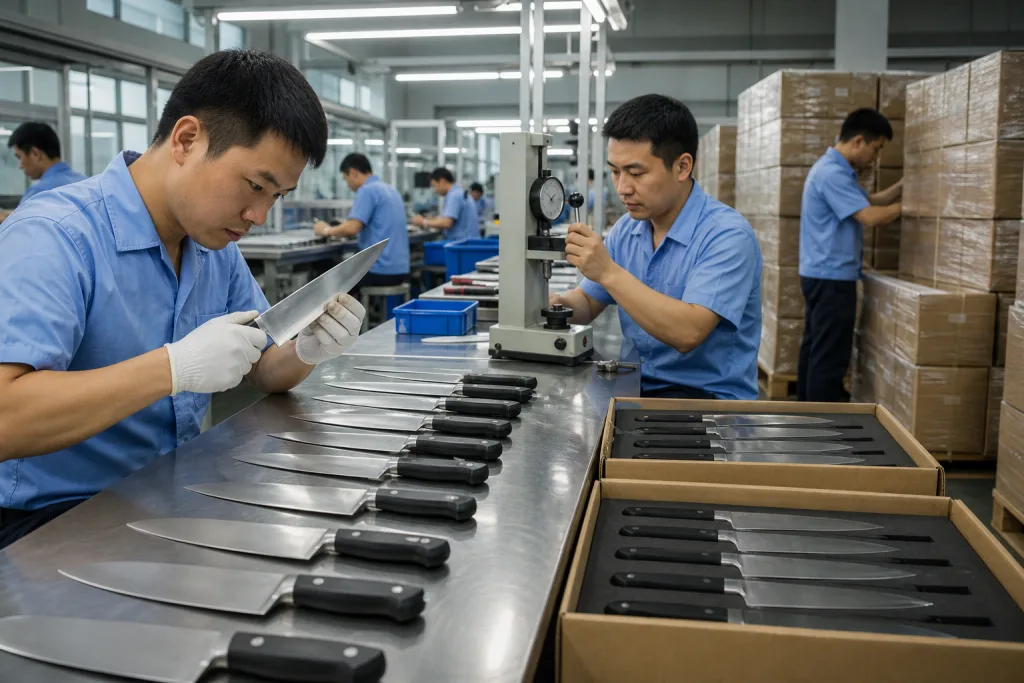
Packaging inspection deserves the same discipline as knife inspection. Do not wait until goods reach your warehouse to find the logo sitting 2 mm too low, or a PET insert rubbing a satin handle during vibration. For private label jobs, we run one signed golden sample before bulk packing: knife and logo checked against artwork, box and insert checked on the packing bench, manual and barcode scanned, polybag thickness confirmed, master carton label matched to the PO. QC pulled one sample last month where the buyer’s PO had “folding chief knife” on the carton mark. We fixed it before printing plates were made.
For mass production, use AQL sampling. About 8 out of 10 importers we ship use AQL 2.5 for major defects and AQL 4.0 for minor defects. Critical defects should be zero tolerance. For a folding chef knife, critical packaging issues include wrong warning text, unreadable barcode, exposed blade from a failed insert, wrong country of origin, or mixed SKU in one carton. Major defects include crushed retail boxes, incorrect logo color, missing manual, loose knife movement inside the tray, or carton quantity mismatch. This is where the math does not work: saving USD 0.03 on a thinner insert can create a full carton rework if 125 mm blades shift in transit.
Packaging QC should check appearance and function. Scan 12 barcodes from at least 4 different master cartons, not only the first sample sitting on the QC table. Confirm the retail box opens and closes cleanly after lamination, because glue squeeze-out can make a magnetic lid feel cheap. Check that the knife can be removed without cutting the insert or touching the blade edge. If the package includes a magnetic lid, confirm magnet pull after lamination and assembly. If it uses a hanging tab, load test it with the packed weight for 24 hours. The buyer flagged this once after a peg hook test in Germany; we now test it before sealing cartons.
Our factory output for mixed knife categories is planned around stable monthly capacity, not heroic last-minute overtime. For folding chef knife programs, realistic scheduling works better: 7-10 days for packaging proof, 10-20 days for confirmed printed packaging, and 35-55 days total production after sample approval. China factories can move fast, but printing mistakes move slowly because rework means new paper, new film, new die-cutting, and another pass through the packing line. We have seen this go sideways when artwork approval came 12 days before vessel closing instead of 18 days. The grinding line can catch up; a wrong barcode on 3,000 color boxes cannot.
Cost control without cheapening the brand
Good packaging is not the priciest packaging. It has to match the price point, protect the knife, and give the distributor fewer reasons to push back. If your MSRP is USD 29.99, a 350 gsm printed carton with a PET insert may beat a rigid gift box that adds USD 0.62 and slows packing on the line. If your MSRP is USD 89.99, a stronger gift box with a 1.5 mm greyboard base can make sense. The math decides.
Cost control starts with boring choices. We run one common box size for 2 custom folding chef knife models, then change the sleeve, label, or barcode. Keep foil stamping on the front face, not 5 panels. Oversized boxes look nice in a meeting, but DDP freight goes sideways when the master carton jumps from 12 kg to 15 kg. Use black-and-white manuals for safety instructions, then put recipe photos and warranty content online with a QR code. Confirm barcode and SKU structure before the first print run; QC once pulled 800 cartons because the PO had “CFK-08B” while the artwork said “CFK-80B.” Stickers fixed it, but nobody liked that fix.
Be honest about the order stage. A launch order should keep flexibility. A reorder should cut unit cost. For 500-1,000 pcs, keep tooling and printing simple: printed carton, standard EVA or PET insert, no custom mold unless the buyer accepts the charge. For 3,000-5,000 pcs, push for better paper, a custom molded insert, and stronger master carton specs such as 5-layer K=A for export. For 10,000 pcs and above, ask your folding chef knife manufacturer to check packaging automation, carton palletization, and container loading; saving 4 seconds per unit at the packing table becomes real money.
TANGFORGE works with kitchenware brands, importers, and distributors that need a folding chef knife factory in China to handle knife production and packaging coordination together. We do not say yes to every artwork idea. If a matte black box scratches after 20 rubs on the sample table, if a 0.2 mm logo line is too thin for foil, or if a blister leaves the blade tip too close to the edge, we will flag it before mass printing. We have seen this go sideways, and fixing packaging after shipment costs more than fixing it during pre-production.
Frequently asked questions
For a first order, plan on 500 pcs if you can accept a stock box with a custom label, sleeve, or laser-marked logo. Fully printed retail cartons usually make sense from 1,000 pcs per SKU. Magnetic rigid boxes and molded inserts are more efficient at 1,000-2,000 pcs, while clamshell or blister packaging often needs 3,000 pcs because of tooling and setup. If you are testing a new kitchenware brand, do not overbuy packaging. Use a common box size and change the sleeve by SKU. Once monthly sales are stable, upgrade to fully custom folding chef knife packaging with better insert control and lower unit cost.
Yes. The usual private label setup is laser engraving on the blade plus printed logo on the box or sleeve. For 500 pcs, blade laser marking and a printed label are the fastest route. For 1,000 pcs and above, we can add a custom carton, manual, barcode, and carton label. Handle logos are possible by laser, CNC engraving, pad printing, or metal badge depending on material. For fine logo lines, keep minimum line width around 0.2 mm for laser and avoid tiny reversed text on foil stamping. We always recommend approving one physical sample before mass production because blade grind, pivot placement, and handle texture affect how the logo actually looks.
If artwork is clean and the box style is already chosen, packaging proofing usually adds 7-10 days. Printed packaging production normally takes 10-20 days after proof approval. For a complete custom folding chef knife order, a realistic lead time is 35-55 days after deposit and approved sample, depending on steel, handle material, logo method, and packaging complexity. Rigid boxes, EVA cases, molded pulp inserts, and blister tooling can extend the schedule. The common mistake is approving the knife sample but delaying barcode, warning text, and dieline approval. That blocks printing, and printing delays can hold the whole shipment even when knives are finished.
Major defects include wrong logo color, crushed retail boxes, loose inserts, missing manuals, unreadable barcodes, mixed SKUs, wrong carton quantity, and visible stains or glue marks on premium packaging. Critical defects should have zero tolerance: exposed blade, wrong safety warning, incorrect country-of-origin mark, or packaging that allows the knife to open during transit. Many buyers use AQL 2.5 for major defects and AQL 4.0 for minor cosmetic issues. For higher-end retail, you may tighten cosmetic criteria because packaging is part of the product value. Always define the golden sample, defect photos, and acceptance standard before the folding chef knife supplier starts mass packing.
It can, but you need to design for both from the start. Amazon needs scannable FNSKU or barcode placement, carton labels, drop resistance, and clean warehouse handling. Retail stores may need a hanging hole, shelf-ready front panel, anti-theft visibility, and stronger branding. A practical compromise is a printed carton with a strong insert, barcode area on the back, optional sticker space for FNSKU, and master carton labels separated by channel. If you plan DDP delivery to Amazon and separate FOB shipment to distributors, tell the factory early. Carton size, label format, and packing quantity may need to be different for each channel.
Build packaging before you approve production
Send your knife specs, logo files, target channel, and MOQ. We will review packaging format, logo method, lead time, and factory-side cost before sampling.
Request a Quote