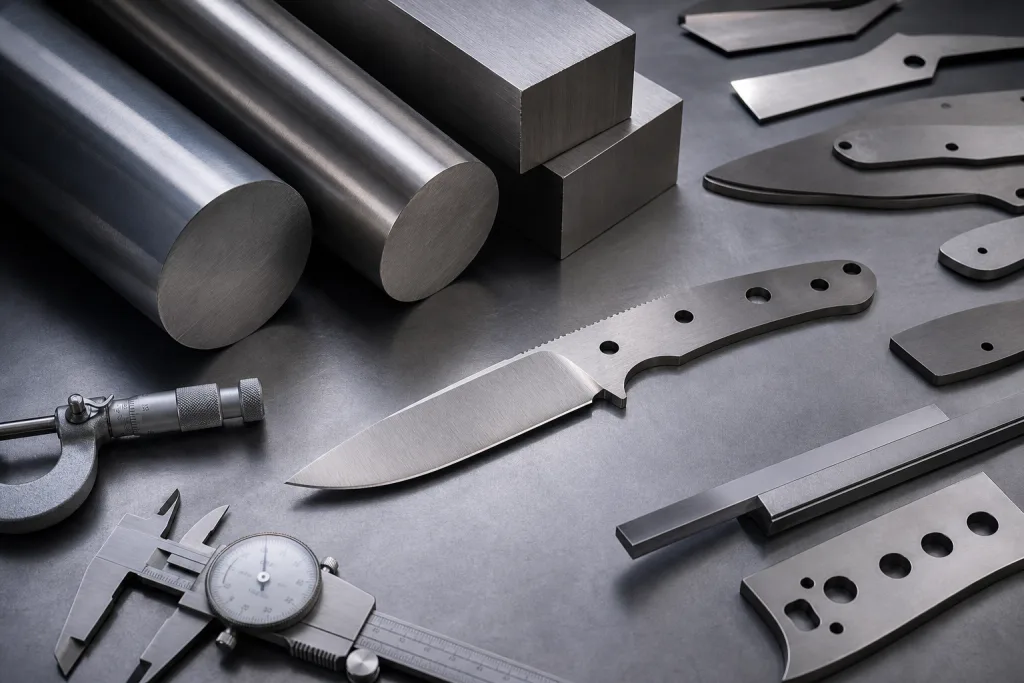
A folding chef knife is not a regular chef knife with a hinge pinned on. The blade stock is thin, often around 1.8 mm at the spine, and the lock takes real board-cutting force when the user chops garlic or trims meat at a campsite table. Get the steel hardness wrong by even 2 HRC and the sample can come back with micro-chips under a 10x loupe, dull sharpening feedback, or an edge that feels soft after one weekend trip. We’ve seen this go sideways.
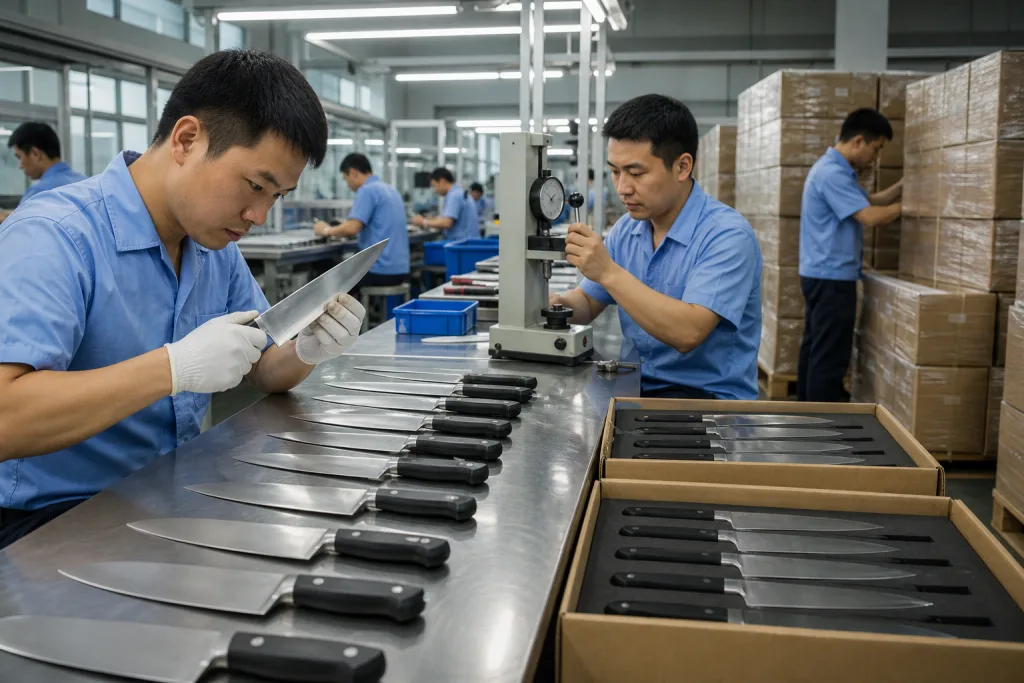
For promotional product buyers, the risk grows because the knife must pass retail packaging checks, logo decoration tolerance, barcode control, and rough user handling from people who never read a care card. At TANGFORGE in Yangjiang, China, we run folding chef knife steel hardness as a launch decision, not a throwaway material line on a quotation. Our Zhejiang and Yangjiang export team checks HRC readings on the Rockwell tester, confirms edge angle on the grinding line, tests lock strength, and measures carton drop damage before we call a project retail-ready. If a buyer only asks “what steel is it?”, that is the wrong question to ask.
Set the hardness before quoting
If you are asking three factories for prices, do not write “stainless steel blade” in the RFQ. Write the steel grade, target HRC band, blade thickness in mm, edge angle per side, and heat treatment method, such as oil quench plus tempering. A folding chef knife steel hardness factory cannot quote cleanly if one buyer expects 3Cr13 at 52 HRC and another expects 8Cr14MoV at 58 HRC. Same outline. Different job. Last month our quoting desk caught a PO typo that said 58 HRC on page 1 and 52 HRC on the packing spec, and the buyer flagged the price gap only after we sent samples.
For promotional retail launches, I advise buyers to choose hardness by the selling promise, not by chasing the biggest number. This is the wrong question to ask. A gift knife for camping meals does not need a brittle, high-HRC edge that chips when someone cuts on a steel plate. A premium boxed folding chef knife sold through outdoor retailers needs better edge retention and cleaner sharpening behavior, so the safest commercial band is often 56-58 HRC for mid-range stainless steel. If you push 59-60 HRC, we run tighter edge geometry checks on the grinding line, including a 0.3 mm behind-edge spot check before final sharpening.
At TANGFORGE, our monthly capacity is about 300,000 knife units across kitchen, outdoor, pocket, and custom lines. For folding chef knives, we still slow down at the sample stage because hardness changes grinding heat, polishing time, laser marking contrast, final sharpening, and after-sales risk. QC pulled one 8Cr14MoV sample at 59 HRC last season because the burr would not clean off after the second pass on the leather wheel. A factory that gives you a price without asking about HRC is either assuming the cheapest route or leaving the decision until production. We have seen this go sideways.
Put the hardness target into the quotation sheet and purchase order. Use a band, not a single number. “57 ±1 HRC” is more realistic than “58 HRC exactly.” If you need independent verification, write Rockwell C testing into the inspection plan, with test points taken from production blades before final packing. For a 3,000 pcs retail order, we normally ask the inspector to test 5 blades from bulk production after heat treatment and before blister cards are sealed, because once the cards are packed, rework turns into wasted freight and new barcodes.
Match steel grade to retail use
A folding chef knife sits in a tricky slot: food-contact kitchen knife on one side, liner-lock outdoor folder on the other. Steel choice drives returns, sharpening complaints, and landed cost, so treating it as “just hardness” is the wrong question to ask. We need rust resistance after sink washing, a stable edge for tomato and meat slicing, plus enough toughness around the pivot area; on our grinding line, a 0.8 mm edge before final sharpening behaves differently from a 1.2 mm outdoor blade.
For entry promotional programs, 3Cr13 or 420J2 works when the price target is tight and the carton claim stays honest. Do not sell it as a high-performance chef knife. Buyers push back here most often after a salt-spray mark or a weak edge-retention test, not at PO stage. For stronger retail appeal, 5Cr15MoV, 7Cr17MoV, 8Cr13MoV, or 8Cr14MoV are common choices in China knife production. We run these steels in the 55-59 HRC range with normal scrap, provided heat treatment is held and QC checks 5 blades per lot with a Rockwell tester. For a premium custom folding chef knife steel hardness project, 9Cr18MoV or AUS-10 type steels are options, but the math gets tighter because polishing time, belt wear, and sharpening control all move up.
| Steel option | Typical HRC target | Best retail position | Buyer note |
|---|---|---|---|
| 3Cr13 / 420J2 | 52-55 HRC | Low-cost promo gift | Easy to polish; edge retention is limited |
| 5Cr15MoV | 55-57 HRC | Value kitchen/outdoor set | Good corrosion resistance at this price point |
| 8Cr13MoV / 8Cr14MoV | 57-59 HRC | Mainstream retail SKU | Cost and cutting performance stay in a safe retail range |
| 9Cr18MoV | 58-60 HRC | Premium private label | Needs tighter QC and sharper bevel control |
If you sell in Europe, ask your folding chef knife steel hardness supplier for food-contact declarations and material traceability before sample approval, not after mass production. We have seen this go sideways when a buyer flagged a PO typo that said “outdoor tool only” while the blister card showed food prep photos. For North America, FDA food-contact expectations and general product safety documentation still matter, even when the knife is sold as an outdoor or promotional item. REACH, LFGB, and Prop 65 screening depend on the sales channel, coating, handle material, and packaging claims; QC pulled the sample should mean paperwork is checked too, not only blade play and lock strength.
Define the usable HRC band
Hardness is not a trophy number. A blade marked 60 HRC can still fail if the heat treat is patchy or the edge comes off the grinding line too thin. We have seen QC pull a sample at 60 HRC with a 0.18 mm edge before sharpening, and the buyer still got chip complaints. A blade at 56 HRC can sell well as a folding chef knife when the steel matches the geometry. Chasing the highest number for a blister card is the wrong question to ask.
For folding chef knives, the user might cut on a campsite table, plastic board, bamboo board, or even a plate. Some will twist through cheese or frozen sausage. Bad habit. Retail products still need to survive it. If you choose 59-60 HRC, do not grind it like a thin Japanese kitchen knife unless your channel trains the user. We run 15-18 degree per side edges on this type for a reason; once the spec drops under that, chipping claims can jump from 2 calls per 1,000 pcs to 9 in our after-sales records.
Your launch checklist should define three hardness points with no guessing: target HRC, acceptable production range, and reject limit. For example, target 57 HRC, acceptable 56-58 HRC, reject below 55 or above 59. Ask how many pieces get tested per batch and where the tester bites the blade. On a 3,000 pc order, one nice sample tells you almost nothing; we normally test each heat treatment lot with a Rockwell tester, not just the first 5 pcs packed for the approval photo.
Check whether finishing around the folding mechanism adds heat near the edge. Final grinding can soften the cutting zone even when the heat treatment sheet looks correct. We control belt grit, coolant flow, and edge finishing pressure because a dry 240# belt can ruin a good blade in seconds. If you see blue color near the edge, reject it. The buyer once flagged this as “normal polishing color” on a PO note, but the math doesn't work: blue at the edge means heat, and heat means risk.
Check mechanics before packaging approval
A folding chef knife has to open cleanly, lock without chatter, and wash down without hidden food traps. Hardness won’t rescue a knife with blade play. Wrong question to ask. Before we approve printed boxes, QC should check the full assembly on the bench with the pivot driver, feeler gauge, and lock test jig. Once color boxes are printed, a mechanical change can force new manuals, warning labels, and product photos; we have seen 12 days turn into 18 days just because the lock warning icon no longer matched the knife.
Start with blade centering and lock engagement. The blade should not rub the liner when closed; we normally reject visible liner rub over 0.2 mm offset on pilot samples. Side-to-side play needs control without making the pivot so tight that a buyer struggles to open it with wet hands. If the knife uses a liner lock or frame lock, check lock face contact after repeated opening. We run 200 open-close cycles on samples from pilot production, then QC checks blade play and lock slip again. For kitchen-use folding knives, handle hygiene matters. Deep grooves around screws, raw wood pores, and rough handle-to-bolster transitions can trap food residue; the grinding line often leaves this at the screw recess if nobody calls it out.
Handle material has to fit the shelf price. PP or ABS works for low-cost promotional units, especially when the MOQ is 3,000 pcs and the buyer wants a sharp landed cost. G10, pakkawood, stainless steel, aluminum, or micarta-like laminates can support a higher retail ticket if the fit line is clean and the logo does not bleed. Wood looks strong in gift packaging, but it needs moisture control and clear care instructions. If the knife will be washed often, don’t sell wood as dishwasher-safe; the math doesn’t work when returns start at 2 cartons out of the first 100.
Ask for a pilot sample with the exact blade steel, exact HRC band, exact handle material, logo method, and final screws. A cosmetic sample made from substitute steel is fine for sales photos, but it is not launch approval. We have had a buyer flag a PO typo where black oxide screws became “black color screws,” and the factory used painted screws that scratched after 30 openings. In China manufacturing, changing screw length by 0.5 mm or switching washer material can change the opening feel. Small details get expensive after 5,000 pcs.
Build QC into the purchase order
The purchase order should read like a control document, not a price agreement. For a folding chef knife steel hardness wholesale program, lock the specs before deposit: steel grade, HRC range, blade thickness tolerance at the spine and behind the edge, closed length, open length, edge angle, handle material, logo size, packaging type, carton quantity, and inspection standard. Put the numbers in the PO. We run into trouble when a buyer writes “sharp enough” or “standard box”; last month QC pulled a sample with a 2.3 mm spine against a 2.0 mm approved sample, and the buyer flagged it after packing. If it is not written, it becomes an argument later.
AQL 2.5 for major defects and AQL 4.0 for minor defects is a workable retail baseline. Critical defects should be zero tolerance. Critical defects include unsafe lock failure, exposed sharp points when closed, cracked blades, contaminated food-contact surfaces, and incorrect warning labels. Major defects include blade play outside tolerance, wrong HRC, poor sharpening, wrong barcode, serious logo defects, rust spots, or damaged retail boxes. Minor defects include small cosmetic marks that do not affect saleability. Be strict here. If the lock bar fails after 300 open-close cycles on the test bench, the math doesn't work for retail returns.
For launch orders, I like a two-step control: pre-production sample approval and final random inspection. If the order is above 10,000 pcs or split across several SKUs, add inline inspection after the first 10-20% of production. This catches grinding line drift, laser logo position, and packaging mix-ups before the full run is packed. TANGFORGE’s export QC team in Yangjiang, China, can work with buyer inspection plans based on ISO 2859-1 sampling, and third-party inspectors can test against the same checklist. We have seen this go sideways when a PO had “black handle” but the approved sample was dark grey G10; 6 cartons were already sealed before anyone noticed.
Do not skip carton drop and barcode scanning. Promotional buyers often focus on the knife and forget retail logistics. A nice knife in a crushed box is still a failed launch. If you use Amazon FNSKU, retailer EAN/UPC, inner carton labels, or mixed SKU cartons, test the scans from printed packaging, not from PDF artwork. Ink density and gloss lamination can both cause scanning problems, and curved labels on small inner cartons are worse. On one 3,000 pcs order, the handheld scanner read 9 out of 10 labels at 200 mm distance, but the warehouse scanner rejected the last one because the varnish sat too heavy over the barcode.
Prepare packaging and compliance files
Packaging is where 4 out of 10 folding chef knife launches lose time on our side. The blade passes the 58-60 HRC check, the FOB price is signed, and then QC pulls the retail sample and finds missing warning text, a barcode that will not scan, or a color box that lets the knife rattle 6 mm inside. Reprinting 5,000 boxes hurts. A tighter sample sign-off costs less.
Your retail launch checklist should include the master artwork file and dieline with locked dimensions; logo placement with Pantone code; warning statements and age language; country of origin and importer address; material claims, barcode, FNSKU if needed, and care instructions. For Europe, ask for REACH and LFGB-related declarations if the knife is sold for food preparation. For the United States and Canada, check the retailer’s sharp-product rules, small-accessory choking hazard wording, and state chemical warning text if it applies. One buyer once sent a PO with “stainless steal” on the back label, and the typo reached the CTP plate before anyone flagged it. That is the wrong place to catch copy.
For promotional product buyers, gift packaging carries part of the sell price. A magnetic box with a 1.5 mm greyboard wall works for premium sets, while a kraft sleeve or color box keeps MOQ and freight under control. The insert still has one job: stop blade movement during transport. A folding chef knife is heavier than a pen or keychain; if it shifts inside the box, the tip or pivot end can punch through the EVA insert after two warehouse drops. We run a packed carton drop test from 76 cm for export cartons, especially for DDP shipments with 6 to 8 handling points before the final warehouse.
Freeze packaging before mass production packing starts. That means approved color proof, barcode scan confirmation on a Zebra scanner, carton marks, and pallet requirements. If your sales channel needs bilingual English/French or English/German text, approve it before printing plates are made. Zhejiang-based import offices and Yangjiang factories both dislike late artwork changes for the same reason: the grinding line may be ready, but the packing room sits idle for 3 days waiting for new labels. We have seen this go sideways.
Lock timeline, MOQ, and launch buffers
A realistic folding chef knife launch has four time blocks: design confirmation, fixture work, pilot sample approval, and mass production. For an existing factory model with logo engraving and a ready color box, we run 35-45 days after deposit plus locked artwork. That assumes the PO has the blade finish, logo position in mm, and carton mark typed correctly. If the project needs a new blade profile, handle mold, special steel, retail box, and compliance documents, plan 60-90 days before ex-factory shipment. Rushing this is where launches get messy.
MOQ depends on the change you ask us to make. For existing models with laser logo and standard packaging, 600 pcs per SKU can be workable; the laser room sets the jig once and QC checks logo depth before packing. For custom packaging, 1,000-1,500 pcs is more realistic because the printing factory will not stop a Heidelberg press for 300 boxes. For special steel, custom handle tooling, or an exclusive folding chef knife steel hardness design, expect 2,000-3,000 pcs or a tooling charge. We have seen buyers ask for 100 pcs fully custom at a low price. The math does not work; that is sampling, not a retail program.
Separate FOB product cost from freight, duty, inspection, and retailer prep before arguing over price. A wholesale knife quoted at USD 4.80 FOB China can land at a different number after color box, inner carton, duty, DDP service, warehouse labeling, and retailer chargebacks. Last month a buyer flagged a USD 0.18 sleeve insert after the quote was approved, and it changed the carton cube by 9 mm. Ask for a costed BOM and a packaging option table. Do not negotiate blind on the final number.
Before launch, keep a buffer stock plan. For a first retail test, some buyers order 80% of forecast and reserve capacity for a reorder. That works only if the steel strip, EVA tray, and handle material remain available after the first shipment. Ask your folding chef knife steel hardness supplier how long they can hold component pricing, and whether a reorder can ship in 30-45 days. QC pulled the sample at 58 HRC when the spec called for 60 HRC once; catching that early saved 12 days versus 18 days of rework after packing. Retail launches punish wishful timing. A plain checklist and honest lead time beat a pretty sample that arrives too late.
Frequently asked questions
For most retail and promotional folding chef knives, 56-58 HRC is the safest starting point. It gives reasonable edge retention without making the blade too brittle for mixed kitchen and outdoor use. If you use 8Cr13MoV or 8Cr14MoV, 57 ±1 HRC is a practical target. If you choose 5Cr15MoV, 55-57 HRC is more realistic. Premium steels can run 58-60 HRC, but then the edge angle, grinding heat, and final sharpening must be controlled more tightly. Put the HRC band in the PO and ask for Rockwell C test records by heat treatment lot.
For an existing factory model with laser engraving and standard packaging, expect around 600 pcs per SKU. If you need a custom color box, insert, barcode, and manual, 1,000-1,500 pcs is more realistic. If you need a custom blade profile, handle mold, special steel, or exclusive retail design, MOQ often moves to 2,000-3,000 pcs plus tooling. Promotional buyers sometimes ask for 100 pcs with full customization, but that usually means high unit cost, hand sampling, or unstable repeatability. MOQ should match the amount of tooling, packaging setup, and material purchasing needed.
Ask for production Rockwell C testing, not only a statement on the quotation. The inspection plan should state the target range, such as 56-58 HRC, and the number of blades tested per heat treatment lot. For launch orders, you can also ask a third-party inspection company to test samples during final inspection. Remember that the HRC test leaves a small mark, so it is often done on retained samples or non-sale pieces from the same batch. If the factory refuses any hardness verification, treat that as a sourcing risk.
Not always. A higher number sounds premium, but a folding chef knife used by general consumers needs toughness and corrosion resistance too. A 60 HRC blade with a thin edge may chip if the user cuts on ceramic plates or twists through hard food. A 57 HRC blade with good steel and controlled edge geometry can create fewer returns. For packaging claims, avoid promising professional chef performance unless the steel, edge retention, and QC support it. Retail buyers care about repeatable satisfaction more than an impressive HRC number.
If you choose an existing model and only add logo plus standard packaging, plan 35-45 days after deposit, artwork approval, and sample sign-off. For custom packaging, new handle materials, custom steel selection, or private-label retail files, plan 60-90 days before ex-factory shipment. Add freight time separately: air may take 7-12 days door to door, while sea freight plus inland delivery can take 30-45 days depending on route. Build at least a 2-week buffer for barcode, carton marks, inspection, and retailer routing changes.
Send Your Folding Chef Knife Spec
Share target price, steel grade, HRC band, MOQ, packaging style, and launch date. TANGFORGE will review the spec before you commit to tooling.
Request a Quote