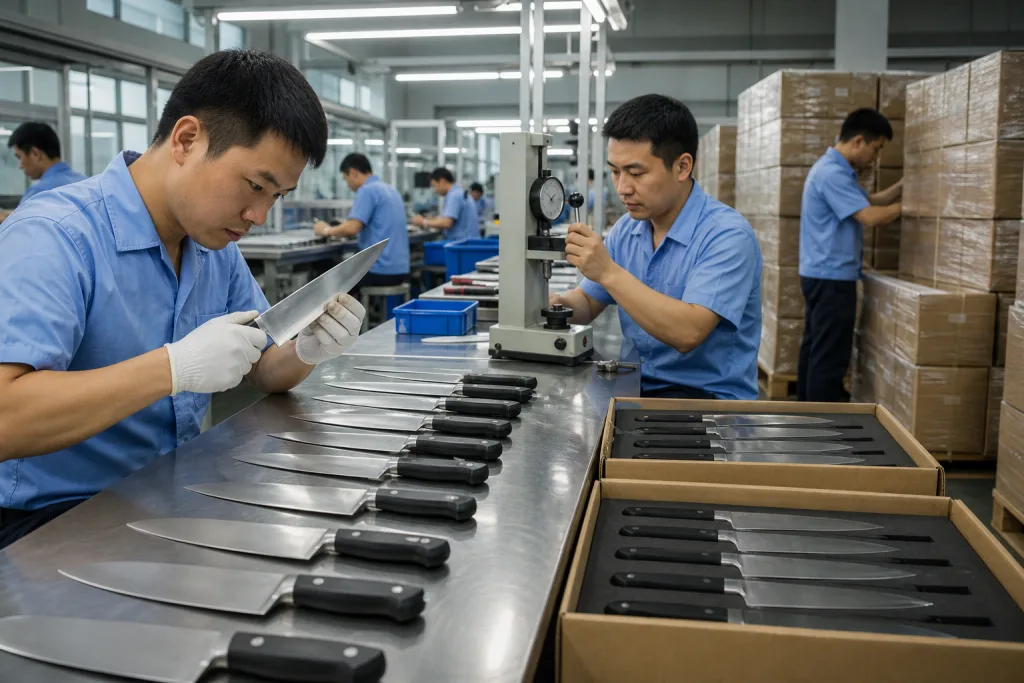
Folding chef knives look simple on a product page. They are not. We run them through the same sharpness and closing-action checks because one blade has to slice onions like a kitchen knife, fold cleanly like an EDC knife, resist lemon juice and salt spray, pass import compliance, and survive being thrown into a backpack or camp kitchen box. Last month QC pulled 32 samples from the grinding line and found 3 blades with tips sitting 0.6 mm proud when closed, which is exactly the kind of small miss that becomes a bad review.
For Amazon and DTC sellers, steel choice is not just a product detail. It changes return rate, review wording, landed cost, sharpening complaints, and whether the supplier can hold HRC inside the agreed band. At our China knife factory serving buyers from Europe and North America, we see the same sourcing mistake about 9 times out of 10: the buyer specifies a famous steel name, then leaves heat treatment, blade thickness, grind, lock geometry, and AQL 2.5 inspection limits loose. This is the wrong question to ask. A PO that says “VG-10 folding chef knife” but forgets 60-62 HRC, 2.2 mm spine thickness, and lock-up tolerance gives the factory too much room to guess.
Why folding chef knives are harder to spec
A standard chef knife has one job: cut food on a board. A folding chef knife fights itself. The blade is wider than a pocket knife, often 140-180 mm long, but it still needs pivot clearance, lock strength, safe closing action, and weight the buyer can accept. On the grinding line, a 0.3 mm change at the ricasso can decide whether the blade feels solid or rubs the liner. Too thin near the pivot, and we see flex plus weak lock-up during sample testing. Too thick, and the buyer sends the same complaint: “It wedges in onions and carrots.” Fair pushback.
A folding chef knife steel hardness steel specification comparison should start with use case, not with the highest-priced steel on the quote sheet. This is the wrong question to ask if the first email only says “best steel.” A camp kitchen knife that gets rinsed in a stream, a picnic knife packed in a lunch bag, an Amazon gift product, and a premium DTC folding chef knife do not need the same HRC target. We run different sample routes for these: 2 pcs for geometry check, 5 pcs for lock testing, then a pilot lot if the buyer approves the edge feel.
For Amazon sellers, the biggest risk is a knife that looks premium but behaves differently from batch to batch. One batch sharpens cleanly, the next chips at the edge, and the third shows orange spots around the pivot after dishwasher exposure. Nicer photos will not fix that. The fix is written steel grade, HRC range, heat treatment process, blade geometry, and incoming inspection. QC pulled one sample last year with 59 HRC on the blade but visible black residue inside the pivot washer stack; the buyer flagged it before FBA booking, which saved a painful return cycle.
At TANGFORGE in Yangjiang, China, we normally ask buyers four questions before quoting a custom folding chef knife steel hardness project: target retail price, food-contact market, sharpening behavior, and corrosion exposure. We also check the PO wording because one typo, “9Cr18” instead of “9Cr18MoV,” can send purchasing in the wrong direction. A 9Cr18MoV blade at 58-60 HRC may fit one DTC seller, while a 5Cr15MoV blade at 55-57 HRC can work better for a promotional wholesale program that needs fewer returns and easier maintenance. The math doesn’t work if the steel spec beats the retail price.
Common steel grades and hardness ranges
The steel name etched on the blade does not tell the full spec, but a buyer still needs a table clean enough for RFQ work. These ranges come from OEM folding chef knife runs we ship, not lab maximums. QC checks the first 5 blades with a Rockwell tester after tempering, then pulls samples again before packing so the hardness number matches stable grinding, repeat inspection, and normal resharpening.
| Steel grade | Typical HRC target | Best fit | Buyer note |
|---|---|---|---|
| 3Cr13 / 420J2 | 52-54 HRC | Low-cost gift sets | Strong corrosion resistance, short edge life |
| 5Cr15MoV | 55-57 HRC | Entry folding chef knives | Easy to sharpen, low after-sales risk |
| 8Cr13MoV | 56-58 HRC | Amazon mid-range | Good value when the heat treatment is controlled |
| 9Cr18MoV | 58-60 HRC | DTC and premium wholesale | Better edge holding, needs tighter tempering control |
| AUS-10 | 58-60 HRC | Japanese-style positioning | Good toughness balance if the coil source stays consistent |
| 14C28N | 58-60 HRC | Premium corrosion resistance | Clean steel, suitable for outdoor food prep claims |
| VG-10 | 59-61 HRC | Premium retail | Strong marketing value, higher cost and more chipping risk if pushed too hard |
For folding chef knife steel hardness wholesale programs, the safer middle zone is 8Cr13MoV at 56-58 HRC or 9Cr18MoV at 58-59 HRC. Not fancy. It works. A folding blade gets side load at the pivot during opening and closing, then more abuse when a camper twists the tip through onions on a plastic board. Pushing hardness for a better CATRA number is often the wrong question to ask; we have seen the grinding line pass sharpness, then QC pulled the sample for tiny chips around the belly after rough sharpening.
If you are positioning a premium DTC knife above USD 60 retail, 14C28N or VG-10 can make sense. The MOQ, steel lead time, and scrap cost still move up, and the math does not work if the buyer expects entry-level pricing with premium steel written on the PO. For our Yangjiang production line, a custom folding chef knife steel hardness order with special steel normally starts around 600-1,000 pcs per SKU, while standard 8Cr13MoV or 5Cr15MoV models give us more room on handle color, carton print, and blister or gift-box packaging.
Heat treatment matters more than steel name
Two knives made from the same steel can behave like two different SKUs. Heat treatment sets hardness, toughness, retained austenite, grain size, and corrosion resistance. If the supplier cannot state the hardening temperature, quench method, tempering cycles, and HRC inspection point, the steel certificate is thin paper. We run Rockwell checks on the C scale at the blade flat, usually 3 pcs from the furnace lot before the grinding line touches them.
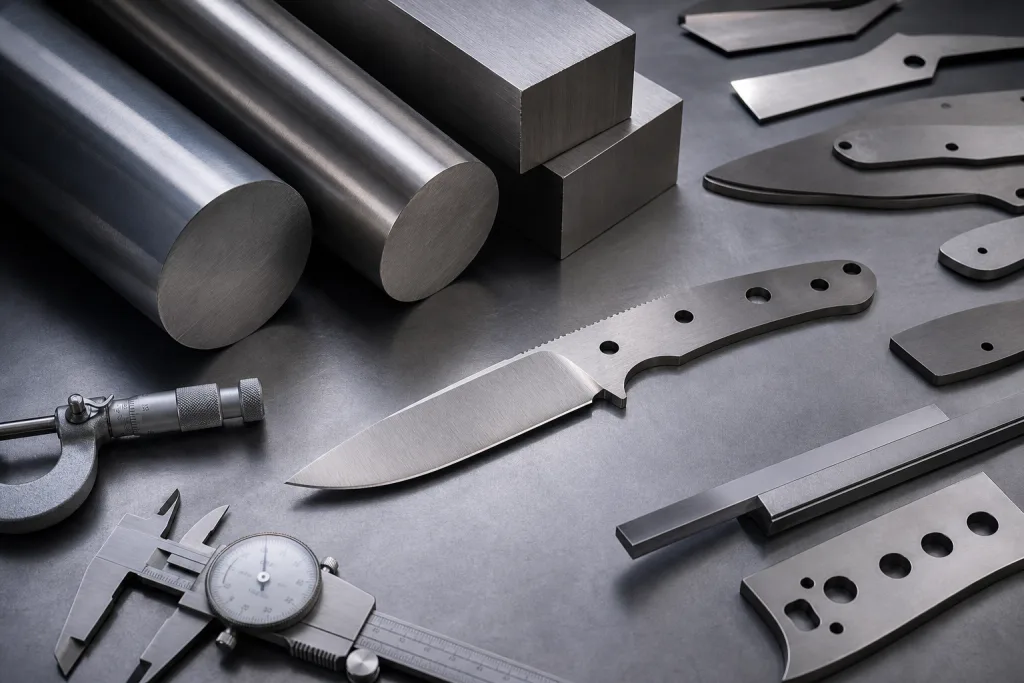
For stainless folding chef knives, a normal production route includes blanking or laser cutting, rough grinding, vacuum or controlled-atmosphere heat treatment, sub-zero treatment for some grades, double tempering, straightening, finish grinding, sharpening, and assembly. Simple route. Hard to control. The blade sees heat again from grinding friction, so water flow and belt pressure during finish grinding matter. Last quarter QC pulled a sample where the spine read 59 HRC, but the edge showed blue burn under 10x inspection after a dry belt pass.
A practical folding chef knife steel hardness factory should write a target like 58-60 HRC on the PO, not sell “high hardness steel” as a specification. We prefer one target band on the purchase order, then check random blades before assembly and again after final grinding if the order uses thin edges or satin finish. For stable OEM orders, AQL 2.5 for major defects and AQL 4.0 for minor cosmetic defects is common, while critical safety defects should be zero-tolerance. One buyer once typed “58-60 HRB” on the PO; we stopped the order that day because the math does not work.
Some buyers ask for 60-62 HRC because they think a higher number always sells better. This is the wrong question to ask. For folding chef knives, I do not recommend that unless the steel, blade geometry, and customer instruction card all support it. A 59 HRC blade with good heat treatment, 0.35-0.45 mm edge thickness before sharpening, and a clean 15-18 degree per side edge can beat a poorly treated 61 HRC blade in real customer hands, especially after 30 days in a restaurant drawer.
Matching hardness to sales channel
Your sales channel changes the spec. Amazon buyers judge a folding chef knife against pocket knives, camp knives, and 8-inch kitchen knives on the same search page. Some wash it in a dishwasher, cut on ceramic plates, or twist the tip through pumpkin; QC pulled one returned sample with a 2.3 mm tip snap and dried rice in the pivot. DTC buyers will accept more maintenance if the copy and care card do the work. Wholesale buyers care about 3 things: fewer returns, stable reorder cost, and no surprise change after the second PO.
For Amazon FBA, we run away from extreme hardness claims. A listing that says "ultra-hard 62 HRC" gets clicks, but it also invites the wrong complaint. If the blade chips after frozen ribs, the review will not say user error; it will say the knife is brittle. We have seen this go sideways. A 58-60 HRC stainless claim backed by edge-retention testing is easier to defend, and the grinding line can hold that range without slowing every batch to 18 days instead of 12 days.
For DTC sellers, custom folding chef knife steel hardness can carry the product story. You can say 14C28N at 59 HRC keeps better corrosion resistance for camp cooking, or VG-10 at 60 HRC suits buyers who use a 15° sharpening guide and wipe the blade dry. Then ship the support materials with it: care cards, sharpening angle guidance, and warnings against dishwashers, bones, frozen food, and prying. We usually print those warnings on a 90 x 55 mm insert because the buyer flagged tiny care text on one PO as “not retail-safe.”
For wholesale and distributor programs, the best folding chef knife steel hardness supplier is not the factory quoting the highest HRC. This is the wrong question to ask. You need low batch-to-batch drift. If you order 5,000 pcs and receive blades from 55 to 61 HRC, feedback will split even if the average looks acceptable. On repeat programs, we define inspection frequency, hardness location, and retest method before mass production starts; our QC team normally checks near the heel, mid-blade, and 20 mm from the tip with a Rockwell tester before packing.
Specification points buyers should lock
A proper RFQ needs more than steel grade and handle material. This is the wrong question to ask if the buyer only says “8Cr13MoV with G10 handle.” A folding chef knife has a food-contact blade plus a moving lock system, and our QC bench checks both with an HRC tester, 0.05 mm feeler gauge, and lock pressure by hand before the sample leaves Yangjiang.
- Blade steel: name the exact grade, require the mill certificate, and state whether 7Cr17MoV can replace 8Cr13MoV or not.
- Hardness: set the target HRC range, test standard, sampling plan, and test point, such as 15 mm from the heel on the flat.
- Blade geometry: give blade length, spine thickness, thickness behind edge, grind type, and edge angle with tolerances in mm and degrees.
- Pivot and lock: state liner lock, frame lock, back lock, or slip joint, then define opening force and lock engagement range.
- Corrosion test: choose salt spray, humidity cabinet, or a soak and wipe test based on the sales market and retail claim.
- Food-contact compliance: confirm LFGB for Germany/EU, FDA expectations for the US, and REACH limits for restricted substances.
- Packaging: lock Amazon FNSKU label size, suffocation warning text, barcode, country of origin, and insert card artwork before mass packing.
For a folding chef knife steel hardness manufacturer, making one clean sample is not the hard part. Matching it across 3,000 pcs is where orders go sideways. The sample approval sheet needs numbers: spine 2.5 mm, edge angle 15 degrees per side, lock engagement 35-55 percent, blade centering within 0.4 mm. “Sharp edge” fails as a spec. Use paper cutting, tomato slicing, or a defined sharpness tester if the price point can carry it. “Smooth folding” also fails. Define blade centering, no blade play, no lock slip under firm hand pressure, and no burrs on liner edges; last month QC pulled 12 samples because the liner edge still caught a cotton glove.
For China export production, we run a pre-production sample, seal one golden sample, inspect at 20-30 percent completion, then do final random inspection before shipment. It usually adds 3 days, not 12 days. The math works because repacking 3,000 pcs after the color box is sealed can burn 2 workers for a full shift, and we have seen a PO typo turn “black POM” into “black pakkawood” on the grinding line traveler.
Cost impact of steel and hardness choices
Steel and heat treatment move FOB price, but the math is not straight. A switch from 5Cr15MoV to 8Cr13MoV is usually a small bump, often USD 0.20-0.45 per knife on a 3,000 pcs PO. Jumping to 14C28N or VG-10 is different: raw sheet MOQ, annealed stock availability, grinding belt wear, heat-treat yield, and final inspection time all change. QC pulled a 14C28N sample last month with a 0.35 mm tip warp after quench, and that scrap cost more than the steel upgrade looked on paper. For a folding chef knife, liner fitting, pivot tuning, and CNC handle machining can eat the same budget as the blade steel.
As a working reference, a private-label folding chef knife with 8Cr13MoV steel, G10 or pakkawood handle, liner lock, color box, and standard sharpening may land around USD 4.80-8.50 FOB China, depending on blade size, satin or stonewash finish, order quantity, and packaging. A 14C28N or VG-10 version can move into the USD 8.50-15.00 FOB range. Not a quote. We run the numbers again once the buyer confirms blade length, lock structure, CNC handle pattern, carton spec, and AQL level. One buyer flagged a USD 0.18 color box increase after the PO already said “single wall,” so packaging can change the landed cost fast.
Lead time moves too. For standard steel and existing tooling, sampling may take 10-20 days and mass production 35-55 days after deposit and packaging approval. For special steel, new molds, custom hardware, or gift box packaging, plan 60-90 days. We ship faster when the buyer uses our existing liner lock tooling and 2.5 mm blade stock; a new pivot screw drawing with a missing tolerance can add 7 days before the grinding line even sees the blades. If you sell on Amazon, add time for FNSKU labeling, carton drop testing, photography samples, and first-article inspection.
The buyer mistake I see often is spending the whole budget on steel grade and cutting packaging, inspection, or sharpening. Wrong question to ask. A 9Cr18MoV knife at 59 HRC with a rough 0.6 mm edge before sharpening will feel cheaper than an 8Cr13MoV knife at 57 HRC with a clean grind and proper burr removal. We have seen this go sideways: the steel spec looked strong, but the buyer’s returns mentioned “dull out of box,” not “wrong alloy.” Your customer judges the finished knife in hand, not the steel line in your spreadsheet.
How to verify supplier claims
Trust helps, but a return claim costs more than a 3-minute file check. Before you place a folding chef knife steel hardness order in China, ask for the steel certificate, heat-treatment record, HRC test report, and batch photos or a short video from the grinding line. For repeat orders, we ask QC to seal 2 retained samples per shipment and keep them for at least 12 months, with the carton number written on the sample tag.
Test the right spot. Hardness testing belongs near the spine or ricasso, not on the thin sharpened edge where a Rockwell cone can give a bad reading or leave a mark the buyer will flag. If the blade has coating or heavy stonewash, QC may need to polish a 6 mm test window before the HRC check. For premium programs, third-party inspection should cover HRC, dimensions, lock function, sharpness, packaging, and carton marks with exact limits on the checklist. SGS, Intertek, Bureau Veritas, or a qualified independent inspector can work if they know where to put the tester and what tolerance to reject.
At TANGFORGE, our Yangjiang, China team produces OEM and ODM knives for importers, brand owners, and distributors, with monthly capacity depending on model complexity and a typical folding knife output that can exceed 80,000 units/month across active lines. We run incoming steel checks, heat-treatment lot tracking, and final AQL pulls before packing. One buyer once sent a PO with “58-60 HRC” in the spec sheet and “56-58 HRC” in the email thread; that is how orders go sideways. Our rule is simple: if a specification cannot be measured, someone will read it differently.
Ask your folding chef knife steel hardness supplier what happens if HRC falls outside the agreed band. Rework, replace, discount, or ship only after written approval? Put it in the PI before deposit, not after QC pulled the sample and found 57 HRC against a 59-61 HRC target. For Amazon and DTC sellers, the math does not work on a bad first batch: 300 refunds, weak reviews, wasted ads, and weeks spent rebuilding buyer trust.
Frequently asked questions
For most Amazon and DTC folding chef knives, 56-60 HRC is the practical range. Entry models using 5Cr15MoV often work best at 55-57 HRC because they sharpen easily and resist chipping. Mid-range 8Cr13MoV is usually stable at 56-58 HRC. Better stainless grades such as 9Cr18MoV, AUS-10, and 14C28N can be specified at 58-60 HRC. I would avoid 61+ HRC unless the buyer accepts higher cost, tighter QC, and more customer education. Folding chef knives are used in less controlled environments than kitchen-only knives, so toughness and corrosion resistance matter as much as edge retention.
Yes, if it is heat treated correctly and matched to the right retail price. 8Cr13MoV at 56-58 HRC is a strong value choice for folding chef knife steel hardness wholesale orders, especially for Amazon mid-range listings. It offers acceptable corrosion resistance, reasonable edge retention, and easy sharpening. It is not a premium powder steel, so do not overpromise performance. The key is consistency: specify the HRC band, blade thickness, edge angle, and final inspection standard. A well-made 8Cr13MoV knife often gives fewer returns than a poorly heat-treated premium steel knife.
Both can work, but they position differently. VG-10 has strong name recognition in kitchen knives and is often specified around 59-61 HRC. It can hold a fine edge, but if pushed too hard or ground too thin, it may chip with rough outdoor use. 14C28N is very attractive for folding chef knives because it balances corrosion resistance, toughness, and edge stability at about 58-60 HRC. For DTC buyers selling camp kitchen or travel cooking knives, I often prefer 14C28N. For a more traditional premium chef knife story, VG-10 may be easier to market.
For an OEM folding chef knife with custom logo, standard steel, and existing structure, MOQ is commonly 600-1,200 pcs per model. If you need special steel such as 14C28N or VG-10, custom handle machining, new lock hardware, or fully custom packaging, the realistic MOQ may move to 1,000-3,000 pcs. Sampling usually takes 10-20 days for standard designs and longer for new tooling. Mass production is often 35-55 days after sample, deposit, and packaging approval, but special materials can push the schedule toward 60-90 days.
Start with the mill certificate, but do not stop there. Ask for heat treatment records, HRC inspection data, and batch traceability. For higher-value orders, use third-party testing such as chemical composition verification by XRF or lab analysis, plus Rockwell hardness testing on random samples. Define the sampling plan before shipment, for example 3-5 blades per batch for HRC and AQL 2.5 for major defects. Also check performance: sharpness, corrosion resistance, lock function, blade play, and edge chipping. Correct steel with poor heat treatment is still a failed specification.
Send Your Steel Spec for Review
Share your target retail price, steel grade, HRC range, quantity, and sales channel. Our engineering team will check the specification before you commit to tooling.
Request a Quote