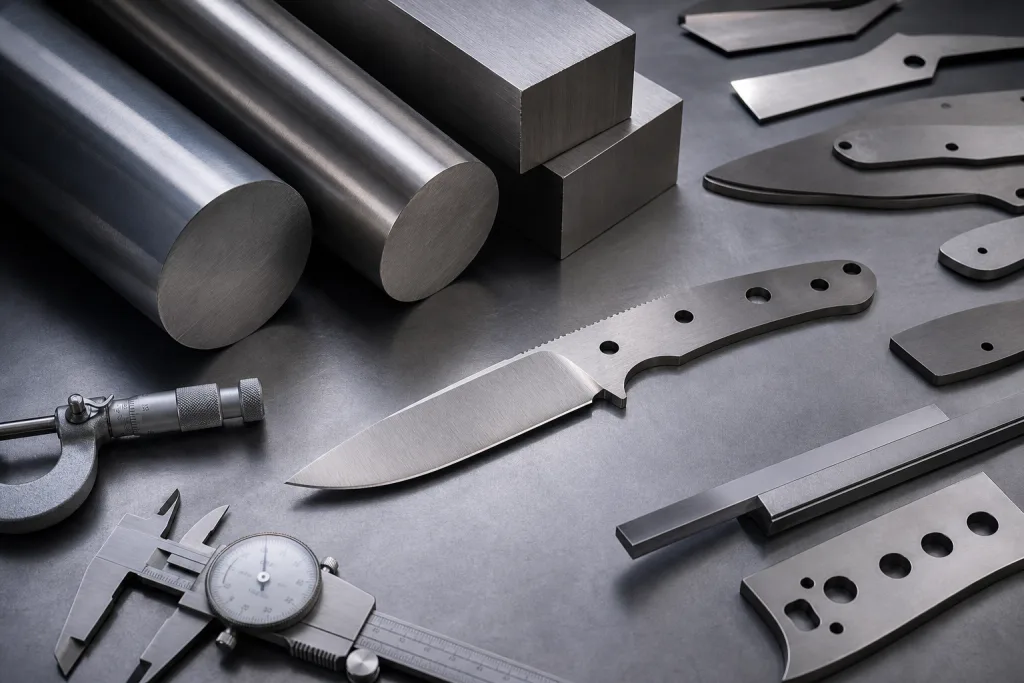
Buying folding pocket knives looks simple until PP sample day, when QC pulls 12 pieces from the tray and finds 0.35 mm blade play, a weak detent, uneven bevels, or a color box that fails the buyer’s shelf test. For importers and brand owners, the damage is rarely one big failure. It is usually 8 small spec gaps that turn into 800 customer complaints.
At TANGFORGE in Yangjiang, Zhejiang, China, we run folding pocket knife OEM and ODM orders for outdoor brands, tactical distributors, hunting programs, and gift buyers with blister card or color-box packing. Our monthly knife capacity is about 420,000 units across categories, but folding knives need tighter control than most fixed blades; the pivot screw, washer thickness, liner lock contact, and detent ball all show up on the grinding line. Define steel, lock type, pivot hardware, HRC, finish, MOQ, and AQL before quotation. Asking for “best price” first is the wrong question to ask, because the math changes fast when 8Cr13MoV moves to D2 or retail QC asks for AQL 2.5.
Start With Use Case, Not Catalog Photos
A folding pocket knife wholesale sourcing guide should start with the buyer’s job, not nice catalog photos. Wrong question to ask. A knife for a 20,000 pcs outdoor subscription box is a different build from a work knife for a hardware chain or a boxed EDC model for a DTC brand. On the sample bench, two knives can share a 105 mm closed body and still need different steel, lock strength, clip screws, edge angle, carton marking and compliance paperwork.
Before you ask a folding pocket knife factory China supplier for a quote, send a one-page target spec. Put the hard dimensions first: open length, closed length, blade length, blade thickness, handle thickness and target weight. Then add lock type, opening style, steel grade, handle material, clip position, finish, logo method and packaging. If the RFQ only says “same quality, best price,” we quote to the cheapest readable version; last month QC pulled a sample with a 0.35 mm blade wobble because the buyer’s PO never stated pivot tolerance. That wins a spreadsheet and loses the customer.
For North American outdoor retail, common blade lengths are 70-90 mm, with 2.5-3.5 mm blade thickness. For European importers, check the selling country before we cut tooling. Assisted opening, double-edge blades, tactical profiles or oversized blades can trigger customs holds or channel refusals. We’ve seen this go sideways: one buyer approved a flipper sample for Germany, then their distributor flagged the opening mechanism after 3,000 pcs were packed in 24 kg export cartons.
Custom folding pocket knife projects also need a straight positioning call. Are you building a USD 9.99 retail promo knife, a USD 24.99 blister-card knife, or a USD 59.99 boxed EDC knife? The factory route changes fast. The math doesn’t work if a USD 3.80 FOB knife is expected to carry the same pivot fit, G10 machining, D2 heat treatment and magnetic box as a USD 14.50 FOB knife. We run the grinding line differently for those two orders, and the product brief has to match the retail promise before the first PP sample.
Core Specs Buyers Should Lock Early
The biggest sourcing mistake is treating the spec sheet like back-office paperwork after the sample passes. For folding knives, the spec sheet is the control document. If the wording says “good action” or “normal gap,” your QC inspector has no firm reason to reject a bad lot. We run this problem often: QC pulled the sample, blade rub was 0.8 mm into the liner, and the buyer’s PO only said “centered blade.” At TANGFORGE in Yangjiang, Zhejiang, China, we freeze the key mechanical specs before the golden sample, then attach signed photos and measurement tolerances to the purchase order.
Blade steel sets cost, edge performance and the claim printed on the blister card. For entry and mid-market folding pocket knife OEM orders, 3Cr13, 5Cr15MoV, 7Cr17MoV, 8Cr13MoV, 9Cr18MoV and D2 are common. 8Cr13MoV usually gives a workable balance at 56-58 HRC; our hardness tester checks 3 points per blade batch before final sharpening. D2 can be run around 58-60 HRC for better wear resistance, but the grinding line needs tighter heat control and clear rust-prevention wording in the manual. Do not sell D2 as stainless. The math doesn’t work after the first customer sends photos of orange spots from a wet tackle box.
Handle material is the next cost lever. Stainless steel handles are strong and low risk, but a 120 g sample often gets flagged by retail buyers as “too heavy for pocket carry.” Aluminum cuts weight and takes color anodizing well, though we still check color drift against the approved swatch under a D65 light box. G10 gives grip and a stronger shelf feel, but CNC machining and dust extraction add cost. Micarta suits outdoor brands, but color variation must be approved with a shade range, not one perfect studio photo. Wood looks warm, but moisture content needs control before ocean freight or the scale can lift 0.3 mm at the bolster.
Lock type has to match price and use. Liner locks are common and cost-effective. Frame locks feel stronger, but handle machining must stay tighter or the lock face wears wrong after 200 open-close cycles. Back locks are traditional and sell well on safety perception, but they need cleaner fit-up at the spring and rocker. Crossbar-style mechanisms can perform well, but they add small parts, spring checks and stricter testing. If your channel is workwear, construction or hunting, pay for better lock control. A failed lock is not a cosmetic issue; it is a liability issue, and we’ve seen this go sideways when a buyer tried to save USD 0.18 on the lock bar thickness.
- Blade centering: define the off-center limit, often within 0.5 mm by visual check or no liner rub when QC uses a 0.5 mm feeler gauge.
- Edge angle: factory EDC knives often run 18-22 degrees per side, but confirm the angle by steel, blade thickness and carton-drop complaint history.
- Pivot screw: specify threadlocker grade, torque feel and whether end users can adjust it; we have seen POs typo “no glue” when the buyer meant removable glue.
- Pocket clip: confirm tip-up or tip-down, left/right option and screw pull-out resistance, with at least 5 samples checked before mass packing.
MOQ and Price Reality
Folding pocket knife MOQ is usually decided by the parts around the blade, not the blade itself: handle finish, clip tooling, logo process, carton style, color control, packaging, and whether we already run a close ODM platform on the grinding line. Use our existing model, laser logo, and white box, and 600 pcs per SKU is workable. Ask for a new handle mold, CNC scale pattern, private clip, printed retail blister, and custom EVA insert, and 1,200-3,000 pcs is the real range. We had one buyer push for 500 pcs with a new clip mold; the mold fee alone killed the math.
Watch low MOQ promises. 200 pcs can be assembled, sure. But at that volume the factory may skip special steel buying, squeeze the heat-treatment batch, or struggle to keep black G10 from shifting between lots. Small orders carry higher unit cost because setup, sampling, print plates, and QC time get divided across fewer knives; our QC pulled 32 pcs from a 600 pcs trial last month just to check lock engagement and blade centering. A serious folding pocket knife MOQ discussion should split sample MOQ, trial order MOQ, and repeat order MOQ. Mixing them is the wrong question to ask.
Here is a working FOB China reference for importers. These are not fixed quotes, because exchange rate, steel cost, packaging, and surface finish move the price. Still, they help you spot a quote that is too low to survive production. On one PO, the buyer typed 9Cr18MoV but priced it like 3Cr13; we flagged it before tooling, because that kind of typo turns into a claim after shipment.
| Product level | Typical specs | MOQ range | FOB reference |
|---|---|---|---|
| Promo folder | 3Cr13 or 5Cr15, stainless handle, simple box | 600-1,200 pcs | USD 2.80-5.20 |
| Mid-market EDC | 8Cr13MoV, liner lock, G10 or aluminum | 800-1,500 pcs | USD 5.80-10.50 |
| Outdoor premium | D2 or 9Cr18MoV, CNC G10/Micarta, better pivot | 1,000-2,000 pcs | USD 10.80-18.50 |
| Gift or retail set | Knife plus pouch, tin, sheath or display packaging | 1,200-3,000 pcs | USD 7.50-22.00 |
For DDP pricing, add freight, duty, customs clearance, insurance, local delivery, and sometimes platform labeling. For Amazon or marketplace orders, FNSKU labels, carton drop tests, and barcode checks belong before dispatch, not after the forwarder collects cargo. We ship 12 kg and 18 kg master cartons differently, and the drop-test result changes fast when the inner tray is loose by 2 mm. If you compare FOB from one supplier with DDP from another, your landed cost analysis is wrong.
OEM Customization Without Creating Risk
OEM folding pocket knives go smooth when you change 2 or 3 items, not the whole knife at once. If you are new to the category, we usually start from an existing platform and change the steel, handle scale, surface finish, logo position, pocket clip or color box. That keeps the lock geometry proven; our QC gauge already checks blade play at the pivot and liner lock engagement at roughly 40%-60%. A new mechanism, new handle, new blade profile and new clip in one PO is not a reorder. It is a development job, and the math doesn't work if the buyer still expects 500 pcs MOQ and a 35-day ship date.
Logo choice changes risk. Laser engraving is the safe pick for low MOQ, clean edges and fast sampling; we run it on the fiber laser before final oiling, so the mark stays sharp. Pad printing can cut cost on flat scales, but we have seen it rub off on pocket clips after 200 thumb wipes and on coarse G10 where the ink sits on the peaks. Etching or deep engraving on blades looks heavier, but the logo must stay away from thin grind areas and plunge lines, or the polishing line will show. For coated blades, QC pulled samples after salt spray and rub testing, because showroom light lies.
Color causes more arguments than blade steel. Black is not one color. Anodized aluminum, black oxide screws, PVD-style coating, powder coating and black G10 all bounce light differently under the inspection lamp on the packing table. If your brand needs a fixed tone, send a Pantone reference, then accept that metal finishing still has process tolerance. For repeat orders, keep a signed color panel or master sample at the factory; we once had a buyer flag “black” because the second batch looked charcoal next to the first 1,200 pcs shipment.
Packaging should match the sales channel, not the prettiest mockup. A distributor may only need a kraft box, silica gel and carton label with item code, quantity and NW/GW. A retail chain may ask for hang hole strength, barcode position, warning text, REACH declaration, anti-rust bag and carton drop test from 80 cm. For the EU, check REACH requirements for restricted substances. For food-contact knife categories, LFGB or FDA can matter, but folding pocket knives are usually outdoor tools. Still, coatings, handle materials and packaging inks deserve a real check; we have seen cartons held because a PO typed “FDA” for a pocket knife and the buyer’s compliance team refused the wording.
A workable OEM timeline is 7-12 days for drawing confirmation, 15-25 days for first samples if no hard tooling is needed, 35-55 days for mass production after deposit and sample approval, and 7-10 days for final inspection and booking. New tooling can add 15-35 days. Around Chinese New Year, add at least 20-30 days of buffer. The grinding line shuts down before the office does, and workers may return in batches, not on the same Monday. China production calendars are real; ignoring them does not make the vessel leave faster.
QC Risks Unique to Folding Knives
Folding knives fail in more ways than fixed blades because each piece is a small mechanical assembly, not just a sharpened blank. A blade can pass the edge check and still get rejected for 0.3 mm side play, vertical play, weak detent, late lockup, liner rub, exposed burrs, loose clip screws or opening force that jumps from one carton to the next. Photos miss these problems. On the grinding line, we run the sample through open-close cycles by hand before QC pulls the caliper and screw driver.
The golden sample should lock down the acceptable lockup range. For liner locks and frame locks, many buyers accept engagement around 30-70 percent of the blade tang face, but the real control point is repeatability and no slipping under reasonable spine pressure. Too early feels unsafe. Too late eats service life. Back locks should close cleanly without gritty movement or half-engaged positions; we have seen 2 pcs in a 50 pcs pre-shipment draw catch at the half-stop because the lock bar stamping had a burr.
Blade play drives complaints fast. Side-to-side play often comes from pivot tolerance, washer thickness or assembly torque. Vertical play usually points to lock geometry, and that is the one buyers should not wave through. If workers over-tighten pivots to hide blade play, the knife becomes hard to open, sometimes over 4 kg pull on a simple spring scale. If they loosen pivots to improve action, blade centering and safety suffer. This is why folding pocket knife factory China inspections should include open/close feel, not just dimensions; asking only for a dimension report is the wrong question to ask.
Sharpness can be measured several ways. CATRA testing is excellent for controlled comparison, but many wholesale orders use practical cut tests plus edge visual inspection. For a mid-market folding knife, we normally check paper slicing, burr removal, bevel symmetry and tip condition under a 10x loupe. If the order claims premium edge retention, consider batch testing steel chemistry and HRC. For example, check 5 pcs per lot with Rockwell testing or use third-party lab verification for high-value orders; the math does not work if a “D2” PO typo turns into 420 steel after packing.
- Critical defects: lock failure, cracked blade, exposed sharp burr on handle, unsafe tip, wrong steel grade confirmed by PMI or lab report.
- Major defects: blade play over approved sample feel, off-center rubbing, weak detent, loose T6 or T8 screws, poor coating adhesion after tape pull.
- Minor defects: small finish marks under 3 mm, light color variation against the approved swatch, tiny packaging scuffs within approved limit.
For most export orders, use AQL 2.5 for major defects and AQL 4.0 for minor defects. For lock safety, we recommend 100% factory function screening before final random inspection. It adds labor cost, usually 0.03-0.08 USD per knife on our line, but we have seen this go sideways when buyers skip it: 12 cartons cleared visual QC, then the buyer flagged weak detent after warehouse receiving.
Compliance, Documentation and Shipping Checks
Importers often ask for “certificates” after QC has already sealed the cartons. Too late. We ask for compliance notes before sampling, because blade steel, black coating, handle material, retail copy and even the warning sticker decide which documents we prepare. A folding pocket knife is not usually a food-contact product, but EU buyers still ask for REACH-related declarations, California buyers flag Prop 65 wording, and customs wants the HS code to match the actual lock type and blade length. Last month QC pulled a wood-handle sample from the grinding line because the PO called it “rosewood,” while the approved spec sheet said pakkawood. That mismatch creates document trouble fast.
Factory audits matter once the buyer is selling to a 50-store chain or a marketplace program with supplier screening. TANGFORGE operates under ISO 9001-style quality controls and can support social compliance preparation such as BSCI-type documentation when required by the buyer. Send your retailer audit checklist before the deposit. Do not wait until the order is packed. We have seen this go sideways when a buyer asked for dormitory photos 3 days before shipment, after 320 cartons were already strapped on pallets. Audit gaps are easier to fix before production pressure hits the assembly tables.
Shipping a folding knife order needs carton control, not guesswork. We run drop checks on export cartons and check whether inner boxes stop the knives from rubbing through the coating during a 35-day sea shipment from China to Europe or North America. Anti-rust oil, VCI paper or 5 g desiccants are standard discussion points for carbon steel, D2 or black-coated blades, especially when the buyer ships into humid warehouses. The wrong question is “Can you pack it cheaper?” Ask whether the blade edge, clip screw and liner lock area will still look clean after port storage and truck vibration.
Labeling looks small until receiving blocks the shipment. Confirm item number, barcode, country of origin, carton quantity, gross weight, net weight, carton size and warning text against the final PO, not the first quotation sheet. For marketplace shipments, confirm FNSKU, suffocation warning if polybags are used, and master carton label format. For retail chains, check whether the barcode must scan through blister packaging; our packing table uses a handheld scanner before sealing the master carton. One wrong digit can block receiving, and we have seen a buyer flag “Made in Chian” on a carton mark proof 12 hours before loading.
DDP buyers still need to understand who touches the shipment after it leaves Yangjiang. Some suppliers quote cheap DDP, then use weak routes or vague customs handling, and the math does not work when a remote area surcharge appears after arrival. Ask whether pricing includes duty, customs clearance, final delivery appointment, insurance and remote area surcharge. FOB is cleaner for importers with their own forwarder and a broker who knows knife HS code classification. DDP works for smaller buyers only when the route, liability and delivery address limits are written on the PI before we book the truck.
How to Judge a Supplier Quote
A supplier quote is not a single unit price. It needs to name the blade steel, target HRC, open and closed dimensions in mm, surface finish, packing method, MOQ, sample schedule, mass-production lead time, payment terms, trade term, master-carton data and quote validity. If two prices are 25 percent apart, this is the wrong question to ask: do not ask which factory is “cheaper.” Ask what was removed. We have seen quotes change after QC pulled the sample and found 1.2 mm liners instead of 1.5 mm, nylon washers instead of phosphor bronze, thinner black coating, bulk polybag packing or fewer lock checks on the assembly bench.
Ask blunt questions. What is the real blade steel, and how will it be checked on incoming material? What HRC band will the heat-treatment shop hold, for example 56-58 HRC or 58-60 HRC? Is the handle CNC machined, stamped or cast? Are the screws stainless, or carbon steel with black coating? Is threadlocker applied at the pivot screw and clip screws? What percentage of knives get lock function checks? Which AQL standard is used? A serious factory answers with numbers, photos from the grinding line and inspection points in mm. A weak supplier says “good quality” and hopes the buyer stops there.
For a new folding pocket knife OEM project, we usually run 2-3 sample rounds when the item is above USD 10 FOB. Round one checks the outline, blade centering and lock feel. Round two checks finish, logo position and retail box fit. Pre-production samples confirm the steel, handle material and packing before the bulk order starts. Skipping that PP sample can save 10 days on paper, but the math does not work if 3,000 pieces arrive with weak detent or a logo shifted 2 mm off the approved drawing.
Test communication before paying the deposit. Send a marked drawing with 8 changes and see whether the supplier sends back a clean revision, not a screenshot with three missed notes. Ask for a packing plan that keeps the master carton under your warehouse limit, such as 15 kg or 18 kg per master carton, and ask for the QC checklist before production starts. Small detail, big signal. We once had a buyer flag a PO typo that changed “stonewash” to “satin,” and the factory that catches that before tooling usually catches bigger problems before shipment.
TANGFORGE is based in Yangjiang, Zhejiang, China, with about 240 employees focused on custom knives for global brands, importers and distributors. We are opinionated about one thing: a folding knife order should not pass approval by appearance alone. If the lock, pivot, heat treatment and packaging are not controlled, the buyer is importing risk with a logo on it. On our side, QC checks pivot torque, lock engagement, blade centering and carton drop-test condition before we ship, because we have seen this go sideways when buyers approve only the beauty shot.
Frequently asked questions
For an existing folding knife model with laser logo and standard packaging, a realistic folding pocket knife MOQ is usually 600-1,200 pcs per SKU. If you need custom G10 scales, anodized aluminum color, exclusive clip, special screws or retail blister packaging, plan for 1,200-3,000 pcs. Full custom tooling can require higher volume because mold, fixture and sampling costs must be spread over enough units. For a first order, we often suggest one core SKU at 1,000 pcs instead of five colors at 300 pcs each. You get better color consistency, smoother production control and a more serious QC process.
There is no single best steel. For entry-level wholesale knives, 3Cr13 and 5Cr15MoV keep cost low and are easy to maintain. For mid-market folding pocket knives, 8Cr13MoV at about 56-58 HRC is practical and widely accepted. For stronger outdoor positioning, D2 at about 58-60 HRC gives better wear resistance, but it is semi-stainless and needs honest rust-care messaging. 9Cr18MoV is a good option when you want better corrosion resistance. The right choice depends on retail price, customer expectations, warranty risk and whether you can support the marketing claim with HRC or material testing.
For an existing model with normal logo and packaging, sample preparation usually takes 10-20 days and mass production takes 35-55 days after deposit and sample approval. If you need new handle tooling, CNC programming, custom packaging or multiple finish trials, add 15-35 days. Final inspection, carton correction and vessel booking can add another 7-10 days. Around Chinese New Year, you should add 20-30 days of buffer because workers, heat-treatment vendors, packaging suppliers and freight capacity all become tight. A safe first-order timeline is often 75-100 days from confirmed artwork to shipment.
At minimum, require dimensional checks, visual inspection, blade centering, opening and closing function, lock engagement, blade play, screw tightness, clip attachment, sharpness check, logo position, packaging and carton labeling. Use AQL 2.5 for major defects and 4.0 for minor defects, but add 100% factory lock function screening before final inspection. For higher-value orders, test HRC on 3-5 pcs per lot and confirm steel chemistry through a lab or handheld analyzer where appropriate. If the knife has coating, include adhesion and rub checks. For D2 or carbon steel, add rust-prevention review before ocean shipment.
FOB is better if you already have a forwarder and import process. It gives cleaner control of freight, customs, insurance and delivery. DDP can be convenient for smaller importers or marketplace sellers, but the quote must state whether duty, customs clearance, final delivery, insurance, remote surcharge and appointment fees are included. Folding knives can face stricter carrier and customs handling than ordinary kitchen goods, so vague DDP terms are risky. For orders above 2,000-3,000 pcs, many experienced buyers prefer FOB China and manage logistics directly. For trial orders, DDP is acceptable if the route and liability are written clearly.
Send Your Folding Knife Spec for Review
Share your target price, blade steel, lock type, MOQ and packaging plan. Our sales engineers will check feasibility before you spend money on samples.
Request a Quote