G10 is a safe handle choice for working knives, but cheap and problem-free are two different things. Ask 5 suppliers for a custom G10 handle knife and you can see a 40% price gap fast, because one quote is based on 3 mm liners and 8Cr13MoV, another uses 1.5 mm liners, D2, longer CNC milling time, stonewash finish, color box packing, and AQL 2.5 inspection. Same product name. Not the same knife.
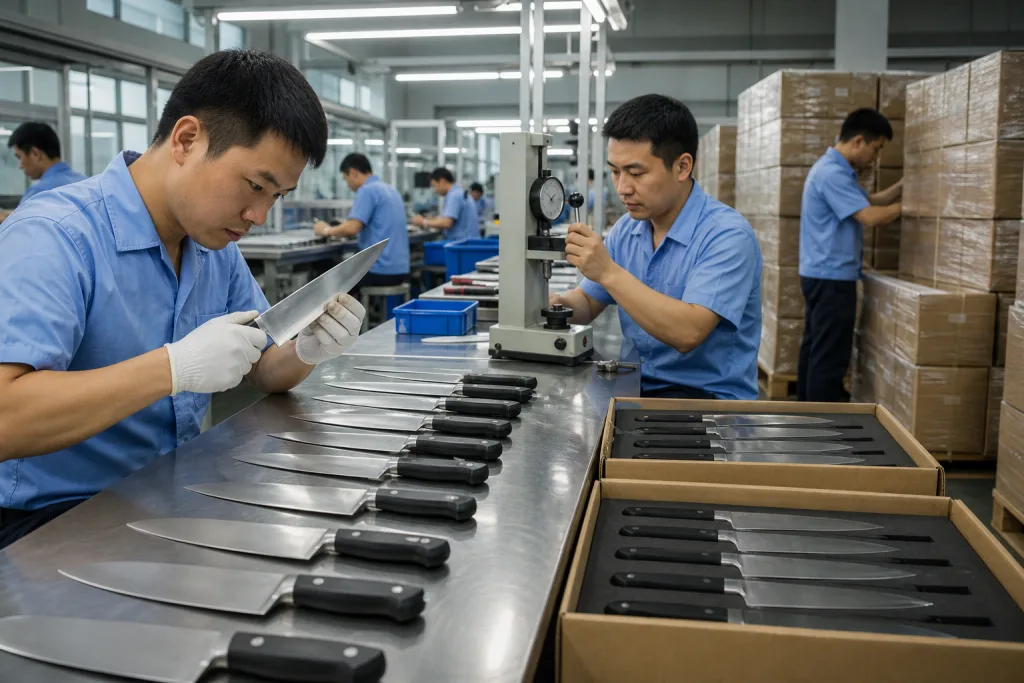
At TANGFORGE, a Yangjiang knife OEM/ODM factory established in 2008 with about 240 employees, we see the same sourcing mistake every month: buyers negotiate the G10 handle knife MOQ before the engineering sheet is locked. This is the wrong question to ask first. For Europe and North America, a usable RFQ should fix the G10 grade, blade steel, HRC band, hardware, logo method, carton pack, compliance documents, and AQL target before price talk; last week QC pulled a pre-production sample where the PO said black G10, but the drawing called for black-green layered G10, and that small typo changed both cost and lead time.
What G10 Actually Means
G10 is a glass fiber and epoxy laminate. We use it because it stays hard, holds shape in wet hands, and takes a clean texture on the CNC router. For knives, the selling point is practical: G10 does not swell like walnut after 48 hours in a soak test, it cuts clean with a 3.175 mm carbide bit, and it gives pocket knives or tactical models a technical look buyers can explain at retail.
Not all G10 is equal. Cheap sheet stock can show uneven resin, color drift between batches, or pin voids after CNC machining. Black hides a lot. Layered black-orange, OD green-black, and blue-black do not; QC pulled one 5.0 mm sample last month where the orange line wandered almost 0.6 mm after contour grinding. If you are building a brand line, visual consistency is not decoration. It is part of the spec.
For a G10 handle knife OEM project, specify the sheet thickness and finish. Common handle scale thickness is 3.0 mm, 4.0 mm, 4.5 mm, or 5.0 mm per side. Flat scales cost less because we run fewer CNC passes. 3D contoured scales need a longer cycle, usually 12 minutes per pair vs 7 minutes for flat scales on our small fixture. Aggressive texture improves grip, but we have seen this go sideways: the buyer flagged torn EVA tray inserts and said the kitchen sample felt too sharp after one shift of prep work.
At our Yangjiang, China facility, we normally ask buyers to approve both a material swatch and a finished handle sample. The swatch confirms color against the PO; one buyer once typed “blue-black” on the artwork file and “black-blue” on the PO, so we stopped guessing. The finished handle confirms machining marks, edge chamfer, screw countersink, palm feel, and whether the texture fits the job. A hunting knife handle can bite harder. A chef knife handle should wash clean and not punish the user’s hand.
MOQ Depends on More Than Quantity
A realistic G10 handle knife MOQ is not a magic number. It changes with the mold, blade profile, G10 sheet color, logo method, sheath, retail box, and carton mark. Last month a buyer asked for 100 pcs with a new blade profile, custom olive G10, laser logo, Kydex sheath, color box, and side-mark cartons; the PO even listed “G-10 green” in one line and “OD black” in another. Fine for sampling. The math doesn't work for production pricing.
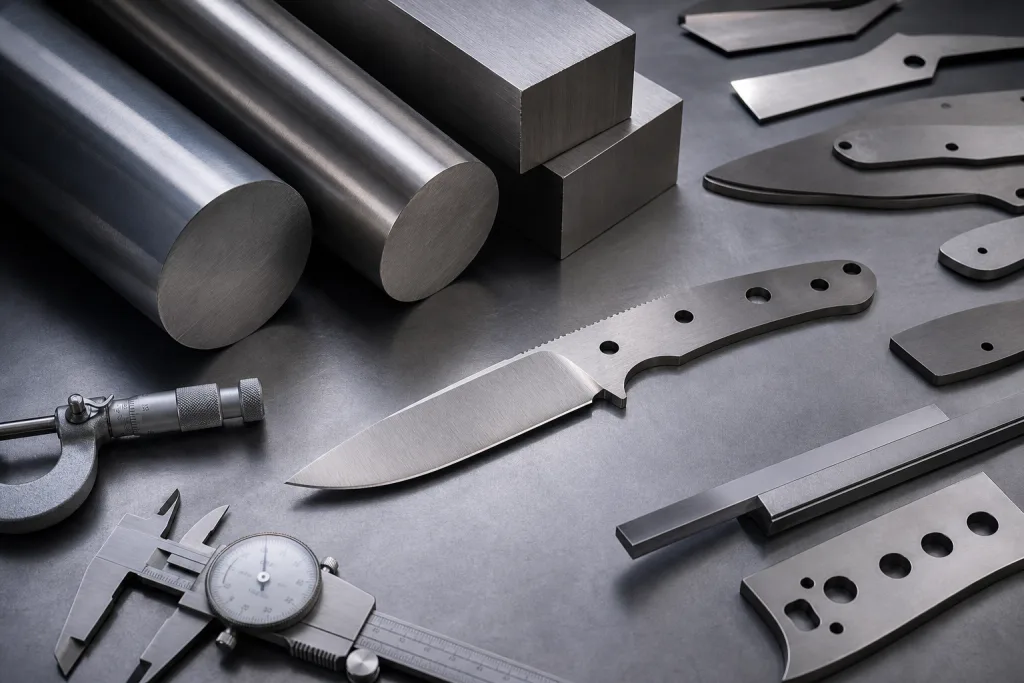
For a custom G10 handle knife, we buy full G10 sheets, load CNC programs, make jigs, order screws or rivets, cut blades, send heat treat, run the grinding line, finish, assemble, inspect, and pack. A 0.8 mm change on the handle contour still means the fixture needs checking with calipers before mass work starts. Small changes create real setup cost. If the MOQ is too low, the unit price carries the setup cost, and the production team will push bigger, cleaner orders ahead of it.
Typical production references for importers, based on how we cost SKUs on the factory sheet:
- Existing knife with logo only: 200-300 pcs per SKU is often workable.
- Existing blade, custom G10 color or texture: 500 pcs per SKU is more realistic because the G10 sheet purchase and CNC setup need room.
- New blade profile and G10 handle: 800-1,000 pcs per SKU is safer, especially when a new blanking die or fresh grinding fixture is involved.
- Multiple colors: treat each color as a separate SKU unless the total volume is strong; QC pulled samples before where black G10 passed, but orange G10 showed edge chipping after CNC routing.
- Retail box with private label: box MOQ may be 500-1,000 pcs even if the knife MOQ is lower, and printing plants do not like splitting 200 boxes across five artworks.
TANGFORGE runs about 180,000-220,000 knives per month across kitchen, outdoor, folding, and Damascus categories. That capacity helps when the spec is locked before we open the work order. It does not cancel sensible MOQ planning. If you want a launch test, we would rather run one core color at 500 pcs than three colors at 200 pcs each; we have seen the second option go sideways when buyers reorder only the best color and leave 400 odd handles in the rack.
FOB Price Ranges Buyers Can Use
For a G10 handle knife factory China quote, read FOB price as a build sheet result, not a catalog number. A USD 6.20 knife and a USD 8.40 knife can look the same in a buyer deck, then QC pulls the sample and finds different steel, HRC control, liner thickness, G10 scale thickness, sheath fit, and inspection time. Photos hide a lot.
The table below gives planning ranges we would use before opening tooling or booking the grinding line. These are not offers; they are RFQ anchors for Europe and North America when volume sits around 500-3,000 pcs per SKU and packaging is normal export retail packaging. Last month one buyer flagged a PO typo: “500 pcs” in the email, “5,000 pcs” in the attachment. That changes the quote.
| Knife type | Common spec | MOQ guide | FOB China range |
|---|---|---|---|
| Small fixed blade | 8Cr13MoV, flat G10 scales, nylon sheath | 500 pcs | USD 4.80-7.20 |
| Hunting knife | 5Cr15MoV or 8Cr13MoV, contoured G10, Kydex sheath | 800 pcs | USD 7.50-12.80 |
| Folding knife | D2 blade, G10 scale, liner lock, clip | 600 pcs | USD 8.80-16.50 |
| Tactical knife | D2 or 14C28N, textured G10, coated blade | 800 pcs | USD 11.50-22.00 |
| Chef knife | X50CrMoV15 or 9Cr18MoV, full tang G10 | 500 pcs | USD 9.50-18.00 |
The main price movers are blade steel, heat treatment, handle machining time, sheath, coating, and packaging. D2 costs more than 8Cr13MoV because the heat-treat window is tighter and the grinding line cannot rush it without burning edges. We check HRC on the Rockwell tester, and a 2-point drift means rework or scrap. 14C28N costs more again but gives better corrosion resistance when treated correctly. A molded Kydex sheath can add USD 1.20-3.50 compared with a simple nylon sheath. A magnetic gift box can add USD 1.00-2.80 before freight impact.
If you need DDP pricing, split product cost from freight, duty, and last-mile delivery. Asking 6 factories for DDP on day one is the wrong question to ask; the math gets muddy before the knife spec is locked. FOB is cleaner for comparing factories. DDP belongs later, after your forwarder confirms carton size, channel rules, and delivery address type.
Specs to Freeze Before Quoting
For quotes you can compare, send one spec sheet to every supplier. “Custom G10 handle knife with D2 blade” is too loose. We see this go sideways after deposit: one buyer’s PO said “black G10,” but the sample room used black/gray layered G10 because the photo looked striped.
Start with blade details. Define steel grade, blade length, blade thickness, grind type, finish, coating, target HRC, and edge angle. For D2 outdoor knives, 6 out of 10 buyers we quote ask for 58-60 HRC. For 8Cr13MoV folders, 56-58 HRC is common. For X50CrMoV15 kitchen knives, 55-57 HRC may fit better depending on toughness and sharpening claims. If you push 60 HRC on the wrong steel for the wrong use, the math doesn't work; QC pulled one D2 sample at 61 HRC and the edge chipped after a 20 mm rope-cut test.
Then lock the handle. Define G10 color, layer pattern, thickness, texture, chamfer, fastener type, liner material, and whether scales must be removable. Small parts matter. On folding knives, handle thickness changes pocket feel and screw length, so we run calipers on the first 10 pcs before the grinding line continues. On full tang fixed blades, the tang and G10 must finish flush; if there is a 0.2 mm step at the seam, the buyer will feel it right away.
Do not skip packaging and compliance. For EU buyers, REACH documentation is commonly requested. For kitchen knives or food-contact packaging, LFGB or FDA-related material declarations may matter. For Amazon or marketplace distribution, include FNSKU labeling, suffocation warning bags when needed, master carton weight limit, and drop-test expectations. We ship cartons under 18 kg when the buyer asks for manual handling, and the buyer flagged one batch because the FNSKU font was 8 pt instead of the 10 pt shown on the artwork.
A good RFQ includes a drawing or 3D file, target FOB price, annual forecast, first order quantity, destination market, inspection standard, and sample deadline. Better yet, attach a marked PDF with blade length in mm and AQL 2.5 if that is your inspection base. You will get cleaner answers, and fewer surprise add-on costs after the sample invoice is paid.
QC Risks With G10 Handles
G10 handle problems rarely look serious at sample stage. They show up on the 2,000-piece run when the sheet batch changes, the 6 mm CNC end mill starts wearing, and the assembly bench is chasing output. Sample approval is not a QC system. We have seen this go sideways.
The defects we catch most often are scale gaps over 0.20 mm, tang edges sitting proud, uneven chamfers, stripped T6 or T8 screws, shallow texture, color drift between left and right scales, resin voids, and lanyard holes that do not line up. On folders, QC also needs blade centering, lock engagement, detent pull, clip screw torque, and open-close feel after 50 cycles. On kitchen knives, the buyer should call out hygiene points: no sharp inside seams, no glue squeeze-out, no rough rivet edges. Last month QC pulled the sample because one rivet hole had a black resin pit right at the chamfer.
Set AQL before we cut production material. Around 8 in 10 importers we work with use AQL 2.5 for major defects and AQL 4.0 for minor defects. For premium launches, AQL 1.5 major makes more sense, but the math needs to be clear because inspection takes 12 hours instead of 7 hours on a 3,000-piece lot and rejection risk goes up. Critical defects should be zero tolerance: unsafe lock failure, loose blade, cracked handle, exposed sharp burrs, wrong steel, or wrong logo. The wrong question to ask is “Can you check quality?” The PO should say exactly what fails the carton.
Functional tests should be simple enough for the line and repeatable enough for the buyer’s inspector. Check HRC on every heat-treatment batch, not just the golden sample. Measure blade thickness and handle thickness with digital calipers, and write the tolerance in mm, not “same as sample.” Run salt spray or corrosion spot checks when the blade uses bead blast or black coating. For edges, CATRA works for formal benchmarking, but buyers selling on Amazon or to retailers often still need a paper cut, rope cut, or 10-pass cardboard cut test that matches the sales claim.
At TANGFORGE in Yangjiang, we keep signed pre-production samples, inspection photos, and batch records by lot number. We also keep the small things: torque notes from the screw station, handle thickness readings, and the PO revision if someone typed “G01” instead of “G10.” For buyers importing into Europe and North America, that paperwork is not office decoration. It is how you answer a retailer claim three months after we ship.
Sampling, Tooling, and Lead Time
Sampling is the cheap place to catch the expensive problem. For an existing G10 handle knife with only logo changes, we run samples in 7-12 days if the laser file is clean and the handle scale is already on the CNC program. For a new blade profile, a new G10 CNC program, or a custom sheath, allow 15-25 days. If heat treatment trials or coating validation are needed, add another week. QC pulled one sample last month because the G10 scale sat 0.35 mm proud at the tang. Better to find that on 3 pcs than on 3,000 pcs.
Sample fees vary by how much bench fitting is needed. A simple logo sample may cost USD 50-150. A new fixed-blade sample can be USD 150-400 depending on machining time and sheath work. Folding knives cost more when mechanism parts are new, because the pivot and stop pin need tight fitting, the liner lock face needs contact checked, and the clip holes must line up after stonewash or coating. Tooling or fixture fees may be charged separately if the design cannot sit in our existing jigs. The math doesn't work if a buyer expects a USD 80 sample to cover a new fixture, wire-cut liner, and 2 rounds of hand adjustment.
Mass production lead time starts after sample approval, deposit arrival, artwork sign-off, and packaging file approval. For G10 handle OEM orders, 35-60 days is realistic. Rush orders work only when steel grade is in stock, G10 sheet color is available, screws match the BOM, and the packing carton is not waiting on a revised barcode. We ship late when those details move. If your selling season is September, approving samples in late July and expecting clean ocean freight is the wrong question to ask; the vessel schedule alone can burn 18-26 days port to port.
Ask for a production schedule with checkpoints tied to real factory steps: steel purchase with thickness confirmed in mm, blade blanking count, heat treatment batch and target HRC, first grinding-line sample, handle CNC first article, assembly trial, QC, packing, and final inspection. For China sourcing, serious factories will accept reasonable checkpoints. We push back when the buyer changes logo placement, box design, or G10 color after material is already cut; we've seen this go sideways after a PO typo changed “black/green” to “black/grey” on 1,200 sets. Change control is procurement work, not paperwork decoration.
How to Reduce Cost Without Regret
The cheapest cost reduction is not beating up the factory after the quote lands. The better move is to build the knife around the way we run production: sensible blade steel, fewer CNC passes on the G10, tighter color control, and packaging that matches the retail math. On the grinding line, one extra decorative groove can mean a second fixture setup and another 6-8 minutes per 100 handles.
For example, a flat G10 scale with a clean 0.8 mm chamfer is often the smarter spec than a deep 3D-contoured handle on an entry-level hunting knife. You may save USD 0.80-1.50 per unit and cut down the patchy light reflection QC keeps pulling under the inspection lamp. On a premium tactical folder, contoured G10 can pay for itself because the shelf price can carry it. Personal preference is the wrong question to ask here. Channel position decides.
SKU discipline saves real money. If your first order is 1,500 pcs, one SKU at 1,500 pcs gives better pricing and steadier QC than five colors at 300 pcs each. We have seen buyers ask for black, OD green, orange, tan, and blue on the first PO, then the buyer flagged carton label mix-ups before shipment. One color also means fewer spare parts, fewer printed labels, cleaner master cartons, and easier retailer forecasting. Add colors after the first sell-through report.
Be careful with steel downgrades. Moving from D2 to 8Cr13MoV may cut cost, but it changes the promise your sales team makes on edge retention and hardness. Moving from a heavy molded sheath to a simpler nylon sheath is often safer if the end user is not asking for tactical carry. We have seen this go sideways when the PO said “D2” but the artwork still claimed “premium tool steel” after the buyer changed specs. A good factory should push back when a detail adds cost but no buyer value.
TANGFORGE works with brand owners, importers, and distributors from Yangjiang and through a broader China supply chain including packaging and accessory partners in Zhejiang. Share the target retail price, annual forecast, MOQ, and must-have tests, and we can usually quote 2 spec levels instead of one take-it-or-leave-it number. QC pulled the sample, checked the G10 fit gap at 0.2 mm, and priced the packaging separately for a reason: the math gets clearer when every cost driver is visible.
Frequently asked questions
For logo-only projects using an existing model, 200-300 pcs per SKU can be workable. For a custom G10 handle knife with a selected color, texture, and private label packaging, 500 pcs per SKU is a more realistic starting point. For a new blade shape, new CNC handle program, custom sheath, and retail box, plan around 800-1,000 pcs per SKU. The MOQ is driven by G10 sheet purchase, CNC setup, heat-treatment batching, packaging MOQ, and inspection workload. If you need three handle colors, treat each color as a separate SKU unless the combined order is large enough to absorb setup cost.
Compared with basic plastic or simple wood, G10 usually adds cost through material price and machining time. Flat G10 scales may add roughly USD 0.40-1.20 per knife depending on thickness and size. CNC-contoured or layered G10 can add USD 0.60-2.20 or more because the machining cycle is longer and scrap risk is higher. On folding knives, G10 may also affect screw length, liner thickness, clip seating, and assembly time. The cleanest way to control cost is to specify handle thickness, texture depth, chamfer, and color before quoting, then avoid late design changes after samples.
G10 is versatile, so the steel should match the knife use and retail promise. For value outdoor or folding knives, 8Cr13MoV at about 56-58 HRC is common. D2 at 58-60 HRC is popular for harder-use folders and fixed blades, but it needs better corrosion communication because it is not as stainless as some buyers assume. 14C28N is a strong upgrade when corrosion resistance matters. For kitchen knives, X50CrMoV15, 5Cr15MoV, 9Cr18MoV, or similar stainless steels are more common, usually around 55-58 HRC depending on geometry and toughness requirements.
AQL 2.5 for major defects and AQL 4.0 for minor defects is a common baseline for export knife orders. Premium programs may use AQL 1.5 major. Critical defects should be zero tolerance: unsafe lock failure, loose blade, cracked G10, wrong steel, exposed burrs, or incorrect warning labels. Add functional checks such as HRC batch testing, blade centering for folders, screw torque, handle gap measurement, corrosion spot checks, and edge sharpness tests. For retail orders, also inspect barcode, FNSKU, carton marks, packaging drop resistance, and country-of-origin labeling before shipment.
If you use an existing G10 handle knife with logo and standard packaging, samples may take 7-12 days and mass production may take 35-45 days after approval and deposit. A new blade, new G10 CNC contour, custom sheath, or retail box can push sampling to 15-25 days and production to 45-60 days. Ocean freight and customs clearance are separate. For a seasonal launch in Europe or North America, build in at least 2-3 weeks of buffer for artwork revisions, inspection findings, and freight schedule changes.
Send Your G10 Knife RFQ Today
Share drawings, target MOQ, steel, HRC, packaging, and market requirements. We will return practical spec options with factory-level pricing.
Request a Quote