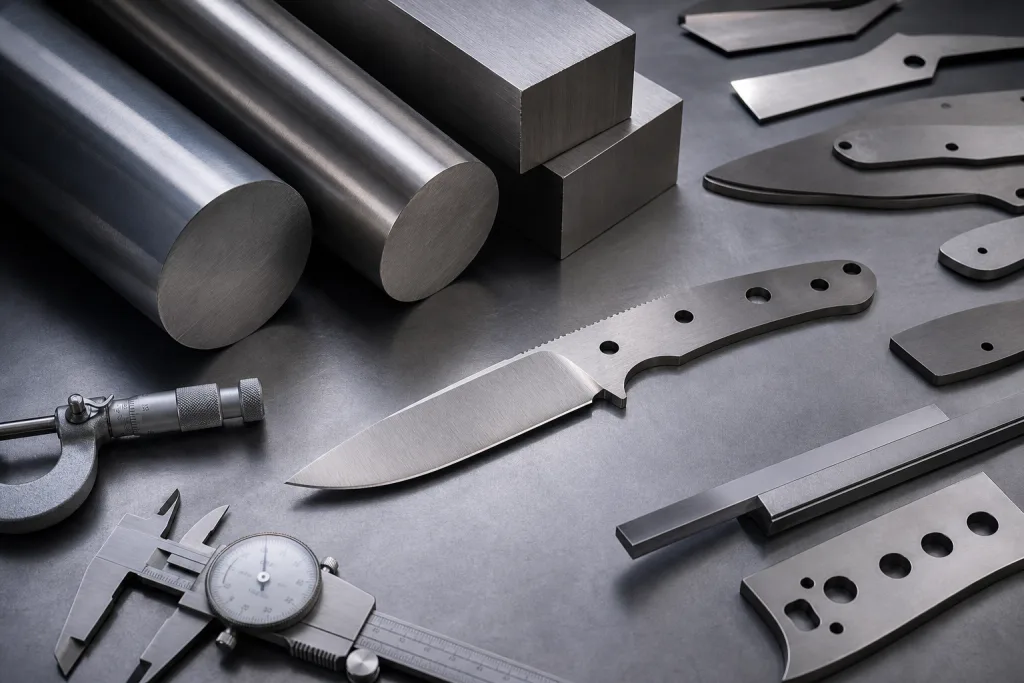
German 1.4116 sells because it gives your retail line a stainless, low-maintenance knife at a sane shelf price, without calling it VG-10 or some miracle steel. The steel name is the easy part. The PO needs the real buying specs: MOQ at 1,000 pcs per model, target 56-58 HRC, edge angle in degrees, grinding tolerance in mm, handle construction, carton packing, and AQL 2.5 inspection level. QC pulled one sample last month with a 0.6 mm tip offset; that small number is where margin starts leaking.
At TANGFORGE in Yangjiang, Zhejiang, China, we see two problems again and again: vague specs that make buyers overpay, and aggressive specs that turn into claims after shipment. A custom German 1.4116 knife can run as a steady SKU, but the math does not work if price, MOQ, and QC are discussed after sampling. We run the grinding line better when the buyer confirms blade thickness, handle material, logo method, and packaging artwork before the sample room cuts steel; one buyer even sent a PO with “1.4116” typed as “1.4118,” and the buyer flagged it only after the proforma invoice.
What German 1.4116 really means
German 1.4116 is a martensitic stainless knife steel, usually sold in the X50CrMoV15 family. The chemistry we see on mill certs is about 0.45-0.55% carbon and 14-15% chromium, with small molybdenum and vanadium additions. It will not beat powder steel on edge holding. Wrong question to ask. For a kitchen program, 1.4116 is chosen because it resists rust, takes a fast edge on a 1000-grit wheel, and survives normal home use without angry returns.
For a German 1.4116 knife OEM project, the steel makes sense when your buyer wants low maintenance instead of hard-core edge retention. We ship it for European supermarket runs, mid-range chef knife sets, hospitality supply, Amazon private label kitchen knives, and gift sets, but the spec sheet needs to say blade thickness, handle material, packing, and MOQ clearly. Last month a buyer flagged a PO typo: “1.4416” instead of “1.4116.” QC pulled the sample before mass cutting, or that mistake would have followed 3,000 blades into production.
The HRC range matters. We normally recommend 55-57 HRC for chef knives, santoku knives, utility knives, and paring knives. At 54 HRC, the edge feels soft after 30-40 cuts on a bamboo board. At 58 HRC or above, some factories can hit the number, but the math does not work if tempering control is loose; chipping risk goes up fast after the grinding line thins the edge to 0.25-0.35 mm. For most importers, 56±1 HRC is the honest specification.
Do not buy only by the stamped steel name. Ask for incoming steel certificates, heat treatment records, and random HRC checks after grinding. At our China factory, TANGFORGE records hardness by batch and can include HRC photos in the pre-shipment report. We run the Rockwell tester on pulled samples, not just the golden sample from the showroom. That beats a clean catalog claim every time.
MOQ depends on what you customize
German 1.4116 knife MOQ is not one fixed number. We price it by how far the order pulls us away from a running line. Use an existing blade blank, black POM handle, master carton, and laser logo, and the MOQ stays lower because the grinding line does not need a new jig. Ask for a new blade profile plus custom bolster, then add color box, barcode labels, FNSKU, and DDP-ready carton markings, and the MOQ climbs fast. QC pulled one sample last month because the carton mark was 3 mm off the buyer’s artwork, so even “just packaging” is not free work.
At TANGFORGE in Yangjiang, Zhejiang, China, our practical MOQ for German 1.4116 kitchen knives often starts at 300 pcs per model for repeat molds and 1,000 pcs per model for new OEM development. For mixed sets, we can plan 500-1,000 sets if the blade blanks already exist and the handle drilling pattern matches our current fixture. Small change, small MOQ. For pocket or outdoor knives using 1.4116, MOQ can go higher when CNC handle parts or special locking hardware are involved, because one wrong lock bar tolerance at 0.2 mm becomes scrap, not rework.
| Customization level | Typical MOQ | Best for | Cost risk |
|---|---|---|---|
| Laser logo on existing knife | 300-500 pcs/model | Distributor test order | Low |
| Custom handle color or rivets | 500-800 pcs/model | Private label range | Medium |
| New blade profile or mold | 1,000-2,000 pcs/model | Brand-owned design | Tooling and scrap |
| Retail set with custom box | 500-1,500 sets | Amazon or chain retail | Packaging MOQ |
The costly mistake is pushing MOQ too low while loading the order with custom details. We have seen this go sideways: the factory accepts 300 pcs, then the buyer flags a higher unit price, a 45-day lead time instead of 30 days, or uneven satin finish because the batch is too small to run cleanly. The math does not work. Start with 2 strong models, check sell-through, then add the next handles or retail packs after the first AQL 2.5 inspection comes back clean.
Realistic FOB price bands
For a German 1.4116 knife MOQ and price guide, the honest answer is a price band, not a magic number. FOB China pricing shifts with blade length, blade thickness in mm, handle resin grade, polishing hours, color box spec, AQL 2.5 inspection time, and whether the first mold charge is buried in the unit price. A 3.5 inch paring knife and an 8 inch full-tang chef knife do not run through the grinding line with the same cost. Wrong question, if a buyer only asks “best price?”
As a working reference, a basic 1.4116 paring knife with PP or simple ABS handle may land around USD 2.20-3.50 FOB. A standard 8 inch chef knife with full tang, POM handle, three rivets, satin finish, and color box often sits around USD 5.20-7.80 FOB; we usually check the tang fit with a 0.2 mm feeler gauge before handle assembly. A heavier forged-look chef knife with bolster, better polishing, custom packaging, and stricter inspection can move to USD 8.00-12.50 FOB. Damascus cladding, premium wood, or magnetic gift boxes are different projects, and the math does not work if they are compared with a supermarket blister-card item.
Price also changes with order quantity. Moving from 300 pcs to 1,000 pcs per model may reduce unit cost by 5-12%, mainly through fewer line changeovers, stronger packaging purchase volume, and less carton handling per knife. Moving from 1,000 pcs to 5,000 pcs can improve cost again, but not always by much, because steel, grinding labor, heat treatment, and packing still dominate. We run 1.4116 around 55-57 HRC for most retail kitchen knives, and QC pulled the sample last month because one batch came back 54 HRC on the Rockwell tester.
Ask your German 1.4116 knife factory China supplier to separate tooling cost, sample fee, handle mold charge, packaging plate fee, and unit price. If everything is hidden in one number, you cannot compare quotes properly. We have seen this go sideways. One buyer flagged a PO typo where “barcode sticker included” became “barcode design included,” and the cheap quote then excluded carton drop test, spare rivets, barcode labeling, and pre-shipment inspection support.
Specs buyers should put in RFQs
A loose RFQ makes loose knives. If the sheet says only “8 inch German 1.4116 chef knife, black handle, logo, color box,” our costing clerk has to guess spine thickness, handle resin, carton grade, and logo process. We saw one PO written as “1.4116, 2.5mm,” but the buyer meant 2.5 mm at heel while the drawing showed 2.0 mm at mid-blade. Different guesses give different quotes. Bad comparison.
For a custom German 1.4116 knife, put the working numbers in the RFQ: blade length in mm; overall length measured tip to handle end; spine thickness at heel and mid-blade; target weight with a ±5 g window; full tang or half tang; handle material by grade; rivet material; satin or mirror finish with scratch limit; edge angle; HRC target; logo method; inner box, color box, or blister card; compliance files; inspection level. If your target retail price is 9.99 EUR or 19.99 EUR, say it. We will not punish that. We run the BOM from the grinding line backward, and the math does not work if the buyer asks for G10, mirror polish, LFGB, and a gift box at discount-store pricing.
- Steel: German 1.4116 / X50CrMoV15 equivalent, certificate required, with mill sheet matched to the heat number.
- Hardness: 56±1 HRC after heat treatment and final grinding, checked with a Rockwell tester on retained samples.
- Edge: 15-18 degrees per side for kitchen knives, burr removed, no wire edge under thumb-pad check.
- Blade finish: satin, mirror, stonewash, or coated, with acceptable scratch limit stated in mm and inspection distance.
- Handle: POM, PP, ABS, pakkawood, G10, or stainless hollow handle, with color chip or Pantone reference if appearance matters.
- Compliance: LFGB for EU food contact, FDA for US food contact, REACH where applicable, named before sample approval.
- Inspection: AQL 2.5 major, AQL 4.0 minor, 100% function and visual checks on critical points such as tip, edge, rivets, and handle gaps.
For kitchen knives, define point alignment, handle gap tolerance, logo position tolerance, and packaging drop test. QC pulled a 20 pc sample last quarter where the logo sat 3 mm off-center; the buyer flagged it after carton photos, and we lost 6 days reworking handles before shipment. TANGFORGE can produce about 120,000 knife units per month across kitchen, chef, outdoor, pocket, tactical, and Damascus lines, but capacity means little if the spec leaves the factory guessing.
QC risks with 1.4116 knives
German 1.4116 is forgiving steel, but a careless line can still ruin it. The usual QC risks are shop-floor discipline issues, not rare metallurgy: mixed coils on the material rack, heat-treatment drift, blueing at the grinding line, edge angles running from 14° to 22° per side, handle glue voids, rivets left proud by 0.15 mm, plus gift boxes that crush after 30 days at sea. QC pulled the sample last month because the PO said “1.4116,” while the mill sheet in the file was for 3Cr13. That claim is painful.
Check hardness after heat treatment, then spot-check again after final grinding. We run the Rockwell tester on the spine, but that alone is the wrong question to ask. If the operator pushes too hard on a #400 belt, the edge can lose temper while the spine still reads 55-57 HRC. For higher-value SKUs, ask for cut testing or CATRA-style comparative testing when the cost makes sense. For normal mid-range programs, document simple checks: A4 paper with no tearing; 10 mm rope with counted cuts; tomato skin after edge wiping; edge retention sampling after 20 blades from the lot.
Handle gaps create repeat claims. POM and pakkawood handles need tight contact against the tang or bolster, and our QC uses a 0.2 mm feeler gauge at the bolster shoulder. Gaps collect moisture. They also look cheap under German retail lighting. For riveted handles, check flushness after polishing and watch for halo marks around the rivet head. For molded handles, check shrinkage and seam lines, then be careful with any “dishwasher safe” wording. If you print it, test at least 50 cycles; the math does not work if the buyer expects the edge and handle finish to look new after that.
Packaging is QC, not decoration. A sharp tip will cut through an inner tray if the protector is soft PE or fitted 2 mm short; we have seen this go sideways in mixed-container shipments. For Europe and North America, we ship with carton drop testing, barcode scan checks using a handheld scanner, carton weight control within ±0.3 kg, plus moisture control with desiccant where needed. AQL inspection needs open-box presentation checks along with blade defects: tray fit, sleeve scuffing, barcode readability, warning label position, and whether the knife moves after five firm shakes.
Lead time, samples, and payment terms
Sampling for German 1.4116 knives takes 10-20 days when we run existing blade blanks and stock handles. New blade profiles, CNC handle trials, custom bolsters, or retail packaging prototypes need 25-45 days because the grinding line, jig setup, and color box proof cannot all move at once. Mass production runs 35-60 days after deposit and approved pre-production sample, with order size and season doing most of the pushing. Before Christmas and Chinese New Year, add 7-14 days. We have had buyers ask for 12 days vs 18 days after artwork approval; the math does not work if the blade still needs heat treatment and 1.4116 hardness checking.
A normal payment structure is 30% deposit and 70% balance before shipment or against copy of bill of lading, depending on relationship and credit terms. For first orders, most factories will not offer open account. Tooling, mold, and packaging plate charges are paid before development starts; our mold room will not cut a new handle cavity from a WhatsApp sketch. If you require DDP delivery, Amazon FBA labeling, palletization, or importer-of-record support, put it in the RFQ before quotation. We once saw “DDP DE” added as a tiny PO remark after price confirmation, and the buyer flagged the extra cost only when the forwarder asked for EORI details.
For a German 1.4116 knife OEM launch, we suggest a three-step approval flow. First, approve drawings and the material board, including blade thickness in mm, handle color chip, rivet finish, and carton structure. Second, approve functional samples: HRC report, unit weight, balance point, logo position, and packaging fit should all match the spec sheet. Third, approve a pre-production sample from the real production setup before mass production. Skip this and we have seen it go sideways; QC pulled the sample, found the logo 1.5 mm low, and the carton barcode still carried the old SKU.
Our factory was established in 2008 and has about 240 employees, so rushed projects are not new to us. We are slightly strict on approval records because this is the wrong place to rely on memory. A signed sample label, dated photo, and final PO version protect you and the factory when a buyer, designer, and QC team remember the same sample differently.
How to compare supplier quotes
Do not compare German 1.4116 quotes by the bottom line only. This is the wrong question to ask. A USD 0.40 gap on a 200 mm chef knife might be clean line efficiency, or it might mean 2.2 mm stock quoted against your 3.0 mm drawing, a 250 gsm box instead of 350 gsm, 8 minutes less on the polishing wheel, no batch hardness printout from the Rockwell tester, or inspection cut from AQL 2.5 to “factory standard.” Normalize the spec before you push price.
Send each supplier the same drawing, HRC band, handle material, finish, logo method, packaging, carton size, inspection requirement, Incoterm, and lead time. We run into this often: one PO says “1.4116 satin,” but the PDF drawing shows mirror polish, and the buyer flagged it only after the PP sample landed. If one quote is FOB and another is EXW or DDP, split product cost from freight and duty. If one price includes LFGB testing and the other skips it, add the lab fee back before you judge the offer.
A good German 1.4116 knife factory China partner should explain the cost drivers without acting offended. Satin finish costs less than mirror polish because the grinding line needs fewer passes, often 6 minutes vs 14 minutes per chef knife after heat treatment. POM holds repeat color and shrinkage better than natural wood when we ship 3,000 pcs across two batches. A 3.0 mm chef knife costs more than a 2.2 mm blade, but it will not cut better for every retail customer. Magnetic gift boxes also surprise buyers; QC pulled one sample last month where the box alone was USD 0.62 over the buyer’s packaging budget.
When you send an RFQ to TANGFORGE in Yangjiang, China, include your target market, expected annual volume, compliance destination, and must-not-fail points. Give us the MOQ target too, even if it is 500 pcs and not 3,000 pcs. We can tell you where the math works and where it goes sideways, such as laser logo on a small trial order or a custom color handle below our resin supplier’s 200 kg MOQ. That beats squeezing the factory into a price that later turns into claims, chargebacks, or slow-moving inventory.
Frequently asked questions
For private label German 1.4116 kitchen knives, a practical MOQ is usually 300-500 pcs per model if you use an existing blade shape and only add laser logo or standard packaging. If you need a custom handle color, custom rivets, or retail color box, expect 500-800 pcs per model. For a new blade profile, new mold, or full OEM design, 1,000-2,000 pcs per model is more realistic. MOQ is driven by setup time, steel cutting yield, handle material purchase, packaging MOQ, and QC workload. If you are testing a new market, start with fewer models rather than forcing every SKU to a very low quantity.
A standard 8 inch German 1.4116 chef knife with full tang, POM handle, satin finish, laser logo, and color box often falls around USD 5.20-7.80 FOB China at normal OEM quantities. A simpler stamped handle build can be lower, while forged-look construction, bolster polishing, premium packaging, or tighter cosmetic standards can push the price to USD 8.00-12.50. Quantity matters, but design matters more. A move from 300 pcs to 1,000 pcs may save 5-12%, while changing handle material or polishing standard can move the price more than volume does.
Yes, German 1.4116 is suitable for many European and North American kitchen knife programs when positioned honestly. It is stainless, easy to sharpen, and stable at 55-57 HRC. It is not a premium powder steel and should not be marketed as extreme edge retention. For supermarket, hospitality, gift set, DTC starter sets, and mid-range private label programs, it is a sensible material. You should still require LFGB for EU food contact, FDA-related food contact documentation for the US, REACH review where applicable, and batch hardness checks. The steel is acceptable; poor heat treatment or vague QC is the bigger risk.
Use AQL 2.5 for major defects and AQL 4.0 for minor defects as a baseline, then define critical defects as zero tolerance. Critical items include wrong steel, unsafe sharp tip exposure in packaging, loose handle, cracked blade, wrong logo, and failed carton labeling. Ask for HRC checks, blade length and thickness checks, edge sharpness sampling, handle gap inspection, rivet flushness, logo durability, barcode scan test, carton drop test, and packaging appearance review. For orders above 1,000 pcs, a pre-shipment inspection report with photos and measurement data is worth the time. For repeat SKUs, keep a signed golden sample.
You can use German 1.4116 for pocket, hunting, and some outdoor knives, but the positioning should be realistic. It gives good corrosion resistance and easy sharpening, which is useful for general outdoor users. For heavy tactical marketing or hard-use hunting claims, buyers often expect higher wear resistance or tougher steels. If you choose 1.4116, specify 55-57 HRC, lock function testing for folding knives, blade play tolerance, coating adhesion if coated, and handle screw torque checks. MOQ may be higher than kitchen knives, often 800-1,500 pcs per model, because hardware, liners, clips, and CNC handle parts add setup complexity.
Send Your 1.4116 Knife RFQ
Share drawings, target MOQ, packaging, market, and compliance needs. TANGFORGE will return a practical FOB quote with specs, lead time, and QC checkpoints.
Request a Quote