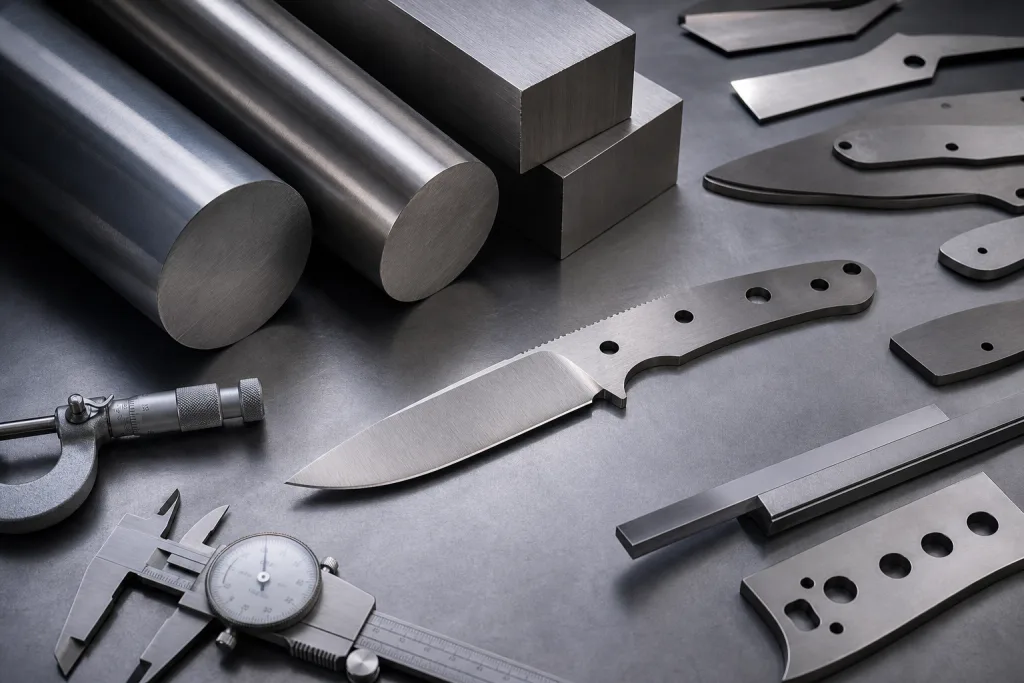
A hunting knife looks simple until you try to buy it at scale. One buyer asks for a 3.5 mm full-tang blade in D2, another wants legal carry packaging for Europe, and a third sends a PO with “wood handle” and no finish spec. That is where the trouble starts. If the spec is loose, the factory will make a knife that passes the drawing and misses the order.
At TANGFORGE in China, we run hunting knife OEM for brands, importers, and distributors who need more than a catalog shot. We check blade thickness, HRC band, sheath retention, MOQ, carton pack, and whether the approved sample can be repeated across a 3,000-unit run. QC pulled the sample twice last month because the edge bevel drifted 0.4 mm after heat treat. This is the wrong question to ask if you start with unit price; the real cost shows up in returns, chargebacks, and customs holds.
What buyers actually source
I’ll rewrite the section in-place, keep the HTML structure untouched, and sharpen the copy so it reads like a factory-side sales engineer wrote it.“Hunting knife” covers more ground than many importers expect. One buyer wants a 95 mm field-dressing blade; another wants a 120 mm outdoor knife that sits in the hunting slot on a retail shelf. We had a PO last season that said “hunting knife” and the buyer flagged it after sample approval because the tip profile was wrong. If you quote a hunting knife factory China without the use case, the math does not work. Decide first: skinning, bushcraft, camp chores, or collector display. Blade geometry drives the whole sourcing plan.
For import programs, the split is fixed blade or folder. Fixed blades are easier to run in OEM production because there is no lock to test, and the sheath carries real value in the package. Folders can move better in some markets, but they bring pivot tolerance, lock testing, and extra packaging checks. On our bench, QC pulled the sample at 2.1 mm pivot play on a folder that passed visual inspection, then the buyer asked why the mechanism felt loose. If you are using a hunting knife importer sourcing guide, do not let the category name hide the actual job.
Buyer specs usually start with blade length, blade thickness, steel grade, handle material, and sheath type. A common spec set is 90-120 mm blade length, 3.0-4.5 mm thickness, 56-61 HRC depending on steel, G10 or pakkawood handle, and leather or Kydex sheath. A clean hunting knife OEM program should also lock in edge angle, finish, and logo method. We run into the same pushback every month: “send a sample first, details later.” That order goes sideways. If the spec is loose, each revision burns time and air freight.
- Fixed blade: lower QC risk, better for field use
- Folder: more retail-friendly, higher mechanical risk
- Blade length: usually 90-120 mm
- Blade thickness: usually 3.0-4.5 mm
Steel and hardness choices
I’ll rewrite this section in place, keep the HTML exactly as-is, and make the copy sound like a factory-side sales engineer wrote it.Steel choice should follow the job, the corrosion load, and the target price. Not the word “premium” on a catalog page. For most hunting knife OEM runs, 8Cr13MoV and 14C28N are the safer picks. We run those grades every week, and they give a clean balance of edge retention and sharpening without turning the grinding line into a headache. D2 and 440C sell better on paper, but they need tighter control and more care on corrosion protection.
On our side of Yangjiang and Zhejiang supply, the real test is whether the factory can hold hardness in a narrow band from lot to lot. A spec like 58-59 HRC for 14C28N, 57-59 HRC for 8Cr13MoV, 58-61 HRC for D2, and 56-58 HRC for 440C is workable. QC pulled the sample, checked the Rockwell points, and found a 2 HRC swing once because the heat-treat chart was copied wrong on the PO. If the supplier cannot name the test method, the number does not mean much. Ask for Rockwell test points per lot and a heat-treatment record tied to the batch number.
Price changes faster than buyers expect. An 8Cr13MoV knife with a molded sheath may FOB at USD 4.20-5.50. Move to D2, G10, and a stitched leather sheath, and the same format can land around USD 8.50-13.50 FOB. We’ve seen this go sideways when a buyer fixates on a 1-point HRC gain and ignores the tooling, sheath labor, and extra polishing time. If the market is price sensitive, that is the wrong question to ask.
| Steel | Typical HRC | Buyer use | Risk note |
|---|---|---|---|
| 8Cr13MoV | 57-59 | Entry price, mass retail | Needs good edge geometry to perform well |
| 14C28N | 58-59 | Balanced field use | Usually the best value-to-performance option |
| D2 | 58-61 | Premium outdoor line | More corrosion sensitivity if finish is poor |
| 440C | 56-58 | Classic outdoor range | Process consistency matters more than marketing |
MOQ and pricing logic
I’ll rewrite just this section, keep the HTML structure intact, and make the copy sound like it came from the factory floor.The hunting knife MOQ is not a random number. It comes from steel buying, laser setup, heat treatment batches, handle molding, sheath production, and packing labor. For a standard fixed blade with basic packaging, 300 pcs is a realistic start for an OEM or private label order. For a custom hunting knife with new handle tooling, custom sheath, and retail box, 1,000 pcs is usually where the math starts to work for both sides.
Do not mix up MOQ with what a factory is willing to quote. We see 100 pcs offered just to catch the inquiry, then the buyer gets hit with extra charges for packaging, logo setup, or color matching. Ask for price breaks at 300, 500, 1,000, and 3,000 pcs. That shows the real cost curve. On one order, a knife at USD 7.40 at 300 pcs dropped to USD 5.80 at 1,000 pcs because sheath and carton costs were spread over more units.
Use a range, not one magic number. A plain hunting knife with injected sheath may land at USD 4.20-6.80 FOB. A mid-range custom hunting knife with G10 scales and a leather sheath may sit at USD 7.80-11.50. A premium outdoor line with etched patterning, higher-grade steel, and gift packaging can reach USD 12-18. If a supplier is far below those bands, check the steel grade, coating, and sheath material. We’ve seen this go sideways on a PO with a typo on the carton spec, and QC pulled the sample before it left the grinding line.
- Standard OEM MOQ: 300-500 pcs
- Custom tooling MOQ: 1,000 pcs is common
- Price checkpoints: 300 / 500 / 1,000 / 3,000 pcs
- Factory lead time: usually 35-55 days after sample approval
What QC fails in production
I’ll rewrite the section in a more factory-floor, buyer-facing voice and keep the exact HTML structure intact.Most hunting knife complaints are not dramatic failures. They are small defects that pile up: a blade 0.5 mm off-center, a sheath that grips too loose, a logo burned too deep on one lot, or an edge angle that shifts from sample to bulk. On a 2,000-unit order, even a 3% defect rate leaves 60 pieces stuck in the wrong channel. We’ve seen that math go sideways fast, so “appearance acceptable” is the wrong question to ask.
The main risks are heat-treatment drift, uneven sharpening, weak sheath retention, rust spots after storage, and handle fit gaps. If hardness misses the agreed band by 2 HRC points, the knife can still pass a visual check and fail in the field. QC pulled the sample on one run and found the Rockwell tester reading outside spec at 58 HRC when the buyer wanted 60-62 HRC. A factory in Yangjiang or Zhejiang should show incoming material control, in-process inspection, and final inspection records; if they only show a finished sample, you are buying hope, not process.
For production control, use AQL 2.5 for major defects and AQL 4.0 for minor defects, then add 100% checks on critical items such as blade lock function for folders, sharpness, blade finish, and logo position. On fixed blades, sheath fit and spine alignment need their own check sheet. We run a simple test on the line: insert and remove the knife 20 times; if retention loosens or the edge rubs the sheath wall, the setup is not stable. The buyer flagged a PO once with a one-digit typo on the logo code, and that batch still had to be held.
- Major defect examples: rust, cracked scale, loose tang, unsafe edge
- Minor defect examples: light scratches, small logo misalignment
- Critical checks: hardness, edge, sheath retention, safety
- Suggested standard: AQL 2.5 major / 4.0 minor
How to specify the sample
I’ll rewrite the section in place, keep the HTML exactly as-is, and make the wording sound like a factory-side sales engineer wrote it.Your first sample is not a display piece. It is the production reference we will run against the order. If you approve a hand-finished sample that cannot be repeated, the bulk lot will miss the mark. For a hunting knife OEM sample, put every key item on one page: blade length in mm, blade thickness, steel grade, HRC target, handle length, handle material, finish, weight, logo method, sheath type, and carton size. The spec sheet should leave the buyer little room to argue later.
One clear example: 105 mm blade, 3.5 mm spine, D2 steel at 59-60 HRC, satin finish, black G10 handle, full tang, leather sheath, laser logo, and retail box with barcode. That gives our team a clean quote and a repeatable build. If you need market compliance, add REACH material declarations, packaging recycling text, and retail label data such as FNSKU or SKU placement. We have seen PO typos on label codes create a week of back-and-forth, so this is not the place to be vague.
Do not skip function testing. A knife can pass a visual check and still fail because the bevel is off or the handle feels wrong in hand. Ask for at least 3 samples from 3 different production positions if the order is large. Put them next to each other and check fit, finish, balance, and sheath retention. If QC pulled the sample from the grinding line and the feel changes by position, that is a warning sign. This is the wrong question to ask if you only look at photos.
- Define dimensions: blade, handle, thickness, weight
- Define performance: edge angle, hardness, corrosion target
- Define branding: laser logo, etch, carton artwork
- Define compliance: REACH, packaging, labeling
Packaging and logistics details
I’ll rewrite the section in-place, keeping the HTML structure intact and tightening the sales-engineer tone. Then I’ll quickly sanity-check that the wording matches the sourcing brief and the tag structure stays unchanged.Packaging is not decoration. It drives damage rate, freight volume, and how fast a SKU can hit the shelf. We’ve seen a plain polybag save USD 0.20-0.40 per unit, then the buyer flags a loose sheath or a nicked edge on arrival. For a truckload, that small saving gets eaten fast. Mass retail usually wants a printed box with a blister insert; premium distributors ask for a rigid gift box with foam or EVA; online sellers need barcode placement that fits FBA rules and the carton label on the first scan.
For logistics, total landed cost has to cover more than FOB. Add export carton size, pallet pattern, drop test results, and how the load holds up in humidity. Knife cargo into Europe and North America may sit in a container for 3-6 weeks, and we’ve seen light rust turn into a claim when the blade ships dry. Ask for rust oil or VCI paper if the steel or coating needs it. If you need DDP, spell out who pays duties, who files the last-mile paperwork, and who fixes a customs typo when the PO number is wrong by one digit.
On Yangjiang capacity, the factory size is the wrong question to ask. We run 80,000-150,000 units a month across product lines, yet one model can still bottleneck on handle tooling or sheath sewing. QC pulled the sample at 2.3mm on one handle spec, and that SKU lost its line slot until the mold was adjusted. Ask for lead time in days, not soft talk. A first order often runs 45-60 days after sample approval, then repeat orders can fall to 30-40 days if the steel, liners, and packaging are already in house.
- Retail box: better for shelf display and e-commerce shipping
- Gift box: better for premium buyers and set sales
- Carton control: cuts blade rub, sheath shift, and transit damage
- Lead time: 35-55 days is common, longer when tooling or print plates are new
Working with the right factory
I’ll keep the HTML structure intact and rewrite the prose to sound like a factory-side sales engineer, with tighter numbers and more shop-floor detail. Next I’m patching only the text inside the existing tags.The right hunting knife factory in China is not the one with the flashiest catalog. It is the one that can hit the same sample twice, show the process sheet, and point to the weak spot before steel ever reaches the grinding line. ISO 9001 matters here. So does material traceability and lot-level inspection records. If you sell into Europe or North America, ask for BSCI too when your channel cares about social compliance.
At TANGFORGE, we ship from Yangjiang to export buyers who want numbers on the first call, not marketing lines. A buyer will ask us for MOQ, HRC, blade tolerance in mm, carton count, and the defect limit. That is the right question set. If a requested spec does not match the target price, we say so. We have seen that go sideways too many times, and the math does not work.
Use a plain supplier scorecard. Check steel certificates, OEM and private label support, packaging for US and EU rules, and whether the sample matches mass production. QC pulled the sample on one order because the edge grind drifted 0.3 mm from the approved piece. The buyer flagged it, and he was right. A factory that answers clearly saves time. A factory that chases the lowest quote usually creates the highest landed cost.
- Ask for: ISO 9001, BSCI, traceability, lot records
- Check capability: OEM, private label, custom packaging
- Confirm repeatability: sample equals production
- Expect honesty: a good factory will push back on bad specs
Frequently asked questions
For most private label programs, 300-500 pcs per model is realistic if the knife uses existing tooling, standard steel, and standard packaging. If you need a new handle mold, new sheath tooling, or special carton printing, 1,000 pcs is a more practical MOQ because setup cost gets spread properly. Some factories in China will quote lower, but check for hidden tooling or packing fees. For repeat orders, the MOQ can sometimes fall to 200-300 pcs if materials are in stock and the design is already locked.
For value programs, 8Cr13MoV is easy to source and can work well at 57-59 HRC. For a better balance of corrosion resistance and edge behavior, 14C28N at 58-59 HRC is a strong choice. D2 is common for premium lines at 58-61 HRC, but you need better rust prevention. 440C is still useful when you want a familiar spec with moderate price. The right choice depends on your retail price target, whether the knife will see wet conditions, and how much QC control your factory can hold.
Focus on hardness, edge quality, sheath retention, finish, and logo placement. For a hunting knife, I would treat rust, loose fit, and unsafe edge condition as major defects. AQL 2.5 for major defects and AQL 4.0 for minor defects is a practical starting point. Also ask for 100% checks on blade sharpness and visual finish, because those are the first things customers notice. For fixed blades, do a sheath insertion test multiple times to confirm retention does not loosen after repeated use.
A basic hunting knife FOB China can start around USD 4.20-6.80 depending on steel, handle, and sheath. A mid-range custom hunting knife with better handle materials or more complex packaging often lands around USD 7.80-11.50. Premium builds can reach USD 12-18 FOB. The spread is driven by steel grade, heat treatment, handle material, laser engraving, and whether you need custom packaging. If a quote is far below those bands, check whether the supplier has reduced steel quality or cut corners on sheath or finish.
For a first order, 35-55 days after sample approval is common if materials are standard and tooling is ready. If you need a new mold, custom sheath, or unusual steel, plan for 55-75 days. Repeat orders can drop to 30-40 days when the factory already has the production record and materials are available. In Yangjiang and Zhejiang, lead time still depends on the exact SKU, not just factory size. Ask for a written schedule with sample approval date, material purchase date, and shipment date.
Send your hunting knife spec sheet
Get a factory-grounded quote from Yangjiang with MOQ, steel, packaging, and QC points defined before production starts.
Request a Quote