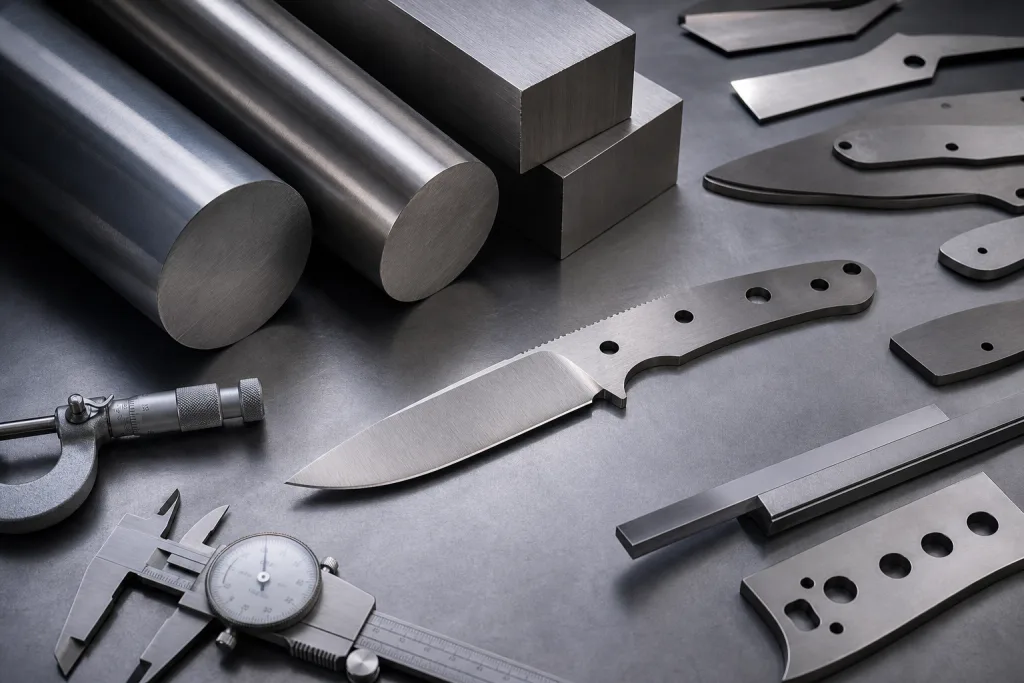
When you buy from a hunting knife OEM factory, the sample in your hand is only half the story. The other half is whether the factory in China can repeat that blade across 1,000 or 10,000 pieces without the Rockwell drifting from 58 HRC to 61 HRC, the grind line walking off-center, or the handle gaps opening after final assembly. We run these checks on the grinding line every shift, because one good sample means little if QC cannot hold the same edge geometry on the next carton. The lowest unit price is usually the wrong question.
For importers, brand owners, and distributors, a hunting knife order usually breaks on details that looked small at RFQ stage: steel grade was left open, the HRC window was too wide, sheath fit was not measured, or the carton art got approved before blade finish was fixed. A good hunting knife factory China should give straight answers on MOQ, lead time, AQL 2.5, and test method. We have seen buyers miss a PO typo on sheath length by 5 mm and then wonder why the shipment held at inspection. If the factory cannot explain those numbers, you are not buying a custom hunting knife program yet; you are buying risk.
What buyers should specify first
I’ll rewrite the section in-place, keep the HTML exactly as-is, and tune the copy to sound like a factory sales engineer with tighter specs and fewer AI markers.The fastest way to lose control of a hunting knife OEM project is to ask for “a better hunting knife” and leave the rest open. Start with the use case: skinning, field dressing, general outdoor carry, or survival backup. Then lock blade length, blade thickness, steel, handle, sheath, finish, and target market price. If those items stay loose, we guess, and the guess shows up in your returns.
For most custom hunting knife programs, the spec sheet should include blade length in mm, thickness in mm, overall length, steel grade, target HRC, edge angle, handle material, and sheath type. A workable outdoor spec is 95-120 mm blade length, 2.8-4.0 mm thickness, and 56-60 HRC, depending on steel choice and abuse level. We run samples on the grinding line against that sheet. This is not paperwork. It is the production control document.
- Blade geometry: drop point, clip point, or spear point; state tip thickness if you care about point strength.
- Steel: 5Cr15MoV, D2, 14C28N, 10Cr15CoMoV, or Damascus build; do not leave it open.
- Handle: G10, micarta, wood, pakkawood, or TPE; include texture and color code.
- Sheath: leather, Kydex, or nylon; specify retention and belt width.
In Yangjiang and Zhejiang, we ship a lot of outdoor knife orders, but the ones that hold margin are the ones with a full tech pack before quotation. We’ve seen this go sideways on a PO with one typo in the handle color and a buyer who wanted “same as sample” after approval. That is the standard you want from a hunting knife factory China supplier.
How MOQ really works
I’m rewriting the section in place, keeping the table and tags intact. Next I’ll tighten the language, add a few factory-floor specifics, and avoid the AI filler patterns.Hunting knife MOQ is not one number. We see it move with blade steel, handle material, finish, and packaging. A straight SKD or stock-geometry model can start at 300 pcs. A full custom hunting knife with new sheath tooling, printed box, and insert card often lands at 500-1,000 pcs. If the order splits into 2 colors or left- and right-hand sheath versions, the MOQ climbs again.
China factories price by process load, not only by metal cost. A laser-engraved logo or tumble finish barely moves the needle. Sandblasted blades, CNC handle scales, and a molded sheath do. On our line, QC pulled a sample after the second sanding pass and caught a 0.3 mm handle gap; that is the kind of detail that turns a “simple” order into a setup job. The wrong question is “Can you do 200?” Ask, “What is the MOQ at this exact spec, and which process changes it?”
| Program type | Typical MOQ | Indicative FOB unit price | Lead time after sample |
|---|---|---|---|
| Basic outdoor knife, stock steel | 300-500 pcs | USD 3.80-5.20 | 35-45 days |
| Custom hunting knife, new handle + logo | 500-1,000 pcs | USD 5.50-8.50 | 40-55 days |
| Damascus or premium build | 300-800 pcs | USD 12.00-35.00 | 45-60 days |
Use MOQ as a negotiation tool, not a trap. If a hunting knife OEM factory in China says 1,000 pcs, ask whether that means one SKU, one color, one sheath, or the full order across variants. We’ve seen buyers miss a PO typo on the quantity split and get boxed into the wrong build. Clear that up before deposit, and the math usually works.
Steel, HRC, and edge retention
I’ll rewrite the section in-place, keeping the HTML structure intact and tightening the sales-engineer tone with more concrete factory-floor detail.Steel choice is where most sourcing mistakes start. A hunting knife has to hold an edge, take field abuse, and stay stable through production without a pile of rework. We run into this every week on the grinding line: if the spec just says “premium stainless” or “high carbon steel,” the quote is guesswork. That is the wrong question to ask.
For general outdoor use, 5Cr15MoV and 14C28N are common picks because they are workable, corrosion resistant, and easy to keep within spec in mass production. D2 gives better wear resistance, but it is less forgiving on rust and heat treat drift. On a premium custom hunting knife line, ask for the hardness target plus the tolerance band, not a loose nominal number. A practical range is 56-58 HRC for stainless utility builds and 58-60 HRC for stronger edge retention programs, depending on geometry.
- Check heat treatment: ask for batch hardness records, not one sample reading from QC.
- Ask about decarb and warping: they show up fast on 3 mm tips and long blades.
- Define blade finish: satin, stonewashed, black oxide, or bead blast changes corrosion behavior.
- Request test method: Rockwell HRC should be measured at the right spot and written down.
A hunting knife factory China supplier with real process control will talk about quenching, tempering, and straightening without being pushed. We once had a PO with “D2 stnlss” typed wrong, and the buyer flagged it before steel was cut. If they dodge those terms, they are buying steel like everyone else, but they are not running it like an OEM partner in Yangjiang or Zhejiang.
Tooling, packaging, and sample control
I’ll rewrite the section in the same HTML, keep the structure intact, and make the prose sound like a factory-side sales engineer wrote it. Then I’ll do a quick pass for the banned filler and phrasing.Most buyers hear “tooling” and think of molds only. That’s too narrow. A hunting knife OEM factory may need a handle jig, sheath-forming die, logo-stamping plate, carton insert cutter, or laser-position fixture. If your custom hunting knife brings a new profile, a new sheath, or a new box size, that is tooling work. It changes lead time and cost, even when the blade spec stays simple.
Sampling should run in stages. First sample checks geometry and hand feel; we use calipers, a profile gauge, and a quick grip check at the bench. Second sample locks steel, finish, logo, and packaging. For Europe or North America, do not sign off packaging until carton size, barcode position, inner bag material, and compliance text are checked. If the buyer wants FNSKU labels, retail hang tags, or master carton marks, fix them before mass production. We’ve seen a 5,000-box rework turn a clean order into a mess.
- Prototype stage: 7-12 days for geometry validation on a standard build.
- Pre-production sample: 10-15 days after revision confirmation.
- Packaging approval: confirm knife, sheath, insert, and carton together.
In Yangjiang, some factories run metalwork fast and let packaging slip. In Zhejiang, you often see tighter packaging control on consumer orders. The math doesn’t work if you skip signoff: one approved sample and one signed packing spec, then we ship to mass production.
QC risks that hurt margins
I’ll rewrite the section in place, keep the HTML structure exact, and tighten the language so it reads like a factory-side sales engineer, not generic web copy.The main QC risks in hunting knife sourcing are plain enough. We see the same failures again and again: edge grind drift, handle gap, sheath retention failure, logo burn-through, and hardness spread outside the agreed band. If you only inspect finished cartons, you miss the real cause. We run the grinding line to the spec, not the guess, and that is where the margin gets saved or lost.
For mass production, an AQL 2.5 plan is common for major and minor defects, but critical defects need a tighter call. A broken tip, cracked handle, loose pivot on a folding model, or sheath that spits the knife out too easily should go straight into critical. QC pulled the sample on one 5,000-piece order and found 7 bad sheath locks in the first 80 units. If the factory says “all good” with no written report, that is not QC. That is a buyer problem waiting to happen.
- Incoming inspection: blade blanks, handle scales, and sheath material.
- In-process inspection: bevel angle, symmetry, 3.0 mm thickness, and logo position.
- Final inspection: blade sharpness, sheath fit, finish, and carton count.
- Testing: salt spray, edge retention, drop test, and retention pull where relevant.
A practical control method is to lock the defect list before production starts. We set numbers the line can hold: no blade chips over 0.3 mm, no handle gaps over 0.2 mm, no visible rust spots, and no sheath pull-out below the agreed force. One buyer once sent a PO with the wrong logo position by 3 mm; the math did not work, and we caught it before steel hit the polishing wheel. Put that in writing with your hunting knife OEM factory. It is cheaper than fighting about credits after shipment.
Pricing, Incoterms, and payment terms
I’ll rewrite the section in-place, keep the table and tags intact, and tune the copy to sound like a factory-side sales engineer.When you compare quotes from a hunting knife OEM factory, put the same basis on the table first. FOB China is usually the cleanest start for importers because freight and destination charges stay visible. DDP looks simple on paper, but we’ve seen it hide the real cost stack and turn messy fast when customs asks for extra papers. For a first run, keep it on FOB, then move to landed cost once the spec is locked.
For a standard hunting knife factory China quote, ask for material, labor, packaging, and any extra charges as separate lines. A quote of USD 4.20 can turn into USD 5.10 once logo, sheath, and color box are added, and the buyer flags it late. We run into this on the sales desk all the time. On payment, 30/70 is the normal setup: 30% deposit, 70% before shipment after inspection. For bigger programs, some factories in China will take LC at sight, but the paperwork is tighter and release timing is slower by 3 to 7 days.
| Cost item | Typical impact | Buyer note |
|---|---|---|
| Laser logo | USD 0.05-0.20 | State size, depth, and position |
| Custom sheath | USD 0.40-2.50 | Material and retention drive cost |
| Printed box | USD 0.15-0.80 | Depends on structure and finish |
| New tooling | USD 150-2,500+ | One-time cost, confirm ownership |
If your target retail is tight, packaging is usually where the clean savings sit, not steel. We’ve seen buyers chase a USD 0.08 box change and save more than a material tweak. A good OEM partner will tell you where to trim and where the math doesn’t work. QC pulled the sample, checked the carton drop mark, and that is where the weak point shows up.
Why factory capability matters
I’ll rewrite the section in-place, keep the HTML exactly as-is, and tighten the sales-engineer voice with concrete factory details and cleaner buyer language.Not every supplier calling itself a hunting knife OEM factory is set up for OEM work. Some are trading companies with one sample room and no grinding line. Others are small workshops that can turn out 100 decent knives but start slipping when the order hits 5,000 pcs. We run into this fast. Ask who owns heat treat, who signs off QC, and how they handle a buyer’s PO typo before you approve any schedule.
A real knife factory should show a clean flow from steel cutting to rough grinding, heat treatment, finishing, handle assembly, sharpening, inspection, and packing. On a medium-size line in China, monthly output often sits around 80,000-200,000 pcs across kitchen, outdoor, and pocket knife programs, but your SKU share still depends on setup time and blade complexity. If a supplier cannot quote lead time for 1,000 pcs of one hunting knife SKU without hedging, the math does not work. We’ve seen that go sideways. A shop with a belt sander and a 1,200°C furnace can still miss delivery if the process is not controlled.
- Ask for capacity by process: get numbers for cutting, grinding, heat treat, and packing, not just total output.
- Check compliance: ISO 9001, BSCI, REACH, and LFGB where applicable.
- Confirm traceability: batch numbers, inspection records, and carton labels, plus the QC sign-off sheet from the last lot.
In Yangjiang and Zhejiang, the stronger factories are not the loudest. They are the ones that can answer one blunt question: if you reorder in 90 days, will the second lot match the first lot on edge finish, handle fit, and carton marking? QC pulled the sample, measured the spine at 3.2 mm, and the answer either holds or it doesn’t. That is the real OEM test.
Frequently asked questions
For a standard hunting knife OEM project, 300-500 pcs is realistic for a simple model, while 500-1,000 pcs is more common for a custom hunting knife with new handle, sheath, or packaging. If you need multiple colors or multiple blade finishes, the effective MOQ often rises because each variant needs its own setup. Always ask whether the MOQ is per SKU or per total order. In China, factories in Yangjiang and Zhejiang will quote differently depending on their line balance and tooling load.
Most buyers should start with a target in the 56-60 HRC range, then narrow it by steel and use case. For stainless utility builds, 56-58 HRC is common; for tougher outdoor edge retention, 58-60 HRC is often workable if the geometry supports it. Do not accept a quote that only says “hardness approved.” Ask for the measurement method, batch records, and tolerance band. A good hunting knife factory China supplier should give you the actual target, not a vague promise.
A practical FOB range for a custom hunting knife is often USD 3.80-8.50 per piece at around 1,000 pcs, depending on steel, finish, handle, sheath, and packaging. Premium Damascus builds or more complex outdoor knives can move much higher, often USD 12.00-35.00 or more. The clean way to compare quotes is to separate blade, handle, sheath, and box. A low base price can become expensive once the extras are added.
Use a locked sample, a written defect standard, and AQL 2.5 for major and minor defects, with critical defects treated more strictly. Define acceptable blade edge, grind symmetry, handle gap, rust limit, logo position, and sheath retention force before production starts. Ask for in-process photos and a final inspection report, not just carton photos. For a first shipment, it also helps to inspect random cartons before the balance payment clears.
Yes, most established factories can handle private label packaging if you give them the final dieline, barcode rules, logo files, and carton spec early. The important point is timing: packaging approval should happen before mass production, not after blades are made. If your program needs FNSKU labels, retail inserts, or bilingual warnings, include them in the PO. A factory in China can usually add these details, but late changes almost always cost time and money.
Send your hunting knife spec today
We can review your blade, handle, sheath, MOQ, and QC targets, then quote a realistic China factory cost for your market and volume.
Request a Quote