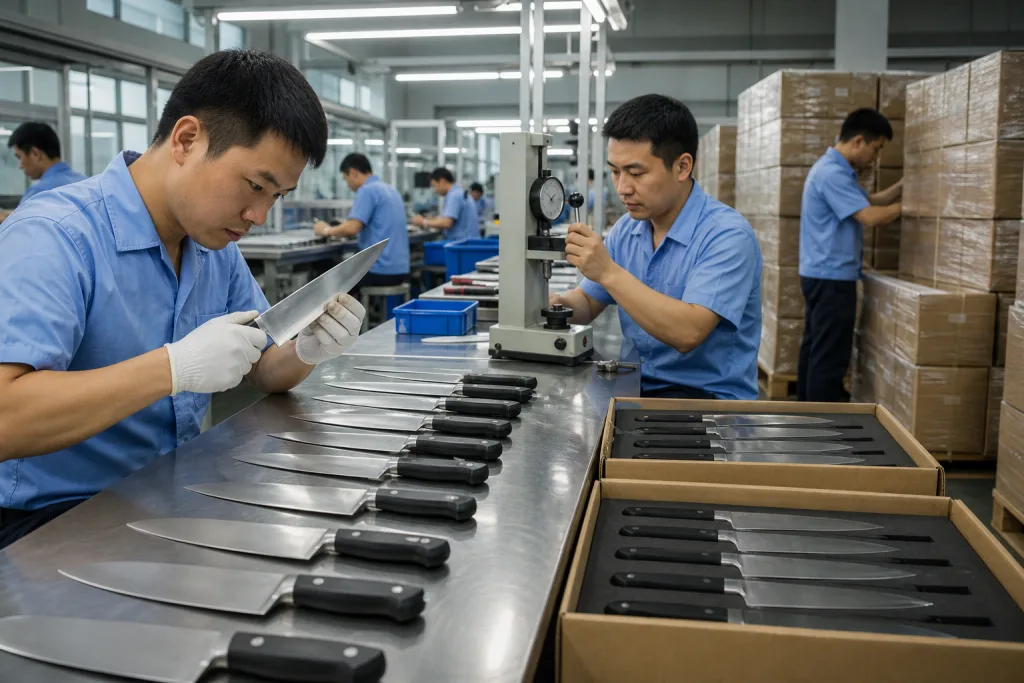
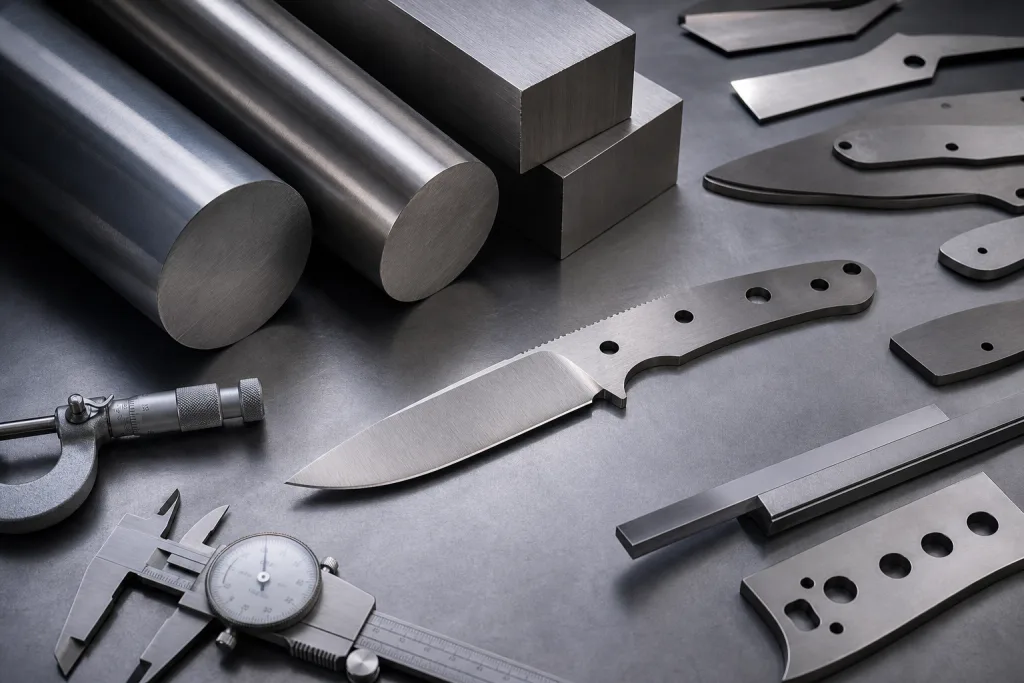
If you buy private label knives, the handle is where most avoidable losses start. A glossy sample can pass a photo check and still fail on 0.3 mm shrinkage, odor, grip, dishwasher resistance, or blade fit once the kitchen knife set handle material manufacturer moves from hand sample to production mold. In Yangjiang, Zhejiang, China, we see this every season: the buyer approves a visual sample, then QC pulls the first mass-run piece and finds color drift, glue lines opening at the ferrule, or a handle that turns brittle after 24 hours in cold storage.
The right kitchen knife set handle material sample approval process is not about collecting pretty samples. It is about locking the resin grade, surface finish, color masterbatch, hardness, and assembly tolerance before you place a PO. On a normal OEM line with 240 employees, we run 1,000-set MOQ and 35-45 day lead time only after the sample is frozen and the tool marks on the handle shell are checked against the drawing. This is the wrong question to ask if you want fewer claims: treat the sample as a contract document, not a sales prop, and you cut rework, reject risk, and freight losses.
What the sample really proves
A handle sample is more than a shape check. It tells us whether the selected resin, wood, composite, or elastomer can live through normal factory conditions. We have seen a kitchen knife set handle material factory polish 12 sample handles by hand until they look flawless, then lose the same finish on a 5,000-piece run because injection temperature moved 8 C, cooling time was cut by 6 seconds, or the wood moisture came in high. Approve the look, but also approve the process behind it.
For PP, ABS, POM, and TPR handles, watch shrinkage, mold release marks, warpage, and grip feel with a real production sample in hand. POM is stiff and stable, but it can show sink marks when the wall thickness jumps from 2.2 mm to 4.0 mm around the rivet area. TPR grips well. Cheap compound is where the trouble starts: QC pulled one packed sample that smelled sharp after 48 hours in a sealed PE bag, and the buyer flagged it right away. Pakkawood and real wood need moisture control, usually around 8-12 percent, or the finished handle can open at the seam after sea freight. In China, 7 out of 10 first-time buyers we deal with still check color first. This is the wrong question to ask. Ask whether the sample came from a soft tool, whether the production mold is finished, and whether the adhesive, rivet, or hidden tang system will stay the same in mass production.
If you buy through a kitchen knife set handle material supplier or wholesale partner, get the exact sample conditions in writing. A sample made at 22 C and 45 percent humidity is not the same as one left beside a wet packing room in Yangjiang, Zhejiang, China for 3 days before sealing. We run into this during rainy season. The right question is simple: what will this handle do after 50 dishwasher cycles, not what does it look like under studio lighting?
Use a staged approval ladder
Do not jump from concept art straight to final approval. That skips the checks that catch trouble early. We run this in stages because each one answers a different risk. First is the material chip or resin card: color, gloss, translucency, odor, and surface feel. Next is the loose handle sample, where we check grip, dimensions, and mold finish on the bench. Then comes the assembled sample with the blade, because balance, tang fit, and rivet alignment change how the knife actually feels. The last step is the pre-production sample, built with the real mold, real packaging, and the real label set. On the grinding line, QC pulled the sample if a handle edge felt sharp at the seam, and that saved a lot of back-and-forth later.
Here is a practical approval ladder for custom kitchen knife set handle material work:
| Stage | What you approve | Typical buyer gate | Risk if skipped |
|---|---|---|---|
| Material chip | Color, gloss, hardness, odor | Delta E within 1.0-1.5 | Color drift after mass run |
| Loose handle sample | Shape, grip, wall thickness | Fit tolerance within 0.3-0.8 mm | Warpage, loose assembly |
| Assembled sample | Balance, blade fit, seam line | No visible gap at normal viewing distance | Returns and bad reviews |
| Pre-production sample | All materials, labels, packout | Signed golden sample | Hidden change before shipment |
For most private label teams, the right move is to freeze the pre-production sample as the golden sample and keep one at the factory and one at your office. We have seen this go sideways when a buyer approved the look by email, then the PO typo changed the logo position by 2 mm and nobody caught it until packing. If the factory later changes resin, handle polish, or logo process, you need a reference you can measure, not a debate over screenshots.
Test the material, not the photo
Visual approval is cheap. Real testing keeps claims off your desk. On our line, QC pulled the sample from cavity 3 before it got a green light. A kitchen knife set handle material manufacturer should be ready for basic mechanical and chemical checks before you release the order. For elastomer grips, ask for hardness testing by ASTM D2240. For rigid plastics, check shrinkage, impact resistance, and gloss consistency. For wood or wood-composite handles, check moisture content, coating adhesion, and whether the grain direction will crack under seasonal humidity shifts.
- Hardness: Shore A 70-85 for many TPR grips, Shore D 80+ for harder POM-style handles.
- Color: spectrophotometer delta E target of 1.0-1.5 against the approved master sample.
- Odor: no strong solvent smell after 24 hours in sealed packaging.
- Dishwasher resistance: 30-50 cycles without obvious whitening, cracking, or logo loss.
- Drop test: 1 m drop on hard floor, no split at the seam or rivet zone.
For Europe, do not ignore REACH and, where relevant, LFGB expectations for odor and migration behavior. For North America, ask whether the material stack and inks are compatible with FDA-facing retail requirements, even if the handle itself is not a food-contact surface in the strictest sense. We have seen a PO typo on a color code turn into a rejected reprint, so ask the kitchen knife set handle material supplier to show test reports before sample sign-off. An approved color with no chemical or thermal data is just paint on a handle.
Buyers who test early spend less on air freight. A 200-300 USD test package is cheap next to a 5,000-set rejection or a full container that fails on arrival in Europe or North America. QC pulled the sample, found whitening after the third wash, and the order sat. The math does not work any other way.
Freeze the specification sheet
Most sample disputes are not technical. They start on paper. We have seen QC pull a production handle that looked “close enough,” then the buyer flagged a 1.2 mm butt-end gap because no one wrote the tolerance on the approval sheet. If the sheet is loose, the factory can say the mass-production handle matches the approved sample. The buyer never set the limit. A proper sheet should read like a manufacturing contract: resin family, color code, finish level, logo process, weight range, hardness target, packaging style, and the exact area allowed to vary. This is how you control a custom kitchen knife set handle material order before the grinding line and packing table turn a small miss into 3,000 disputed sets.
Lock these items before approval. No shortcuts.
- Material name and grade, such as ABS, POM, PP, TPR, pakkawood, or stabilized wood.
- Color reference, ideally Pantone plus a physical chip.
- Surface finish, such as matte 15-25 GU or semi-gloss 40-60 GU.
- Critical dimensions and tolerances at the tang slot, rivet hole position, and butt end fit, checked by caliper in mm.
- Logo method, including laser, pad print, emboss, or insert mark.
- Packaging revision, because a loose tray or wrong insert can rub the handle before retail and leave a mark that looks like a production defect.
Put the revision number on the drawing and on the approved sample bag. We run this with a marker label and a signed sample card; it sounds basic, but one typo on a PO can send the wrong handle finish into production. If you are buying from a kitchen knife set handle material wholesale channel, this step matters more because 3 factories may quote similar prices while using different filler ratios or polishing standards. A buyer in Yangjiang, Zhejiang, China should still demand the same control discipline as a buyer in Germany or the US. The factory location changes the accent, not the physics.
Once the spec sheet is frozen, every deviation has a name. If the supplier swaps resin, changes the masterbatch, or shifts the finish from 25 GU to 45 GU, it is no longer a quiet production choice. It is a written deviation that needs your approval before we ship. The math does not work after the container leaves.
Check the factory controls
Not every kitchen knife set handle material factory is built for stable approval work. Some run a clean sample on one mold cavity and fall apart on the repeat order. Before you move from sample to PO, ask how they control traceability, incoming inspection, mold maintenance, and operator training. In a serious kitchen knife set handle material manufacturer, every lot should tie back to resin batch, color batch, machine, and date code. If they cannot pull that record in 10 minutes, the approval process is already weak.
The factory should be able to explain the inspection system without sliding around the question. For export orders, AQL 2.5 is common for major defects, with a tighter internal check on appearance and fit. Ask whether the plant is ISO 9001 certified and whether it has BSCI or other social compliance coverage if your retail customer asks for it. If the handles use adhesives or coatings, ask for odor control and ventilation records from the line. If the handle is wood-based, check drying records and sealing method. If it is injection molded, ask for the actual tonnage of the machine used on the approved sample, because an 80-ton press and a 160-ton press do not always give the same finish.
A practical supplier should tell you the MOQ, usually 1,000-3,000 sets for custom work, and the real lead time, often 35-45 days after sample approval and deposit. We have seen buyers accept a 25-day promise, then the factory quietly moves the job to packing and QC pulls the sample for edge gaps. That is the wrong question to ask. If the supplier in China gives you a clean answer on mold, material, testing, and inspection, you can move forward with less guessing and fewer surprises at final audit.
Release production without drift
The last step is not the purchase order. The last step is the pre-production release. We run a small pilot lot, usually 100-300 sets, using the real handle material batch, real packaging, real blade, and real carton mark. Check that run before the factory starts the full order. This is where handle drift usually shows up: black PP looking half a shade darker, ABS polish reading rough under side light, a TPR seam line at 0.3 mm proud, or a grip pattern that feels sharper than the approved sample.
Use the pilot run to check assembly force, handle alignment, logo position, and carton fit. Simple work. Important work. On our line, QC pulled a 12-piece sample last month because two handles sat 1 mm off center after riveting. If the order is FOB, confirm the handover point in writing. If it is DDP, the packaging standard carries more weight, because a weak tray or thin outer carton turns transport damage into your claim. Keep one retain sample from the pilot run and one from the approved golden sample. When a later shipment is questioned, both samples settle the argument faster than 18 email replies.
Final inspection still needs a clear standard. AQL 2.5 works for many retail programs, but the buyer checklist should be stricter on handle cracks, blade wobble, and missing rivets. Do not treat every defect the same; this is the wrong question to ask. A tiny color shift on the back of a block is not the same as a loose steak knife handle. If you sell in Europe or North America, check that labels, barcodes, and FNSKU placement do not cover the handle area needed for inspection or customer photography. We have seen this go sideways when a barcode sticker covered the rivet line, then the buyer flagged the Amazon images after shipment. A clean approval process means the exact handle you signed off leaves the factory in Yangjiang, Zhejiang, China, in the same box and under the same revision number.
Frequently asked questions
For one color and one material, ask for at least 4 physical samples: one for your QC file, one for the buyer, one for the factory, and one retain sample sealed in a bag. If you are testing two colors or two finishes, move to 8-12 pieces because lighting and texture can change the judgment. If the set uses a knife block or gift box, request one assembled retail sample as well. For custom work, I would not release a PO until the pre-production sample matches the golden sample and the factory confirms the same resin batch, same mold, and same logo process. That reduces surprise rework after the 1,000-set MOQ has already started.
Test more than appearance. For plastic or elastomer handles, check hardness, odor, color difference, seam quality, and dishwasher resistance. A practical target is Shore A 70-85 for soft grips or Shore D 80+ for hard grips, with color delta E around 1.0-1.5 against the approved chip. For wood or pakkawood, ask for moisture content, usually 8-12 percent, plus coating adhesion and crack resistance after humidity cycling. You should also test assembly fit with the blade tang, because a good handle shell can still fail if the fit is loose by 0.3-0.8 mm. If your market is Europe or North America, request REACH and LFGB-related data where relevant before final approval.
No, not if you want real risk control. Photos are useful for rough direction, but they hide gloss level, mold lines, color shift, and grip feel. A video call helps you confirm shape and work-in-progress, but it does not replace a physical sample under your own lighting. A black handle that looks matte on a phone may be too glossy in warehouse light, and a TPR grip that looks fine on screen may smell strong after sealing. If you are buying from a kitchen knife set handle material supplier in China, ask them to courier the actual sample with the resin code, finish note, and revision number. That is the only version worth signing.
Treat that as a formal deviation, not a small production adjustment. If the supplier changes resin grade, filler ratio, color masterbatch, coating, or polishing method, the approved sample is no longer the same product. The correct response is to require a new sample, a revised spec sheet, and written approval before production continues. If the change is unavoidable, ask for test data on hardness, odor, shrinkage, and color delta E, plus a lot traceability record. In a serious factory, the change should also trigger a new revision number on the drawing and packaging file. Without that discipline, you risk mixed lots, claims, and disputes after shipment.
A basic handle sample can be low cost if the mold already exists, but a new custom handle often costs more because the factory must cut tooling, polish the cavity, and run multiple trials. For private label buyers, a sample fee of 50-300 USD is common, while more complex tooling work can be higher. Transit time is usually 3-7 days by courier, and design corrections can add another 7-14 days. If the sample is approved cleanly, the production lead time is often 35-45 days after deposit for a normal order from China. If the factory promises a much faster timeline, ask what it is sacrificing: mold finish, inspection time, or packaging control.
Request a handle approval pack
Send your target material, color, and market requirements. We will map the sample path, control points, and production checks before you release the order.
Request a Quote