When you source a kitchen knife set for wholesale or restaurant supply, the first quote from China almost never shows the full bill. A clean FOB number can look good on paper, then cartons, master packing, ocean freight, duty, inland delivery, and claims risk push landed cost up by 20 to 40 percent. We had a buyer flag a PO that said 500 sets but listed the wrong carton size, and the math was off before the first blade hit the grinding line. If you are buying from a kitchen knife set MOQ lead factory in Yangjiang, Zhejiang, China, you need a quote tied to the real production path, not just blade price.
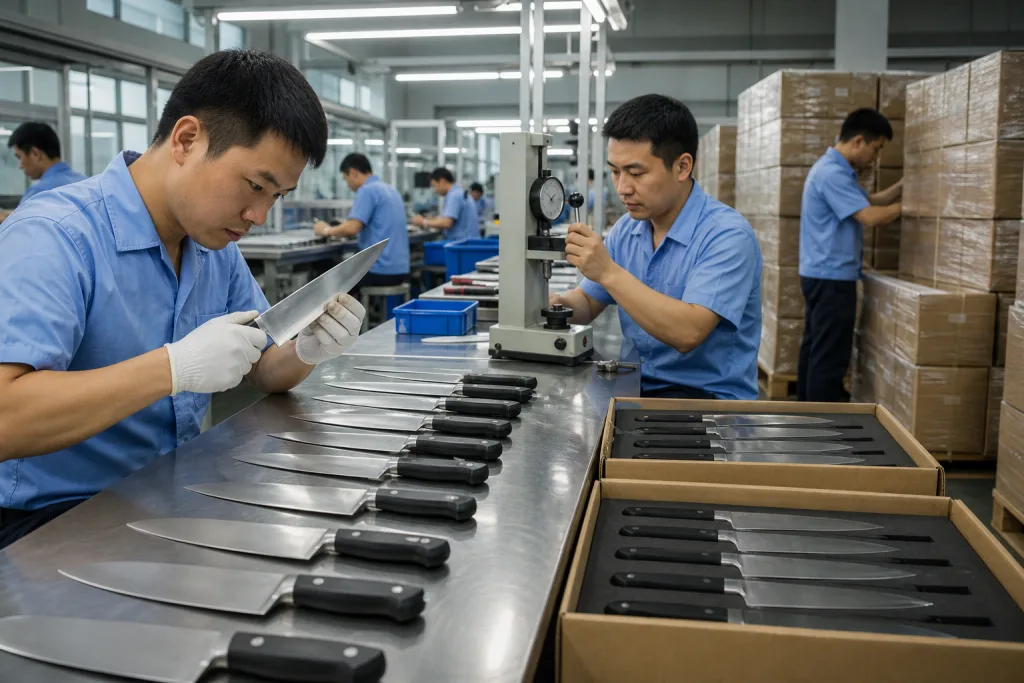
At TANGFORGE, a factory in China with 240 employees and roughly 60,000 boxed sets per month capacity, we see the same pattern every week: the buyer wants a low MOQ, a 12-day lead time instead of 18, and custom packaging, but still expects clean margin. That is the wrong question to ask if the spec is loose. QC pulled the sample on a caliper check at 2.1 mm, and the cost moved because the handle, insert, and carton were not standardized. It only works when you know which parts drive cost, which parts drive delay, and where to keep the offer simple without weakening it.
What MOQ Really Means
MOQ is not just a number printed on a quote. For a kitchen knife set MOQ lead factory, it is the point where blade steel sheets, handle molds, pad-print plates, master cartons, assembly labor, and AQL 2.5 checks stop losing money on the line. A 200-set trial sounds simple. On a fully custom 5-piece set, we still load the same CNC grinding program, set the same carton die line, and train packing workers on the same PE bag and insert sequence used for 2,000 sets. The math does not work, and we have seen buyers push back after QC pulled 12 samples and found the print cost sitting heavier than the blade cost.
For restaurant supply distributors, the better question is not whether a supplier says yes to a small order. Ask if the order can be built at a sane cost. A stock-based kitchen knife set from a kitchen knife set moq lead manufacturer in Yangjiang, China can sometimes start at 500 to 800 sets when the blades, handles, and neutral cartons are already on our rack. Change the handle color or blade finish, and the practical MOQ usually moves to 1,000 to 3,000 sets per SKU because the grinding line, polishing wheels, and color masterbatch all need separate control. If you want a custom insert, branded block, or special sleeve, expect an additional tooling or print setup charge of $150 to $2,500 depending on the item.
The clean way to control MOQ is to split standard parts from branded parts. Keep the blade geometry and handle mold standard, then brand the carton and insert card. We run this often for importers who need private-label shelf appeal without paying for new tooling. One buyer once sent a PO with the handle color typed as “black wood” while the artwork showed brown pakkawood; catching that before production saved 18 days of rework. That is how a kitchen knife set moq lead supplier keeps the quote close to wholesale pricing while still giving you a product that looks private-label.
Lead Time By Set Complexity
Lead time is where buyers lose the launch window. For a kitchen knife set moq lead manufacturer, the schedule follows the slowest item in the bill of materials, not the blade room. A 5-piece set with stock tooling, common steel, and a plain color box can ship in 30 to 45 days after sample approval and deposit. Add a laser logo plate, an EVA insert, or a wooden block, and we move to 45 to 60 days. New injection molds, a new handle shape, or a full custom package structure pushes the order to 60 to 75 days. On the grinding line, QC pulls first-off blades at 10:30 and checks edge width with a 0.02 mm gauge before the batch is released.
Sample timing matters too. A first working sample usually takes 7 to 12 days if we already have the base knife pattern. Packaging samples are a separate job and add another 5 to 10 days, especially for spot UV, embossing, or a printed sleeve. We had a buyer flag a 2 mm typo on the carton flap once, and that reproof cost three extra days. In Yangjiang and across China, the better factories keep sample sign-off away from production slotting, because mixing the two burns calendar time fast.
For a restaurant supply distributor, the practical rule is simple: lock the blade spec first, then the handle, then the packaging. Change the order after sample approval and the lead time slips. If you need a custom kitchen knife set moq lead program for Q4 retail or a spring menu reset, place the order at least 90 days ahead. That gives room for sampling, packaging proofing, in-line inspection, and container booking without paying emergency freight. We run AQL 2.5 on 200-piece lots, and when the buyer pushes the ship date by 12 days, the freight window is gone. The wrong question is whether the blades are ready; we've seen this go sideways because the carton count was still moving.
How Landed Cost Adds Up
The landed cost is the number your buyer, warehouse, or store manager actually pays attention to. A kitchen knife set wholesale quote can look cheap at FOB and still land high once freight, duty, and handling get added. We run this on the factory floor with the packing team, because a 5-piece set that ships in a bulky color box can change the math fast. Break it into factory cost, export packaging, freight, customs charges, and domestic delivery. Skip that split and you end up pushing on the wrong line while the margin leaks somewhere else.
| Cost element | USD per set | Comment |
|---|---|---|
| FOB factory price | 7.80 | 5-piece set, 18/0 steel, PP handle |
| Export carton and inner box | 0.45 | Printed color box, master carton |
| Ocean freight | 1.35 | LCL to US East Coast |
| Duty and port charges | 0.62 | Tariff, MPF, terminal handling |
| Brokerage and admin | 0.20 | Entry filing and release |
| Domestic delivery | 0.85 | Warehouse drop within 300 miles |
| Total landed | 11.27 | Before sales tax or VAT |
That example assumes a normal North America shipment with no special claims or repacking. In Europe, the numbers move because VAT is handled a different way and import duty depends on the tariff code and the country of entry. QC pulled the sample at the packing bench on a 12 mm carton spec before we booked the pallet count, and that is the level of detail that keeps the quote honest. A kitchen knife set moq lead supplier in China should give you an ex-works or FOB number, but you should build your own landed model with your freight forwarder. If your FOB is $7.80 and your target landed ceiling is $12.00, you have only $4.20 left for logistics, duty, and risk. The math does not work if the carton is oversized or the buyer flags a PO typo after booking.
Packaging And Freight Planning
Packaging is not decoration. It is freight density, damage control, shelf appeal, and labor cost in one decision. A custom kitchen knife set with a thick window box, foam insert, and hard block can look premium, but it also adds 15 to 30 percent to cubic volume versus a flat carton. On one Yangjiang run, QC pulled the sample after the carton gauge slipped to 0.8 mm and the inserts started shifting on the packing table. On a container basis, that extra air can cost more than the steel upgrade. For restaurant supply distributors, the right box is the one that protects the set, scans clean in the warehouse, and does not ship empty space.
For wholesale programs, I usually plan packaging around three questions. How many sets fit per master carton and per pallet. Will the carton pass 1 meter drop testing and corner compression. Can the package be repacked fast if you use a fulfillment center. A common 5-piece knife set might ship at 2.0 to 2.4 kg gross weight per set, with 6 to 12 sets per master carton depending on the format. We once had a buyer flag a PO typo on carton count, and the math blew up the pallet plan by half a day on the packing line. Move from a slim color box to a rigid gift box, and pallet count drops while freight cost climbs. That is the wrong place to get fancy.
In Yangjiang, factories that handle export well give you carton dimensions before production, not after. That lets you check cubic meter cost early. If your product moves by LCL, a 0.02 CBM change per set matters. If it moves by full container, pallet footprint and loading efficiency matter more. On a recent export lot, the master carton was 58 x 36 x 31 cm, and the loading plan changed after one insert was thickened by 3 mm. For a kitchen knife set moq lead wholesale order, packaging should keep landed cost predictable, not win points in the sample room for five minutes.
Quality Checks Worth Paying For
If you are buying from a kitchen knife set moq lead manufacturer, put QC in the quote line by line. Not a footnote. For knife sets, the claims that cost money are uneven edge grind, loose handle fit, blade rust after 28 days in a damp container, carton crush, and missing accessories like blade guards or scissors. We run these checks at incoming material, on the grinding line, and before shipment under AQL 2.5 for major defects, with critical defects at zero tolerance. Last month QC pulled 80 sets from a 3,000-set order and found 6 handles with a 0.4 mm gap at the bolster; that is the kind of finding you want before balance payment.
Material compliance matters the same. Ask for stainless steel declarations, handle material data, and any relevant REACH, LFGB, FDA, or food-contact paperwork. If the set includes a block, sharpener, or peeler, check each component separately because ABS, PP, wood coating, and rubber feet can fail for different reasons. For export to the EU, LFGB is the cleaner document for food-contact confidence. For North America, FDA-related declarations and traceability records fit the buyer file better. If you are working with a BSCI or ISO 9001 audited factory in Yangjiang, China, ask whether the audit scope covers the actual knife line, heat-treatment room, packing area, and subcontracted block supplier, not just the office.
Performance checks must match the blade spec. If the steel is meant to run at 56 to 58 HRC, write that range into the approval sheet and ask for Rockwell readings from at least 5 blades per size. If the set includes a chef knife, test edge retention and corrosion resistance on real samples, not a catalog claim. A kitchen knife set moq lead supplier that accepts third-party inspection is easier to trust than one saying inspection is optional. This is the wrong place to save USD 120. We have seen this go sideways when cartons were sealed first and the buyer flagged rust spots only after arrival at the warehouse.
How To Quote Custom Sets
Custom quoting only works after the spec is fixed. For a custom kitchen knife set moq lead order, we need seven inputs before the number means anything: knife count, blade steel, handle material, finish, sharpening spec, packaging style, and trade term. Miss one, and the sheet turns into a guess. That is how bad PO rounds start, and QC ends up chasing a sample with the wrong edge angle.
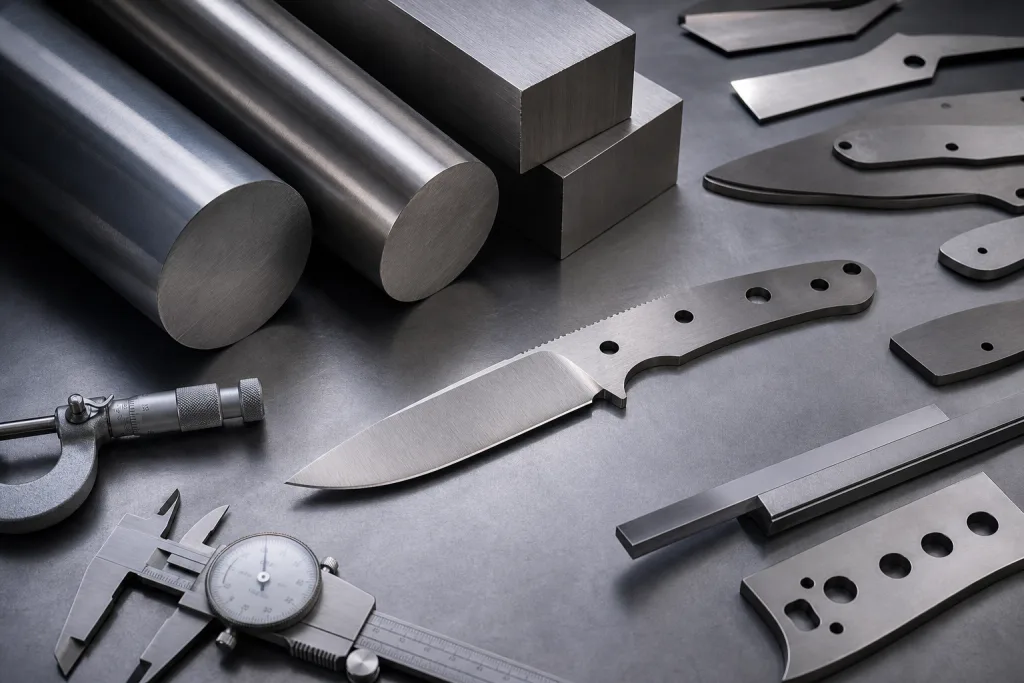
The biggest swing comes from steel and packaging. A standard 3CR13 or 4CR13 set costs less than X50CrMoV15 or 420J2 when the heat treatment is done right, and the gap is usually 8 to 25 percent once you add finish and hardness targets. Handle material changes the math too: PP and ABS run clean, while pakkawood, resin, or a metal composite handle adds cost and slows the line. Laser logo and a printed sleeve stay cheap. A new mold or a full wooden block does not. We have seen buyers push back on this, then ask for the same day they want the sample carton.
For a restaurant supply distributor, the cleanest start is one core set and one upsell set. A 5-piece entry set with a low MOQ, then a 7-piece premium set with better packaging. That keeps the factory slot tight and gives sales a real price ladder. We ship this way for a reason: the 5-piece usually clears faster, the 7-piece carries margin, and the buyer does not get stuck with a bloated first run. In Yangjiang, the factories that know export wholesale are not trying to sell you the hardest build. They are building the set that lands on time, clears customs without drama, and still works after freight and carton loss.
Frequently asked questions
For a stock-based 3- to 5-piece set, 500 to 800 sets can be workable if the blades, handles, and cartons already exist. Once you change the handle color, logo, or box artwork, the practical MOQ usually moves to 1,000 to 3,000 sets per SKU. If you add a new block mold or a special insert, expect a setup charge of about $150 to $2,500, depending on the component. For restaurant supply buyers, the best way to lower MOQ is to keep the knife structure standard and customize only the outer packaging.
For an established design, plan on 7 to 12 days for functional samples and 30 to 45 days for production after sample approval and deposit. If you add custom packaging, the schedule often shifts to 45 to 60 days. New molds, new handle shapes, or a wooden block can push the order to 60 to 75 days. If your sell-in date is fixed, place the PO at least 90 days in advance so you have time for sampling, freight booking, and inspection without paying for air freight.
Start with the FOB or EXW price, then add export carton cost, ocean or air freight, duty, customs brokerage, port charges, and domestic delivery. A set that costs $7.80 FOB can land around $11.27 in the US once you add about $0.45 packaging, $1.35 freight, $0.62 duty and port charges, $0.20 brokerage, and $0.85 domestic delivery. In Europe, VAT is handled differently, so your forwarder should quote the import path separately. Never compare landed cost using FOB only; it hides 15 to 35 percent of the real spend.
Yes, but only if the factory can share common parts. If two sets use the same blade patterns, handle material, and carton structure, you may be able to combine production and still hit 1,000 to 1,500 total sets instead of separate MOQs. The catch is that artwork changes, inserts, and packaging dimensions can break the savings. A kitchen knife set moq lead supplier in China will usually allow a mixed order when the BOM overlap is high enough to avoid line changeover losses. Ask for a split-by-SKU production plan before you assume the MOQ will drop.
The biggest freight driver is usually carton volume, not blade weight. A slim printed box can be 15 to 30 percent more efficient than a rigid gift box or a block-style set. If you move from 6 sets per master carton to 4 sets because the packaging is too bulky, your pallet count and LCL cost go up immediately. On a large order, a 0.02 CBM change per set can materially change the landed cost. For wholesale buyers, ask the factory for carton dimensions before approval so your forwarder can estimate the true ocean freight.
Send Your Set Spec For Pricing
Share knife count, steel, handle, packaging, and target quantity. We will quote MOQ, lead time, and landed cost for China, the US, or Europe.
Request a Quote