You can find a factory to make a knife set. That part is easy. The hard part is lining up MOQ, lead time, logo process, and retail packaging without loading your first PO with cost you did not plan for. We see the same request every week: a 6-piece set, gift box, laser logo, color sleeve, and low MOQ. Then the math doesn't work. One packaging change adds 18 days, drop-test risk goes up, and the carton spec changes after the sample room runs the first fit check with a digital caliper.
At TANGFORGE in Yangjiang, China, we see this every week with importers and private-label buyers in Europe and North America. A kitchen knife set moq lead private label packaging project has to be judged as one package, not as four separate decisions. MOQ usually starts with the box line, not the blade. Lead time usually gets stuck at logo confirmation or insert approval, not on the grinding line. We’ve seen this go sideways after QC pulled the sample and found the tray tolerance was off by 3 mm. One buyer even flagged a PO typo that changed the inner pack count from 12 to 24, which forced a new carton layout. If you know where MOQ comes from, which steps add days, and what retail packaging fits your sales channel, you buy from a kitchen knife set moq lead manufacturer in Zhejiang or Yangjiang with fewer revisions and tighter gross margin control.
Where MOQ really starts and why
Buyers often ask for one fixed MOQ on a kitchen knife set. That is the wrong question. On our side, MOQ usually breaks at four cost points: blade setup, handle parts, logo method, and packaging. The blade rarely kills the project. The carton dieline, 2 mm or 3 mm EVA insert, and print setup fee usually decide whether the start point is 300 sets or 2,000 sets.
For a kitchen knife set moq lead factory program with existing blade shapes, standard black PP handles, a laser logo, and a plain white box, we usually run 300 to 500 sets per SKU. Switch to a color gift box with EVA tray, barcode labels, instruction card, and matte lamination, and the practical MOQ moves closer to 1,000 sets. Add a custom handle color with Pantone matching or a molded wood block, and some parts need 2,000 sets before the math works on unit cost. We have seen buyers push for 500 sets with custom trays, then back off after the first packaging quote lands. QC pulled one sample last month where the tray fit was 4 mm off, and the buyer flagged it right away.
At our Yangjiang production base, we split MOQ into product MOQ and packaging MOQ. Ask that first. A kitchen knife set moq lead supplier may quote 500 sets on the knives, but the packaging vendor still wants 1,500 printed boxes, especially once the buyer flags a custom insert or retail window. We run into this on the packing line all the time. If you do not ask where the MOQ sits, you read the quote wrong.
- Low-risk launch: 300-500 sets using stock blades, standard handles, laser mark, plain box, or a simple sleeve
- Mainstream retail trial: 800-1,200 sets with color box, barcode, and private-label inserts sized to the set
- Full custom shelf program: 1,500-3,000 sets with molded tray, gift presentation, and custom accessories such as shears or a peeler
If your brand is still testing demand, cut variables first. Keep the knife architecture standard. Put the budget into the front-facing packaging panel and logo treatment, where buyers actually notice the difference on shelf. The grinding line will not save a weak box. We have seen this go sideways when a client spends on low-volume tooling for a handle color, then ships in a weak box with a dented corner rate above AQL 2.5.
Head-to-head: packaging options by cost and speed
The quickest way to compare a custom kitchen knife set moq lead project is to line up each packaging route in one table and check assembly time, carton size, and damage risk together. We’ve seen buyers sign off on a premium mockup, then flag the packed height after a carton drop test because the set picked up 18 mm and freight jumped. That happens fast. Channel matters here. Marketplace packs ship one way; hospitality supply and gift programs usually need a different pack-out.
| Packaging format | Typical MOQ | Lead time | Added cost/set | Best fit |
|---|---|---|---|---|
| White box + label | 300-500 | 20-25 days | USD 0.25-0.60 | Market test, B2B wholesale, online bundles |
| Color sleeve + inner box | 500-1,000 | 25-35 days | USD 0.70-1.40 | Entry retail, distributors, private label |
| Full color gift box | 1,000-1,500 | 35-45 days | USD 1.60-3.20 | Department store, seasonal gift, DTC premium |
| Rigid box + EVA tray | 1,500-2,000 | 45-60 days | USD 3.00-4.80 | High-value gift sets, corporate programs |
For 7 out of 10 kitchenware brand owners we quote, the color sleeve plus inner box is the safe middle option. It gives you front-panel branding, compliance marks, and care instructions without the freight penalty of a rigid box. We run this format every week. A full gift box moves better in holiday programs and premium channels, but carton cube rises fast, and the math doesn't work for some buyers once landed cost is on the sheet instead of just FOB.
In China, especially across Yangjiang and Zhejiang supply chains, packaging lead time usually starts at the print shop, not the grinding line. We’ve finished knives in 22 days, then waited 12 more days for cartons, inserts, UV ink curing, and drop-test approval after QC pulled the sample and found one inner card shifting 6 mm in transit. This is the wrong question to ask: “How fast can you make the knives?” Ask when the dieline is locked, whether the packaging vendor is in-house or subcontracted, and who signs off final artwork before print.
Logo methods that look right at retail
Logo customization looks simple on paper until it meets steel grade, blade finish, and a 1.5-meter shelf read. We’ve seen this go sideways. Pick the wrong method and the mark goes flat under retail light strips, or you add USD 0.12 to USD 0.35 per set and get nothing back at sell-through. For kitchen sets, most buyers narrow it to four methods: laser marking, screen print, etching, or a metal badge on the box instead of the knife. On our grinding line, that call is usually locked after the first 12-piece sample review.
Laser marking is the standard choice because it holds up, costs less, and works on satin blades and black-coated blades. On a stock-based kitchen knife set moq lead supplier order, this is usually the fastest route. We run fiber laser marking after blade finish, so the setup stays clean and repeatable from sample to mass run. The look is crisp and industrial. Contrast is the limit, especially on plain stainless, unless the coating gives you more separation or the mark is filled.
Silk screen or pad print on the blade gives stronger shelf impact for entry retail, but dishwasher testing shows the weak point fast. QC pulled the sample after 48 wash cycles on one EU program, and the buyer flagged edge fading around the logo. That is why buyers selling in Europe often move to laser on the blade and push the brand story onto the packaging. We ship fewer complaints that way. It also sells cleaner at store level.
Etching gives a finer premium look, especially on polished stainless or Damascus-pattern presentation pieces, but the math doesn’t work for every SKU. Unit cost goes up, and cycle time slows because surface prep has to stay tight before the acid step. We usually see it fit sets above USD 39.99 retail, where the box, insert card, and finish already carry that price image. On one PO last month, even a 0.3 mm logo line looked too light on the first polished sample, so we had to deepen it before approval.
Use-case fit
- Price-sensitive retail: laser logo on blade, one-color sleeve, put the budget into carton graphics that read from 1.5 meters
- Mid-market private label: laser logo plus branded care card, with barcode data matched to the outer carton SKU label
- Premium gifting: etched logo, rigid box, inside-lid print, and unboxing details that support the higher shelf price
At TANGFORGE, we usually tell new buyers not to over-customize the knife before they validate the packaging message. This is the wrong question to ask first. The customer sees the box first, not the tang grind. In kitchenware, retail packaging does more sales work than a blade logo upgrade that adds cost and disappears under the store light strip.
Lead time breaks at different decision points
Kitchen knife set MOQ lead time usually does not fail from one big issue. It slips because 6 small approvals sit open too long: steel confirmation, handle color chips, logo position, insert fit, export carton marks, and barcode approval. On our side, the grinding line may be on schedule, then one PO typo in the shipping mark stops carton printing for 2 days. We see this every month. You need to separate fixed points from moving points.
A realistic factory timeline for a standard private-label set in Yangjiang, China looks like this:
- Day 1-3: final quote approval, deposit, artwork files, packaging brief
- Day 4-10: pre-production sample, logo confirmation, packaging dieline approval
- Day 11-25: blade processing, heat treatment, grinding, handle assembly
- Day 18-30: box printing, insert production, labels, manuals
- Day 26-35: packing, AQL 2.5 inspection, carton drop test, booking
If you want a custom kitchen knife set MOQ lead manufacturer program with new molds, acacia block, magnetic closure box, or multilingual compliance packs, add 10 to 25 days. That is standard factory time. A new insert fit check alone can cost 3 days if the knife tip sits 4 mm too high and QC pulled the sample off the line. Printing vendors in Zhejiang and other China supply clusters move fast, but they still need locked artwork and color approval before the mass run. We have seen this go sideways after the buyer flagged the Pantone shade when the cartons were already queued.
The fastest way to cut lead time is not pushing the factory after PO placement. This is the wrong question to ask. Freeze the specs earlier. Send vector logo files, carton dimensions, FNSKU or outer shipping marks, and compliance text before sampling. We run smoother when those files land up front, not after sample sign-off. If your account team is still debating whether the blade set should be 5 pieces or 7 pieces after sample approval, the math does not work and the production plan drifts. One set count change can force a new inner tray size and a new master carton count, and 12 days vs 18 days disappears fast. Lead time discipline starts on the buyer side.
Choosing the right set for your channel
Not every kitchen knife set should be built the same way. The right spec starts with your channel and how the end user reads value in 8 seconds. A 3-piece starter set for e-commerce and a 7-piece countertop block set for specialty retail need different pack-out, different freight math, and different return control. We’ve seen this go sideways when a buyer tries to run one box plan for both, then the first carton test fails on the drop bench.
For online-first brands, compact packaging wins. Big gift boxes look sharp in listing photos, then the DIM charge lands and the buyer flagged it on the first reorder. A sleeve with a corrugated inner usually ships better than a bulky presentation box. We run drop checks on the packing line, and a 1.5 mm edge guard, a moisture bag, and solid transit protection save more claims than glossy print.
For brick-and-mortar retail, the front panel does the selling. You need a clear steel callout, piece count, country-of-origin label, and sometimes a cutaway window if the retailer accepts it. On these programs, the custom kitchen knife set moq lead packaging has to hold shelf impact without creating a theft issue. A 12 mm wider window helps display, but this is the wrong question to ask if the peg hook tears after two weeks in a store test.
For distributors and hospitality buyers, presentation comes second to repeat ordering. A 2-piece or 4-piece boxed set with light print and a stronger master carton usually beats decorative packaging. These accounts ask about replacement cycles, spec consistency, and price breaks at 1,000 or 3,000 sets. QC pulled the sample on one order because the PO typo changed the handle color, and that mistake matters more here than foil stamping or a soft-touch lamination.
In practical terms, if your retail price target is below USD 29.99, do not let packaging consume more than 12% to 15% of FOB value. If your brand sells above USD 59.99, you have more room for rigid packaging and richer print treatment, but the knife finish, fit, and edge quality have to support it. We check this under 4000K light at final inspection. If the blade grind looks rough under store lighting, the math doesn't work.
Quality points buyers miss on packaging projects
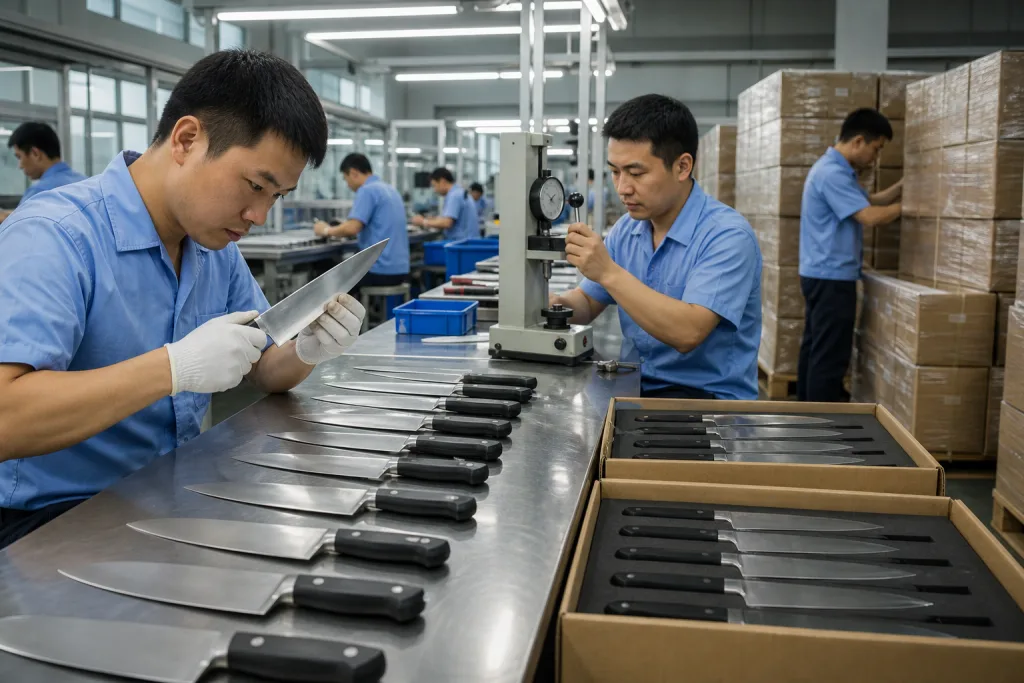
Most packaging complaints start before packing. We catch them on the grinding line and at pack-out: blade tolerance drifts, the insert pocket comes out 1.5 mm too loose, humidity cards never get loaded, and nobody runs a packed-set transit test. Then the buyer asks why a clean mockup fails after 28 days on water or rail. Loose tray fit is usually the reason. The blade tip walks inside the box.
For kitchen sets, ask your kitchen knife set moq lead factory these questions before PO release:
- Is the final inspection standard AQL 2.5 for major defects and clearly defined for cosmetics?
- Will the factory run carton drop testing on the packed set, not just the empty box?
- Are blades protected with tip guards, sleeves, or paper wraps so rub marks do not show up at arrival?
- Will export cartons use moisture protection for humid-season shipments from China, such as a 2 g desiccant pack per inner?
- Are food-contact declarations such as LFGB or FDA required for handle or coating materials?
At TANGFORGE, our typical mass-market kitchen blade range is 3Cr13, 5Cr15MoV, and similar stainless options hardened around 54-58 HRC, depending on design and market. That hardness band is not glamorous. It works. We ship fewer return cases with it, and end users can bring the edge back faster than they can with harder premium steel. If a supplier keeps talking about gift-box finish but cannot hold grind consistency within the same lot or keep handle assembly fit stable within 0.3 mm, the math does not work. You pay later through claims, rework, and replacement cartons.
Watch the small misses: handle odor after sealing, glue squeeze-out near the bolster, and sleeve print abrasion after 6 carton rub cycles. QC pulled the sample on all three in one April run, and one PO even had the color name typed wrong on the sleeve label. We have seen buyers focus on the front artwork and skip the factory-floor basics. This is the wrong question to ask. A box helps sell the first order, but QC wins the repeat order.
How to brief a supplier without wasting rounds
The fastest sourcing projects start with a tight brief. Send a mood board and “best offer,” and you will get a price spread that is useless, plus a lead time no factory will stamp on the PI. A kitchen knife set moq lead manufacturer quotes cleanly only after the packout is clear enough to match real work on the grinding line, the packing table, and the outer carton size.
Your RFQ should list piece count, blade list, target steel, handle material, hardness target, logo method, packaging style, barcode requirement, target market, and Incoterm such as FOB or DDP. Also state if the first order is a launch test or a full rollout. That changes MOQ fast. We see it every week: 1,000 sets for a test PO is one job, 6,000 sets for a chain launch is another, and the carton drop test standard usually gets discussed at the same time.
- Good RFQ: 5-piece kitchen set, 5Cr15MoV, black ABS handle, laser logo, color sleeve, gift inner box, 1,000 sets, FOB Shenzhen, launch in 55 days
- Poor RFQ: Need custom knife set with logo and nice packaging, please quote best price
If you are buying from Yangjiang or Zhejiang, ask for one quotation with stock-based private label and another with full custom packaging. Put them side by side. You will see where the cost sits and which step adds days. We have seen stock-based sets ship in 12 days versus 18 days once the buyer adds a custom gift box, insert card, and outer carton mark. On one PO, QC pulled the sample and found the barcode panel was wrong by 3 mm, so the buyer flagged the gap right away.
That is the practical way to handle kitchen knife set moq lead private label packaging: compare by commercial use case, not by decoration alone. Chasing a prettier box is the wrong question. For a lot of kitchenware brands, the best first PO is the version that ships on time, clears inspection, and leaves room for version two after real market feedback from the first 1,000 sets.
Frequently asked questions
For a stock-based private-label program, 300 to 500 sets is realistic if you use existing blade shapes, standard handles, laser logo, and simple packaging. Once you ask for full-color gift boxes, molded inserts, custom handle colors, or wood blocks, MOQ usually moves to 1,000 to 2,000 sets. The key point is that packaging MOQ and knife MOQ are often different. A factory in Yangjiang, China may agree to 500 knife sets, but the printed box supplier may require 1,500 units. Ask for the MOQ split by component. That gives you a clearer launch budget and avoids paying for excess packaging inventory on your first order.
A normal lead time is 20 to 35 days for stock-based private label and 45 to 60 days for a fully custom project. The shorter timeline applies when the kitchen knife set moq lead factory uses existing tooling, standard materials, and laser logo with simple box labeling. Add 10 to 25 days if you want custom gift boxes, EVA trays, Pantone-matched handles, or multilingual inserts that need extra approvals. In China, packaging approval is often the bottleneck, not knife grinding. If you send artwork late or keep changing piece count, production will slide. To stay on schedule, freeze the specification early and approve dielines before the knife lot is halfway finished.
For most new kitchenware brands, the best starting point is a color sleeve plus inner box. It gives decent shelf presence, space for brand story and compliance text, and lower cost than rigid gift packaging. Typical MOQ is 500 to 1,000 sets, and the added packaging cost is often around USD 0.70 to 1.40 per set. A white box with label is cheaper and faster, but it looks basic for retail. A rigid box with EVA tray looks premium, yet freight volume and damage risk rise quickly. Unless your retail price is above about USD 59.99, you usually get better margin and easier logistics from the mid-level packaging route.
Laser marking is usually the safest and most commercial choice. It is low cost, stable in production, and works well on common stainless kitchen blades. For entry and mid-market programs, laser on the blade plus stronger branding on the packaging gives the best balance of cost and appearance. Printed blade logos can look bolder but may wear faster under dishwasher or abrasive use. Etching has a more premium look, though it adds cost and time. If you are new to sourcing from a kitchen knife set moq lead supplier in Zhejiang or Yangjiang, start with laser and invest more of your budget in front-panel retail packaging, inserts, and carton graphics.
Start with final inspection at AQL 2.5, then make sure the inspection covers both the knives and the packed set. Ask for checks on blade scratches, logo position, handle fit, insert fit, carton sealing, and barcode accuracy. For packaging projects, carton drop testing is important because many claims come from blade movement inside the box, not from blade defects alone. If you ship from China in humid months, moisture protection in export cartons also helps. For food-contact compliance, ask whether LFGB, FDA, or REACH-related documentation is needed for handles, coatings, and packaging inks. A good-looking box is useful, but repeat orders depend more on stable QC than on decorative upgrades.
Send your set brief for a factory review
Share your target price, piece count, logo plan, and packaging idea. We will compare MOQ, lead time, and retail-packaging options for a practical launch proposal.
Request a Quote