If you are sourcing a kitchen knife set for Amazon or DTC, the mistake is usually the same: you start with price, then the MOQ lands at 2,000 sets, the lead time stretches to 45 days, or the steel spec will not hold a clean edge after a few hundred units. In a kitchen knife set MOQ lead steel specification comparison, those four variables move together. Change the blade steel, and we change grinding time on the line, heat-treatment settings, QC risk, and sometimes packaging approval too. That is the part buyers miss.
As a kitchen knife set MOQ lead factory in Yangjiang, China, we see this every week from buyers who want 500 or 1,000 sets, but are asking for laser logos, color boxes, full inserts, and a premium steel spec that really wants a larger run. QC pulled the sample at 58 HRC and the buyer flagged it, then asked why the carton proof changed the same day. The math does not work if the spec is vague. The right answer is not the cheapest steel. It is the steel that gives you stable hardness, predictable lead time, and a finished set your customer can actually keep using. In Yangjiang and Zhejiang sourcing conversations, the best programs are the ones where the spec is clear before sampling starts.
MOQ starts with the blade spec
MOQ is not just a sales number. In a kitchen knife set MOQ lead manufacturer workflow, it starts when purchasing checks coil width, heat-treatment loads, carton space, and how many workers we need at packing. For a 4-piece set in 3Cr13 stainless with a simple PE bag, we often run 500 sets without drama because the blade blank, handle mold, and edge angle are already on the board. Move to stamped blades with a custom bolster shape, printed gift boxes, and a magnetic insert, and the MOQ rises because the grinding line has setup loss and QC pulled samples for burrs, handle gaps, and box magnet position.
For buyers selling on Amazon or through a DTC site, the split is plain. A standard kitchen knife set wholesale program often starts at 500-800 sets when the design stays close to an existing platform. A custom kitchen knife set MOQ lead program with new handle tooling, special knife rack, or brand-specific packaging more often sits at 1,500-3,000 sets. We have had buyers push for 300 sets with a new color handle and a custom insert tray; the math does not work after mold trial, color matching, and the first AQL 2.5 inspection. That is not a sales tactic. It is how a factory in Yangjiang, China keeps cost and yield under control.
If you want a lower MOQ, keep the blade and handle close to proven parts: choose a steel grade we already buy, use an existing handle core with your logo adjusted on the pad-printing plate, keep the current edge geometry, and pick a packaging format already on our line. Separate branding from engineering. That is the practical move. We ship cleaner orders when the PO does not mix a new rack size, a new blade profile, and a new gift box in the same first run; we have seen this go sideways when the buyer flagged the rack slot at 2 mm too tight after pre-shipment photos.
Steel grades that actually matter
I’m rewriting the three paragraphs now, keeping the HTML structure intact and removing the stock phrasing while making it sound like a factory-side sales explanation.For kitchen sets, steel choice drives sharpness, corrosion resistance, grinding cost, and return rate. Buyers keep asking for the “best” steel, but that is the wrong question. You need to compare how the steel runs on the line and how it holds up in the customer’s kitchen. A 3Cr13 set is easy to run, friendly to MOQ, and fine for entry-level retail. A 5Cr15MoV or 7Cr17MoV set costs more, but the edge retention and stain resistance are easier to sell. VG10 or powdered steel sits in a different class, and we treat it as a premium program, not a default upgrade. On the grinding line, a 240# belt wears differently on each grade, and that shows up in the labor time.
Here is the short version. If your target is a volume SKU with clean appearance and controlled FOB cost, 3Cr13 or 5Cr15MoV is usually the rational starting point. If your customer reads steel labels and checks hardness, 5Cr15MoV at 56-58 HRC is easier to defend than a spec the line cannot hold every day. QC pulled the sample, and the Rockwell numbers stayed in range; that matters more than a glossy brochure. If you want a premium story, Damascus construction can work, but you need to spell out the core steel, cladding layers, and etching process. In Zhejiang and Yangjiang sourcing meetings, a typo on the PO for one steel code causes more trouble than packaging ever does.
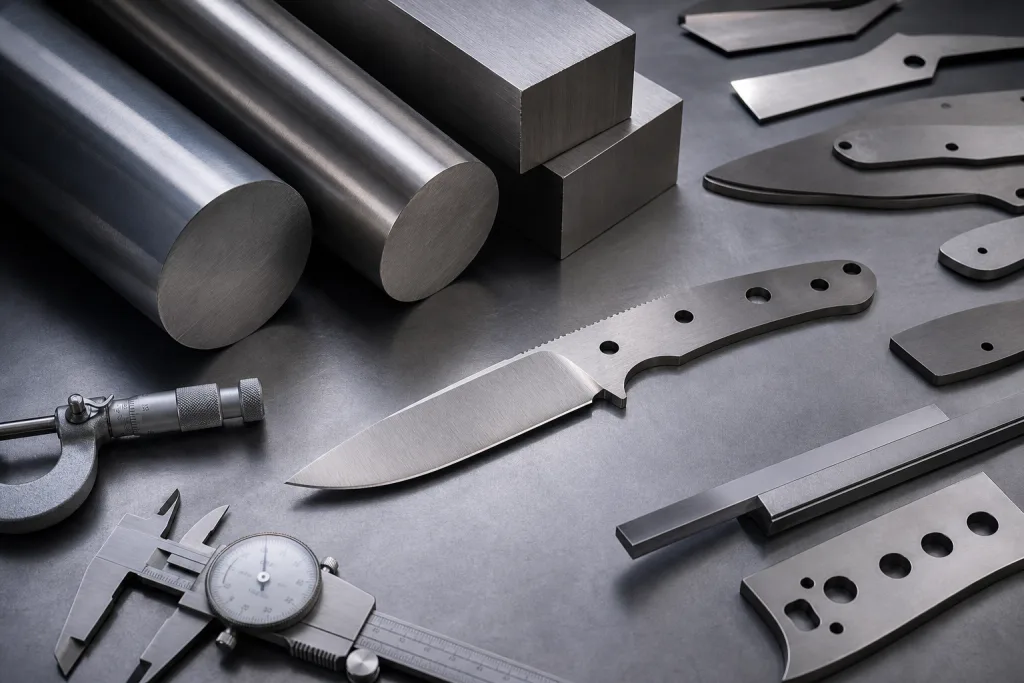
Do not ignore the hidden cost of steel. Harder steels increase grinding wear, need tighter quench control, and can raise breakage risk in thin kitchen profiles. We have seen this go sideways when a buyer pushed for a harder blade but kept the same 2.2 mm spine and the same target price. That is why your kitchen knife set MOQ lead steel specification comparison should cover the nominal grade, the expected hardness band, and whether the factory already runs that steel in mass production.
Hardness and heat treatment
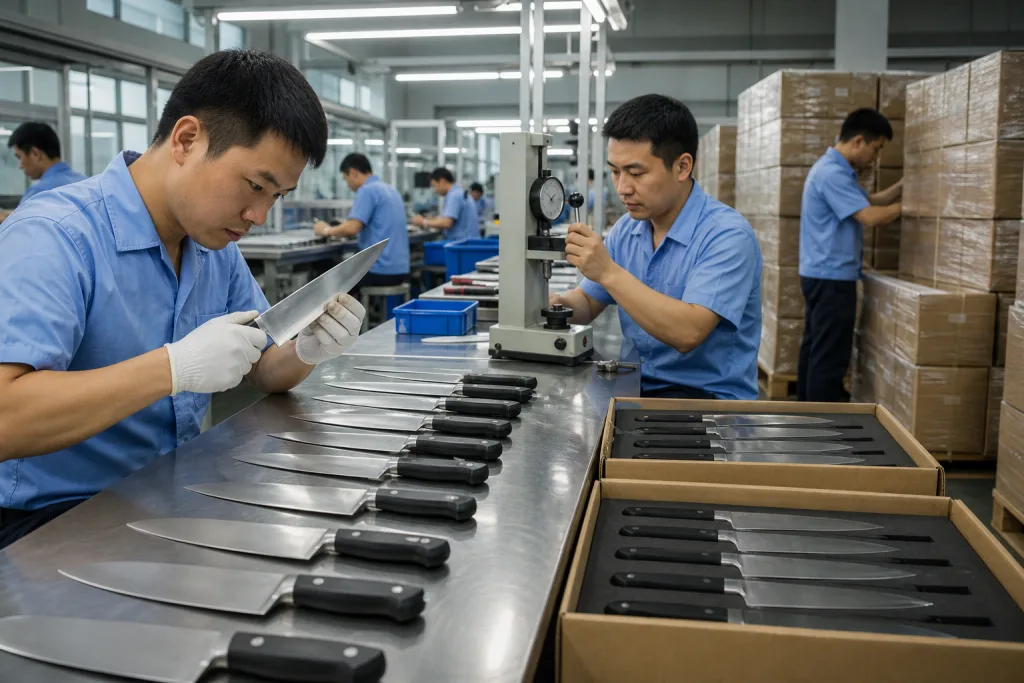
Heat treatment is where good steel turns into a knife that cuts for 12 months, or a blade that comes back with edge roll after 2 dish cycles. Two knives from the same coil can leave the line with different results if one goes through the quench tank and tempering oven at the right schedule and the other gets rushed. For most kitchen sets, a steady hardness target matters more than a shiny steel name. If the spec says 56-58 HRC, ask for the furnace log and the Rockwell test sheet, not a single nice-looking sample.
Most entry and mid-market kitchen knives sit at 54-58 HRC. That range gives usable edge life without turning the blade brittle in normal home use. Higher-end stainless can run 58-60 HRC, but only when thickness, grind angle, and temper cycle stay under control. On a chef knife or santoku, I would take a stable 56-58 HRC with clean polish and even spine thickness over a loose 60 HRC that chips the first time the buyer runs it across a board. The grinding line tells the truth fast.
Ask the kitchen knife set MOQ lead supplier what heat-treatment equipment they run and how they check hardness. You want batch records, random blade pulls, and a clear reject line. A factory in Yangjiang that knows its process will tell you the normal tolerance, then say whether it checks by blade family or by each lot. If they dodge that question, the math does not work.
For Amazon listings, consistency is the whole game because reviews punish one soft blade fast. One sharp knife and one weak knife in the same set can hurt the rating more than a small FOB increase. QC pulled the sample, found a 3 HRC spread, and the buyer flagged it on the next PO. If the supplier cannot hold hardness in a tight band, the steel spec is not ready for production.
Compare the main steel options
I’m rewriting the section in place, keeping the HTML structure and table intact while stripping the AI-style phrasing and adding the factory-floor specifics you asked for.When you compare steel for a kitchen knife set, judge it by the channel, not the sales deck. A club-store bundle and a premium DTC gift set do different jobs, and the steel choice should match the promise on the box. On one 1,000-piece trial, QC pulled the first sample after the buyer flagged a rough edge at the grinding line. The table below is the fastest way to narrow the field before you spend on sampling.
| Steel | Typical HRC | Buyer fit | Lead-time impact | Notes |
|---|---|---|---|---|
| 3Cr13 | 54-56 | Entry retail, promo sets | Lowest | Easy to source, stable MOQ, lower edge retention |
| 5Cr15MoV | 56-58 | Mainstream Amazon, DTC volume | Low to medium | Good balance of stain resistance and sharpness, runs clean on the line |
| 7Cr17MoV | 57-59 | Premium value line | Medium | Better wear resistance, needs tighter grind control |
| VG10 core / layered build | 58-60 | Premium gift and brand lines | Medium to high | More expensive, stronger product story, stricter QC |
| Damascus construction | 58-60 | High-end display sets | Highest | Core steel and etching must be locked before steel is cut |
If your target is a balanced kitchen knife set MOQ lead wholesale program, 5Cr15MoV is usually the working steel. It gives us a clean spec, the grinding line knows it, and lead time stays manageable. If a buyer pushes 3Cr13 into a premium set, the math does not work once you factor in sharpening and rework. We had one PO come in with 5Cr15MOV typed wrong, and that typo turned into a full spec check before we cut steel. Once you move into layered or Damascus blades, treat the order as a separate product family. Do not assume the same MOQ, cycle time, or inspection plan will hold.
Packaging changes the economics
I’m rewriting the three paragraphs in place, keeping the HTML structure intact and tightening the language toward a factory-side sales tone with concrete packing details and fewer generic phrases.People underestimate packaging because it looks simple on paper. On our packing line, a plain insert card and polybag can slide into a short run without much extra handling. A printed gift box, molded tray, barcode label, and full Amazon FNSKU flow add four checks, and QC has to sign off before we release the lot. We have seen a 12-day pilot turn into 18 days just from a box change. If you are planning custom kitchen knife set MOQ lead time for Amazon, the box is part of the product. The wrong question is whether you can add packaging. The right one is what it does to MOQ and ship date.
For DTC, the unboxing matters, but damage control matters more. A knife set packed too tight can dent handles or rub the edge on the sleeve. Packed too loose, it fails a 1.2 m drop test or lands with scuffed blades. QC pulled one sample last month because the corner crush on the inner tray showed up after the second drop. Ask for carton dimensions, inner pack count, master carton weight, and whether the outer pack is set up for FOB or DDP shipping. The buyer flagged it, and he was right.
Real factories in Yangjiang and Zhejiang already handle common retail packs, but you still need to keep the order clean. If you change the handle, blade finish, and box style in the same PO, the math does not work. On the grinding line, we run one variable at a time: keep the blade spec fixed, then test the carton, then move the label. That is how you get a usable pilot run at 500 sets instead of chasing a new sample round for 3 weeks.
How to write the spec sheet
A usable spec sheet is short. It is exact. Start with steel grade, blade thickness, hardness target, finish, handle material, and packaging. Then spell out what can change and what cannot. If you want a kitchen knife set from a kitchen knife set MOQ lead factory, tell them whether the set is for US food-contact compliance, Europe, or both. That changes the steel paperwork, the resin declaration, and the carton print. On the grinding line, we have seen a 0.2 mm thickness gap turn a quote into a dispute.
Use the following structure:
- Blade steel: 5Cr15MoV, 56-58 HRC, batch hardness check
- Blade finish: satin or mirror, with defined scratch tolerance
- Handle: PP, ABS, Pakkawood, or TPR overmold, with material declaration
- Compliance: LFGB, FDA, REACH as needed
- Inspection: AQL 2.5 for major defects, AQL 4.0 for minor defects
- Packing: retail box, master carton, FNSKU labeling, drop-test requirement
This level of detail cuts out the usual fight where the buyer expects a premium edge, but the supplier priced a basic grind. It also gives the kitchen knife set MOQ lead manufacturer a clean basis for quoting. Send the same structure to three suppliers in China and you get three quotes you can compare line by line. Skip it, and you are comparing three different products with the same name. We have seen the buyer flag a PO typo on blade finish and the whole lot had to be rechecked at the packing table.
For Amazon sellers, one weak batch can mean returns, lost ranking, and chargebacks. For DTC sellers, the math is simple: customer trust depends on the same edge, the same fit, every carton. QC pulled the sample, checked the label against the carton art, and found a mismatch in one minute. A clear spec sheet costs less than fixing assumptions later.
What to ask before you place PO
I’m rewriting the section in place, keeping the HTML structure intact and tightening the language so it reads like someone who actually runs knife orders through a plant. I’m also baking in concrete factory detail and cleaner buyer-side language, without changing the headings or tags.Before you place a purchase order, ask five questions that cut through the noise. What is the actual MOQ for the exact steel, handle, and packaging mix you want? What is the normal production lead time in days, not the sample time? What hardness range do they hold in mass production? Which inspection standard do they run? Can they support the compliance files your channel asks for? We have seen a buyer flag a PO that mixed two handle colors in one line item, and the factory had to split the run on the packing table.
A serious kitchen knife set MOQ lead supplier should answer fast. If they quote 30-45 days for a custom set, ask what is material prep, heat treatment, packing, and final inspection. If they cannot break that down, the date is not solid. A plant in Yangjiang, China that runs 240 employees and multiple knife lines monthly should still be able to show the schedule step by step. Capacity only matters when the grinding line and the heat-treatment furnace are both visible.
For buyers importing into Europe or North America, check whether the factory can support BSCI, REACH, LFGB, FDA, or ISO 9001-related documents where relevant. Do not assume every knife set needs every certificate. Ask for the file that matches your market and your materials. QC pulled the sample on one order and found the carton ink code did not match the declaration, so the buyer had to stop the shipment before it left the warehouse. That is the kind of mess you avoid when the paperwork is matched early.
If you want a sharper decision, compare two quotes side by side: one with a lower MOQ and standard steel, one with a higher MOQ and premium steel. The math usually tells the story. We have seen a 500-set order with plain 420J2 move faster than a 2,000-set quote that looked cheaper on paper but sat in the warehouse for 18 days longer because the buyer chased the lowest factory-gate price. The right choice protects sell-through, not the line that looks cheapest.
Frequently asked questions
For a simple 3-piece or 5-piece set, a realistic MOQ is often 500-1,000 sets if you stay close to an existing structure. Once you add custom handle tooling, new box art, and a premium steel like 7Cr17MoV or VG10 construction, many factories move to 1,500-3,000 sets. The exact number depends on whether the plant already runs the blade profile and whether your packaging needs separate print plates. A kitchen knife set MOQ lead manufacturer in Yangjiang, China will usually quote lower MOQ when the design reuses existing production parts.
For most Amazon listings, 5Cr15MoV is the best balance of cost, corrosion resistance, and edge retention. It usually supports a 56-58 HRC target and gives you a spec that is easy to explain in product copy without overpromising. 3Cr13 is cheaper but softer, so it fits promo or entry sets. If you go premium, 7Cr17MoV or layered stainless can work, but the unit cost and QC demands rise quickly. For high review sensitivity, a consistent mid-range steel is usually safer than a harder steel with unstable heat treatment.
A lot. The same steel can feel very different depending on quench speed, tempering temperature, and section thickness. In kitchen sets, the practical goal is a stable hardness band such as 56-58 HRC for mainstream stainless. If a factory is drifting by 2 HRC or more across one batch, you will see edge dulling, chipping, or inconsistent sharpening response. Ask for batch hardness records and random pull tests. A good heat-treatment process matters more than a fancy steel label when the set is sold at scale.
Compare them line by line: steel grade, HRC target, blade finish, handle material, packaging, inspection standard, and incoterm. A low FOB price can hide thinner blades, softer steel, or a simpler box that your Amazon listing cannot use. Ask each kitchen knife set MOQ lead supplier to quote the same specification sheet so you are not comparing different products. Also check whether the quoted lead time includes material purchase, production, packaging, and final inspection. If it does not, the quote is incomplete.
For most retail knife set orders, AQL 2.5 for major defects and AQL 4.0 for minor defects is a practical starting point. Major defects include broken tips, loose handles, and blades that fail hardness or fit checks. Minor defects cover cosmetic issues such as small scratches, print misalignment, or light box damage. If your channel is premium DTC, you may want tighter cosmetic limits. The important part is that the factory and buyer agree on the defect definitions before mass production starts.
Request a steel spec quote
Send your target MOQ, steel grade, HRC band, and packaging spec. We will price the set with realistic lead time, not optimistic guesswork.
Request a Quote