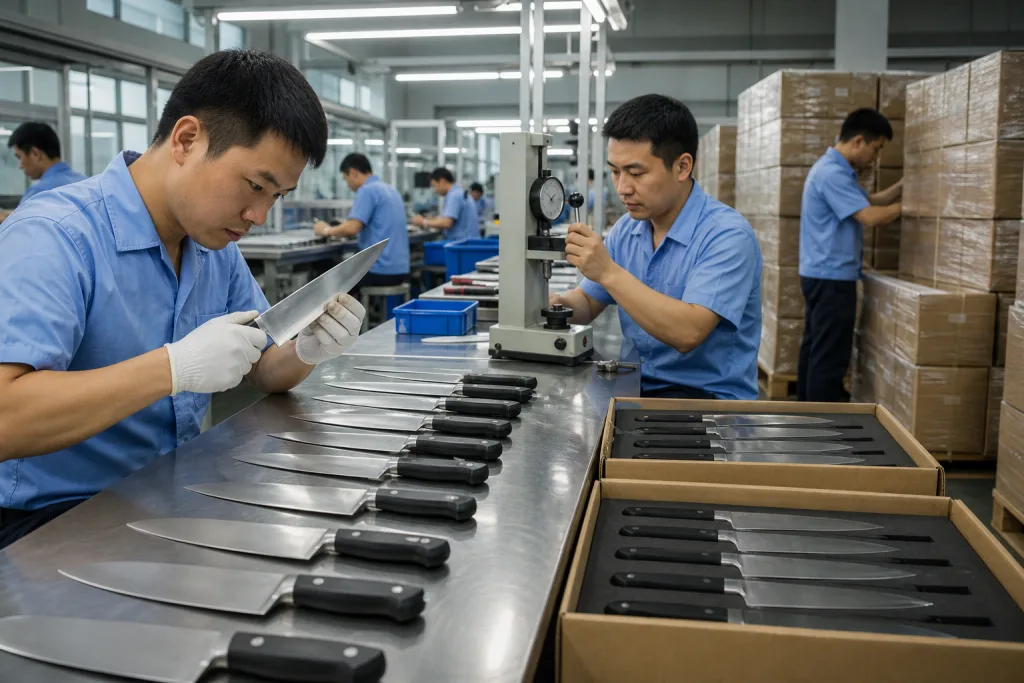
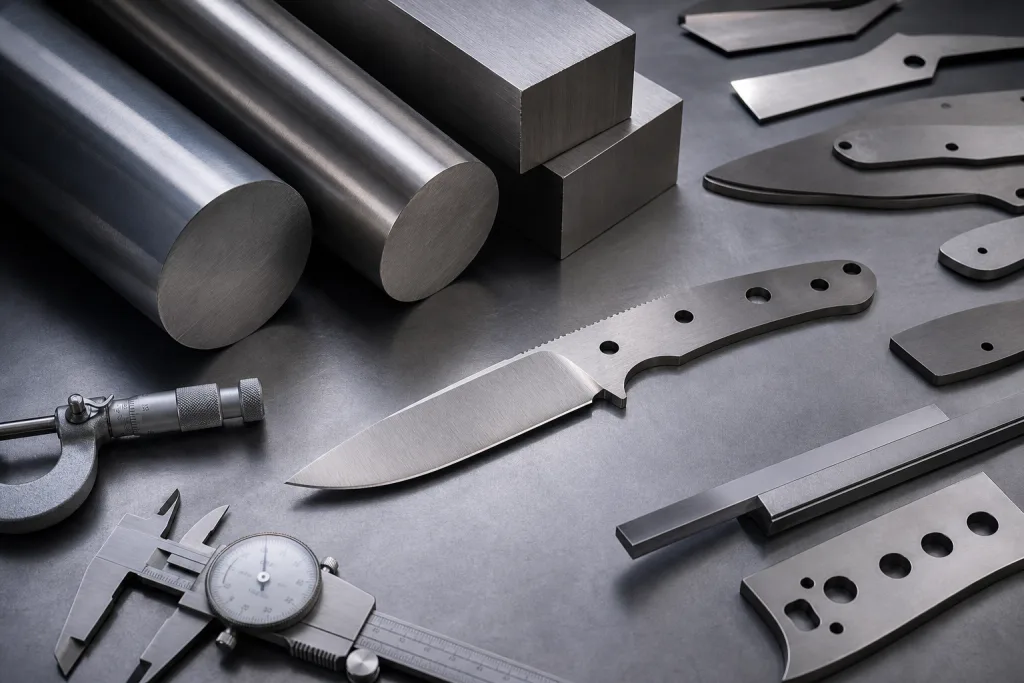
For retail private label teams, kitchen knife set sample approval is not a cosmetic step. On the grinding line, we have seen a 3 mm handle gap or a 0.2 mm blade grind shift turn into a return. When the steel grade, handle finish, carton art, and barcode do not match the approved set, the buyer flags it before the shipment leaves Yangjiang. Approve a nice-looking set without the export file, and the math does not work: you end up paying for rework, chargebacks, or a ship date that slips from 12 days to 18 days.
A serious kitchen knife set sample approval factory in Yangjiang, China should send 2 samples, not one, and a clean sign-off sheet. We run document control because sourcing, compliance, and packaging all need the same frozen spec. QC pulled the sample, checked REACH, LFGB, FDA, and carton marking proof, then matched it against the PO; one typo on the carton count can stop mass production. For Europe and North America, that is the baseline. Anything less is a warehouse problem waiting to happen.
What sample approval actually freezes
Sample approval is the point where your kitchen knife set stops being a concept and turns into a locked product spec. On our bench, that means the 240 mm chef knife, 125 mm utility knife, and the block layout stay tied to one master sample, with blade length, edge grind, balance point, handle material, logo placement, carton structure, and the exact insert count frozen against that unit. If those items are not written down, the grinding line will drift a millimeter here and a print mark there, and you only catch it after 500 cartons are already sealed.
For a kitchen knife set sample approval supplier, the approval file should freeze the product and the process. The BOM, steel spec, handle resin or wood species, coating, printing method, and final pack-out method all need sign-off on the same sheet. In a custom kitchen knife set sample approval project, I expect the buyer to approve the retail claim text too. If the carton says 56-58 HRC, QC should pull the sample and check the hardness file against that band. If you print dishwasher safe, the handle adhesive and edge finish need to support it, not just survive one quick wash. The math does not work any other way, and we have seen that go sideways after the first export inspection.
For kitchen knife set sample approval wholesale programs, check the sample against the real carton count and carton size, not a loose display set on a showroom table. The document pack should also record the sample date, revision number, and the name of the person who signed off. We had one PO where the buyer flagged a typo in the carton count, and that one missing digit forced a second round of proofing. Without that control, the same set can be approved three times by three people, and nobody knows which version is the one we ship.
Documents to request before sign-off
Do not sign off a set just because the knives look clean on the table. The export file should arrive with the sample and give your compliance team, QA team, and freight forwarder one version to follow. Ask for one approval pack, not 14 loose PDFs buried in an email chain; we have seen shipments slow down because the carton barcode in the PDF did not match the sticker QC pulled from the packing line.
- Signed sample request form with SKU, color, set count, target market, buyer signature, and factory stamp
- Spec sheet with blade sizes, steel type, HRC target, handle material, total weight, and tolerance in mm
- Material declaration for blade, handle, adhesive, coating, and printing ink, matched to the supplier batch we run
- Artwork proof showing logo size, carton copy, barcode, and country of origin text exactly as printed
- Test report references for REACH, LFGB, FDA support, or other required standards, with report number and expiry date
- Inspection standard, usually AQL 2.5 for critical and major defects, plus the defect photos your QC team will use
- Golden sample retention sheet signed by buyer and factory, with sample seal number and storage date
A kitchen knife set sample approval factory with its house in order will put version control on every one of these items. If a kitchen knife set sample approval manufacturer cannot confirm which carton art revision was used for the sample, stop there. This is the wrong question to rush past. In a factory in Yangjiang, China, the document pack should be as clear as the physical sample: blade length in mm, HRC target, barcode file name, and who signed the golden sample. If the pack is messy, you are not buying control; you are buying risk.
EU and US compliance checks
For retail private label teams, compliance is where sample approval either saves the order or creates a claim later. A knife set is not a toy, but it touches food prep boards, hands, inner trays, gift boxes, and carton labels. Sharp is not enough. The better question is whether the steel, handle resin, coating, ink, and printed claims can pass the EU or US channel you plan to sell into. We have seen this go sideways when a buyer approved a black handle sample, then the PO changed to wood-look ABS and nobody updated the report.
| Market | What to check | Why it matters | Common mistake |
|---|---|---|---|
| EU | REACH support, LFGB where needed, traceable materials | Reduces customs holds and retail compliance questions before goods reach the DC | Using test reports from the wrong colorway or handle resin |
| US | FDA-related material support, country of origin, carton labeling | Protects retail intake, Amazon listing setup, and barcode scanning at warehouse receiving | Missing origin wording or incorrect barcode placement |
| Both | AQL 2.5, product dimensions, blade hardness | Keeps the approved sample tied to the same spec the grinding line will run in bulk | Accepting a sample that is not tied to an inspection standard |
For a kitchen knife set sample approval supplier in China, the compliance bundle should say whether the blade hardness sits at 54-58 HRC, whether edge sharpness was checked more than once, and whether handle inks or soft-touch coatings have paperwork. Ask for the test date and report number. A screenshot is weak. QC pulled one sample last year where the blade passed hardness at 56 HRC, but the gift box still carried an old FDA claim from a different handle coating; the buyer flagged it before shipment, which was lucky. Your importer or retailer will ask for the same file later, so build the document pack during sample approval, not after 3,000 sets are packed.
Packaging proof your buyer team needs
Packaging is where sample approvals quietly break. The knife can pass, then the carton fails the buyer's shelf test. We see it on the line all the time: the blade spec is fine, but the print on the retail box is 2 mm off, the barcode scans poorly, or the master carton mark does not match the channel requirement. Private label buyers should ask for a packaging proof with the final consumer unit, master carton, and ship-ready label set before they release the PO.
The approval file should show the inner tray, insert card, sleeve, hang tag, or window box if those parts are in the build. For a custom kitchen knife set sample approval, we ask for print proof on logo placement, care instructions, warning text, and the exact knife count or accessory count in the carton. QC pulled a sample on the drop-test bench last week, and the buyer flagged the insert because the knife handle moved 6 mm in transit. If the set is gift-oriented, confirm carton compression strength and drop test targets. If it ships DDP or FOB from China, the export marks need to match the commercial invoice and packing list line by line.
Retail teams should check barcode type, FNSKU or EAN placement, and where the country of origin sits on the pack. The wrong question is whether packaging can be fixed after approval; the math does not work. A kitchen knife set sample approval wholesale order moves fast, but speed does not clean up a bad proof. If the sign-off lands late, the factory may print 5,000 cartons against the wrong version, and that gap is what triggers chargebacks. We have seen a PO with a typo on the carton mark go straight to reprint, and that burned 12 days.
A practical approval workflow
A clean approval workflow has to be simple enough for sourcing, QA, and design to run it without guesswork. In a 240-employee factory in Yangjiang, China, where monthly output runs 80,000 to 120,000 pieces depending on the set type, the grinding line keeps moving whether the paperwork is ready or not. If one sample question takes five people to answer, the process is already broken.
| Stage | Owner | Output | Typical time |
|---|---|---|---|
| Sample build | Factory engineering | Physical sample and draft spec | 3-5 days |
| Document review | Buyer QA and packaging | Redlines and corrections | 2-4 days |
| Compliance check | Supplier and lab contact | Test report references | 3-7 days |
| Final sign-off | Buyer decision maker | Golden sample and frozen BOM | 1-2 days |
For kitchen knife set sample approval factory workflows, we run one master PDF with revision history, one signed physical sample, and one backup sample stored at the plant. QC pulled the sample against the carton spec on a recent order and caught a 2 mm mismatch before the buyer flagged it, which saved a round of rework. If the order is custom, list the approved steel code, handle color code, carton dimension, and the exact accessory count. After approval, the factory should confirm whether the order is going to trial production or straight to mass production. This is the wrong question to ask if the BOM is still loose. We have seen it go sideways when a PO typo changes the accessory count, so compare the new order against the last launch for the same customer before you freeze anything.
Common mistakes that slow approval
The expensive approval misses are usually tiny. We have seen a buyer like the sample, then catch that the box went from six pieces to seven when QC pulled the carton on the packing bench. The art team updates the barcode, the factory keeps the old carton file, and the cartons run on the line with the wrong revision. A handle passes by photo, then gets rejected in store lighting because the molded color shifts under fluorescent tubes. That is not a tooling problem. It is document control slipping.
Another common mistake is signing off without a date-stamped test reference. If the sample blade checked at 56-58 HRC on the Rockwell tester, but the next steel lot or heat-treatment setting changes, the approval means little. The same applies to rust resistance, dishwasher safety, and food-contact claims. This is the wrong question to ask if the paper trail is missing. If the claim cannot point to a material declaration or a test note, we do not print it on the box.
For a kitchen knife set sample approval manufacturer, the clean fix is a sign-off sheet with owner names and one frozen revision number. If the buyer changes a handle color, carton count, or insert text, the sheet gets updated before the next round. We run it that way on export jobs because a PO typo can turn into a week of back-and-forth if nobody catches it early. That discipline is normal in China export production. It is also the gap between a controlled launch and a fire drill.
Frequently asked questions
For a normal retail private label launch, ask for 2 finished samples and 1 retained reference sample at the factory. If you are approving multiple markets, request a second set for compliance or photography. For fragile packaging, add 1 spare carton. A serious kitchen knife set sample approval supplier should also provide a digital spec pack, not just the physical set. If the order is custom, a pre-production sample and a top-of-production sample are both useful. That gives you a clean comparison when mass production starts 35-45 days later.
Before PO release, you should have a signed spec sheet, artwork proof, material declaration, and the sample approval sheet with revision number. For export orders from China, add carton marks, barcode file, and country of origin text. If the set is entering the EU or US, keep the relevant compliance references attached, such as REACH, LFGB, or FDA support where applicable. I also recommend a golden sample retention record. Without those documents, the approved sample can drift during production, and the factory has no clear boundary for what is acceptable.
Email alone is not enough unless it is attached to a locked document pack and a specific revision. A buyer in Europe or North America should still sign a sample approval sheet that lists SKU, set count, blade sizes, handle material, packaging version, and test references. If the sample was approved by photo only, you are taking a risk on color, finish, and packaging fit. In practice, the best kitchen knife set sample approval process uses email for traceability, but the actual approval is confirmed by a signed PDF or stamped sheet that the factory keeps on file.
You need a frozen BOM, a retained master sample, and an inspection plan tied to the approval version. Ask the factory to confirm blade steel, HRC band, handle resin, and carton materials before production starts. For a kitchen knife set sample approval manufacturer in China, the real proof is not the sample photo; it is whether the line can repeat the same result at scale. I would also require AQL 2.5 final inspection terms and one pre-production check on the first output cartons. That gives you a much better chance of catching drift before the shipment leaves the plant.
For a standard kitchen knife set, sample lead time is often 7-10 days if the tooling and packaging files are ready. After final approval, mass production usually takes 35-45 days, depending on the set complexity, finish, and packaging. If the order is fully custom or requires new molds, add more time. A kitchen knife set sample approval wholesale program can move faster, but only if the document pack is complete and no artwork changes are pending. If you are buying DDP into a retail launch window, do not cut the approval phase short. You will pay for it later in air freight or missed shelf dates.
Send your sample pack for review
If you need a kitchen knife set sample approval manufacturer in China, we can review your spec sheet, packaging proof, and compliance file before you place the order.
Request a Quote