If you approve a kitchen knife set for restaurant supply, the sample is more than a product check. It is the first cost test. The FOB quote may look tidy at USD 6.80 per set, then the tray, EVA insert, 5-layer master carton, air freight, duty, inspection, and one blade-angle revision push the landed cost into a different column. We see buyers miss this at the sample bench when QC measures a 2.2 mm blade spine but the PO packing line still says gift box only.
A kitchen knife set sample approval landed cost breakdown should be built before sign-off, not after the buyer says "approved." In Yangjiang, Zhejiang, and other China export hubs, a serious kitchen knife set sample approval manufacturer will give you the sample route, packing spec, carton CBM, and forecasted MOQ so FOB, DDP, and warehouse-ready cost sit on the same sheet. The wrong question is "does the sample look good?" Ask whether the sample can still sell after 12 days of air sample work, one AQL 2.5 inspection, and the buyer flagged a typo on the color box barcode.
Start With the Real Approval Question
Most buyers ask whether the sample cuts well. That matters, but it is not the approval question that decides the PO. For a restaurant supply distributor, the sample has to prove three things at once: the set cuts cleanly, the carton survives a 1.2 m drop test, and the landed cost still works when you scale to 3,000 sets. Approving a kitchen knife set sample on looks alone is the wrong question.
On the factory floor, we split approval into blade performance, handle fit, packaging integrity, and cost structure. If you are working with a kitchen knife set sample approval supplier in China, ask for the steel grade, target hardness, and finishing method before the first sample ships. QC pulled the sample at 56 HRC on one run and the buyer flagged the handle gap at 0.8 mm, so we stopped the line and corrected it before mass production. A practical kitchen knife set sample approval factory in Yangjiang will also tell you whether the final set can stay inside your carton size target, because 18 mm of extra height can move freight more than people expect.
Use the sample stage to lock the commercial promise. If you need a 5-piece set with a magnetic block and a target wholesale price under $19.50 FOB, the sample has to match the same blade profile, the same insert count, and the same carton size planned for mass production. We have seen this go sideways when a buyer approved a prototype, then changed the block insert and found the carton went from 12 days to 18 days in transit planning because the volume no longer fit the pallet spec. In China, that is where the math breaks if nobody checks it early.
Build the Landed Cost Model
Build the landed cost model at the sample stage, not after approval. If you treat the sample charge as sunk cost, you miss the production shape it points to. On our grinding line, a 2 mm miss in insert depth or blade length turns into a second sample, a new carton run, and a late PO correction. That is not a small slip.
Here is a simple planning framework you can use when checking a kitchen knife set sample approval manufacturer:
| Cost item | Typical sample-stage range | Buyer impact |
|---|---|---|
| Sample unit charge | $15 to $40 per set | Sets the first test spend |
| Express freight | $25 to $80 per carton | Moves with carton count and service level |
| Packaging revision | $50 to $300 | Changes carton size and retail readiness |
| Compliance test | $120 to $450 | Needed for REACH, LFGB, or food-contact review |
| Import duty and VAT | Varies by destination | Must be modeled before approval |
On one run, QC pulled the sample and found the handle insert sat 2 mm deep, so the buyer flagged the PO and the carton artwork had to move twice. A set that samples at $22 FOB can still land at $31 to $36 once you add air freight and retail cartons. We shipped that first lot in 12 days by air because the buyer needed it before the lab slot closed, and the math still held. The wrong question is whether the sample is cheap. The math is whether the wholesale price still works when you print the bigger carton and ship by air.
MOQ Changes Everything
MOQ is not a factory preference. It is the point where sample math turns into procurement reality. A kitchen knife set sample approval supplier may quote a 1-set sample, but when we run the stamping and packing line, production usually starts at 300, 500, or 1,000 sets per configuration, depending on blade count, handle material, and how many trays the carton needs. If you want custom kitchen knife set sample approval with a logoed block or molded tray, the MOQ moves because the packing line is the bottleneck, not the knives.
For restaurant supply distributors, the wrong question to ask is whether the MOQ is low. The real question is whether the MOQ fits your sell-through window. If you can move 600 sets in 90 days, a 1,000-set MOQ may still work. If your reorder cycle is 120 days, it will sit. Push for modular packaging, shared inserts, or one common outer carton across variants. We have seen a buyer flag a PO typo from "600 sets" to "600 cartons", and that kind of miss burns a week. On the packing table, that is the difference between a clean launch and dead stock.
Ask the factory to quote three versions at once: sample-only, pilot run, and production run. That shows how much of your cost is fixed and how much moves with volume. It also shows whether your landed cost drops at 500 or 1,000 sets. If the price only falls by 3 percent after doubling volume, the mold, print plate, or tray insert is too expensive. QC pulled the sample on a 38 mm tray last week and the math did not work. Better to catch that before approval, not after purchase order placement.
Packaging and Freight Drive Variance
Packaging is where many kitchen knife set sample approval wholesale programs lose discipline. A good knife set turns expensive the moment you move from a brown box to a printed gift box, or from a loose tray to a molded pulp insert. On our packing table, QC pulled the sample and checked the carton size before we taped the first master carton. Lock the structure early, because freight is priced on volume as much as weight.
For example, a 5-piece set packed in a compact carton may fit 24 sets per master carton. The same set in a premium gift box might only fit 12 sets. Even if the unit ex-factory price rises by just $0.60, the landed cost can climb by $1.50 to $2.20 per set once you add more air volume. We record carton dimensions and gross weight in the first sample report, not after approval. The buyer flagged a typo on the PO before, and that single 10 mm carton error changed the pallet plan for the whole order.
When you compare packaging options, ask for an apples-to-apples freight forecast. You want FOB price, carton count, CBM, and estimated pallet count. If your distribution network uses Amazon-style receiving or a regional DC, ask for FNSKU-ready outer labels or unit labeling before final approval. That avoids a second packing operation in your warehouse. We have seen a buyer save 12 to 18 percent on landed cost by moving from decorative blister to compact recycled paperboard. This is the wrong question to ask if someone says shelf appeal alone will carry the freight bill.
Check the Knife Specs That Matter
I’m rewriting the three paragraphs to sound like a buyer-facing sales engineer: tighter claims, concrete shop-floor checks, and no generic filler. Next I’m keeping the same HTML structure and only changing the prose inside each ``.
During sample approval, do not chase cosmetic noise. We check the specs that change how the knife cuts and how buyers can sell it: blade steel, hardness, edge geometry, handle material, corrosion resistance, and balance point. On the grinding line, a 15° edge can look sharp and still fail after a few board tests. For most stainless kitchen knives, 52 to 57 HRC is the band we see work; specialty steels can sit above that when the steel and end use justify it.
If the set includes a chef knife, bread knife, utility knife, and paring knife, test each one a different way. The chef knife should pass push-cut and chopping tests. The bread knife should cut crust without tearing. The paring knife should hold tip control. If the handle is wood, check finish consistency and moisture response after a 24-hour soak. If it is PP, TPR, or G10, test grip with wet hands. QC pulled the sample, and we saw the same issue twice last quarter: a handle that felt fine in the catalog turned slick after a full rinse cycle. That is the wrong question to ask if the set is going to restaurant supply.
Compliance belongs here too. Depending on your market, you may need LFGB, FDA contact review, REACH declarations, and an ISO 9001-oriented quality system from the factory. For a custom kitchen knife set sample approval program, ask for material declarations before the sample ships. We run a steel check, a handle resin check, and a coating review before carton close. If the supplier cannot identify the steel, the coating, or the handle resin, stop there. A clean sample with unclear materials is not approvable for import.
Use Inspection to Lock the Standard
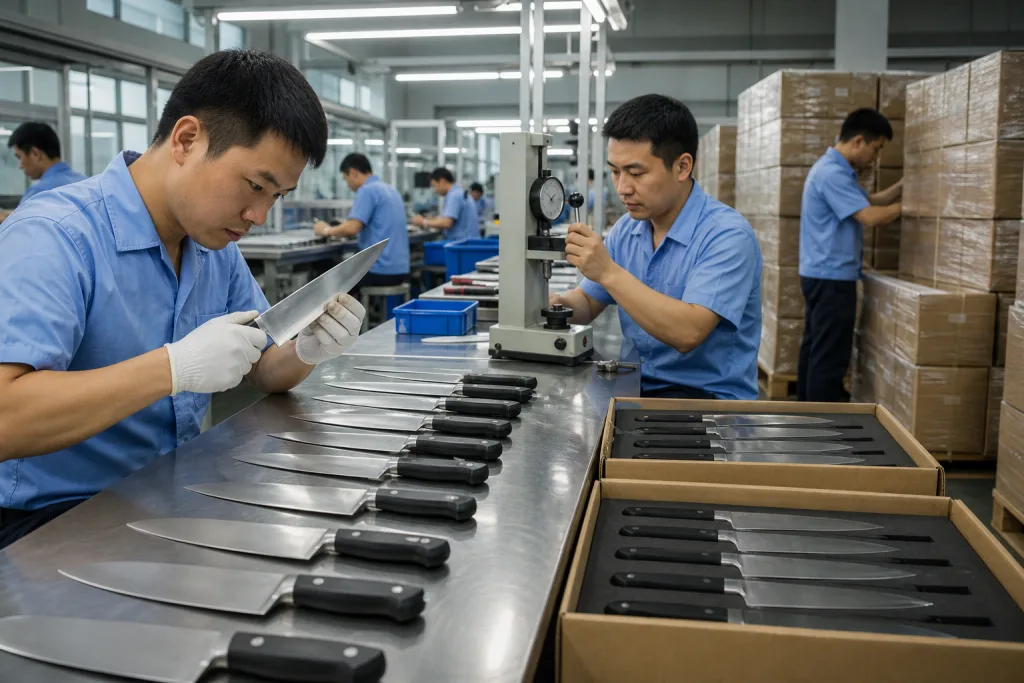
A sample approval only works when it becomes a measurable production standard. The approval note should list blade length in mm, handle fit gap, edge burr limit, blade finish, carton artwork, barcode placement, and acceptable tolerance. Put it on paper. When the first mass-production batch lands, your inspection team should check against that approved sample, not someone's memory of "good quality." AQL 2.5 for major defects is common in consumer knife programs, but the sample needs to define the defect: chipped tip over 0.5 mm, logo shift over 1 mm, loose rivet, rust spot after wipe test.
If you are sourcing from a kitchen knife set sample approval supplier in Yangjiang, ask for one control sample sealed at the factory and one kept at your office or 3PL. We run this with a signed label, date, PO number, and buyer initials on the carton. It stops the usual argument about whether the handle color changed from black to charcoal or the logo moved 2 mm toward the bolster. Also request photo records of the approved sample and a written list of agreed exceptions, such as minor frosting on a molded insert or a tolerance on blade spine polish.
The best buyers use inspection to measure landed cost risk, not just defects. This is the wrong question to ask: "Did the knives pass?" Ask what the failure would cost after shipping. If a batch fails because packaging collapses in transit, your true cost includes replacements, relabeling, and customer chargebacks; we have seen one weak inner tray turn a USD 0.18 saving into a 12-day rework delay. The approval process should include drop-test expectations, carton compression checks, and moisture exposure where relevant. When those points are defined before PO release, the grinding line and packing team can build the run to the standard instead of guessing after QC pulled the sample.
Approve for Rollout, Not Just One Sample
I’m rewriting the section in-place, keeping the HTML structure intact and tightening the language so it reads like a factory-side sales engineer, not marketing copy.The final approval should answer one thing: can we run the same set in China at scale without price creep? The wrong question is whether the sample looks perfect. If the sample was hand-finished, overpacked, or built with oddball materials, the production run will miss your margin. We saw this on the grinding line last month, where a polished sample looked fine, then the production set came in 1.2 mm lighter on the handle and the buyer flagged it. This is where the landed cost breakdown stops being a spreadsheet and starts doing real procurement work. You need a set we can reorder in 30 to 45 days, not a one-off showroom piece.
For restaurant supply distributors, the cleanest move is to approve a base set, a packing spec, and a reorder formula. Keep the blade structure fixed, then change only the gift box print or one accessory count if the customer pushes for it. QC pulled the sample against the carton spec on the packing table, and that is the kind of check that keeps the math honest. That keeps MOQ cleaner and avoids requalifying the full set every season. A kitchen knife set sample approval manufacturer with real production discipline should be able to state monthly capacity, often 80,000 to 150,000 units across mixed knife lines in a medium-sized factory, plus the repeat-order lead time after sign-off. We've seen this go sideways when buyers keep changing the box art after approval.
When you approve, record the commercial terms with the sample: MOQ, target FOB, carton size, tolerance band, and any compliance documents. The math does not work if you leave freight out. One buyer once typed 12 pcs instead of 12 sets on the PO, and the carton count shifted the landed cost by 8 percent before anyone caught it. That document matters more than the sample itself because it anchors future purchasing. If the next order lands 8 percent above the approved cost, you will know whether the difference came from steel, labor, packing, or freight, and you can push back with facts instead of guesses.
Frequently asked questions
Include sample charge, express freight, packaging revision, compliance testing, customs brokerage, duty, VAT or sales tax, and expected rework cost. For a typical 5-piece set, a $20 to $30 sample can become $30 to $40 landed once air freight and carton handling are added. If you skip compliance, the real cost can jump later when LFGB, FDA, or REACH paperwork is requested. Ask the factory for FOB, carton dimensions, gross weight, and CBM so you can model the full landed number before approval.
For a simple 3 to 5 piece set, production MOQ is often 300 to 500 sets if the packaging is standard and the blades use existing tooling. If you need a custom block, printed gift box, or molded tray, 1,000 sets is common. The right MOQ depends on your sell-through, not just factory preference. If you can move 600 sets in 90 days, a 1,000-set MOQ may be workable. If not, push for shared packaging components or a pilot run before you commit.
A revised sample usually takes 7 to 15 days from confirmed spec, depending on blade finish and packaging complexity. After approval, mass production for kitchen knife sets in China typically runs 30 to 45 days. Add 3 to 7 days for packing and inspection if the order needs retail labeling or carton drops tests. If the supplier is in Yangjiang and the packaging is already validated, repeat orders can move faster. Always confirm whether the quoted lead time starts at artwork approval or at deposit receipt.
Compare the sample landed cost to your target wholesale margin, not to the sample FOB price. A sample that costs $24 FOB may still land at $34 or more after freight and packaging, which is fine if your target wholesale price is $22 to $28 and the production cost drops with volume. If the sample only works with air freight and oversized cartons, your wholesale model is fragile. A healthy program should allow at least a 25 to 35 percent gross margin after inbound freight and duty for your channel.
Ask for material declarations, steel grade, target HRC band, packaging specification, carton dimensions, and compliance support for REACH, LFGB, or FDA where needed. If you are buying from China, request ISO 9001 or equivalent process control evidence, plus photos of the approved sample and signed approval notes. For the first shipment, use AQL 2.5 for major defects as a baseline and keep a control sample. That gives you a defensible standard when you inspect production later.
Request a sample cost breakdown
Send your target set count, packing style, and destination port. We will map sample, freight, and MOQ into a usable landed cost for China sourcing.
Request a Quote