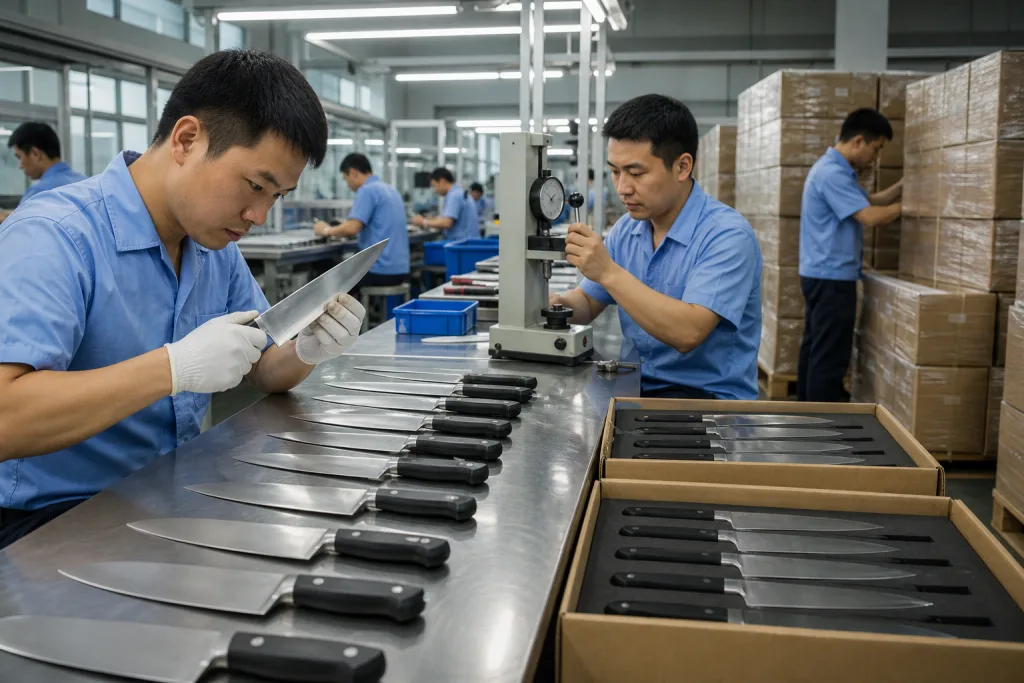
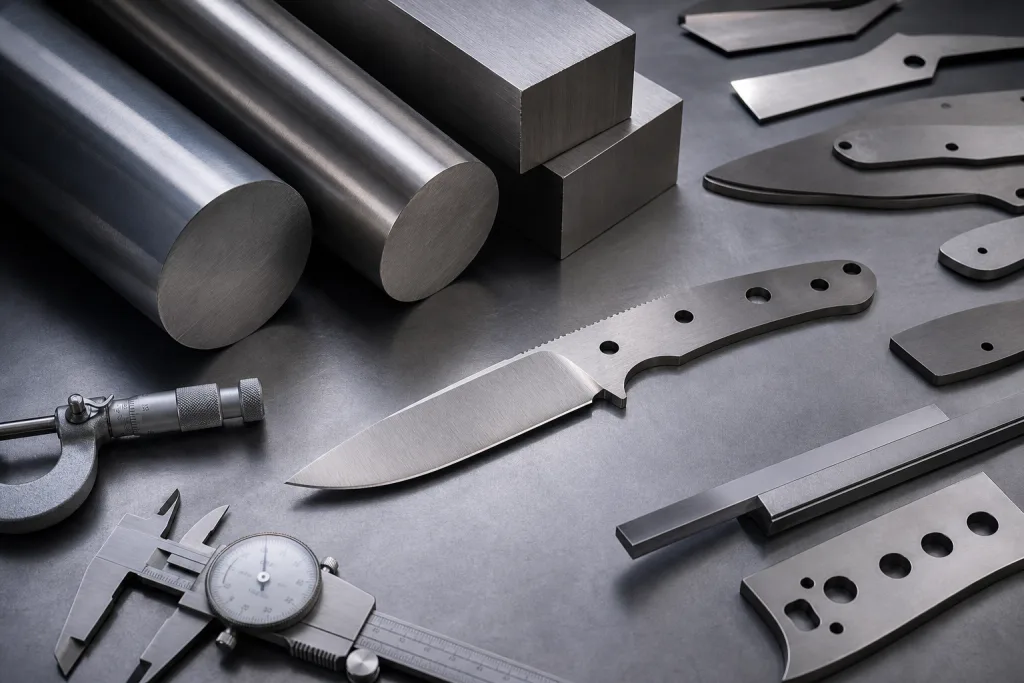
For a private label kitchen knife set, the sample is the first real checkpoint, not a courtesy piece. It proves whether the kitchen knife set sample approval sample approval process is under control: steel grade, edge angle, handle fit, box insert, and carton marks. We have seen QC pull a 5-piece set where the chef knife measured 54 HRC against a 56 HRC spec, and the buyer only caught it because the sample was checked with a Rockwell tester before the PO deposit moved. Skip the review and the issue comes back later as wavy sharpening, loose rivets, a logo 2 mm off center, or a retailer claim after shipment.
A kitchen knife set sample approval factory in China should treat samples as pre-production risk control, not sales decoration. In Yangjiang, Zhejiang, and other export knife hubs in China, a serious kitchen knife set sample approval manufacturer sends the full sample pack, revision notes with dates, and a signed specification sheet before mass production starts. We run this step before opening the grinding line, because changing a bolster shape after 3,000 sets are half-finished is where the math does not work. For a retail private label team, this is where MOQ, delivery date, and gross margin are protected. A shiny prototype is not enough.
What sample approval really means
In a serious kitchen knife set program, sample approval is the buyer's gatekeeper for production risk. The question is not, "Does this look good?" It is, "Can we run this exact set at scale in China with repeatable quality, acceptable cost, and the compliance paper trail for my market?" When we build for a kitchen knife set sample approval supplier, the sample has to answer three things at once: does the design match the brief, can the factory hold the spec, and will the lot clear the retailer's acceptance criteria. QC pulled the sample on the hardness tester at 58 HRC, and that number either holds or the conversation ends fast.
The process should start with a written product brief. Put the blade steel, hardness band, blade thickness, handle material, bolster style, surface finish, set composition, packaging, and target market on one page. A 5-piece kitchen set for a discount channel does not need the same finish or carton spec as a premium private label launch. We run prototype jobs in Yangjiang in 7 to 15 days, but speed is the easy part. The real question is whether the approved sample becomes the production reference sample and whether both sides sign the same control points before the grinding line starts.
For a B2B buyer, approval has to tie back to commercial terms. If the sample uses a different steel, different handle tooling, or hand-finishing that will not exist in mass production, you do not have an approval sample. You have a display piece. We have seen this go sideways when the buyer flagged a PO typo on the carton count and the factory built to the wrong pack-out. That distinction matters when you are sourcing from a kitchen knife set sample approval manufacturer in China and placing a first order with MOQ, packaging, barcode, and carton route already fixed.
Build a complete sample pack
I’m rewriting the section now, keeping the HTML structure intact and tightening the wording so it reads like a factory-side approval note instead of generic copy.A clean sample review needs more than one knife in a box. Run the approval as a full pack: set, retail pack, master carton plan, spec sheet, and any test reports on file. On our line, QC pulled the sample after the final polish, and that is the level buyers should ask for. If the factory is in Yangjiang or another export base in China, the kitchen knife set sample approval wholesale process should show how the set ships, not just how it sits on a table.
For private label teams, the sample pack should include the labeling details people miss when they rush the PO: logo size, laser position, blade etching depth, country of origin mark, care instructions, and UPC or FNSKU placement if the set is going to Amazon or a similar channel. We have seen the buyer flag a 2 mm logo shift, so check every mark against the artwork before sign-off. If your packaging needs moisture protection, include the inner tray, silica pack, and carton thickness in the approval package. A packaging mismatch kills perceived quality even when the knives pass.
The table below is a practical way to structure the first review with your kitchen knife set sample approval factory:
| Item | Buyer Check | Typical Target |
|---|---|---|
| Blade steel | Match against brief and mill cert | 3Cr13, 5Cr15MoV, 8Cr13MoV, or specified equivalent |
| Hardness | Spot check by batch with a handheld tester | 52-56 HRC for general kitchen sets |
| Edge angle | Verify sharpening consistency on the grinding line | 15-20 degrees per side |
| Handle fit | No gaps, no wobble | Flush fit, no visible step greater than 0.3 mm |
| Packaging | Retail and shipper match | Drop-safe, print accurate, carton test ready |
If the factory cannot provide this level of detail, pause the approval. A missing spec sheet turns into a chargeback after the PO is released. We have seen that go sideways when the carton art had a 1 mm typo and QC caught it too late.
Test the sample like production
The sample has to be judged like the production lot will be judged, not like a showroom piece on a white shelf. For kitchen knife set sample approval sample approval process control, we look at cutting performance, edge retention, balance, corrosion resistance, and a basic hand feel check. On the grinding line, a sample that slices one tomato cleanly and then starts dragging on onion after 10 passes is not a clean approval. That is the wrong question to ask if you sell into Europe or North America, where reviews turn fast and buyers notice the first dull edge.
Ask the factory for practical test methods. A small cut test on tomato, onion, carrot, and chicken skin tells you more than a loose "sharp enough" note from sales. We usually ask QC to pull the sample, mark it, and log the result with a 3-step cut count. For harder steels, ask for the hardness range, not a single number. A practical export band is often 52-56 HRC for stamped or entry forged sets and 56-60 HRC for higher-performance lines, depending on blade design and heat treatment capability. If the factory claims a higher number, ask for the test method and sample location, because a surface reading at one spot can look clean while the core tells a different story.
For compliance, the sample stage is where you confirm whether the materials can support your market requirements. If the handle or coating touches food, check for LFGB or FDA expectations. If you need broader supply chain compliance, ask about REACH, BSCI, and ISO 9001 documents before the order is locked. A kitchen knife set sample approval manufacturer with a real export record in China should be able to tie the sample, test report, and traceability file to the same batch code, usually printed on the carton and the blade bag. We have seen this go sideways on a PO with one wrong code, and the buyer flagged it before shipment.
In Yangjiang, the better suppliers keep one control sample in the factory. That reference sits in QC, often with a 0.5 mm grind note and the original handle color chip, so mass production has something real to match when cartons, handles, or blade grind start drifting.
Handle revisions and red flags
Most sample problems are small. They cost money when the same mistake is pressed into 5,000 sets. In a custom kitchen knife set sample approval process, the handle causes repeat revisions more than the blade: the palm swell can miss by 0.5 mm, the balance point can sit 8 mm too far back, or the polishing worker can leave a sharp edge around the rivet. Photos hide this. A handle can look approved on WeChat and still feel wrong because the butt pulls the knife backward. Check grip with dry hands and again after a wet towel wipe; retail customers cut onions, rinse the knife, and keep working.
Watch these red flags: blade symmetry off by 1 mm at the tip, grind lines that do not match across the chef knife and utility knife, rough rivets, visible glue at the ferrule, loose inserts, printing that fails after one alcohol wipe. QC pulled the sample, rubbed the logo for 10 seconds, and the black ink came up on the cloth. If the factory says the sample is hand-finished and production will match, ask which steps stay manual and how many workers will touch each set. For China production shipping to Europe or the US, loose handwork is where the math doesn't work; output drifts and AQL failure rates rise fast.
One useful rule: if the revision only changes appearance, record it as a sample comment. If it changes dimensions, materials, or process route, require a revised spec sheet. That line matters for a kitchen knife set sample approval supplier because it keeps the approval file tied to the actual build method on the grinding line. We have seen this go sideways after a buyer approved photos, then later asked why production used a different handle resin. A change to handle resin, blade thickness, or heat treatment should trigger a new pre-production sample, not a verbal promise.
Keep the conversation specific. Do not write "make the handle better." Write "increase handle length by 2 mm, reduce palm swell by 0.5 mm, remove visible seam line at the end cap." Add the tool if needed: digital caliper reading, alcohol wipe result, or balance point measured from the heel. The cleaner the note, the easier it is for a factory in Yangjiang or Zhejiang to run the same approved result in volume.
Lock pre-production control points
Once the sample is approved, the real work starts: lock the pre-production control points. This is where a kitchen knife set sample approval wholesale program stays clean or turns into a chain of exceptions. The approved sample needs a signed control sheet that lists the BOM, steel grade, heat-treatment target, edge angle, handle material, logo method, packaging artwork, and final inspection criteria. Without that sheet, someone on the line will swap a part to save cost or keep the machine running.
Set the process before mass production starts. Confirm the first article, production lead time, in-process QC points, and final inspection method. On a 3,000 to 10,000-set private label run, we usually see 30 to 45 days, and the number moves if tooling, coating, or packaging is still open. If the order needs a new mold or a custom box insert, the pilot run takes longer, plain and simple. QC pulled the sample at the grinding line with a 15-degree angle gauge, and that is where the real standard gets pinned down. The defect plan should be written there too, usually AQL 2.5 for major defects and AQL 4.0 for minor defects unless your retailer asks for a tighter lot.
This is also the point to align shipping terms. FOB works if your team books freight often and can track the handoff without excuses. DDP only makes sense if the factory or forwarder can handle customs paperwork, carton marks, and duty math without guessing. A Yangjiang factory that ships every week should be able to show carton labels, pallet pattern, and export docs before the PO is released. We have seen this go sideways when the buyer flagged a typo on the consignee line and the carton art had to be reprinted.
A practical approval checklist should end with one sentence: the approved sample, signed control sheet, and approved artwork are the only references for production. That line saves time later. It also cuts arguments on the shop floor when the buyer asks for a change after the first 200 sets have already passed final packing.
Use approval to protect margin
I’m rewriting the section in place now, keeping the HTML structure intact and tightening the language so it reads like a buyer-facing sales engineer, not generic copy. I’m also inserting concrete shop-floor details and commercial checks where the current draft is abstract.The sample approval stage is where you protect gross margin before it gets burned in rework, missed freight cutoffs, and customer claims. Retail private label teams often start with unit price, but a kitchen knife set sample approval manufacturer can only hold that price if the build method is stable. If the sample calls for hand finishing and the quote assumes automated grinding on the line, the gap shows up after the first carton leaves the dock. We have seen a 12-second difference per knife wipe out the margin on a 5,000-set order.
Use the sample review to check commercial feasibility. Ask whether the pack count, carton size, and set configuration fit your warehouse and shelf plan. A two-piece or three-piece variation can hold price better in a wholesale channel. A seven-piece or eight-piece set can lift shelf value, but it also adds inserts, bags, and packing labor. That is the wrong question to leave until after tooling. We had a buyer flag a 480 x 260 x 110 mm master carton only after the PO was signed, and the pallet plan had to be redone. If you need coordinated branding across knives, inserts, and shipper cartons, a service such as custom packaging for kitchen knife sets should be reviewed with the sample, not separately.
For repeat orders, lock a reference file set with photos, measurements, test results, and signed comments. That file becomes the baseline for reorders and vendor scorecards. If you work with a kitchen knife set sample approval supplier in China over multiple seasons, the difference between a smooth reorder and a painful one is usually documentation discipline, not metallurgy. QC pulled the sample with a caliper and Rockwell tester, then caught a 0.3 mm handle shift before packing started. The factories in Yangjiang that scale well know this. The ones in Zhejiang that handle export programs well know the same thing: sample approval is the start of process control, not the end of it.
When you combine a firm sample gate with clear QC and a realistic commercial model, you get a product that can move from sample room to shelf without surprise. We ship faster when the approval sheet is clean, because the grinding line, packing table, and carton print all stay on the same spec. There is no mystery here. If the buyer wants a clean reorder, the sample has to carry the business case, not just the look.
Frequently asked questions
For a private label kitchen knife set, 1 approved reference sample is the minimum, but 2 or 3 physical sets are better. Keep one at your office, one with QC, and one sealed at the factory. If the set includes a new handle mold, coating, or box insert, ask for a revised sample after each material change. For a first order of 3,000 to 10,000 sets, the approved sample should match the exact BOM, artwork, and edge spec that will go into production. If the factory cannot provide traceable samples, you are approving photos, not product.
The approval sheet should list blade steel, hardness target, blade thickness, edge angle, handle material, dimensions, surface finish, logo method, packaging spec, and acceptance criteria. Add any compliance requirement that matters for your market, such as REACH, LFGB, FDA, or BSCI documentation. For kitchen knife set sample approval wholesale programs, include carton size, master carton qty, barcode placement, and shipping mark text. The sheet should also state which sample is the master reference and who signs off on changes. Without that, small revisions get lost and the production line fills in the gaps.
Use a repeatable cutting test. A practical check is tomato skin, onion slice, and carrot push-cut, plus a paper or hanging-slice test if your team knows how to apply it consistently. For a higher-end set, ask for a simple edge retention comparison after 20 to 30 cuts on cardboard or similar material. You are not trying to replace lab testing; you are checking whether the factory heat treatment and grind are consistent. A sample that feels sharp but chips at the edge after light use is not ready for approval, even if the factory says the HRC is high.
For a standard kitchen knife set sample approval factory in China, 7 to 15 days is common for a straightforward sample if the tooling already exists. If you need a new mold, a new carton insert, or a custom finish, 15 to 25 days is more realistic. For first-time ODM work, allow extra time for revisions. In Yangjiang, faster factories can rush a prototype, but a rushed sample often hides process problems. The better metric is not only speed, but whether the sample arrives with measurements, notes, and a spec sheet that can actually be used for production.
Late failures usually come from one of four issues: the sample used different materials than the quote, the packaging did not fit the retail channel, the handle feel changed between samples, or the factory treated the sample as a one-off and never froze the process. A common mistake is approving a hand-finished prototype and then expecting the same result from a line build. Another is skipping label and carton signoff. In practice, most late failures are avoidable if you require a signed control sheet, clear tolerances, and a first production reference sample before the PO is fully released.
Approve the right sample, not a prototype
Send your spec sheet, target market, and carton requirements. We can build a sample path that fits your MOQ, compliance needs, and production timeline in China.
Request a Quote