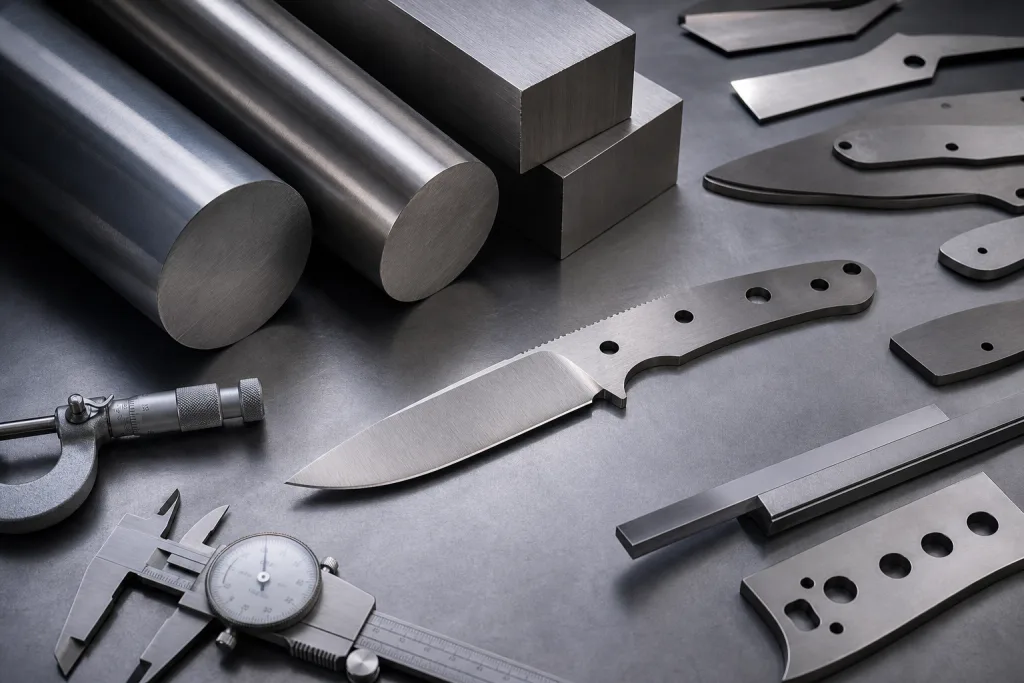
For Amazon and DTC sellers, sample approval is the point where a knife set either holds the spec or starts drifting. We have seen a polished sample pass photos on day 1 and then fail after 300 dishwasher cycles, trigger edge-retention complaints, or get held up because the packing list does not match the carton code.
At our Yangjiang factory, we treat sample approval as a control step, not a display table. Before bulk runs, we write down steel grade, HRC, blade thickness, heat-treatment route, handle material, packaging, and inspection limits. QC pulled the sample, measured a 2.1 mm spine, and the buyer flagged a 0.3 mm gap at the bolster. If you approve only the look, you leave too much room for the line to guess.
Why Sample Approval Must Start With Steel
A kitchen knife set sample approval steel specification comparison should start before the factory cuts the first blade. We see about 7 out of 10 new buyers send a reference photo and ask for a sample quote, then talk about steel after the sample lands on their desk. Wrong order. Steel grade decides blanking, grinding wheel choice, heat treatment curve, polishing time, sharpening angle, cost, lead time, and the hand feel customers mention in reviews.
For a 5-piece or 15-piece set, the wrong steel call usually creates one of two headaches. One is a soft blade, usually 52-54 HRC, easy to sharpen but dead after a few weeks of tomato and onion work. The other is a blade pushed harder than the chemistry can carry, and then QC pulls the sample with micro-chips near the heel or rust spots after a 24-hour salt mist check. Amazon buyers do not care that the steel name looked good on your listing. They care whether the chef knife still cuts tomatoes after two months.
A serious kitchen knife set sample approval manufacturer should ask where you will sell, your target retail price, whether the knives are hand-wash only, and whether you need LFGB, FDA, or REACH documentation. In Yangjiang, China, we run retail knife sets in 3Cr13, 420J2, 5Cr15MoV, X50CrMoV15, 7Cr17MoV, and patterned Damascus laminates. Each sits in a sensible price band. None is magic. If a buyer wants 5Cr15MoV performance at 3Cr13 cost, the math doesn't work.
For a first private-label order, your approval sheet should state the exact steel grade, HRC range, blade thickness tolerance, handle material, logo method, edge angle, finish, packaging version, and approved sample date. Put it in writing. We once had a PO typo change 5Cr15MoV to 3Cr13 on a reorder, and the buyer flagged the weight and edge retention only after pre-shipment inspection. That sheet becomes the factory instruction. Without it, bulk production depends on memory, and memory is not a quality system.
Common Steel Grades For Knife Sets
The steel grade has to fit the knife set position. A 12-piece promo block for supermarket gift season, a 15-piece Amazon set, and a premium DTC launch cannot all carry the same spec and still hit margin. Over-spec the steel and the FOB math breaks. Under-spec it and reviews come back with edge complaints after 30 days. The better question is not “which steel is best?” It is “which steel matches the retail price and the failure risk we can accept?” Last month QC pulled a 5Cr15MoV chef knife at 54 HRC from the grinding line; that 1-point miss was enough for the buyer to flag the sample.
| Steel grade | Typical HRC | Best use | Buyer note |
|---|---|---|---|
| 3Cr13 / 420J2 | 52-55 | Entry knife blocks, gift sets | Good rust resistance for low-price sets, but edge life is limited |
| 5Cr15MoV | 55-57 | Mainstream chef and kitchen sets | Balanced cost and sharpening feel; we run this often for 1,000-3,000 set orders |
| X50CrMoV15 | 56-58 | European-style DTC sets | Reliable stainless choice with better listing value and cleaner buyer story |
| 7Cr17MoV | 57-59 | Sharper-positioned retail sets | Holds an edge better, but heat treatment needs tighter control |
| Damascus laminate | 58-60 core | Premium gift and chef sets | Higher cost; pattern consistency must be signed off before bulk |
For kitchen knife set sample approval wholesale projects, 5Cr15MoV at 55-57 HRC is usually the working middle. It cuts well enough for home cooking, keeps grinding and mirror polishing time under control, and survives normal sink-and-drawer abuse better than harder brittle choices. We ship a lot of this steel because the math works. X50CrMoV15 makes sense when the DTC page talks about European-style performance and the buyer accepts a higher FOB, often USD 0.30-0.60 more per main knife depending on handle and finish.
Damascus needs tighter checking. Approve the core steel and layer count, then check etching contrast, pattern area, and whether the bolster or tang carries the same pattern. A photo is not enough. We have seen this go sideways when the sample billet looked bold, but the bulk grinding depth washed the pattern out near the 2.0 mm spine. Ask for one pre-production sample after final grinding, not just a beauty photo from the sample room.
Hardness Is A Band, Not A Promise
HRC matters, but it is not the whole knife. A 57 HRC chef knife can pass cleanly or come back with edge complaints, depending on the steel chemistry, the heat treatment curve, the belt temperature on the grinding line, and the final edge angle in degrees. If a kitchen knife set sample approval supplier writes only “high hardness,” ask for the tested range and the test point. Spine or mid-blade? We run ours on a Rockwell tester after wiping the scale off the flat, because a dirty test spot gives nonsense.
For most stainless kitchen sets, approve a band of 2 HRC points. Use clear ranges: 5Cr15MoV at 55-57 HRC for entry retail sets, X50CrMoV15 at 56-58 HRC when the buyer wants better edge feel, and 7Cr17MoV at 57-59 HRC when the spec allows a harder blade. A single target like 58 HRC sounds neat on a PO, but the math doesn't work across 10,000 blades, especially when one set includes chef, santoku, bread, utility, and paring knives with different blade thickness and grinding time.
Product mix changes the right answer. A paring knife can run slightly harder because it sees less impact on the board. A cleaver, boning knife, or heavy-duty utility knife needs more toughness, or QC will start pulling chipped-edge samples after the drop test. If you force every blade in a set to the same hardness, preventable returns are waiting for you. Our factory output is about 180,000-220,000 knives per month, and the stable programs are the ones where hardness bands are agreed by blade type, not copied blindly across the set.
Ask for at least 3 hardness readings during sample approval: one from the approved sample, one from a pre-production blade, and one from mass production inspection. For larger programs above 5,000 sets, require a simple HRC report per production lot. It is cheap paperwork. We ship faster when the buyer's PO says “55-57 HRC, blade center test” instead of one lonely number that the inspection team has to interpret at packing time.
Heat Treatment Decides The Real Performance
I’m rewriting the four paragraphs in place, keeping the HTML tags and structure unchanged while tightening the wording and adding the factory-floor detail the section needs.Steel grade gets the attention, but heat treatment does the work. We run two 5Cr15MoV samples through the same spec, and if one is quenched and tempered right while the other gets overheated at the grinding line, the edge behaves differently in the first 12 cartons. The buyer sees the same steel name. The customer feels a different knife.
A good kitchen knife set sample approval manufacturer should explain the heat-treatment route in plain language. For stainless kitchen knives, the usual flow is blanking, heat treatment, straightening, rough grinding, fine grinding, polishing, sharpening, cleaning, and final inspection. Heat treatment should control furnace temperature, holding time, quenching method, and tempering cycle. For some premium steels, cryogenic treatment may be used, but ask whether it runs on the production floor or only appears in the sales deck. We have seen a PO typo like "tempring" hide a bigger problem: the supplier could not state the soak time.
During custom kitchen knife set sample approval, test the sample like a normal customer, then abuse it a little. Cut cardboard, tomatoes, onions, chicken cartilage if relevant, and a plastic cutting board. Do not only slice paper on video. Paper cutting after final sharpening tells you the edge is sharp today. It does not prove the heat treatment will hold after 3 days in the rack. QC pulled the sample, checked the edge under a 10x loupe, and found two micro-chips after the cardboard run. That is the wrong question to ask if the buyer wants stable field performance.
For Amazon sellers, I also recommend a basic corrosion check. Leave a wet salted cloth on the blade for 2-4 hours, then inspect staining. This is not a formal ASTM salt spray replacement, but it shows whether your finish, passivation, and cleaning are doing their job. For European importers, align this with LFGB food-contact expectations and REACH material declarations. We ship by what the blade shows on the bench, not by what the brochure promises.
What To Approve Before Bulk Production
Sample approval should lock the sellable version, not a showroom sample. The approved piece must match the production quotation. If the sample has hand polishing from the senior worker on the grinding line, 1.8 mm thicker handle scales, or a 400 gsm gift box while the quote was based on 350 gsm, the math does not work. You are approving cost the factory has not priced, and we have seen this turn into a fight 30 days later when QC pulled the first mass-production set.
For kitchen knife set sample approval factory work, we run a specification sheet that includes blade steel, HRC range, blade length, spine thickness, grind type, surface finish, edge angle, handle material, rivet material, tang construction, logo position, logo method, sheath or block details, inner box, master carton, barcode, FNSKU if needed, and inspection standard. No guessing. A normal MOQ for a private-label kitchen knife set is 500-1,000 sets per SKU, depending on handle, packaging, and whether tooling is required. On one PO, the buyer wrote 3Cr13 in the email but 5Cr15MoV on the attached spec; we stopped the job before steel cutting because that typo changes both cost and performance.
Logo approval needs more attention than most buyers give it. Laser engraving, etching, stamping, and printed packaging do not wear the same after washing and rubbing. If your brand mark is on a polished blade, ask for a 3M tape test and a cleaning test with alcohol wipes. If it is on a handle, check depth, alignment, and color fill against the approved artwork. On Amazon, a crooked logo is not a small defect when the customer uploads photos; the buyer flagged 2 mm drift on a chef knife logo last season, and they were right.
Packaging also affects sample approval. A beautiful knife can become a returned product if the gift box collapses, the blade tip pierces the insert, or the carton exceeds FBA handling preferences. For e-commerce, test a 76 cm drop on carton corners and edges, confirm barcode scanning, and keep carton weight practical. We ship cartons that warehouse staff can handle all day. The approved sample should include final packaging, not a placeholder box, because a loose EVA insert or thin E-flute box is where sample approval often goes sideways.
Inspection Standards That Match E-Commerce Risk
A kitchen knife set sample approval steel specification comparison is not finished until the inspection limits are written down. We have seen buyers approve 3Cr13 or 1.4116 hardness at 52-56 HRC, then leave defects under “factory standard.” That wording is too soft for Amazon returns and DTC unboxing in North America and Europe. On our QC table, a 0.8 mm handle gap that passes local wholesale can still become a 1-star photo review.
Use AQL inspection language. For a 3,000-set kitchen knife order, AQL 0 for critical defects, AQL 2.5 for major defects, and AQL 4.0 for minor defects is a practical starting point. Critical defects include loose blades, cracked handles, exposed sharp points in packaging, wrong steel, wrong logo, and food-contact safety issues. Major defects include poor edge sharpness, visible rust, blade warping, loose rivets, failed barcode, wrong carton mark, or packaging damage. Minor defects include polishing marks under 10 mm, slight color variation, or small packaging scuffs inside the approved limit. QC pulled the sample once for a carton mark typo: “stianless” instead of “stainless.” Small error. Big warehouse headache.
Sharpness testing should be agreed before production. Some buyers use CATRA testing for higher-end programs; it works, but it adds cost and usually 5-7 days. For mainstream kitchen sets, we run a controlled paper cut, tomato skin test, edge angle check, and sampling plan. That is often enough. The key is consistency. If your listing says professional sharpness, the grinding line needs a number, such as 15 degrees per side or 18 degrees per side, not a nice adjective.
For China export orders, ask for BSCI or ISO 9001 status if your channel requires it, and confirm FDA, LFGB, or REACH documents before the deposit. Do not wait until goods are ready. We have seen this go sideways when fresh LFGB testing needed 12 working days, while the vessel cut-off was already fixed. The math does not work.
How To Compare Suppliers Without Guessing
Compare one kitchen knife set sample approval supplier against another on the same sheet. Send the same target spec, ask for the same steel grade, keep the same HRC band, and compare landed cost, not just FOB. We have seen a $1.20 FOB gap vanish after thicker inserts, a failed salt-spray check, and one extra carton print change. That is the wrong question to ask if you are trying to protect margin.
Ask each supplier for a written sample report: steel grade, HRC result, blade thickness, sample date, packaging version, and every deviation from your requested spec. On our QC desk, the Rockwell tester and caliper do not care about sales wording. If a factory writes only “stainless steel” and cannot name the grade, the buyer flagged it for a reason. For kitchen knife set sample approval wholesale, simple construction is fine, but unclear material is not.
Lead time is the other filter. A real custom sample takes 7-15 days after artwork and specification confirmation. Bulk production is usually 35-55 days after sample approval and deposit for standard private-label sets. Damascus, new handle molds, custom blocks, or gift boxes can add 10-25 days, and we run those jobs through the grinding line before packing. We would rather quote 42 days and ship on time than promise 30 days and miss a launch by 12 days.
Compare communication quality last. Good factories push back on bad math. If you ask for entry-price steel at 60 HRC, zero rust risk, luxury packaging, and a 300-set MOQ, the math does not work. QC pulled the sample, the buyer spotted a typo on the PO, and the whole order would have gone sideways if nobody spoke up. That pushback protects your reviews, your cash flow, and the next reorder.
Frequently asked questions
For a first Amazon kitchen knife set, 5Cr15MoV at 55-57 HRC is usually the safest middle choice. It is stainless enough for normal home use, tough enough for daily chopping, and cost-effective for 500-1,000 set MOQs. If your target retail price is higher and your brand position is more performance-focused, X50CrMoV15 at 56-58 HRC is worth quoting. I would avoid pushing a budget steel to 58-60 HRC just for listing language. It can increase chipping risk without giving you a better customer experience.
Approve at least one full finished set with final logo, finish, edge, handle, and packaging. For larger orders above 3,000 sets, ask for a pre-production sample from the actual production line before full mass production. If the set has 8 or more knife types, check every blade type, not only the chef knife. You should also approve the master carton, barcode, FNSKU if used, instruction insert, and warning label. A single loose blade sample is useful for early development, but it is not enough for final kitchen knife set sample approval.
Yes, a serious kitchen knife set sample approval factory can provide a material certificate from the steel supplier and, when needed, third-party chemical composition testing. For normal private-label orders, buyers often request supplier mill certificates plus HRC reports. For higher-risk or premium programs, you can add SGS, Intertek, or equivalent testing before production or during inspection. The cost depends on the test scope, but it is small compared with a rejected shipment. The key is to request documents before deposit, not after goods are packed.
A 2-point HRC band is realistic for most stainless kitchen knife production. Examples include 55-57 HRC for 5Cr15MoV, 56-58 HRC for X50CrMoV15, and 57-59 HRC for 7Cr17MoV. A single exact number is not a good approval standard because blade size, furnace loading, and production variation all matter. For a 1,000-set order, request random HRC checks during production and final inspection. If you need tighter control, discuss it early because it may affect cost, sorting, and lead time.
Damascus can work well for a DTC launch if your brand can support the higher cost and explain the care requirements honestly. Approve the core steel, target core hardness, cladding pattern, etching contrast, handle fit, and packaging before placing the order. Many Damascus kitchen sets use a VG10-type or 10Cr15CoMoV core around 58-60 HRC, but the exact construction must be written in the spec. MOQ is often 300-500 sets for simpler designs and higher for custom handles or blocks. Pattern consistency is the issue to control, not just sharpness.
Send Your Knife Set Spec For Review
Share your target retail price, steel preference, MOQ, packaging plan, and market. We will return a practical sample approval spec before you commit to production.
Request a Quote