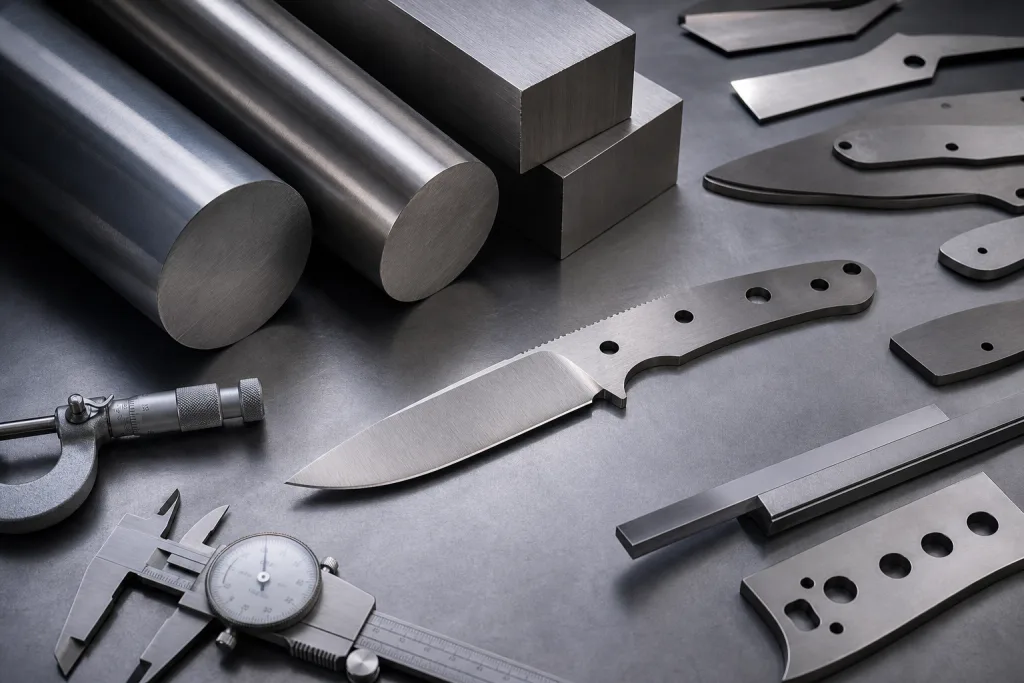
Hardness looks simple on a quotation sheet: 56 HRC, 58 HRC, 60 HRC. On the grinding line, that number changes edge life, chipping claims, sharpening feel, rework rate, and return cartons after a retailer test. We had 1 buyer ask for 60 HRC on a stamped 1.8 mm chef knife because their catalog said “premium.” QC pulled the sample after the brass-rod check; the edge showed micro-chips under a 10x loupe. Bad fit. The math did not work at that FOB price. Do not copy an HRC value from another kitchen knife set and expect it to pass in Europe or North America.
At TANGFORGE in Yangjiang, Zhejiang, China, we quote knife sets by steel grade, target HRC band, blade thickness, handle build, finish, packaging, and inspection level. Our usual MOQ for a private-label kitchen knife set is 1,000 sets, with 35-55 days lead time after sample approval. We run Rockwell checks on the blade body and near the edge; a 2 HRC drift can send the batch back for heat-treatment review before packing. We have seen this go sideways when the buyer only asks, “Can you make it harder?” That is the wrong question. The right kitchen knife set steel hardness specification is not the highest number. It is the number your customer can sharpen, use, and not return.
Why HRC Drives Buyer Risk
Rockwell C hardness, marked as HRC on most spec sheets, tells us how much the hardened blade steel resists the diamond cone on the tester. For a kitchenware brand owner, it is not cosmetic text on the drawing. It changes edge life, sharpening feel, and the complaint rate when an end user twists the knife through frozen food or cuts near chicken bones on a PE board. We run spot checks on the Rockwell hardness tester after heat treatment, and QC records the test point 8-12 mm above the edge so nobody takes the reading on a thin grind.
A soft blade at 52-54 HRC takes abuse and bends before it breaks. The edge rolls fast. After 14 days, customer service gets the classic line: “dull after two weeks.” We hear it 7 or 8 times per quarter on 8-inch chef knives and santoku knives with 15° per side edges. A hard blade at 60-62 HRC keeps a cleaner edge for 30-45 days in normal home use, but bad tempering or the wrong edge angle brings micro-chips. QC pulled the sample last month on a 61 HRC chef knife because the grinding line left the edge too thin at 0.18 mm before sharpening. Hardness alone does not make a premium knife. Wrong question.
For custom kitchen knife set programs sold through retail chains or online marketplace distributors, a hardness band protects both sides better than one fixed number. Do not write “58 HRC” on the PO. Write “56-58 HRC after heat treatment and final grinding.” A real kitchen knife set manufacturer needs tolerance because blade thickness, furnace loading position, quench position, and steel lot can move the reading by 1-2 HRC. We once had a buyer flag a PO typo that said “58-58 HRC”; the math does not work unless you reject good blades for no selling benefit. If a supplier promises every blade at exactly 58 HRC, ask which tester they run and how many pieces they scrap per 1,000 pcs.
At our Yangjiang, Zhejiang facility in China, we treat HRC as one line in the product risk file, not the whole file. A 20 cm chef knife should target edge retention, a 9 cm paring knife should stay easy to sharpen, and kitchen shears need toughness around the pivot screw and handle rivet area. The chef knife might sit at 56-58 HRC, while shears need more give where the two blades cross. We ship the set to feel consistent in hand, but each blade has its own job. We have seen this go sideways when a buyer copied one HRC line across 6 SKUs just to make the spec sheet look tidy.
Practical Hardness Bands by Steel
Steel grade sets the HRC window we can repeat in production. Chasing a number outside the steel’s safe range is the wrong question to ask. A kitchen knife set supplier may say “we can do 60 HRC” because one chef knife showed 60.1 on the Rockwell tester, but that reading alone does not buy you stable goods. The real test is keeping the same band across 5,000-20,000 blades while QC checks blade straightness within 1.5 mm on the granite plate, runs the brass-rod edge check without cracking, reviews salt-spray panels, and still gets normal yield from the grinding line.
For entry and mid-range stainless sets, 3Cr13 and 420J2 are usually quoted at 52-55 HRC. They resist rust and keep the bill of material down, but the edge rolls sooner after 2-3 weeks of daily home use. No surprise there. 5Cr15MoV, 1.4116, and close grades are the steels we run most often for mass-market kitchen knife set wholesale because price stays sane and a customer can resharpen the blade with a pull-through sharpener. We run these at 55-57 HRC for retail sets when the buyer wants fewer warranty emails, not a lab trophy number. For stronger edge retention, 7Cr17MoV or 9Cr18MoV can sit higher. AUS-10, VG10 core, or powdered steels need tighter furnace records, slower temper checks, and cleaner bevel grinding on the 15° line. QC pulled the sample last month after one batch showed 58.8 HRC on the spine but micro-chips at the edge under the 20x loupe.
| Steel type | Typical target HRC | Best use in set | Buyer note |
|---|---|---|---|
| 3Cr13 / 420J2 | 52-55 | Budget utility and steak knives; promo sets where edge life is not the main selling point | Low cost, faster dulling |
| 5Cr15MoV / X50CrMoV15 | 55-57 | Mainstream chef and santoku knives; paring knives with thinner stock | Good retail balance |
| 7Cr17MoV / 440A class | 56-58 | Mid-range block sets with full-tang handles | Better edge, still forgiving |
| 9Cr18MoV / 440C class | 58-60 | Premium thin-edge knives with tighter bevel control | Needs tighter heat control |
| VG10 Damascus core | 59-61 | Premium chef knives and gift sets with printed care cards | Higher cost, clearer care instructions |
If your price target is FOB USD 12-18 for a 6-piece basic set, do not specify VG10 at 60 HRC and expect stable margins. The math doesn't work. We had one PO typo call out “VG10 60 HRC” on a promo set with a 2,000 pcs MOQ, and the buyer flagged the quote as too high after we added real core steel, vacuum heat treatment, and 3 extra Rockwell checks per lot. We have seen this go sideways. If your retail product is a USD 149-249 premium gift set, a 59-61 HRC core steel makes sense because the shelf price can carry the furnace cost and the stricter QC hold before we release cartons for packing.
Heat Treatment Matters More Than Claims
Two factories can quote the same steel grade and the same HRC, then deliver knives that cut differently on the same PE cutting board. The difference often starts before grinding. Austenitizing temperature, soak time, quench oil temperature, and temper cycles all move the result, even when the sales sheet says “56-58 HRC.” You do not need a metallurgist on staff. Ask for process control records. On our floor, QC checks 5 blades from each furnace lot on the Rockwell tester, and the grinding line does not touch them until the readings are signed off.
For a custom kitchen knife set, ask the factory to write the heat-treatment route in plain English: vacuum heat treatment, oil or air quench matched to the steel grade, double tempering, target 56-58 HRC. For higher-carbon stainless such as 9Cr18MoV or VG10, ask if they run cryogenic or sub-zero treatment. Do not buy the word “cryo” by itself. The math does not always work. If a kitchen knife set factory offers it, they should show the cost per set, why that steel needs it, and the lead-time impact, such as 18 days instead of 12 days on a 3,000-set PO. We run this question through production first, not the catalog team.
Under-hardness is one headache. Over-hardness can hurt production and after-sales faster. Thin blades warp during quench, and QC may pull 7 bent pieces from a 200-piece tray before the batch reaches final sharpening. Edges chip on the whetstone wheel. Polishing can show pinholes or heat marks that were hidden before the 600-grit belt. Handles can cover stress problems until the customer starts using the knife. We have seen this go sideways: one buyer pushed for 60 HRC on a 15° edge, then flagged chipping after the first sample trial. A responsible kitchen knife set manufacturer will tell you to lower the target by 1 HRC if the edge angle is aggressive or the end users are not trained to maintain hard knives.
At TANGFORGE China, our standard production capacity is about 300,000 knife units per month across kitchen, outdoor, pocket, and Damascus lines. For kitchen sets, we prefer approving 1 golden sample set after lab hardness, salt spray, edge sharpness, handle pull, and packaging drop checks. QC pulls the sample, records the HRC reading by blade position, and keeps the approved set beside the packing table for comparison. Then the mass production batch follows the same route. Boring work wins. When we ship 1,000-10,000 sets, one typo on a PO can turn “56-58 HRC” into a claim nobody wants to defend.
Match Hardness to Edge Geometry
Hardness is only half the spec. We run a 56 HRC chef knife at 15 degrees per side one way; the same steel at 20 degrees per side comes off the grinding line like another SKU. With 1.8-2.2 mm spine thickness and a narrow edge, the heat-treatment window has to stay tight, usually within about 1 HRC on our Rockwell tester after quench and temper. A 2.5-3.0 mm Western-style blade forgives more. Simple math.
If your brand promise is “razor sharp out of the box,” pair the thinner behind-the-edge grind with a higher HRC band and write the care rules around it. That spec sells well in samples; we have shipped 300-piece trial orders where the buyer loved the first tomato cut. We have seen it go sideways when the buyer expects dishwasher use, glass boards, or a chef knife used to crack frozen meat, so the warning card, carton insert, and warranty wording need to say what the blade can take. A slightly lower hardness with a stronger edge often saves more money than chasing 1 extra HRC. The math doesn't work if returns start after week 2.
For a typical 5-piece retail set, we split geometry by blade role. A chef knife or santoku can sit at 15-18 degrees per side depending on steel; a utility knife works around 17-20 degrees. A paring knife should stay thin and easy to resharpen, with no chipping after the first onion test on the QC bench. QC pulled the sample on a bread knife last month because the serration pitch was uneven by about 0.4 mm after final grinding. HRC was not the issue. If the blade is serrated, hardness is the wrong question to ask first.
Brief a kitchen knife set supplier with blade data the factory can cut against: spine thickness at the heel, blade height, taper, edge angle, bevel type, finish, and target sharpness. For bigger programs, CATRA gives useful numbers; for smaller runs, a BESS sharpness check plus a real tomato and carton test catches bad grinding faster. We ship based on the edge the customer feels, not the lab report, and one PO typo on a 15 degree bevel becoming 18 degrees can turn into a reject lot. We had that exact argument on a 1,200-set order; the buyer flagged it before packing.
How to Write the Specification
A usable kitchen knife set steel hardness spec should fit on one PO line, be measurable, and connect straight to inspection. Cut the catalog words. Write the steel grade and target HRC band, then state the tolerance, Rockwell test point, sample quantity by blade type, and release rule if readings miss the band. We run this on a TH320 hardness tester after final grinding, usually after the edge line sits for 30 minutes and the blade backs are cool to the touch. Not from a sales sheet. That one line gives the heat-treatment crew a number to chase and gives your inspector a clean pass/fail point.
For a mid-range custom kitchen knife set, write it like this: “Blade steel 5Cr15MoV, heat treated to 55-57 HRC after final grinding. HRC tested on flat blade area where possible, 3 pieces per blade type per batch. Any reading below 54.5 or above 58.0 requires factory review and buyer approval before shipment.” Plain wording wins here. Last month QC pulled a chef knife sample at 54.2 HRC near the heel, checked it twice on the TH320, and that single number stopped 1,200 sets from being packed into color boxes too early. Good stop.
For premium sets, tighten the control points instead of asking for “better steel.” That is the wrong question to ask. Ask for the steel mill certificate and heat number traceability where the mill can support it. Require a hardness map on the pre-production sample, with readings at the heel and tip marked on a blade drawing in mm, then set edge angle tolerance of plus or minus 2 degrees using a laser angle gauge. Add corrosion test requirements with the soak time written in hours, not “salt water test passed.” If you sell in the EU, include REACH and LFGB checks for food-contact parts. For the US, FDA food-contact expectations matter for handle resin, blade coatings, two-part epoxy, and packaging inks because retailers check those documents one by one. If the factory claims ISO 9001 or BSCI audit status, ask for current documents before placing the order; we have seen buyers accept a 2021 PDF and regret it during retailer onboarding.
Packaging has to match the hardness. Harder blades chip faster when the edge hits plastic during a 1.2 m drop test, so specify edge guards or block slots with at least 2 mm clearance from the cutting edge. We have seen good blades come off the grinding line at 57 HRC, then arrive with tiny edge dents because a cheap PET tray flexed in transit; the buyer flagged 38 sets from the first carton check. For Amazon or marketplace orders, write FNSKU labels with 100% scan check, carton drop test, barcode scan test, and master carton strength into the same packing spec, including scanner model if your warehouse uses a fixed reader. The furnace is only half the story.
QC Checks Before Shipment
Put hardness inspection into the pre-shipment QC plan before anyone starts the carton sealer. On a kitchen knife set wholesale order, we run AQL sampling; checking every knife one by one will bury the schedule. For a 10,000-set order, QC pulls cartons from at least 5 pallet positions, including the middle stack, not just the clean top layer beside the aisle. For standard consumer knife sets, AQL 2.5 for major defects and AQL 4.0 for minor cosmetic issues is a fair starting point. Critical defects stay at zero tolerance: cracked blades, loose handles, exposed sharp points outside packaging, or wrong steel grade. No debate there.
Tell your inspector to record hardness readings by blade type, not just by set. If the 8-inch chef knives pass at 56.5 HRC but the paring knives average 53 HRC, the set is uneven, and the buyer will feel it during the first tomato cut. QC should mark the Rockwell tester point on the blade spine or heel area, usually 8-12 mm away from the edge, so the diamond point does not ruin the cutting line. Check blade straightness on a flat gauge plate. Check edge burr with a cotton wipe; check tip alignment against the sheath slot; check handle gaps with a 0.1 mm feeler gauge. Rivet flushness gets checked by fingertip, bolster polishing under bench light, logo position in mm from the heel, and packaging fit after the insert is loaded. For wooden handles, moisture content and shrinkage matter. We saw a 0.8 mm handle gap open after one approval sample sat two days in the packing room. For plastic handles, QC checks injection marks, smell after 24 hours in a sealed PE bag, color against the approved swatch, and pull strength on the handle jig.
A practical pre-shipment checklist should include 3-5 HRC readings per blade type when the test area allows, visual inspection under normal light at 30-50 cm, functional cutting on A4 paper or tomato skin, carton drop test, barcode verification, and carton quantity count. Use a real barcode scanner. A phone photo is the wrong tool here; one buyer flagged a PO because the outer carton code had one wrong digit, and the warehouse refused the lot. For premium sets, add salt spray testing such as 24-48 hours depending on steel and finish, even though kitchen knives are not marine hardware. Over-testing burns money. Under-testing costs more. We have seen this go sideways when QC pulled the sample after the grinding line had already switched to the next model.
At TANGFORGE in Yangjiang, Zhejiang, China, we prefer buyers to approve inspection criteria before deposit. Once 10,000 sets are packed, arguing about what counts as a major defect wastes time and often costs 3-5 days in rework, repacking, or carton relabeling. The wrong question is “Can we decide after inspection?” Put the standard in writing before production starts: HRC range, AQL level, logo tolerance in mm, and the exact carton mark from the final PO. We once had a PO typo where “Satin Finish” became “Stain Finish”; the buyer flagged it only after cartons were printed, and the math did not work for a free relabel job.
Cost, MOQ, and Lead Time Impact
Hardness affects cost, but HRC alone never explains the invoice. The bill changes when we switch steel grade, narrow the heat-treatment window, hold grinding tolerance at ±0.2 mm, and scrap blades that fail the edge gauge. A basic 5Cr15MoV set at 55-57 HRC runs clean on our standard belt sequence: #180, #320, then polishing. A VG10 Damascus set at 60-61 HRC with a 15 degree edge needs slower passes on the grinding line, 3 extra Rockwell tester checks per batch, and blade sleeves so the edge does not kiss the carton divider.
For a new brand, we start with a mid-range spec that can sell before chasing fancy steel. A 1,000-set MOQ gives enough volume to test pouch print, return rate, and shelf price without locking cash into the wrong SKU. We shipped a run last season where QC pulled the sample and found the front label sitting 2 mm high; the buyer flagged it before launch, which saved 600 cartons from rework. Good catch. If sales stay clean for 3-6 months, we adjust steel grade or blade geometry on the next PO. Jumping straight to the hardest steel is the wrong question to ask.
Typical lead time for a private-label kitchen set is 7-12 days for drawings and sample preparation after details are locked, then 35-55 days for mass production after sample approval and deposit. Shipping time depends on sea, rail, or air. On one order, the sample drawing changed three times because the handle centerline was off by 1.2 mm, and that pushed first approval back 7 days. FOB works for importers with their own forwarder. DDP fits smaller buyers, but the math changes once duties, anti-dumping risk, insurance, and customs signature responsibility are written into the PI.
A good kitchen knife set factory should push back when the spec and target price do not match. If you ask for low-cost steel, 61 HRC, mirror polish, dishwasher-safe claims, and a retail price under USD 29, the math does not work. We have seen this go sideways on the grinding line: edges chip after the final leather wheel, rejects climb from 2% to 9%, and the buyer still wants the same margin. Start with the customer, retail price, warranty terms, and sales channel. Then choose hardness that fits the business model.
Frequently asked questions
For mainstream Western-style sets, specify 55-57 HRC or 56-58 HRC depending on steel. 5Cr15MoV, X50CrMoV15, and similar steels work well in this range because they are tough, corrosion-resistant, and easy for consumers to sharpen. If your set includes a chef knife, santoku, utility, paring, and bread knife, do not assume every blade needs the same exact value. The bread knife and steak knives may be acceptable slightly softer. For retail and marketplace products, a 2 HRC band is more realistic than one fixed value. Ask the kitchen knife set manufacturer to confirm the final HRC after grinding, not only after heat treatment.
Only if the steel, geometry, and customer use match it. A 60 HRC blade can offer better edge retention, especially with 9Cr18MoV, VG10, or similar higher-carbon stainless steels. But if the edge is too thin, the tempering is poor, or users cut bones and frozen food, you may get chipping complaints. For a premium chef knife set sold with clear care instructions, 59-61 HRC can make sense. For a family-use block set sold at mass retail, 55-58 HRC is usually safer. Hardness is not a luxury signal by itself; controlled heat treatment and edge design matter more.
For sampling, ask for hardness readings on at least 3 pieces per blade type from the production batch. For larger orders above 5,000 sets, 5 pieces per blade type is more reassuring. The factory should record steel grade, furnace batch, target HRC, actual readings, and inspection date. Testing should be done on a flat blade area where possible, because handles, bevels, and thin tips can give unreliable readings. For third-party inspection, combine HRC readings with visual checks, cutting performance, blade straightness, and packaging verification. A certificate without sampling detail is weak evidence.
You can, but it is not always the best approach. If all main blades use the same steel and similar heat-treatment route, a common band such as 55-57 HRC is fine. However, a set may include serrated knives, kitchen shears, steak knives, or a honing rod. These components may use different steels or different functional requirements. A chef knife and paring knife can share a target, while shears may need separate hardness for cutting edges and pivot durability. Your technical file should list each component clearly so the kitchen knife set supplier does not substitute materials quietly.
Include steel grade, blade thickness, blade length, edge angle, surface finish, handle material, logo method, packaging, target retail price, order quantity, destination market, compliance needs, and inspection standard. For example: 5Cr15MoV, 56-58 HRC, satin finish, 15-18 degree edge, ABS triple-rivet handle, laser logo, color box, MOQ 1,000 sets, AQL 2.5 major defects, REACH and LFGB for EU sales. If you need FNSKU labels or DDP delivery, state that early. A kitchen knife set factory can quote more accurately when the full product risk is visible.
Send Us Your Knife Set Specification
Share your target retail price, steel grade, HRC band, quantity, and packaging plan. We will review the specification and flag production risks before sampling.
Request a Quote