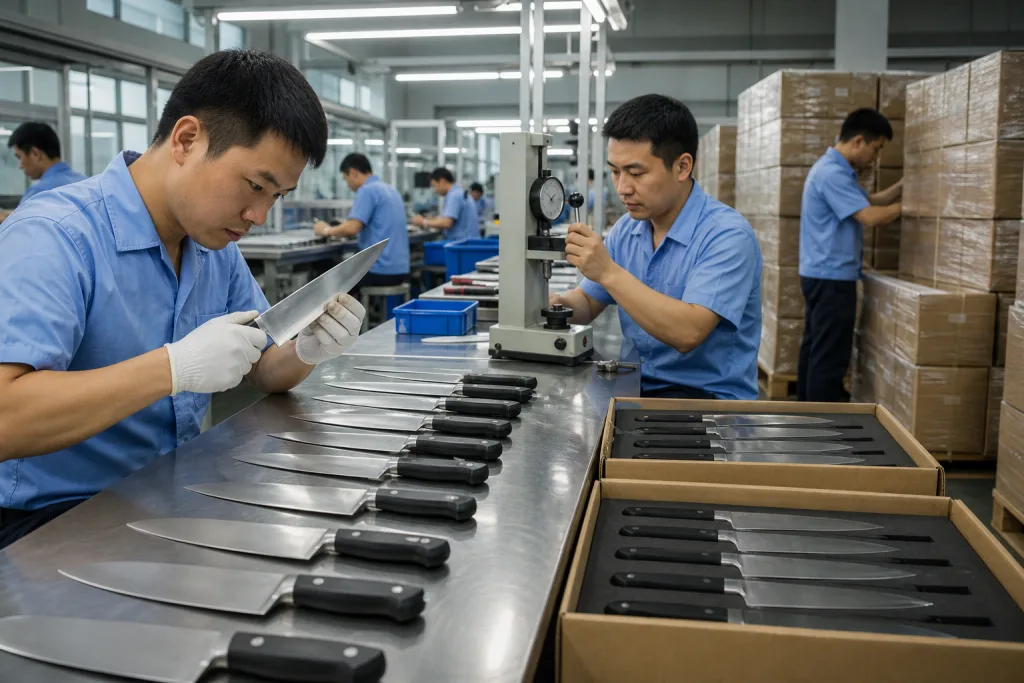
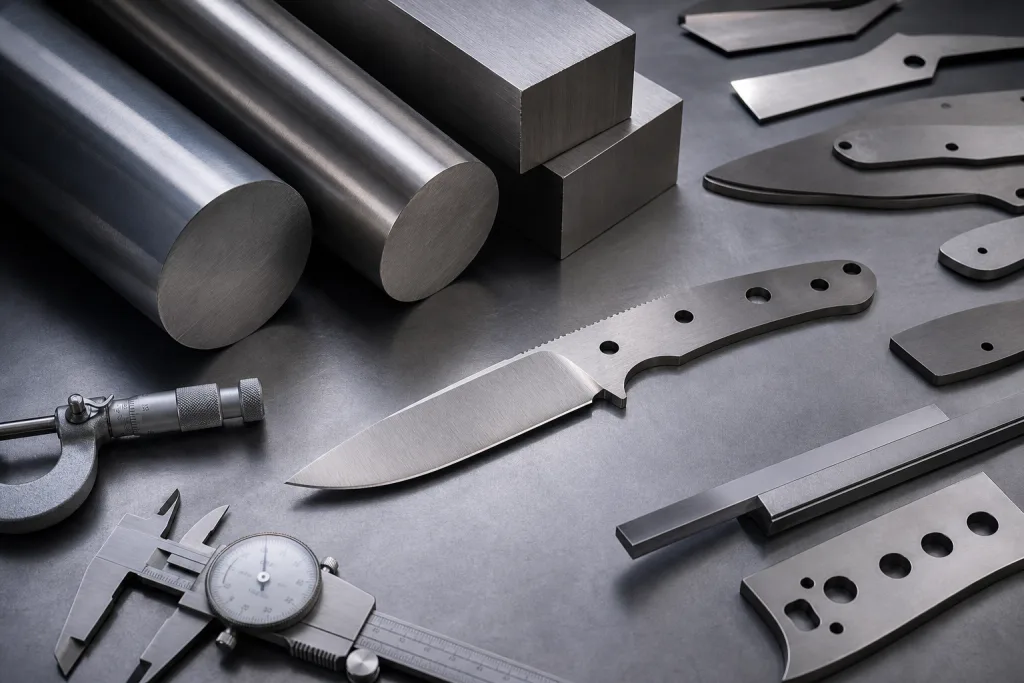
Most buyers ask for a hardness number before they ask for a process. That is backwards. On the grinding line, we see it every week: a buyer sends 58 HRC, but leaves blade geometry, steel grade, and test method open. Then the heat-treat window changes, grinding loss moves, and QC pulled the sample because the edge chipped at the wrong point. At our Yangjiang, Zhejiang, China factory, hardness decides how the steel behaves in heat treat, how much stock you lose at the wheel, how many blades miss QC, and whether a 500 pcs quote holds or jumps at 5,000 pcs.
If you buy from China, you need the full picture. A custom knife blade hardness request can stay repeatable, or it can turn into scrap and add USD 0.30-1.20 per knife. The math does not work if the PO has one typo and the buyer flags 60-62 HRC after the trial run; we run 240 employees and still need the spec tight before the line can hold it. The right hardness band, MOQ, and inspection plan tell you more about the real quote than the catalog photo ever will.
Why hardness changes the quote
Buyers ask for a knife blade hardness MOQ and price guide and expect one number. On the floor, hardness is a pricing lever. Steel grade, quench curve, temper cycle, grind loss, and reject rate all move the quote. At our Yangjiang, Zhejiang, China plant, a 55-57 HRC kitchen knife runs clean on the grinding line. A 58-60 HRC spec needs closer oven control and a bigger scrap buffer. QC pulled the sample twice last week for a 0.6 mm edge check.
For common stainless steels, a one-point HRC increase adds real cost. A basic stamped utility knife lands around USD 1.20-2.20 FOB at 1,000 pcs. A forged chef knife in 1.4116 or X50CrMoV15 with a narrow hardness window sits around USD 3.20-5.80 FOB. Push into higher-alloy steels, decorative finishes, or a custom knife blade hardness request with +/-1 HRC tolerance, and price climbs another USD 0.30-1.20 per piece. We have seen a buyer flag a PO typo before--58-50 HRC instead of 58-60 HRC--and the quote had to be rebuilt from zero. That is why knife blade hardness OEM projects need a written spec, not a verbal target.
Hardness also works with geometry. A 2.0 mm blade that looks sharp on paper can chip at 60 HRC if the edge angle and temper target stay unchanged. That is the wrong question to ask. On the quote sheet, steel cost is only part of it; process risk matters more. The tighter the hardness band, the more we price in yield loss, test labor, and extra sampling. A Rockwell tester and a 5x loupe catch the bad ones before we ship.
Right HRC for each knife category
Hardness starts with the blade, not the brochure. A 2.0 mm EDC blade and a 3.5 mm cleaver do not want the same HRC, and we run the first check on the grinding line with a micrometer before we talk numbers. Match the steel and the geometry first, then lock the HRC band that fits the knife's job and the buyer's 90-day wear target.
| Knife type | Typical target HRC | Practical buyer note |
|---|---|---|
| Kitchen utility | 55-57 | Tough enough for daily use, and it sharpens fast at the service bench |
| Chef knife | 56-58 | Fits 2.0-2.5 mm blades and normal prep loads |
| Pocket / EDC | 56-60 | 58-60 gives better edge holding, but watch chipping |
| Hunting / tactical | 57-60 | Lean toward toughness if the blade may hit bone or hard targets |
| Damascus chef | 58-60 core | Check the core, not just the cladding finish |
If a factory quotes 60 HRC on a kitchen knife made from soft stainless, ask for the steel certificate and the Rockwell method. Asking only for a bigger HRC number is the wrong question to ask. Last month QC pulled a sample on the HR-150A tester and the reading was fine, but the buyer still flagged it because the mark sat too close to the heel. A proper custom knife blade hardness spec should show the exact test spot and say whether the reading comes from the finished blade or the blank. On laminated or Damascus blades, the core and outer layers do different jobs, so the PO needs to spell out which layer gets measured. For premium runs, ask for CATRA-style edge retention data or a simple cutting trial. One Rockwell number will not settle the argument.
What MOQ really means in factory China
Knife blade hardness MOQ is not just a purchase quantity. At the grinding line, it is the smallest run that still holds setup cost, heat-treatment load, edge finishing, assembly, and carton work in one clean batch. Change the blade steel, HRC band, handle color, or box artwork, and we treat it as a new SKU. A buyer once tried to split a 400-piece order into three specs. The math did not work.
As a working guide from a mid-size knife blade hardness OEM factory in China, simple stamped kitchen knives often start at 300-500 pcs per SKU. Forged chef knives and private-label lines usually need 500-1,000 pcs. Pocket knives with lock mechanisms or clips commonly need 500-2,000 pcs because the assembly bench and final inspection slow down. Damascus or special-pattern blades may start at 300-500 pcs, but the unit price stays higher because yield drops and hand brushing on the surface takes more time. QC pulled the sample, and one scratch at the belt sander can hold the whole batch.
Lead time matters too. A stock-model sample can take 10-20 days, while a fully custom order often needs 30-45 days for sampling and 35-60 days for production after approval. We run 240 employees on the floor, so a 500 pc order is easier to slot than a 200 pc mixed-SKU run with three blade steels and two box prints. Asking for 200 pcs at 500 pc pricing is the wrong question to ask. If you want a better quote from Yangjiang, Zhejiang, China, keep the spec tight and the SKU count low. The buyer flagged it before, and the quote moved by 8% after one handle color was added.
QC risks when hardness is off
The biggest QC miss is treating hardness like a look check. It is a working spec. On the grinding line, we have seen a chef knife pass visual inspection and then roll on the first cardboard cut because the temper was 1.5 HRC low. Go too soft and the edge folds after a few cuts on cardboard, vegetables, or fibrous meat. Go too hard and you get chips, especially on thin chef knives or fine-point pocket blades. This is the wrong question to ask: "does it look okay?" In China, most disputes start when the buyer signs off a sample and never asks where the reading was taken or what tolerance the factory wrote on the card.
- Use Rockwell C on a flat, accessible zone after final temper.
- Specify 3-5 blades per lot, and add a separate test if heat treatment changes.
- Set a tolerance of +/-1.5 HRC for standard stainless and +/-2 HRC for tougher steels.
- Keep AQL 2.5 for visual and dimensional inspection, but add a separate hardness pass/fail rule.
For mixed batches, ask the factory to mark each heat lot and keep a hardness record. We run the stamp on the tang or inner box, then QC logs the reading with the furnace batch. A file test is only a screening tool; it does not replace a Rockwell reading. It will catch a dead-soft blade, not a 61 HRC drift. If the supplier cannot show hardness data for a knife blade hardness OEM project, you are buying risk, not savings. On a 10,000-piece run, rejecting one out-of-spec batch at the factory beats 300 returns, chargebacks, and bad reviews in your market. We have seen that go sideways fast.
How to write a buyer spec sheet
If you want a clean quote from a knife blade hardness factory China supplier, send one page, not a long email chain. We run pricing off the spec sheet, and QC will pull the sample back to the Rockwell tester if the numbers are vague. On our side in Yangjiang, Zhejiang, China, we quote the spec, not the picture.
Put these fields on the sheet:
- Steel grade and standard, for example 1.4116, X50CrMoV15, 8Cr13MoV, or D2.
- Blade type, thickness, grind, and intended use.
- Target HRC with tolerance, such as 56-58 HRC with +/-1.5 HRC.
- Test method, test location, and whether the reading is on the finished blade.
- Sample size per lot and your reject rule.
- Finish, edge angle, logo method, and packaging.
- Compliance needs such as LFGB, FDA, REACH, or food-contact declarations.
If you are buying kitchen or chef knives, match the hardness spec to the edge angle, usually 12-15 degrees per side for fine cutting and 18-20 degrees per side for harder use. A 58 HRC blade with a 24-degree included angle cuts nothing like a 58 HRC blade ground thin on the grinding line. We have seen buyers flag this after the first carton lands. That is the wrong question to ask. The goal is a stable cutting tool that your customers can sharpen, sell, and trust.
Price guide by MOQ and finish
Price moves in steps, not one clean number. Once we lock the blade hardness, steel, finish, and pack-out, MOQ is the main lever left. On the grinding line, a 500 pcs order with laser marking needs a different setup than a 3,000 pcs run, and that setup cost shows up in the quote. Ask for custom cartons, a new handle color, or laser engraving, and the buyer flags it fast because every extra step adds labor and stock risk.
| Order profile | Typical MOQ | FOB price pressure |
|---|---|---|
| Standard stainless kitchen knife | 300-500 pcs | Baseline |
| Custom blade hardness + logo | 500-1,000 pcs | +USD 0.20-0.80 per piece |
| Pocket knife with lock and box | 1,000 pcs | +USD 0.60-1.50 per piece |
| Damascus or premium gift set | 300-500 pcs | +USD 2.00-5.00 per piece |
For a 1,000 pc run in China, a custom chef knife usually sits around USD 3.20-5.80 FOB, depending on steel, finish, and the hardness target. QC pulled the sample with a Rockwell tester on one run, and the buyer still pushed back when the heat-treat curve drifted by 2 degrees, so this is the wrong question to ask before the spec is frozen. At 3,000 pcs, the same build often drops 10-18 percent if the line stays stable. If you need DDP into Europe or North America, add freight, duty, carton test, and labeling. The clean move is to ask for three quotes at 500, 1,000, and 3,000 pcs, then lock the hardness band before comparing numbers. That shows where we ship margin and where we hold yield.
Frequently asked questions
For a simple stainless chef knife, 500 pcs per SKU is realistic; 300 pcs is possible if the blade, handle, and box are all standard. Once you specify a new HRC band, new steel, or a new grind, most China factories will reset to 500-1,000 pcs because heat treat and QC need stable batches. If you want mixed sizes, do not split one 500 pc MOQ across five SKUs unless you accept a higher unit price, often 8-15 percent more. For Yangjiang, Zhejiang, China sourcing, the cleanest way to hold cost is to keep one steel, one hardness band, and one packaging spec per order.
No. At 60-61 HRC, edge retention can improve, but chipping risk rises, especially on thin 1.8-2.2 mm chef blades. For general kitchen use, 56-58 HRC is usually the sane zone because it keeps a better balance between sharpness, toughness, and resharpening speed. Pocket knives and hunting blades can run 58-60 HRC if the steel and geometry support it. If a supplier says harder is always better, they are oversimplifying. The right answer depends on steel grade, blade thickness, edge angle, and how your customers actually use the knife.
Use Rockwell C on finished, heat-treated blades, not raw blanks. Most buyers request 3-5 samples per lot, with readings at the heel or another designated flat zone. A file test is only a quick screen; it does not replace a Rockwell reading. For mixed heat lots, request separate records for each batch and ask the factory to identify the heat number or lot code on the QC sheet. If the blade is Damascus or laminated, state clearly whether the core or the cladding is measured, because a single reading can mislead you if the test point is not defined.
Steel choice drives more than raw material cost. 5Cr15MoV or 1.4116 is easier to process and gives the factory a wider hardness window, while higher-alloy or powder steels need tighter heat treat, slower grinding, and more rejection control. On a 1,000 pc FOB basis, the steel choice alone can shift price by about USD 0.50-2.50 per knife. If you add laser engraving, stonewash, satin polish, or gift packaging, the gap gets wider. This is why buyers should compare a full spec sheet, not just the steel name.
You can, but it creates trouble. Samples at 57 HRC and production at 59 HRC may cut differently and fail buyer expectations. Better to approve one target, such as 56-58 HRC with +/-1.5 HRC tolerance, then lock it into the PO and sample record. If you truly need a change, issue a new sample approval and a revised batch note. For knife blade hardness OEM projects, consistency matters more than chasing a slightly higher number after the sample stage.
Send your spec, get a real quote
Share steel, HRC target, MOQ, finish, and packaging. We will quote FOB China, flag QC risks, and suggest the most stable path for your SKU.
Request a Quote