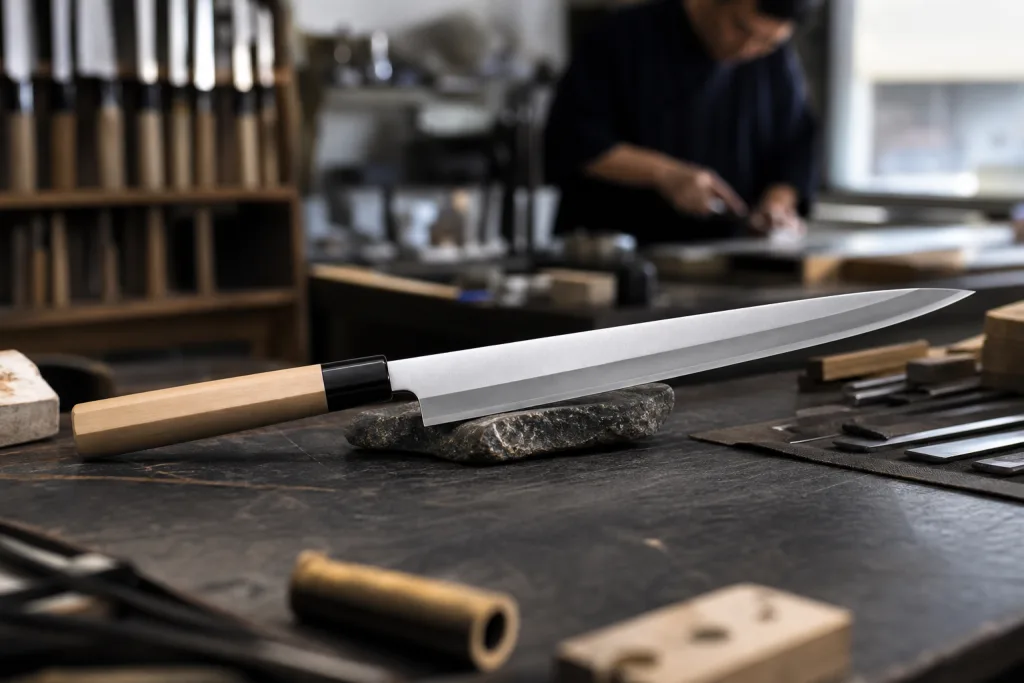
The knife grinding process is the point where a stamped or forged blank turns into something a buyer can judge in five seconds. If the bevel runs 0.8 mm higher on the left side, the tip shows blue heat burn from the belt, or the edge angle shifts 3 degrees between batches, your brand gets the complaint, not the factory. QC pulled a chef knife sample last month with a clean mirror face but 1.2 mm thickness behind the edge. It looked good. It cut badly.
At TANGFORGE in Yangjiang, China, we see importers spend 14 days on handle color and carton artwork, then send a PO with one loose line: “sharp edge.” That spec is too thin for kitchen knives, pocket knives, hunting knives, or Damascus gift sets. We run the grinding line from blade geometry, thickness behind edge, HRC band, finish grade, inspection method, MOQ, and rework limit before mass production starts; otherwise the math doesn't work when 500 pcs need hand correction after final QC.
Why grinding controls buyer risk
Grinding is not just a workshop step. It is where buyer risk starts. The knife grinding process fixes cutting feel, left-right blade symmetry, safety at the edge, and how much hand work our packing team needs before carton sealing. If a buyer pushes the FOB down by USD 0.18 but keeps the same grind spec, the math doesn't work: we either run fewer passes on the belt grinder or accept more rejects at final QC.
For an importer, the wrong question is “Can you make it sharp?” A sample can be sharpened by one skilled worker in 6 minutes. The better question is “Can you keep 2,000 pcs within the same edge geometry, finish grade, and heat-control limits?” QC pulled a 50 pcs sample last month where 7 blades were sharp, but the bevel width drifted from 1.1 mm to 1.8 mm across the batch. That is where sourcing decisions become practical.
A kitchen knife with a 15 degree per side edge cuts different from one at 20 degrees per side. You can feel it. A hunting knife with a secondary bevel ground too thin may pass a paper-cutting video, then chip after the first field complaint. A pocket knife with an uneven plunge grind looks cheap even when the steel passes HRC testing. We have seen buyers lose repeat orders over a 0.6 mm visual mismatch near the choil.
At TANGFORGE in Yangjiang, Zhejiang, our export team asks for a drawing or control sample before final pricing on custom knife grinding process work. Photos help for a first estimate, but they do not protect tolerance on blade spine taper, hollow grind radius, swedge symmetry, or satin direction. One buyer once sent a PO with “same as sample” typed twice but no sample number; the grinding line waited 2 days because nobody could confirm the satin grain direction.
Grinding specs you should put in RFQ
A good RFQ separates the finish the customer sees from the geometry that makes the knife cut. We see 7 out of 10 first-time buyers write “mirror polish” or “stonewashed finish” and leave out edge angle, thickness behind edge, and flatness. That is the wrong question to ask. On the grinding line, a 0.35 mm behind-edge chef blade and a 0.65 mm behind-edge chef blade can both look clean under the LED bench lamp, but they cut and sharpen differently.
Your RFQ for knife grinding process OEM work should include these items:
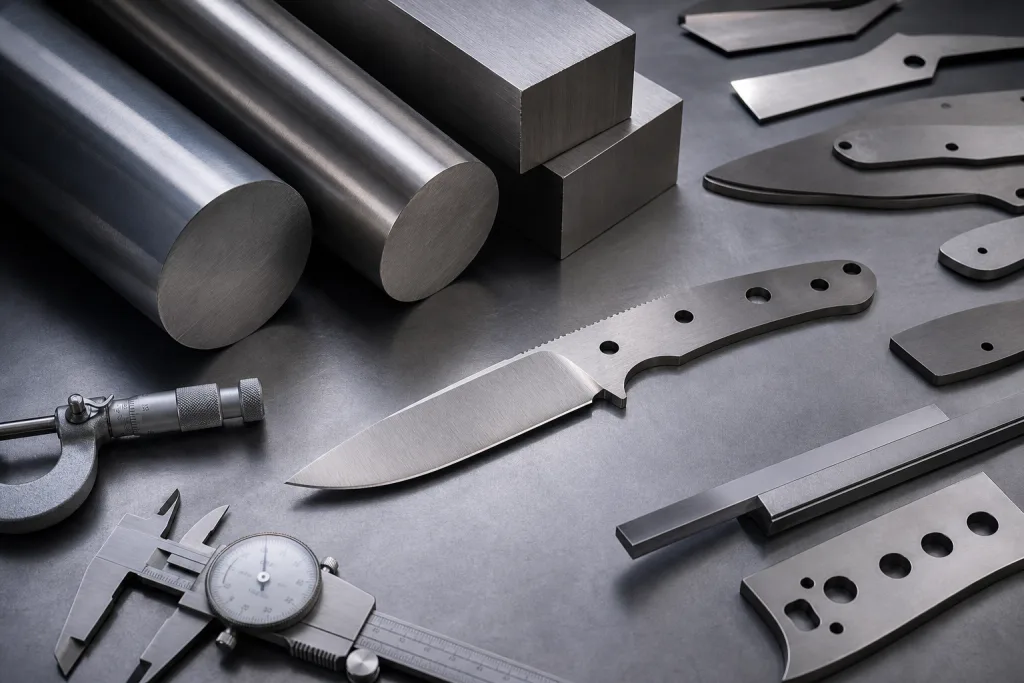
- Blade profile: CAD, DXF, or 1:1 PDF, with blade length and tolerance such as ±0.5 mm; our QC usually checks this with a digital caliper before approving the first 20 pcs.
- Primary grind: flat, hollow, convex, saber, Scandi, chisel, full-flat, or compound grind; name the grind and mark the grind height in mm if the bevel line matters on shelf photos.
- Edge angle: for example 15°±2° per side for chef knives or 20°±2° per side for outdoor knives; the buyer flagged it once when a PO said 15° total but the approved sample was 15° per side.
- Thickness behind edge: common values are 0.25-0.45 mm for kitchen knives and 0.5-0.8 mm for hunting knives; we run spot checks with a micrometer 3 mm above the edge.
- Surface finish: satin 400 grit, brushed 600 grit, bead blast, stonewash, mirror, black oxide, PVD, or acid-etched Damascus; send one finish master sample if your 400 grit means a long vertical brush, not a cross-brushed factory default.
- Hardness: target band such as 56-58 HRC for 1.4116, 58-60 HRC for 14C28N, or 60-62 HRC for some powder steels; QC pulled the sample after heat treatment before grinding, not after packing.
- Inspection limits: no visible burn marks, edge chips under 0.2 mm, bevel width difference under 0.5 mm unless design requires otherwise; write the AQL level if you do not want the merchandiser guessing at final inspection.
Do not rely on “same as sample” alone. Use the sample as a reference, then lock the numbers in writing. We have seen this go sideways when a courier lost the master sample, a new operator took over the belt grinder, or a reorder came 8 months later and the PO still had one typo in the steel code. Written specs protect repeat orders.
Common grind types and cost impact
Grind choice changes bench time, scrap rate, and the MOQ we can quote. On our 400 mm water-cooled belt wheel, a full-flat 8-inch chef blade holds a cleaner SOP than a hollow-ground tactical blade with a false edge and a sharp plunge line. Damascus is the one buyers underprice most; if the grinding line removes another 0.08 mm after etching, the pattern contrast goes flat or the lamination starts looking patchy.
This is the comparison we run with importers before quoting OEM cost. Prices move with steel grade and handle build; box style and surface finish also change the final FOB. The grinding adder is still real. We have seen this go sideways when a buyer approved a satin sample, then wrote “mirror” on the PO and expected the same USD 0.40 grinding allowance.
| Grind type | Typical product | Grinding difficulty | Approx. FOB grinding impact | Key QC risk |
|---|---|---|---|---|
| Full-flat | Chef knife; santoku SKUs | Medium | Base + USD 0.20-0.60 | Uneven distal taper |
| Hollow grind | Pocket knife; tactical blade | High | Base + USD 0.50-1.20 | Asymmetric bevel radius |
| Convex grind | Outdoor and hunting knives | High | Base + USD 0.60-1.50 | Over-thick edge |
| Scandi grind | Bushcraft knife | Medium | Base + USD 0.30-0.80 | Wide bevel scratch marks |
| Mirror polish | Gift sets; premium chef lines | Extra high | Base + USD 0.80-2.50 | Waves and pinholes |
For a normal 8-inch chef knife in 1.4116 or 5Cr15MoV steel, grinding and polishing usually sit at 15-25% of the FOB cost. Small EDC folders can run a higher percentage because the blade is short, but the plunge grind and swedge still need hand control under the 60-grit and 240-grit belts. QC pulled one sample last week at 0.45 mm behind the edge when the spec said 0.30 mm. If your target retail price is tight, tell the factory early. A practical factory can adjust the grit sequence or simplify the bevel, and mirror polish can mean 18 days instead of 12 days on a 1,000 pcs order.
MOQ, sampling, and production timing
Knife grinding process MOQ starts with the setup, not a price sheet. If we run an existing blade pattern in 3Cr13, 420J2, or standard 1.4116, 300-500 pcs per SKU is realistic because the blanking die and magnetic grinding fixture are already on the rack. A new custom blade that needs a dedicated grinding fixture or CNC profile tooling usually lands at 800-1,000 pcs. For Damascus, powder steel, or a multi-step mirror polish, the MOQ goes up because one overheated bevel on the 240# belt can turn a good blank into scrap.
At our Yangjiang, China factory, monthly capacity is about 180,000-220,000 knives depending on product mix, with about 240 employees across blanking, heat treatment coordination, grinding, handle assembly, inspection, and packing. A simple kitchen knife reorder ships in 35-45 days after deposit and artwork approval when the steel is in stock and the carton mark file is clean. A new OEM project usually needs 7-12 days for drawings, 15-25 days for samples, and 45-60 days for mass production after sample sign-off. Last month one PO had the SKU typed as 8-inch “santuko,” and QC held the packing label proof for 2 days. Small typo. Real delay.
Sampling should not be rushed. The first sample checks look and concept, mainly blade profile, handle feel, and whether the buyer’s photo brief matches the actual knife on the bench. The second sample, if needed, should lock production details such as 180#/400# belt sequence, 15° or 20° edge angle, logo depth in mm, handle gap under 0.2 mm, barcode position, and carton drop-test requirements. If your buyer in Europe or North America needs REACH, LFGB, FDA food-contact declaration, or Prop 65-related documentation, ask before deposit. Asking at shipment week is the wrong question to ask because the grinding line is already done and the paperwork team is chasing vessel cut-off.
For logistics, grinding specifications also change packing. A thin 12° per side Japanese-style edge needs stronger tip protection than a 20° outdoor edge because the point can punch through a loose PE bag during a 26-day sea shipment. We often recommend individual blade guards or molded trays for premium chef knives, and QC pulled the sample last quarter after finding 6 bent tips in a 200 pcs transit test carton. Saving USD 0.08 on inner protection is bad math if 2% of tips arrive bent after ocean freight.
QC checkpoints for ground blades
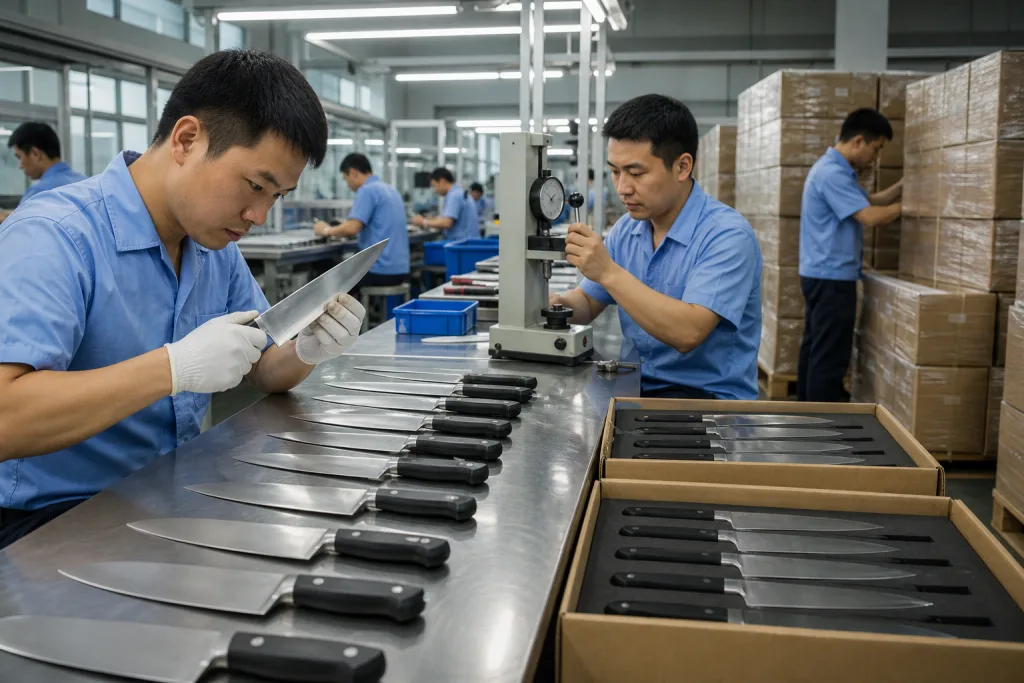
Grinding QC has to happen before final assembly, not after packing. Once the handle is riveted or a folder is pinned together, a 6 mm blade scratch or heat tint near the edge turns into rework, not a quick touch-up. We run checks at blanking, after heat treatment, after rough grinding, after fine grinding, after sharpening, and before final packing; QC pulled 80 pcs from the grinding line last week before any scales were fitted.
For 1,000-5,000 pc import orders, we suggest an inspection plan close to this; our QC sheet stays beside the Rockwell tester and the 0.01 mm caliper, not in the office:
- Incoming steel: grade certificate check against the PO steel code, thickness check at 3 blade positions, visual rust and pitting check under bench light.
- Post heat treatment: HRC test, usually 3-5 pcs per batch minimum; for VG-10 or other premium steel, we test 8 pcs and record blade position.
- Rough grinding: profile tolerance within the approved drawing, warp on a flat plate, plunge line height, scratches deeper than 0.10 mm, and overheating marks at the edge.
- Fine grinding: grit direction matched to the golden sample, bevel symmetry left vs right, spine finish, tip shape, and logo area flatness before laser marking.
- Sharpening: edge angle by gauge, burr removal by cotton-swipe check, cutting test on paper or rope, and random edge retention test for repeat retail SKUs.
- Final inspection: AQL 2.5 major defects, AQL 4.0 minor defects, carton count, barcode scan, FNSKU match, and packaging damage after the drop corner check.
Burning is the grinding risk that causes the nastiest arguments. If the edge turns blue, brown, or straw-colored, that spot has likely lost hardness. On low-price orders, some workshops polish the color away; we have seen this go sideways when the buyer flagged soft edges during an Amazon return review. Your spec should state that visible heat tint at the cutting edge is a major defect, and hardness failures outside the approved HRC band require segregation and root-cause review.
For higher-grade programs, add CATRA cutting tests or rope-cut tests, but do it with a budget in mind. A CATRA slot adds about 2 days vs a same-day paper cut check, and the math does not work for every $1.20 promotional knife. Use it for hero SKUs and repeat retail orders where one dull batch would hurt the brand.
Price drivers buyers often miss
Buyers compare two quotes and call the lower one better negotiation. Sometimes yes. Most times, this is the wrong question to ask. On our grinding line, a quote can drop USD 0.18-0.35 per chef knife if the supplier skips the second belt pass after 240 grit or leaves out hand deburring with a ceramic rod. The difference between 240 grit satin and 600 grit satin is visible under a 600 mm inspection lamp. The difference between machine sharpening only and hand deburring shows up when your customer cuts tomatoes or double-wall cardboard.
Main grinding price drivers are the belt sequence and the minutes spent by hand, then edge angle tolerance, blade hardness, scrap allowance, cosmetic grade. A hard blade at 60-62 HRC holds an edge better, but we burn through more belts and QC sees more micro-chips at the heel during sharpening. Last month QC pulled 32 pcs from a 500 pcs pilot run because the left bevel was 2 degrees wider than the right. A mirror finish also needs repeated polishing and buffing; any pin pit in the steel looks bigger after the felt wheel, not smaller.
For a mid-range chef knife program, a realistic FOB spread might look like this: standard satin finish at USD 4.20-5.80, upgraded 600 grit satin at USD 4.60-6.40, and mirror or premium hand finish at USD 5.50-8.50 before special packaging. We usually run 12 days for standard satin after deposit, versus 18 days for mirror finish if the MOQ is 1,000 pcs. The math does not work if a buyer asks for mirror finish at the satin price, then rejects 3 hairline marks per blade during inspection. For folding knives, blade grinding cost often sits inside the assembly price because detent feel, pivot action, lock-up, and blade centering all depend on the ground blade blank.
DDP pricing hides risk. If you ask for DDP to Amazon warehouses, confirm whether inspection, FNSKU labeling, carton strength, customs duty, and last-mile delivery sit inside the number. We have seen this go sideways when a PO typo listed 5-ply cartons but the buyer expected 7-ply for a 14 kg master carton. A factory can support DDP through freight partners, but FOB China gives a cleaner read on manufacturing cost. Use FOB for factory evaluation, then price freight as a separate line.
How to brief a China grinding factory
A sharp brief beats another 3% price fight. Send the factory 8 things: target customer, annual forecast, target FOB, required certifications, product drawing, reference sample, packaging plan, and inspection standard. If you are moving from another supplier, say the real reason. Edge chipping after 200 cuts, satin lines not straight under 600-grit belt inspection, HRC drifting by 2 points, delivery slipping 12 days vs 18 days, or Amazon returns above 4% all point to different fixes. We run better when the problem is named.
For knife grinding process factory China sourcing, ask how the grinding line controls people and fixtures. Hand grinding still depends on the operator’s wrist, but a bevel template, digital caliper check, written process card, and first-piece sign-off keep the batch from wandering. At TANGFORGE, production teams in Yangjiang work from approved samples and process cards for OEM orders, especially where 0.5 mm bevel width, logo position, and handle fit affect the brand look. QC pulled the sample before lunch, not after packing.
Be careful with over-specification. Asking for ±0.1 mm on a low-cost stamped kitchen knife is the wrong question to ask; the math does not work once the grinding time passes 45 seconds per blade. The quote rises, or the factory walks away. Accepting ±1.0 mm on a premium fixed blade bevel creates the opposite problem: the knife looks loose even if it cuts fine. We have seen this go sideways when the PO says “premium finish” but the drawing gives no bevel tolerance.
The best import projects start with a signed golden sample and a tolerance sheet the inspector can measure with a 150 mm caliper. Then MOQ, price, QC, and lead time turn into an engineering talk instead of a fight during pre-shipment inspection. Simple works. That is the difference between buying 3,000 knives once and building a repeatable knife program from China.
Frequently asked questions
For an existing TANGFORGE pattern, expect 300-500 pcs per SKU if the steel, handle, and finish are standard. For a new custom knife grinding process with dedicated blade profile, fixture setup, or unusual finish, 800-1,000 pcs is more realistic. Damascus, mirror polish, or powder steel may need higher MOQ because scrap cost is higher. If you are testing a new market, start with 1-2 SKUs instead of spreading 1,000 pcs across 8 designs. That gives the factory enough volume to stabilize grinding and gives you cleaner sales data.
Use measurable terms instead of saying “very sharp.” Define edge angle, thickness behind edge, burr removal, and test method. For example, an 8-inch chef knife could be 15°±2° per side, 0.30-0.45 mm behind edge before sharpening, no continuous burr over 5 mm, and pass a paper slice or tomato skin test. For premium SKUs, you can add CATRA or controlled rope-cut testing, but it adds cost. Keep one approved golden sample at your office and one sealed sample at the factory for comparison.
Major defects should include visible heat burn near the cutting edge, edge chips above your limit such as 0.2 mm, warped blades, cracked tips, unsafe burrs, wrong blade profile, wrong grind type, and HRC outside the approved band. For most import inspections, AQL 2.5 for major defects is practical. Minor defects can include light cosmetic scratches, small satin direction variation, or tiny polish marks if they do not affect function. Put defect photos into the QC file so the inspector, factory, and buyer judge the same way.
No. Higher HRC can improve edge retention, but only if the steel, heat treatment, grind, and use case match. A 60-62 HRC chef knife may perform well with a thin edge, but a hard outdoor knife with a very thin edge can chip under impact. Many mass kitchen knives are 54-58 HRC because they need toughness, easier sharpening, and stable cost. For premium chef knives, 58-62 HRC is common. Your factory should recommend HRC together with edge angle and blade thickness, not as a single marketing number.
For a new OEM knife, allow 7-12 days for drawing review and process planning, then 15-25 days for samples depending on steel and finish. After sample approval, mass production normally takes 45-60 days. Reorders of standard kitchen or outdoor knives can be faster, often 35-45 days after deposit and packaging approval. If you require LFGB, FDA, REACH documents, custom packaging, FNSKU labeling, or third-party inspection, add those requirements at the RFQ stage. Late changes to grind geometry can reset the sampling clock.
Send your blade drawing for grinding review
Share your target FOB, MOQ, steel, HRC, finish, and sample photos. Our Yangjiang team will check manufacturability before you commit tooling money.
Request a Quote