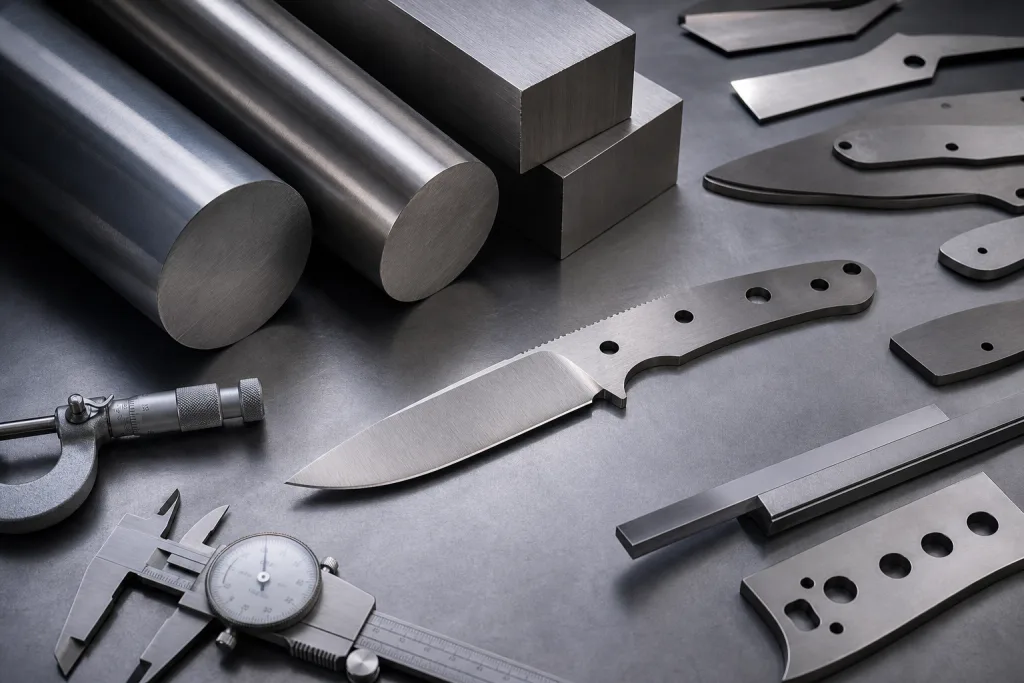
Most buyers ask about steel first. Fair question. But on the grinding line, steel is only half the story. A 1 mm change at the spine, a 0.3 mm thick spot behind the edge, or a washed-out heel transition can turn “premium blade” into a return claim. We’ve seen this go sideways when the PO says “thin grind” but the drawing gives no spine taper or bevel width, so QC pulled the sample and the buyer flagged cutting feel after the first carton was packed.
At TANGFORGE in Yangjiang, Zhejiang, China, we treat grinding as an engineering control point, not a polishing step. Our factory was established in 2008, has about 240 employees, and supports OEM/ODM programs for kitchen, chef, pocket, hunting, tactical and Damascus knives. We run belt grinders, surface wheels and final edge fixtures by spec sheet, not by guesswork. Typical production capacity is 180,000 to 220,000 units/month depending on handle type, finishing and inspection level, and the math doesn’t work if a buyer locks MOQ but leaves grind tolerance open until pre-shipment inspection.
Why grinding controls knife performance
Grinding is where a hardened blank turns into a cutting tool. Heat treatment gives the steel its hardness band, for example 56-58 HRC for German-style kitchen knives we run in 5,000-piece batches, or 58-60 HRC for 8Cr13MoV pocket knives. On the floor, the Rockwell tester only tells us the steel is hard enough. The grinding line decides how that hardness meets food, rope, cardboard, hide or wood.
For a buyer, this is the wrong question to ask: “Is it sharp?” Two knives can use the same steel, handle and color box, then cut like different products because the blade geometry changed. Spine thickness, distal taper, primary bevel angle, behind-the-edge thickness and final sharpening angle all matter. A chef knife at 2.2 mm spine and 0.25 mm behind the edge cuts differently from one at 2.8 mm spine and 0.45 mm behind the edge, even if both claim 58 HRC. We check those points with a digital caliper at 30 mm, 80 mm and 150 mm from the tip.
A knife grinding process manufacturer China buyers can rely on should talk geometry before quoting. If a supplier only says “we make it sharp,” push for numbers. Ask whether grinding is done by CNC, semi-automatic wheel, belt grinding, water-cooled grinding or hand finishing. Each method changes tolerance, cost and reject risk. We have seen this go sideways when a buyer approved a drawing with no behind-edge spec, then flagged the first 300 pcs because the knife felt too heavy in onions.
At our knife grinding process factory China setup in Yangjiang, China, production engineers normally freeze three reference samples before mass production: visual master, geometry master and packaging master. The geometry master gets ignored too often. Do not skip it. It should define spine taper, bevel height, edge thickness and visual grind line position. Once that sample is approved, QC pulled the sample from the rack and measures against it, instead of arguing over whether the grind line “looks right” under the inspection lamp.
Grinding methods and buying trade-offs
No grinding method wins every job. The right call depends on blade category, target shelf price, steel, order size, and tolerance. A $4.80 FOB promotional paring knife should not be built like a $38 FOB full-tang forged chef knife. We see this go sideways when a buyer asks for a premium convex edge on a 3,000 pcs promo run; the math does not work after the grinding line adds 0.6-0.8 mm stock removal control and extra QC time. Over-specifying burns margin. Under-specifying brings returns.
| Grinding type | Typical use | Buyer benefit | Main risk |
|---|---|---|---|
| Flat grind | Chef, santoku, outdoor blades | Stable cutting control with repeatable bevel height | QC will catch visible left-right asymmetry if fixtures drift by 0.5 mm |
| Hollow grind | Pocket, hunting, tactical knives | Sharp bite at first cut with lower blade weight | Thin edges chip faster when hardness sits near the upper HRC limit |
| Convex grind | Outdoor, hunting, heavy-use knives | Better edge support for chopping and impact work | Needs more hand belt work, so unit cost rises on small MOQ orders |
| Scandi grind | Bushcraft and utility knives | Simple sharpening story for retail staff and end users | Wide bevel scratches show up fast under 600 grit inspection light |
| Double bevel kitchen grind | Western kitchen knives | Familiar 15-20° per side edge for kitchen buyers | Behind-edge thickness must stay controlled, usually within the signed sample range |
CNC grinding gives better repeatability on larger orders, mainly when blade profiles stay consistent. It is not magic. Tooling, wheel dressing, coolant flow, and operator setup still decide the result. We run CNC on stable profiles, then still check the heel and tip with a caliper because a 0.2 mm miss near the plunge can fail a buyer’s golden sample review. Semi-automatic and manual belt grinding remain common in China because knife designs often need flexible touch-up around heel, tip, and plunge areas.
For a custom knife grinding process, we ask buyers to define where the knife must perform. A kitchenware distributor may care about food release and low cutting resistance, so we check behind-edge thickness before polishing. An EDC brand may push for tip strength and edge retention; QC pulled one sample last month because the tip overheated and showed color change after belt grinding. A hunting importer may prefer a slightly thicker edge to survive bone contact. Same factory. Different spec sheet.
Specs you should put in the RFQ
A serious RFQ needs more than steel grade and order quantity. If grinding is left open, we quote against our standard route on the grinding line, usually the same jig and belt sequence used for the last 3 similar SKUs. The lowest price is often the least controlled blade geometry. That does not mean the factory is cheating. The buyer just left a blank space on the PO.
For kitchen knives, specify blade length tolerance, spine thickness at heel and mid-blade, distal taper target, bevel type, behind-the-edge thickness before sharpening, final edge angle, and finish direction with grit. Use numbers we can check with a digital caliper. For example: 8 inch chef knife, 2.4 mm spine at heel ±0.15 mm, 1.6 mm mid-blade ±0.15 mm, 0.28-0.35 mm behind edge before sharpening, 15° per side final edge, 58±1 HRC, vertical satin 400 grit. QC pulled one chef sample last month at 0.52 mm behind the edge; it looked fine in photos, but the buyer flagged it as “too wedgy” after tomato cutting.
For pocket or hunting knives, add plunge grind position, ricasso width, swedge requirement, lock clearance, and the edge test you expect. Name the test. Paper cut, rope cut, or a CATRA-style internal check needs its own pass rule, not a marketing line like “razor sharp.” We’ve seen this go sideways. A better standard is simple: each sample must cleanly slice 80 gsm copy paper after 3 cuts on corrugated board, checked before oiling and packing.
Packaging and compliance tie back to grinding more than buyers expect. If you claim food contact compliance, confirm blade coatings, polishing compound, and the cleaning process match LFGB, FDA or REACH requirements where applicable. On one blister-pack job, a sharp exposed tip punched through after a 1.2 m drop test because the tip grind was 0.18 mm thinner than the approved sample. The packaging supplier blamed the tray. The math did not work.
One practical note: do not set tolerances tighter than the price level supports. A ±0.05 mm grinding tolerance on a low-cost stamped kitchen knife sounds professional, but it creates rework, sorting fees, and 12 days of delay versus a normal 3-day inspection window. This is the wrong question to ask if the MOQ is 1,000 pcs and the target price is under USD 2.00. A useful OEM drawing separates critical dimensions from cosmetic preferences, so our QC team knows where to spend time with the caliper and where a visual AQL check is enough.
MOQ, tooling and price reality
Knife grinding process MOQ depends on blade shape, steel grade, finish, and whether we already have the fixture on the rack. For a standard chef knife or pocket knife profile, TANGFORGE usually starts OEM sampling at 50-100 pcs and mass production around 300-500 pcs per SKU. If the drawing calls for a new forged bolster, a new lock structure, a fixed Damascus pattern, a PVD coating, or a dedicated CNC fixture, MOQ moves to 800-1,200 pcs per SKU. We run this check against the 2D DXF and one 3.0 mm test blank before quoting.
Buyers ask why every custom knife cannot start at 100 pcs. Setup loss is the reason. Before the grinding line settles down, the team adjusts the fixture, dresses the wheel, tests belt grit from 120# to 400#, checks the first samples with a digital caliper, and briefs the operator on the bevel target. On a complex grind, the first 30-80 blades may go into tuning appearance and geometry. The buyer flagged this last month on a 60 pcs trial order, but the math does not work when 42 blades are spent before the finish looks stable.
Price movement is real. A basic stamped kitchen knife with standard flat grind may be FOB China $2.20-$5.50 depending on steel and handle. A full-tang chef knife with controlled taper, hand satin finish, and gift packaging may be $8.50-$22.00 FOB. A folding knife with hollow grind, stonewash, liner lock, and G10 handle may sit around $7.50-$18.00 FOB. Damascus chef knives can range widely, often $18.00-$55.00 FOB depending on core steel, layer count, handle material, and final hand work. We once had a PO typo that changed “matte bolster” to “mirror bolster”; QC pulled the sample, and the quote had to move because mirror polishing added another pass at the buffing wheel.
Grinding can move cost by 8-25%. More hand blending at the heel, tighter bevel symmetry, mirror polish, convex edge, or a secondary swedge adds labor and raises reject risk. DDP pricing includes ocean or air freight, import duty, customs brokerage, and local truck delivery, so compare FOB with FOB first. If one China supplier is 18% lower than the others, check whether they cut grinding steps, shortened inspection time, or used thinner packing foam. We have seen this go sideways when AQL 2.5 inspection found uneven bevels after the cartons were already taped.
QC risks buyers usually miss
Grinding defects do not always show in catalog photos. A knife can sit nicely on a white background and still fail the onion test. We have seen buyers approve 2 good-looking samples, then ask why the 3,000 pcs bulk order feels wedgy. The wrong question is “does it look like the sample?” QC pulled the sample and measured 0.65 mm behind the edge; bulk was running 0.95 mm. Visual matching alone sends the grinding line in the wrong direction.
The grinding risks we watch are burnt edges, left-right bevel mismatch, thick edges, wavy grind lines, weak tips, and satin scratches near the logo. Overheating is the costly one because it pulls hardness out of the cutting area. A blade can test 58 HRC on the flat and still have a soft edge if the belt was run dry or pressed too hard on a 240-grit pass. Blue or straw color is a warning sign. Polishing can hide it.
Asymmetry hits performance and brand feel at the same time. On chef knives, a 1.5 mm bevel-height difference near the heel makes the knife look cheap in the buyer’s hand. On folding knives, an off-center grind makes the blade drift during carton cutting. On hunting knives, over-thinned bellies and needle tips come back as warranty photos after field use. We have seen this go sideways when a buyer approved the profile drawing but never asked for bevel-height tolerance.
We run grinding QC in three layers, because one final check is too late. Inline operators check every 30-50 pcs for bevel position and heat marks, using a marked sample blade at the machine. Production QC checks by caliper and angle gauge, usually 5-10 pcs per 500 pcs at each grinding stage. Final inspection follows AQL 2.5 major / 4.0 minor, with a separate functional sampling plan for sharpness and edge consistency. If the edge thickness drifts after heat treatment, the math does not work.
For importers, the purchase order should name the reject categories clearly. Major defects can include burnt edge, wrong grind type, edge chips over 0.3 mm, blade warp over 1.0 mm, unsafe burrs, loose handle, lock failure, or wrong HRC band. Minor defects can include small satin line variation, light cosmetic scratch outside the logo area, or packaging scuff. One buyer once wrote “satin finsh OK” on the PO, typo included, then flagged every visible line at inspection. Clear wording prevents the old argument: factory says cosmetic, buyer says unsellable.
Sampling workflow before mass production
A clean knife grinding process OEM project usually needs three sample rounds, not one. Round one checks the idea: blade profile, handle grip, rough geometry and carton direction. Round two locks the engineering details, including final steel, heat treatment, grind height, surface finish, logo position and assembly fit. Round three is the pre-production sample from the same laser cutting program, fixture and grinding line planned for bulk production. Skip this and we’ve seen it go sideways.
For standard products, sampling can take 7-12 days. For custom blades requiring new laser cutting program, CNC fixture, mold adjustment or Damascus material scheduling, allow 18-35 days. Mass production is usually 35-55 days after deposit and approved pre-production sample, depending on order size, peak season and packaging complexity. Around Q3, 40-60 China knife factories we deal with are building stock for holiday retail, so add buffer if your delivery window is fixed. One buyer once asked for 12 days vs 18 days on a new CNC handle fixture; the math did not work.
During sampling, ask for measurement photos, not beauty shots. A useful sample report includes spine thickness, blade weight, HRC reading, bevel height, behind-edge thickness, edge angle and packaging weight. For folding knives, also include blade centering, lock engagement percentage, detent feel and opening force if relevant. QC pulled the sample with a digital caliper at 0.01 mm resolution, because a nice photo cannot show a 0.35 mm behind-edge mistake.
Do not approve a sample just because the handle looks good. If the grind is too thin, it can pass your desk test and fail in the field. If it is too thick, it can survive abuse but collect bad reviews for cutting performance. The buyer’s job is to choose the correct compromise for the retail promise. This is the wrong question to ask: “Is it sharp?” Ask whether the grind matches the use case, whether that is a camp knife, chef knife or EDC folder.
At TANGFORGE in Yangjiang, Zhejiang, we keep signed golden samples and digital QC sheets for repeat orders. That matters when you reorder after 6 or 12 months and need the same grind line, not a similar one. For distributor programs with multiple SKUs, this documentation beats a small one-time price discount. We run the old golden sample beside the new batch, and if the buyer flagged a PO typo like “satin” vs “stonewash,” the QC sheet saves the argument.
How to qualify a grinding factory
Before you talk price with a knife grinding process factory China supplier, ask how the blade moves through the line. This is the wrong question to ask first: “What is your best MOQ?” Ask where heat treatment sits, whether straightening is checked at 0.3 mm tolerance, what coolant hits the belt, how often the 240# and 600# belts are changed, and who signs off the final edge. On our grinding line, QC pulled 12 chef knife samples last week because the left bevel was 0.6 mm wider than the right.
Factory audits help when the risk matches the order. ISO 9001, BSCI, REACH documentation and food-contact testing matter for European and North American buyers, especially when the handle, coating, or packing touches food rules. Certificates do not grind a straight bevel. We have seen a clean audit room and still found 7 uneven tips in a 125 pcs inline check because the buyer’s PO only said “sharp edge” with no bevel width or finish sample.
Ask for production evidence: inline QC records, HRC reports, sample retention photos, AQL inspection forms and previous export packaging examples. If you sell on Amazon or chain retail, confirm barcode and FNSKU size, carton drop test height, master carton strength at 5-ply or 7-ply, and warning label position before mass production. Small detail, big mess. One buyer flagged a typo on the PO, “FNSK” instead of “FNSKU,” and the packing team almost printed 3,000 wrong labels before QC caught it at the packing table.
Payment terms and inspection timing matter. A normal structure is 30% deposit and 70% before shipment after inspection. For new suppliers, do not skip pre-shipment inspection to save $200-$350. The math does not work. If your order is 3,000 pcs and the bevel geometry is wrong, rework can run 10-20 days, sometimes 12 days vs 18 days depending on belt stock and handle assembly, and the satin finish may still show double grinding marks under a 600-lux inspection lamp.
A good supplier pushes back when your specification fights the knife’s use. If you request 61 HRC on a thin outdoor knife edge for heavy chopping, we should talk about chipping before we run steel. We ship hard blades, but not magic blades. Last season a buyer wanted a 0.25 mm edge on a camp knife, and the sample passed paper cutting but chipped after 30 wood strikes in our bench test.
Frequently asked questions
For standard kitchen, outdoor or pocket knife models, a realistic knife grinding process MOQ is usually 300-500 pcs per SKU. If you use an existing blade profile and standard grind, sample cost and setup loss stay manageable. For custom blade geometry, dedicated CNC fixtures, forged bolsters, special coatings or Damascus steel, MOQ often rises to 800-1,200 pcs per SKU. Very small runs of 100 pcs are possible in some cases, but unit cost can increase 15-40% because grinding setup, QC and packaging work are spread over fewer pieces. If you are testing a new market, start with one or two SKUs instead of forcing five low-volume SKUs.
Include spine thickness at the heel and mid-blade, blade length tolerance, grind type, bevel height, behind-the-edge thickness before sharpening, final edge angle, HRC band and surface finish grit. For an 8 inch chef knife, a practical spec could be 2.4 mm spine at heel ±0.15 mm, 0.28-0.35 mm behind edge, 15° per side final sharpening and 58±1 HRC. For folding knives, add plunge line position, swedge details, blade centering and lock engagement. If you do not have drawings, send a physical benchmark sample and allow the factory to create a measured spec sheet before quoting mass production.
Grinding affects FOB price through labor time, fixture cost, abrasive consumption, reject rate and inspection workload. A standard flat grind on a stamped kitchen knife is relatively efficient. A convex grind, deep hollow grind, mirror finish or hand-blended heel can add 8-25% to the blade cost. Tight symmetry requirements also increase rework. For example, a chef knife that costs $9.80 FOB with standard satin finishing may move to $11.20-$12.50 FOB if you require finer hand satin, thinner behind-edge geometry and stricter visual matching. Always compare quotes with the same grind specification, not just the same steel grade.
Yes, you can catch many problems with simple tools. Use a caliper for spine thickness and behind-edge checks, an angle gauge or microscope for edge angle, a flat plate for warp, and consistent paper or cardboard cutting tests for sharpness. For hardness, you still need an HRC tester or third-party lab. A practical incoming check for importers is 5-10 pcs per SKU: measure spine, inspect bevel symmetry under strong light, cut 80 gsm paper, check for burrs and look for heat discoloration near the edge. For large shipments, use AQL 2.5 major / 4.0 minor plus special functional checks.
For existing blade profiles with minor grinding changes, samples usually take 7-12 days after confirming specs. For a custom knife grinding process with new blade shape, fixture work, heat treatment trial or special surface finish, plan for 18-35 days. Mass production normally takes 35-55 days after deposit and approved pre-production sample. Add another 5-10 days if you need third-party testing for LFGB, FDA, REACH or retail packaging validation. During peak export season in China, especially before holiday retail deadlines, build in a buffer instead of assuming the shortest quoted lead time will hold.
Send Us Your Grinding Specs
Share drawings, target MOQ, steel, HRC band and benchmark samples. We will review geometry, cost drivers and QC risks before quoting your OEM knife order.
Request a Quote