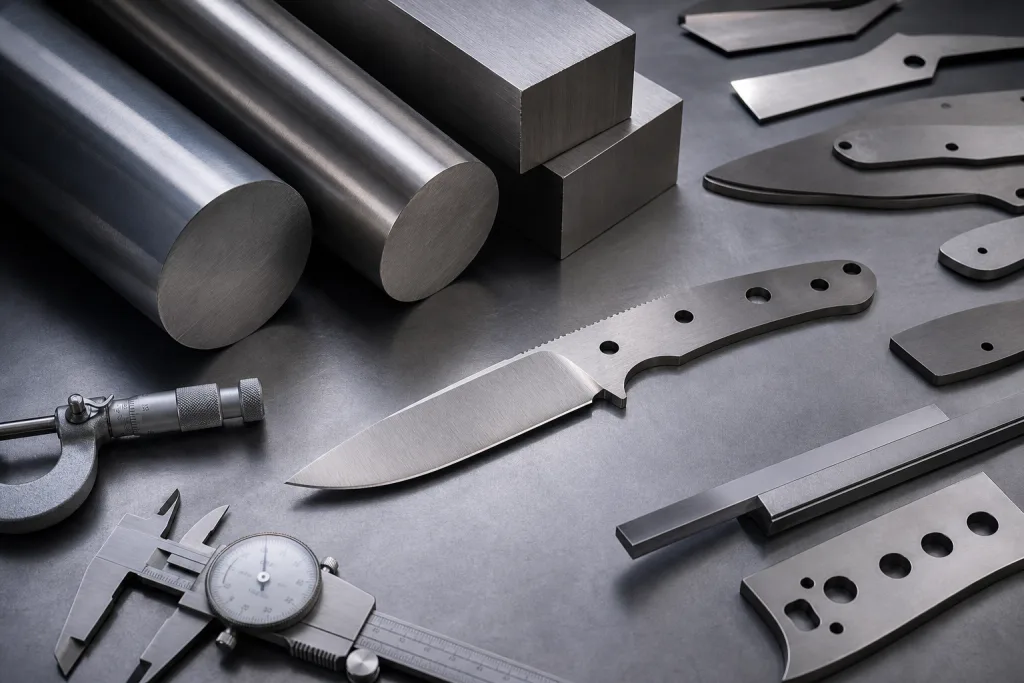
Heat treatment is the point where a private label knife order becomes saleable stock or a warranty claim in a good gift box. You can sign off the steel grade, handle shape and logo, but if QC pulls a blade at 54 HRC when the spec says 56-58 HRC, the end user only sees weak edge retention or chipped tips. The math does not work.
At our Yangjiang, Zhejiang export office and on the China factory floor, the best buyer specs stay practical. We run better with steel grade, HRC band, blade thickness in mm, quench and temper requirements, Rockwell test points, sample approval rules and the reject plan written on the PO; last month a buyer flagged a PO typo showing 1.8 mm on the drawing but 2.0 mm in the spec sheet. For knife heat treatment OEM orders, we normally discuss MOQ from 300 to 1,000 pieces per SKU, depending on steel and construction.
Why heat treatment belongs in your RFQ
About 7 out of 10 RFQs we see list steel grade, blade length, handle material, logo method and target FOB price, then skip heat treatment. The factory then runs its standard furnace recipe. Sometimes that passes. Sometimes it gives you a knife that looks right on the carton label but misses the job, especially if your sales claim is edge retention, toughness or outdoor use. QC pulled one 200-piece pre-shipment sample last month: logo, packing and blade length were correct, but hardness ranged 54 HRC to 59 HRC on the Rockwell tester.
A knife heat treatment private label specification belongs beside your drawing and BOM. It tells the knife heat treatment factory China team what performance you are buying, not just what shape you want. 5Cr15MoV at 54-56 HRC is a different product from 5Cr15MoV at 57-59 HRC. The second cuts 18 sheets versus 12 sheets in our simple paper-strip check, but it chips faster if the edge is ground at 12° per side or the temper cycle is shortened to catch a vessel date.
For kitchen knives, the wrong question is “what is the maximum hardness?” Tie hardness to edge angle and steel first. For pocket, hunting and tactical knives, we see the opposite problem: the buyer asks for toughness, then puts a high HRC target on the PO because a competitor’s retail page shows that number. We can hit the number. The math still doesn’t work if a 2.2 mm D2 blade gets a thin hollow grind and the buyer expects batoning photos with zero returns.
In Yangjiang, China, our production team treats heat treatment as a controlled process, not a catalog slogan. For standard private label chef knives, a realistic production band may be 56-58 HRC for X50CrMoV15 or 58-60 HRC for 9Cr18MoV. For D2 outdoor knives, 59-61 HRC is common, but the final call depends on blade thickness, grind, intended cutting and return tolerance. We run furnace charts by batch, check HRC near the heel and mid-blade, and flag any PO that says “59-61 HRC” in one line and “easy sharpening for supermarket users” in the next.
What your specification must include
A workable specification is short, measurable, and stapled to the purchase order file before we run the furnace lot. “Good heat treatment” and “high hardness” fail at the HRC bench because QC has nothing to record. Give us numbers, test points, and the rule for pass or fail; last month one PO even said “58 HCR,” and the buyer flagged it only after QC pulled the sample.
For most private label programs, include these fields:
- Steel grade: name the standard, such as 1.4116, 8Cr13MoV, 9Cr18MoV, AUS-10, D2, 14C28N or 67-layer Damascus with the core steel stated, because 20 cartons of mixed steel cannot share one furnace recipe.
- Target hardness: use a clear band, for example 57-59 HRC, and state the test position, such as blade flat 15 mm above the edge or the spine area near the logo.
- Blade geometry: give spine thickness in mm, grind type and edge angle; a 1.8 mm chef blade at 15° per side behaves differently from a 3.5 mm outdoor blade after hardening.
- Process requirement: state vacuum heat treatment, salt bath, oil quench, cryogenic step or standard furnace only where the steel needs it, not because a catalog line sounds premium.
- Inspection plan: set sample size, HRC tester type, visual check, straightness tolerance and cutting test method; we normally record Rockwell readings before the grinding line takes the batch.
- Failure rule: define whether a hardness miss means sorting, rework, replacement or batch rejection, so nobody argues after 3,000 pcs are packed.
Do not over-specify the process unless you understand the trade-off. Asking for cryogenic treatment on a budget 3Cr13 promotional knife is the wrong question to ask; the math does not work when the MOQ is 1,200 pcs and the retail price is fixed. Pushing 61-62 HRC on a thin 8Cr13MoV kitchen knife can also go sideways, with chipped-edge returns after the first tomato test. Define the cutting life, corrosion need, and breakage limit, then let the knife heat treatment OEM engineer confirm the route that survives production.
At TANGFORGE, we keep the pre-production master sample, hardness report, and production inspection sheet in the same job folder, with the first HRC record checked before handle assembly. Our standard capacity is around 280,000 knives per month across kitchen lines and outdoor or pocket knife lines, but furnace scheduling still follows steel family. Mix 6 steels in one small order and lead time moves fast: a clean 8Cr13MoV batch can ship in about 12 days, while mixed D2, 14C28N and Damascus lots often push closer to 18 days. We have seen this delay surprise buyers more than the MOQ itself.
Typical HRC bands by knife category
Hardness has to fit the user, steel grade and claim risk. For a restaurant chef knife, we run the edge through daily board-contact thinking: 18-20° per side, wet-grind finish, no tiny chips after the chop test on PP board. A hunting knife needs edge holding, but the tip still has to survive side load. A tactical fixed blade will get used for prying even when the insert card says “no prying.” We’ve seen this go sideways when a buyer copied 60-62 HRC from a premium sample and put it on a 5Cr15MoV mass-order PO.
| Knife type | Common steels | Practical HRC band | Buyer note |
|---|---|---|---|
| Budget kitchen knife | 3Cr13, 420J2 | 52-55 HRC | Low cost and quick sharpening, but edge life is short after 2-3 weeks of home use |
| Mid-range chef knife | 1.4116, 5Cr15MoV | 55-58 HRC | Safe band for retail sets and hotel kitchens; QC should check 3 blades per carton lot |
| Premium kitchen knife | 9Cr18MoV, AUS-10, VG10 core | 58-61 HRC | Needs tighter edge inspection, tip guards and sleeve packing so the bevel is not knocked in transit |
| Pocket knife | 8Cr13MoV, 14C28N, D2 | 57-61 HRC | Check lock-up, blade centering and closing rub marks, not hardness alone |
| Hunting or tactical knife | 420HC, 440C, D2 | 56-61 HRC | Temper color, tip toughness and sheath fit matter as much as the Rockwell number |
These ranges are sourcing starting points, not factory law. If the target is FOB USD 3.20 per kitchen knife at 1,200 pcs MOQ, do not write a heat-treatment spec that belongs to a USD 18.00 knife. The math doesn’t work. If you are selling a premium D2 field knife, don’t accept “56-60 HRC” just because the quote looks clean; ask where QC will test, near the heel or mid-blade, and get that position written on the spec sheet.
The key issue is consistency. A batch running from 55 to 60 HRC gives you mixed reviews: one customer says easy sharpening, another says edge rolls, another sends photos with chips under a 10x loupe. QC pulled the sample, tested 5 points on the Rockwell machine, and the spread told the story. We prefer a 2 HRC window for established SKUs and a 3 HRC window for new steels or complex blades during first production.
MOQ and pricing impact
Knife heat treatment MOQ is a production number, not a sales trick. It comes from furnace loading, steel separation, fixture setup, quenching method, HRC testing time and small-batch variation. If your order is 120 pieces split across four steels and three hardness targets, the furnace rack sits half empty and the grinding line waits. The math does not work, so the factory charges more or rejects the split.
For private label sourcing, plan around these numbers. Standard kitchen knives using regular steels often start at 300 pieces per SKU when the handle and packaging are normal. Pocket knives and fixed blades usually start at 500 pieces per SKU because CNC machining, assembly fit and lock safety checks add setup time. Special heat treatment, special steel, Damascus billets or exclusive tooling often pushes MOQ to 1,000 pieces or more; last month one buyer flagged 200 pcs of VG-style steel with a custom bolster, and QC pulled the sample because the blade spine measured 0.4 mm over drawing.
Heat treatment cost is usually buried inside the FOB unit price, but the change still hits the quote. Vacuum heat treatment, cryogenic treatment, extra tempering cycles and added HRC checks can add roughly USD 0.15 to USD 1.20 per knife depending on blade size and steel. For a chef knife at FOB USD 8.50, that can pass. For a promotional knife at FOB USD 2.10, it kills the margin; we have seen buyers approve 58-60 HRC on the PO, then ask for 60-62 HRC after mass production starts.
Lead time changes too. A normal repeat kitchen knife order may run 35-45 days after deposit and sample approval. A custom knife heat treatment trial with new steel can add 7-15 days for sample heat treatment, lab checks and buyer sign-off. We run the sample blades through the hardness tester before color box artwork is locked. If you need DDP delivery to Amazon warehouses with FNSKU labels, do not finalize packaging before the heat treatment sample passes. Repacking 1,000 finished pieces after a hardness failure is expensive and slow.
The honest sourcing decision is simple: spend money where the end user feels it. For a chef knife brand, edge retention and corrosion resistance matter. For a gift set, safe packaging and clean appearance often beat chasing the top HRC number. This is the wrong question to ask if the buyer only says “harder is better”; a 61 HRC blade with poor temper control comes back as chipped-edge claims, and QC sees it first under the 10x loupe.
QC checks before mass production
Heat treatment QC starts before the mass batch goes into the furnace. A gold sample approved only for shape, logo position and handle color is not enough. We need a pre-production sample that has been hardened, tempered, ground on the same grinding line, sharpened to the target edge angle and tested like the final knife. QC pulled one sample last year that looked perfect, then measured 54 HRC on a Rockwell tester against a 58-60 HRC spec. The math doesn't work.
For new private label knife programs, we usually ask for these checks before mass production, even when the MOQ is only 1,000 pcs:
- HRC test on 3 finished sample blades from the first trial, taken from different positions in the furnace load.
- Blade straightness check after heat treatment and after final grinding, with warpage recorded in mm instead of “pass” only.
- Edge retention comparison using rope or cardboard; CATRA-style internal testing is better when the buyer has a retail claim on packaging.
- Tip drop or controlled impact test for outdoor and hunting knives, since thin tips fail fast when the temper is wrong.
- Corrosion check for stainless kitchen knives going to EU or North American retail, usually after logo marking and final cleaning.
During production, AQL 2.5 works for visual and fit defects: scratches, weak logo marking, loose handles, wrong packaging, blade centering problems. Hardness should not sit inside normal AQL only. If the approved band is 58-60 HRC and 2 tested blades show 55 HRC, that is not a minor defect. It is a heat treatment process failure, and we stop the batch before packing. We have seen this go sideways when a buyer only checked carton labels and found soft blades after Amazon returns started.
Our normal approach at TANGFORGE is to test 3-5 blades per heat treatment batch for standard steels, then increase the count when the order uses a new steel or a tight HRC band. We keep heat treatment batch records tied to production date, steel lot and SKU, not just a loose note in the QC file. On a 3,000 pcs kitchen knife order, that record can point back to one furnace load in 20 minutes instead of arguing for 12 days over email. That traceability matters when an importer asks six months later why one shipment had higher return rates.
For EU buyers, pair performance QC with compliance planning from the sample stage. REACH, LFGB or food-contact requirements can apply to PP handles, TPR grips, coatings, packaging inks or any food-contact part. Heat treatment will not fix a coating compliance failure. We ship better when the buyer sends the compliance checklist with the PO, not after QC finds the wrong ink code on the color box.
Common QC risks and how to control them
The heat treatment problems we see most are not dramatic failures. They are small misses that get expensive after 3,000 pcs land in the buyer’s warehouse. Soft blades bring bad reviews. Over-hard blades chip on frozen food or bone contact. Warped blades look like cheap stock when QC lays them on a granite plate. Mixed hardness in one shipment makes after-sales messy; we had one 8-inch chef knife order where QC pulled the sample and found 55 HRC, 58 HRC and 61 HRC in the same carton stack.
Soft blades usually come from the wrong furnace set point, short soak time, weak quench control or mixed steel lots. We control this by locking the steel grade on the BOM, asking for mill or supplier records on critical steels, and testing production blades, not only the pre-production sample. Over-hardness or brittleness often comes from light tempering or a buyer target that looks good on paper but fails in use. This is the wrong question to ask: “Can you make it harder?” The better spec is a working HRC band, then cutting and impact checks after tempering. On our line, QC uses the Rockwell tester after 2 temper cycles and still cuts rope or cardboard because the number alone does not tell the whole story.
Warping shows up fast on thin blades, long chef knives and complex profiles. A 240 mm gyuto-style blade is less forgiving than a 120 mm utility knife. If your drawing has a thin spine, sharp distal taper or laser-cut holes, ask the factory to confirm straightness tolerance before quoting, not after the deposit. We run finished blade straightness on a flat plate with a feeler gauge; a reasonable tolerance may be within 1.5-2.0 mm depending on length and style. We’ve seen this go sideways when the buyer approved the CAD shape but forgot to add straightness on the PO.
Another risk is rework after grinding. Heavy grinding can overheat the edge and damage the heat treatment in one local area. A single spine HRC test will miss that. Look for blue discoloration, uneven burr behavior and weak edge retention near the tip or heel. For premium SKUs, ask for edge cooling controls during grinding and sharpening; on the grinding line we check the water flow, belt condition and edge temperature by touch between passes. If the belt is worn and the operator pushes harder, the math doesn’t work.
The buyer-side control is documentation. Put the HRC band, inspection count, sample approval and rejection rule on the PO. Chat records are not enough. Before Chinese New Year, the line is full and people follow the PO first; we once saw “58-60 HCR” typed on a buyer PO, and QC flagged it before production because one typo can turn into 5,000 pcs of arguing.
How to brief your China factory
A good factory brief is short and usable. Send the 2D drawing, target retail market, FOB range, order quantity, steel choice, HRC band, packaging plan and compliance requirements in one email or one PO attachment. Please do not ask us to quote five steels, four handles and three hardness levels unless you will place a test order for those routes. The math does not work. Each extra route means the grinding line checks spine thickness again, the heat-treatment master confirms quench settings, and sales waits another 1-2 days before giving a price.
For a new knife heat treatment factory China project, your brief can be as simple as: 8 inch chef knife, 1.4116 steel, 2.5 mm spine, full tang, pakkawood handle, 56-58 HRC, satin finish, laser logo, gift box, MOQ 500 pieces, EU market, LFGB-related food-contact concern, AQL 2.5 for final inspection, hardness failure not accepted. That is enough for us to quote price, lead time and risk without guessing. We run the first sample through the Rockwell tester near the polishing room, then QC writes the actual HRC reading on the sample card instead of leaving “OK” in the file.
If you are not sure about the HRC band, say so. A capable export sales engineer should recommend a workable band based on steel and cutting use. At TANGFORGE in Yangjiang, Zhejiang, we would rather push back early than accept a spec that creates brittle knives and claims later. We have seen this go sideways: one buyer requested 60 HRC on a low-cost kitchen knife, QC pulled the sample after tip-drop testing, and the edge chipped before the carton mock-up was even approved.
Before deposit, ask for confirmed product specification and a proforma invoice showing MOQ and lead time, plus a sample approval checklist with signature space. Before shipment, ask for final inspection photos, packaging photos, HRC records and any required compliance documents. If your distributor needs carton marks, FNSKU labels or pallet rules, add them before production starts, not after the knives are packed. Last month a PO had “FNSK” typed instead of “FNSKU”; the buyer flagged it after 37 cartons were sealed, and re-labeling cost half a day on the packing table.
Private label knife sourcing is not about writing the longest specification. Pick the controls that protect your brand. Heat treatment is one of them. Get it written, tested and tied to batch acceptance, with at least 5 pcs checked per production lot when the order is small. On our side, QC records the HRC reading, blade SKU and furnace batch number on the same sheet, because a loose screenshot in WeChat will not save anyone when a retailer opens a claim.
Frequently asked questions
For most private label knife production, use a 2-3 HRC band instead of one fixed number. A mid-range kitchen knife in 1.4116 may be specified at 56-58 HRC. A D2 hunting knife may be 59-61 HRC. A tighter band is possible after the SKU is stable, but it can increase scrap and cost. Do not accept a very wide range such as 54-60 HRC unless it is a low-cost promotional item and performance is not a key selling point.
Knife heat treatment MOQ depends on steel, blade size and whether the factory already runs that recipe. At TANGFORGE, standard private label kitchen knife projects often start around 300 pieces per SKU. Pocket knives and fixed blades are usually 500 pieces per SKU. Special steel, Damascus, exclusive tooling or custom knife heat treatment can require 1,000 pieces or more. If you mix several steels in one small order, expect higher unit cost or longer lead time.
Yes, but request it only when the steel and price level justify it. Cryogenic treatment can help certain higher-carbon stainless and tool steels by improving retained austenite conversion and consistency. It is not magic, and it is usually wasted on very low-cost steels. Depending on blade size and batch quantity, it may add about USD 0.20-1.20 per knife and several days to sampling or production. Ask the factory for sample test results before adding it to every SKU.
Hardness should be checked with a calibrated Rockwell tester on production blades from the actual heat treatment batch. For normal orders, test at least 3-5 blades per batch or more for critical SKUs. The test point must be agreed because finished blades may have limited flat areas. HRC results should be recorded by SKU, batch and date. Treat out-of-band hardness as a separate process failure, not just a normal AQL 2.5 visual defect.
No. Higher HRC can improve edge retention, but it can also reduce toughness and increase chipping if the steel, tempering and edge geometry are not suitable. A 58 HRC chef knife with good grinding may outperform a 61 HRC knife that chips during normal board work. For outdoor knives, toughness and tip strength can be more important than maximum hardness. Your specification should match the user, warranty risk and retail price, not chase the highest number.
Send your heat treatment specification for review
Share your steel, HRC target, MOQ and market requirements. Our engineering and export team will check whether the spec is practical before sampling.
Request a Quote