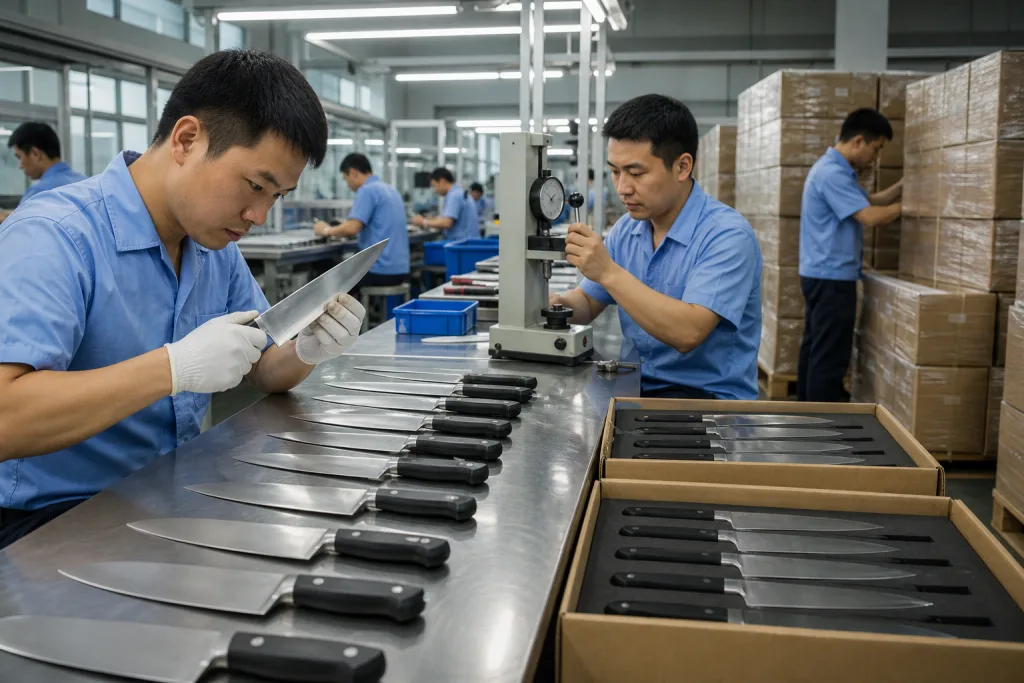
Heat treatment is where a good knife program passes or fails, usually without anyone noticing until cartons land. We have seen a 200-piece pilot run look fine on the bench, then QC pulled the sample on the Rockwell tester and found blades chipping at 60 HRC, rolling at 54 HRC, or drifting by 4 points inside one shipment. Pretty handle, clean logo, nice color box. None of that saves a soft edge.
At TANGFORGE in Yangjiang, Zhejiang, China, we run heat treatment as a controlled production step, not a mystery box behind the grinding line. If you are buying from a knife heat treatment factory China partner, your PO should lock the steel grade, target HRC band, Rockwell C test method, sample approval rule, and AQL level before mass production starts. We had one buyer send “hardness as usual” on a PO; the math does not work when 3 suppliers read “usual” 3 different ways.
Start with steel and use case
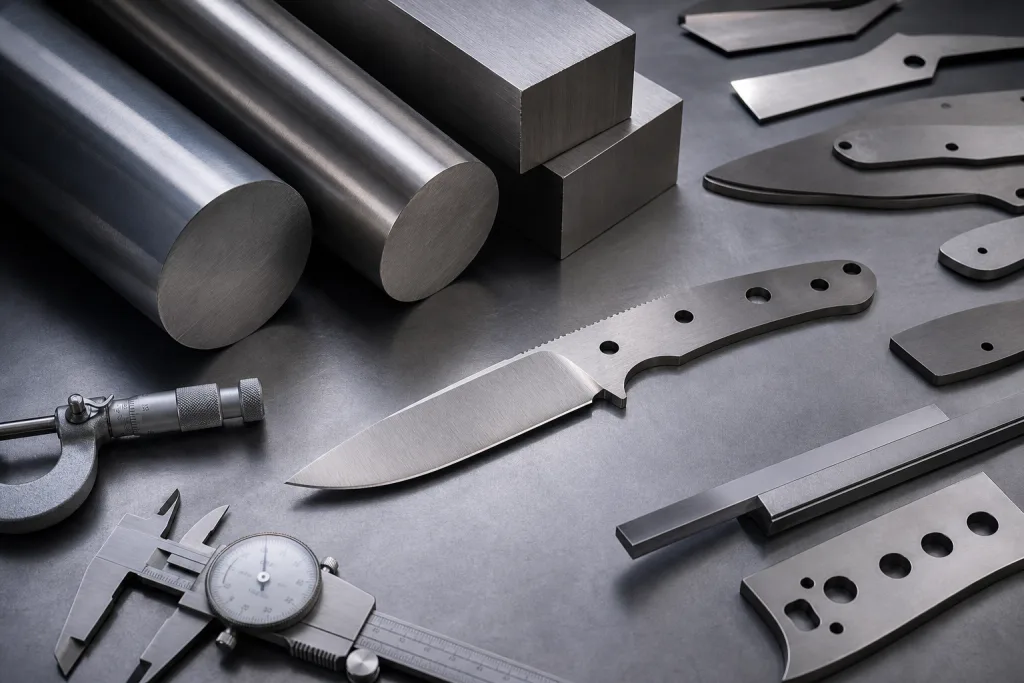
Heat treatment is not one universal recipe. A 7Cr17MoV chef knife, a 440C hunting knife, a D2 pocket knife, and a VG10 Damascus kitchen knife cannot share the same furnace card. We set austenitizing temperature, soak time, quench media, temper cycle, and cryo step by steel and blade shape; on the grinding line, a 2.0 mm kitchen blade and a 4.0 mm hunting blank already behave differently before they enter the oven. If your spec only says “high hardness” or “good edge retention,” the factory is left guessing. That is the wrong question to ask.
Start with use. A western kitchen knife for supermarket retail usually needs toughness and easy sharpening before chasing 60 HRC. A Japanese-style gyuto can run harder if the edge is thin and the buyer accepts chipping risk; we have had buyers flag 0.3 mm edge damage after a frozen-chicken test and still ask for higher hardness. A tactical or hunting blade needs tip toughness, corrosion resistance, and stable cutting after wet sheath storage or outdoor abuse.
For a knife heat treatment OEM order, your technical sheet should include steel grade, blade thickness, edge angle, target hardness, surface finish, and compliance requirements. For example, a 1.4116 kitchen knife at 56-58 HRC behaves very differently from a D2 outdoor knife at 59-61 HRC. Same HRC, different result. QC pulled one D2 sample at 60 HRC last month, but the 18° edge angle made the math fail for impact use.
At TANGFORGE in Yangjiang, China, our monthly knife capacity is about 180,000-220,000 units across kitchen, outdoor, pocket, hunting, tactical, and Damascus lines. That volume only works when heat treatment recipes are locked by SKU, furnace batch, and HRC target, not adjusted casually by operator feeling. We run each SKU against a signed process sheet; one PO typo changing 58-60 HRC to 60-62 HRC can turn a 12-day production slot into an 18-day remake.
Write HRC specs buyers can enforce
Hardness looks like the cleanest heat-treatment number on a PO, but it is easy to write it in a way the factory cannot hold. Do not call out one exact HRC point unless you are ready to reject good blades from normal furnace drift. We run production specs as a band, usually 2 HRC points wide, checked on a Rockwell C tester after tempering and before final grinding.
For OEM kitchen programs, 57-59 HRC gives QC something enforceable; “58 HRC” just starts arguments. If you ask for 59-60 HRC, plan for extra sorting, slower packing, and a higher unit price. We have seen a 5,000 pcs chef-knife lot move from 12 days to 18 days because QC pulled borderline samples twice. On large lots, tight hardness windows can add USD 0.10-0.35 per blade depending on steel, blade size, and inspection frequency. The math does not work unless the retail positioning pays for it.
| Knife type | Common steel | Practical HRC band | Buyer risk if too hard |
|---|---|---|---|
| Western chef knife | 1.4116 / X50CrMoV15 | 56-58 HRC | Micro-chipping at thin edge |
| Asian kitchen knife | VG10 core | 60-62 HRC | Higher sharpening complaints |
| EDC pocket knife | 8Cr13MoV / 9Cr18MoV | 57-60 HRC | Lock stress plus brittle tip |
| Hunting knife | 440C / D2 | 58-61 HRC | Field breakage under prying |
Agree on the Rockwell test location before mass production. Testing 3 mm from the cutting edge can mark the blade and read different from the spine, so this is the wrong place for routine shipment QC. In our shop, 8 out of 10 buyer specs accept the ricasso, tang, or a witness coupon heat-treated in the same basket. For premium programs, pair HRC checks with CATRA edge retention or bend testing, then add salt spray if the handle or coating needs proof. HRC is still the release gate.
MOQ and pricing realities
Knife heat treatment MOQ starts with furnace loading, then steel separation by grade and thickness. If we run a proven recipe on an existing blade drawing, TANGFORGE usually supports OEM MOQ from 300 pieces per SKU for fixed-blade kitchen knives and around 500 pieces per SKU for pocket or tactical knives with more components. The grinding line still has to hold the edge thickness, usually around 0.35-0.55 mm before hardening, or the HRC result means less than the buyer thinks.
For a new steel, special hardness band, vacuum heat treatment, cryogenic treatment, or an unusually thick blade, the MOQ can move to 1,000 pieces because trial loss and furnace scheduling become real costs. This is where the math gets uncomfortable. A buyer may ask for 80 pieces at 61-62 HRC on a custom D2 outdoor knife, but we still need setup time, 6-10 test pieces, oil or vacuum furnace slots, and QC paperwork. Someone pays for that complexity.
As a rough FOB China guide, standard heat treatment is normally included in the knife unit price. Upgraded heat treatment controls add cost when the spec needs tighter records. Vacuum heat treatment can add about USD 0.20-0.80 per blade on common kitchen and outdoor knives. Cryogenic processing can add USD 0.30-1.20 per blade depending on blade mass and batch size. Extra HRC sorting or third-party lab testing is quoted separately; QC pulled the sample last month because the PO said 58-60 HRC while the drawing said 60-62 HRC.
Be careful with low quotes from any knife heat treatment factory China supplier. If the price is below the real processing cost, the saving often comes from mixed steel batches, fewer temper cycles, no hardness sampling, or accepting wider variation. We have seen this go sideways: 2 cartons passed appearance check, then 37 blades came back from Europe with chipped edges after three months. A Rockwell tester would have flagged the spread before shipment.
Process controls to request
You do not need to become a metallurgist. You do need proof the line is under control. A serious knife heat treatment OEM factory keeps a traveler showing steel batch, furnace number, loading date, target temperature, soak time, quench method, tempering temperature, and operator sign-off. We run this check before grinding starts; if QC pulled the sample and the tray tag is missing, the HRC numbers do not mean much.
A practical checklist starts with incoming material verification before heat treatment. For stainless steels, the mill or service center should send a material certificate with chemistry, heat number, and coil or plate reference. For higher-risk programs such as D2, 440C, VG10, or powdered metallurgy steels, ask for PMI checks or third-party material confirmation before production. This is not overkill for a USD 49-129 retail knife; we have seen a buyer flag a PO because “VG10” was typed as “VG-10” in one file and the steel cert used a different heat number.
For blade distortion, write down the straightness tolerance. Do not leave it to the inspector’s mood. A 240 mm chef knife may need blade straightness within 1.5 mm tip-to-heel, checked on a granite plate with a 0.05 mm feeler gauge, while a thicker outdoor knife can use a looser drawing tolerance. If you skip this line item, warped blades get treated as cosmetic defects, and the math does not work after handles are fitted.
Ask whether the factory uses controlled atmosphere, vacuum, salt bath, or conventional furnace processing for your steel, and ask which step is done in-house. The answer changes decarburization risk, scale thickness, grinding loss, and final edge quality. In Yangjiang, Zhejiang, China, we see about 7 out of 10 knife factories outsource at least one heat treatment step; that is acceptable only when the OEM factory still owns the QC record, the rejection decision, and the rework cost when the grinding line finds soft spots.
QC risks importers often miss
The biggest QC risk is not one failed blade. It is spread inside the same shipment. We have seen a 2,000-piece run where the approved sample measured 59 HRC, then bulk goods checked from 55 to 61 HRC because blades from 3 furnace loads were packed together after tempering. QC pulled 32 pieces with the Rockwell tester, and the pattern was obvious. The buyer flagged mixed feedback later: some users said the knife dulled fast, others said it chipped. Asking “did it pass hardness?” is the wrong question to ask. Ask how tight the batch range is.
Edge damage after heat treatment gets missed too often. A blade can pass hardness testing and still fail after the grinding line overheats the last 0.3 mm of the edge. Look for blueing, burned edge marks, heavy burr over 0.15 mm, or sharpening angles drifting 2 degrees from side to side. We run a quick paper cut and 10x loupe check before packing on export orders, because HRC alone will not catch a cooked edge.
For kitchen knives, rust complaints get blamed on steel first, but the math does not always work. Heat treatment, passivation, and cleaning decide a lot of what the customer sees after 7 days in a humid warehouse. Poor satin finishing or carbon dust from the grinding belt can leave rust spots even on stainless grades. If your products contact food, request REACH, LFGB, or FDA-related material declarations where applicable, especially for handles and coatings, plus oils and packaging inks. We once had a PO typo list “food-grade oil” but the sample room used standard anti-rust oil; QC caught the smell before shipment.
For pocket and tactical knives, heat treatment shows up during assembly. If the blade tang is too hard or uneven, the lock face can wear fast or feel gritty after 50 open-close cycles. If the pivot area distorts by even 0.2 mm, the knife may leave the line with blade play. Your final QC plan should include opening force, lock engagement depth in mm, blade centering, and drop safety checks, not just blade hardness. We have seen this go sideways when buyers only put HRC on the inspection sheet.
Sampling and AQL inspection plan
Your purchase order should spell out how QC makes the call, not just say “standard inspection.” For export knife orders, we see about 7 out of 10 buyers reference ANSI/ASQ Z1.4 sampling with AQL 2.5 for major defects and AQL 4.0 for minor defects. Critical defects need 0 acceptance: broken tips, unsafe locks, wrong steel, wrong hardness, loose handles, or food-contact contamination. QC pulled one sample last month with a 54 HRC reading against a 56-58 HRC spec; that is not a “minor issue.” It blocks shipment.
For pilot production, inspect tighter. On the first 300-500 pieces of a new SKU, test 5-10 blades for HRC from different furnace positions or batches: front tray, middle tray, rear tray, if the load is mixed. We run the Rockwell tester before packing, not after the cartons are sealed. If readings stay stable, mass production can drop to 3-5 pieces per heat treatment lot, based on risk and order size. The wrong question is “how few samples can we test?” Ask where the heat treatment can drift.
Define the failure process before the goods are packed. Keep it simple: isolate the lot, retest on agreed equipment, sort if the defect can be separated, and rework only if re-tempering or finishing can restore performance without hurting the blade. We have seen this go sideways when a buyer accepted “next order will be better” after balance payment. Don’t do that. If 1,200 pcs are sitting beside the grinding line with failed hardness, the current shipment must meet the agreed specification before release.
If you use a third-party inspector in China, give them the HRC band, test location, sample size, and defect classification. General inspection agencies can check carton marks, logo position, handle gaps under 0.3 mm, and cosmetics, but 6 out of 10 will miss heat treatment risk unless the checklist is written clearly. The buyer flagged it once because the PO said “HRC 58” while the approved drawing said “56-58 HRC.” For higher-value launches, add a pre-shipment lab test or keep golden samples at the factory and buyer office.
Checklist for your next purchase order
A clean PO stops the argument before it starts. For each SKU, write the steel grade, blade construction, target HRC band, surface finish, edge angle, handle material, packaging, logo method, compliance documents, and inspection standard. Put it in a table if you can. Last month QC pulled the sample with a 57 HRC reading on the Rockwell tester while the PO said 58-60 HRC, and that 1 point became a two-day email chain. If you are buying Damascus knives, specify the core steel and cladding structure, not just “67 layers.” The edge cuts because of the core steel and heat treatment, not the layer count on the product photo.
Put the commercial terms on the same PO. State MOQ, unit price, Incoterm such as FOB Shenzhen or DDP to your warehouse, sample cost, tooling cost, payment terms, and lead time. For most OEM knife programs from TANGFORGE, sampling takes 7-15 days when materials are available, while bulk production is normally 35-55 days after deposit and approved sample. Complex Damascus, G10, Micarta, titanium, or coated tactical knives need a real buffer; we have seen coated tactical blades run 18 days for samples instead of 12 days because the PVD vendor rejected a color panel. The math does not work if the buyer books a promotion before the grinding line has approved steel in hand.
Do not approve mass production from photos only. Ask for physical pre-production samples and check cutting feel, sharpening, balance, handle comfort, packaging fit, barcode placement, FNSKU if you sell through fulfillment channels, and carton drop protection. We ship samples with a simple edge test sheet and carton size marked in mm, because a 3 mm tight blister tray can bend a tip during packing. Heat treatment is technical, but the buyer feels it in fewer returns, fewer chargebacks, and fewer distributor arguments.
The final checklist should be short enough for the supplier to follow on the factory floor. One page per SKU beats a 40-page manual that sits beside the caliper box unread. If the factory pushes back on a reasonable HRC band, batch records, and AQL inspection, pay attention before you transfer a 30% deposit. We have seen this go sideways after a PO typo changed “black G10” to “blank G10,” and the buyer flagged it only after 600 handles were cut.
Frequently asked questions
For western-style stainless kitchen knives using 1.4116, X50CrMoV15, or similar steel, 56-58 HRC is a practical band. It gives acceptable edge holding while keeping sharpening easy and reducing chipping complaints. For VG10 core chef knives, 60-62 HRC is common, but the blade geometry and edge angle must match the higher hardness. If you sell to mainstream retail, avoid chasing 63+ HRC unless your customers understand thin-edge maintenance. Put the HRC band, steel grade, and test location in the PO. A single approved sample at 60 HRC is not enough; ask for several readings from the pilot lot before releasing mass production.
For standard OEM kitchen knives, a realistic knife heat treatment MOQ is usually 300-500 pieces per SKU when the factory already has a proven steel and blade recipe. For folding knives, hunting knives, tactical knives, or new steel programs, 500-1,000 pieces per SKU is more realistic because furnace loading, component matching, and QC sorting take more time. Small trial orders are possible, but the unit price will be higher. If you need custom knife heat treatment with vacuum processing, cryogenic treatment, or a tight 1 HRC band, expect either a setup charge or a higher MOQ.
You can use the factory report as part of the QC file, but do not rely on it alone for a new supplier or new SKU. Ask for the tester model, calibration status, test location, sample quantity, and readings by batch. For first production, request 5-10 HRC readings across the lot, not one number. If the order value is high, use a third-party inspector or lab in China before shipment. The cost of extra checking is small compared with replacing 1,000 knives after customers report chipping, bending, or fast dulling.
No. Harder usually improves edge retention up to a point, but it can reduce toughness and increase chipping risk. A 62 HRC blade with a thin 12° edge may impress on a specification sheet but fail with mainstream users who cut bones, frozen food, or hard plastic packaging. For many retail kitchen knives, 56-59 HRC is safer. For premium Japanese-style blades, 60-62 HRC can work if the steel, heat treatment, edge angle, and user instructions align. The right target depends on use case, warranty policy, and customer skill level.
Request material certificates, heat treatment batch records, HRC inspection results, final QC report, packing list, and compliance documents relevant to your market. For food-contact kitchen knives, ask for LFGB, FDA, or REACH-related declarations where applicable. For retail or marketplace shipments, also check barcode, FNSKU, carton marks, and packaging drop-test requirements. The QC report should reference your SKU, order quantity, AQL level, defect list, and actual measurements. If your PO specifies 58-60 HRC, the report should show individual readings, not just “pass.”
Send us your heat treatment spec
Share your steel grade, target HRC, MOQ, drawings, and market requirements. Our engineers will review the risks before quoting your OEM knife project.
Request a Quote