A knife sample is not a factory souvenir. It is the physical contract between your brand, your QA team, and the grinding line. If the approved sample says “close enough,” bulk production will copy that mistake 3,000 times. We have seen this go sideways: blade length off by 1.5 mm, handle color passing under office light but failing beside the Pantone book, logo position shifted 2 mm, carton label still showing the old SKU from the first PO.
At TANGFORGE in Yangjiang, Zhejiang, China, we run knife sample approval like a spec-sheet job, not a handshake. Our export desk sees the same miss on about 7 out of 10 private-label sample approvals: the buyer likes the look, then leaves the measurable lines blank. Wrong question to ask. Before we open steel, handle material, packaging, and QC files for production, we need numbers, tolerances, dated photos, revision notes, and one final signed sample; last month QC pulled a chef knife sample with 58 HRC marked on the file while the buyer’s email still said 56±2 HRC.
Start With The Sample Identity Block
The first lines of your approval sheet need to pin down the sample so nobody in purchasing, the QA room, or the grinding line mixes it with another version. Basic? Yes. Still, we see this mistake about 6 times a year, and it burns money fast on knife OEM orders. A chef knife with the same handle shape but 1.4116 instead of 5Cr15MoV is a different product. A tactical knife with black oxide instead of stonewash is not a “small note” if the retail listing photo shows stonewash. QC pulled one sample last month because the carton label said K-210B while the blade laser file said K-210A.
Your identity block should include item code, buyer SKU, factory model code, product name, intended market, sample version, sample date, and approval status. If you sell through Amazon or large retailers, add FNSKU, UPC or EAN, and retail pack version, because the buyer will flag it later if the barcode on the color box does not match the PO. For a knife set, identify every piece: 8 inch chef knife, 7 inch santoku, 5 inch utility, 3.5 inch paring knife, scissors, block, sheath, and packaging insert. Name each blade. Do not approve the set as one vague object unless you want a packing table argument at 9 p.m.
At our Yangjiang, Zhejiang facility in China, one OEM kitchen knife project may pass through CAD, grinding, heat treatment, handle fitting, logo, packaging, and final QC teams. A clear identity block keeps those teams working from the same file, especially when the laser room is checking logo position in mm and the heat-treatment record is tied to HRC targets. Our usual sample lead time is 10 to 18 days for standard private-label kitchen knives and 20 to 35 days for new tooling or Damascus patterns. If the sample sheet says only “black handle chef knife,” the production file is already weak. We’ve seen this go sideways.
Practical rule: one sample approval sheet should equal one sellable SKU or one clearly defined set. If you change steel, finish, handle material, logo, or packaging after approval, issue a new revision with a version code such as V2 or Rev.B. Do not let a revised email become the real spec while the old signed sheet remains in the factory file. The math does not work when QC inspects against AQL 2.5 using one sheet and the buyer expects another.
Blade Dimensions Buyers Actually Feel
Blade dimensions are not paperwork for the engineer. Buyers feel them in balance, cutting drag, sheath fit, retail photos, and the first 20 reviews. On the approval sheet, we split visual sizes from working sizes. Overall length, blade length, handle length, blade height, spine thickness, edge angle, tip profile, and weight each need a target with tolerance; for example, 203 mm blade length ±1.0 mm and 185 g ±5%. If you sign off from photos only, this is the wrong question to ask. The grinding line will decide the rest, and we have seen a PO typo like “2.0 mm spine” become 2.8 mm on the first sample run.
For kitchen knives, a normal OEM tolerance might be blade length ±1.0 mm, blade height ±0.8 mm, spine thickness ±0.2 mm, and finished weight ±5%. For pocket or tactical knives, add closed length, open length, blade centering, liner thickness, lock engagement, pivot screw type, and clip position to the sheet. A 0.5 mm shift around a folding knife pivot can change action and safety; QC pulled one sample last year because the blade rubbed the liner after only 30 open-close cycles. For hunting knives, sheath retention and handle palm swell can matter as much as blade length. The buyer flagged that one fast.
Knife tolerance also needs to say where the measurement is taken. Spine thickness at the heel is not the same as thickness 20 mm behind the tip. Blade height at heel is not mid-blade height. Short instruction. Bad result. Your QC inspector needs a caliper point, not “check thickness.” If the approved sample has a 2.2 mm spine at the heel and production averages 2.6 mm, the knife will feel nose-heavy even when the outline passes the retail photo check.
A solid signoff sheet includes 5 to 8 annotated photos with arrows and measurement points. Use millimeters, grams, and degrees, not “same as sample” by itself. We run this with a printed sheet beside the golden sample box, and the sample label must show item number, revision, date, and buyer signoff. “Same as sample” works only after the sample is sealed, labeled, dated, and stored as a golden sample for pre-production and final inspection comparison.
Steel, Hardness, And Edge Requirements
The steel line on a spec sheet needs a real grade code. “German steel,” “Japanese steel,” or “stainless steel” will not pass serious procurement, and this is the wrong place to be loose. Approve the steel grade with EN/JIS/AISI code, blade construction with core or cladding callout, hardness range in HRC, heat treatment target, surface finish sample, edge angle per side, and the corrosion or cutting test written by name. Last month QC pulled a pre-production knife marked VG10, but the PO had a typo as V10; we stopped it before the grinding line packed 300 blades the wrong way. If your retail copy says 1.4116, 420J2, 440C, D2, 14C28N, VG10, or Damascus, the purchase order and sample approval need the same wording.
Hardness hits the buyer fast. Too soft, the knife loses edge retention after a few cartons of home-use testing. Too hard, the edge chips and the return photos start showing bright half-moon breaks near the tip. We run Rockwell checks on the HRC tester after heat treatment and again after final grinding when the order is sensitive. For 18 OEM kitchen knife projects in 1.4116 or 5Cr15MoV, a practical hardness band is 56 to 58 HRC. For D2 outdoor knives, 58 to 61 HRC works when blade thickness and tempering are matched. For VG10 core Damascus kitchen knives, 9 buyers out of 10 ask for 60 ±2 HRC. Approve the exact range before bulk production. After inspection, the math doesn't work.
| Spec line | Typical approval value | Buyer impact |
|---|---|---|
| Steel grade | 1.4116, D2, VG10, 14C28N | Cost control, claim risk, compliance documents, listing accuracy |
| Hardness | 56-58 HRC or 60 ±2 HRC | Edge retention in use, chipping complaints at return desk |
| Edge angle | 15° per side or 20° per side | Cutting bite and edge strength |
| Finish | Satin, mirror, stonewash, black oxide | Shelf appearance, corrosion behavior, scratch visibility after packing |
| Test method | Rockwell HRC check, salt spray hours, CATRA report if required | QC evidence the buyer can file |
If you require CATRA testing, salt spray hours, or third-party steel verification, put it into the sample approval and commercial terms before we open the material order. These tests add cost and days. Third-party lab testing can add 5 to 10 working days; our last steel verification booking sat 7 working days before the lab cut the sample coupon. We ship cleaner when this is priced at quotation stage, not when the buyer flags it after 2,000 pcs are already polished.
Handle Fit, Finish, And Assembly Details
Handle approval is where 6 out of 10 good-looking samples get kicked back once we run pilot production. Put written limits on the handle material, color band, texture, rivet alignment, gap control, tang exposure, glue line, bolster step, and edge rounding. Photos lie. QC pulled a chef knife sample last month that looked clean on WeChat, then the feeler gauge found a 0.30 mm scale-to-tang gap near the rear rivet. For kitchen knives, that gap becomes a hygiene complaint. For outdoor knives, it becomes a cracked-handle claim after hard use.
Your spec should name the handle material in both sales language and factory language: pakkawood with dyed veneer layers, G10 fiberglass laminate, Micarta linen laminate, PP injection handle, ABS handle, TPR overmold, stainless hollow handle, walnut, olive wood, or stabilized wood. Natural wood needs wider color tolerance than synthetic material. If you approve walnut, do not ask the factory to match every piece to the golden sample grain; the math does not work on a 3,000 pcs order. We had one buyer flag “too much dark grain” on 18% of walnut handles, but the PO only said “natural walnut,” so there was no inspection standard to enforce. If retail sets need tight color, choose synthetic or dyed material and write the Pantone number or approved shade range into the sample file.
Assembly tolerance needs numbers, not adjectives. For full tang kitchen knives, we run visible gap no more than 0.15 mm at scale-to-tang joints, rivet proudness no more than 0.10 mm, and handle edge radius matched to the signed sample by touch and caliper check. Small detail. Big headache. For folding knives, define blade play at the tip, lock engagement percentage, detent strength, pivot screw torque feel, clip screw security with threadlocker, and opening action against the signed sample. “Smooth action” is the wrong spec by itself; the grinding line and assembly bench need a QC checklist they can actually measure.
Ask the factory to mark each handle defect as critical, major, or minor, with photos beside the wording. A loose handle is critical because the knife is unsafe. A sharp burr on the handle spine is major; QC should catch it with a cotton-glove rub test before packing. A small color shift on natural wood can be minor if it sits inside the approved range. At TANGFORGE, our private-label production files link these definitions to AQL inspection, commonly AQL 2.5 for major defects and AQL 4.0 for minor defects, unless the buyer writes a stricter plan into the PO.
Logo, Packaging, And Label Signoff
Logo and packaging mistakes hurt because the knife can pass cutting, hardness, and assembly checks, then still be unsellable on the shelf. Your knife sample approval should lock the artwork file name, logo method, logo size, logo position, color, barcode, warning text, country-of-origin marking, user manual, insert card, sheath marking, gift box, master carton, and pallet label if used. We ask buyers to sign the 1:1 PDF and the real sample together; last month QC pulled a sample where the PO said “matte black box” but the AI file was gloss black. For private-label brands, packaging is product spec. Treat it that way.
Logo methods do not behave the same on steel, plastic, leather, or carton board. Laser engraving on stainless steel gives a different contrast from etching, screen printing, hot stamping, pad printing, or sheath debossing, and the grinding line will show every weak artwork choice. A 35 mm logo on a satin blade can look balanced; the same 35 mm logo on a Damascus blade can disappear into the pattern after polishing. Approve the logo on the real surface, not just on a PDF mockup. For retail brands, we set logo position tolerance at ±0.5 mm to ±1.0 mm depending on the process and surface, and we check it with a digital caliper before sample photos go out.
Packaging approval has to cover shelf appearance and warehouse handling. Confirm box dimensions, paper weight, foam or tray fit, anti-rust bag, silica gel, blade tip protection, warning labels, and drop-test requirement against the actual packed knife, not an empty box. A chef knife gift box can look premium and still fail if the blade shifts 8 mm inside the tray during ocean freight; we have seen tip guards punch through thin foam after 10-carton vibration testing. Not acceptable. A pocket knife clamshell that blocks the barcode scanner at receiving is the wrong question to leave for mass production, because the math does not work once 5,000 units are packed.
For Europe and North America, check compliance text before the sample is signed. Depending on product and market, confirm whether the file needs REACH, LFGB or FDA food-contact declarations, Prop 65 warning review, country-of-origin marking, and retailer-specific carton labels. We run carton marks through QC with the master carton layout, because one buyer once flagged “Made in China” printed 4 mm too close to the recycling icon on a 5-layer export carton. If the carton mark changes after sample signoff, revision control must capture it. If not, the warehouse can reject the goods even when the knives pass inspection.
Revision Control Without Email Confusion
Revision control is not office decoration. It stops the wrong sample from turning into 20,000 wrong knives. We run one rule on the sample bench: every approved sample gets a version code, and every change after that goes into a revision table. V1.0 is the first complete sample, V1.1 is a small correction such as a 0.2 mm handle gap fix, and V2.0 is a design change that touches tooling or function. Use your own code system if it already works. Just keep it consistent, or the grinding line will follow the loudest email instead of the approved spec.
Your revision table should state date, requested by, changed line, old value, new value, reason, and approval status. Example: “2026-03-12, buyer QA, blade spine changed from 2.0 mm to 2.3 mm at heel, reason: improve stiffness, status: approved for PPS.” That beats “please make blade a little thicker” buried in an email thread. We have seen this go sideways. Six weeks later, QC pulled the sample and the buyer flagged 47 emails with 3 different spine thicknesses, while the PO still showed 2.0 mm.
Keep cosmetic revisions away from functional revisions. Gift box artwork changes usually do not need a full cutting test, unless the carton size changes and affects drop-test packing. Steel grade, heat treatment, lock geometry, handle mold, or sheath retention need a new physical sample or at least a PPS. For new molds or tooling, ask for a T1 sample first, then a corrected T2 if the CMM report shows a handle cavity off by 0.15 mm. Do not approve mass production from a 3D print or hand-ground prototype unless your team signs the risk in writing. The math doesn't work.
At TANGFORGE in Yangjiang, Zhejiang, China, our production engineering team freezes the BOM, drawings, QC checklist, and packaging file after final sample signoff. That freeze matters when monthly output can reach tens of thousands of units across kitchen, outdoor, and Damascus knife lines. A late “small change” can hit steel ordering, CNC programs, laser fixtures, cartons, or inspection gauges. Last year a buyer changed a logo position by 6 mm after signoff; we had to remake the laser jig and hold shipment 12 days instead of the planned 5.
Turning Approval Into Production QC
The final sample approval step should turn into the factory inspection plan. If it does not, the signoff is just a folder of photos. Before bulk production starts, ask for a pre-production meeting or a written control plan showing checks at incoming material inspection, in-process inspection, and final random inspection. We run this from the same spec sheet used for the golden sample: blade length in mm, handle gap limit, target HRC, logo position, polybag wording, carton mark. Same lines. Same checkpoints.
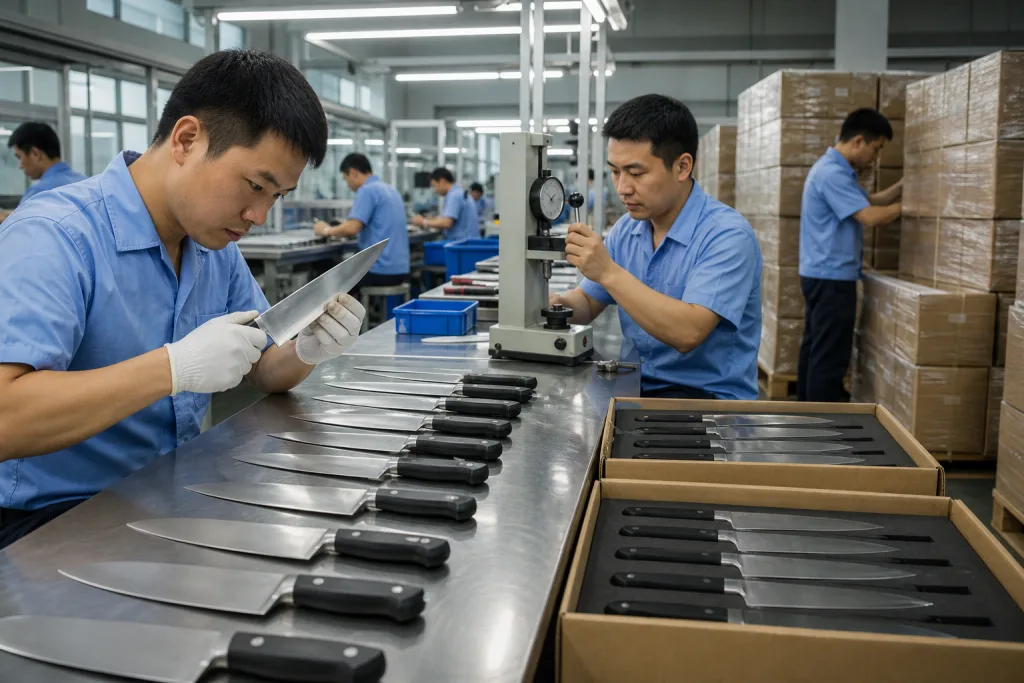
A workable control plan covers steel certificate review, hardness spot checks on the Rockwell tester, grinding dimension checks with calipers, handle fit inspection, edge cutting test on A4 paper or rope, logo position check, packaging check, and carton label verification. For higher-risk orders, require first-article inspection from the first 20 to 50 units before the line keeps moving. We use this for new handle molds, folding knife pivots with fresh tooling, and first-time Damascus patterns because we have seen the grinding line make 300 pieces before anyone noticed a 1.5 mm tip shape drift.
Define who signs off each item. Your factory sales contact should not be the only person approving quality exceptions; this is the wrong question to ask if the buyer only asks, “Can you accept it?” For private-label orders, we recommend three approval levels with clear scope: buyer product owner checks appearance against the golden sample, buyer QA or third-party inspector checks measurable tolerances, and factory quality manager confirms whether the spec can run at production speed. If a tolerance cannot hold during mass production, the factory should say so before deposit or before material cutting. QC pulled the sample once because the PO said black POM handle, but the approved file said pakkawood. One typo stopped the batch.
Final inspection should reference the approved golden sample, signed spec sheet, and latest revision file. Common export terms such as FOB Shenzhen, FOB Ningbo, or DDP warehouse do not replace quality acceptance terms. If you use third-party inspection, send the sample approval pack to the inspector at least 3 working days before inspection. Without it, the inspector may catch loose rivets or stained blades but miss your brand rule that the laser logo must sit 12 mm from the bolster. We ship to the carton mark, but QC inspects to the approval pack.
The best approval system is not complicated. It is strict where the math matters: measurable knife tolerance, dated revision control, approved packaging, and a physical sample that production cannot reinterpret. If a spec cannot be checked with calipers, an HRC tester, a scale, or a signed visual limit board, expect arguments at final inspection. We have seen this go sideways.
Frequently asked questions
For a standard private-label knife based on an existing factory model, one corrected physical sample plus one sealed golden sample is usually enough. For a new mold, new folding mechanism, new Damascus pattern, or custom packaging structure, plan for 2 to 3 rounds. A typical flow is prototype sample, corrected pre-production sample, then golden sample. Each round should have a version number and written comments. Do not approve bulk production from photos only unless the order is low risk and the commercial impact is small. For repeat orders with no change, the previous golden sample and latest approved spec sheet can remain valid, but confirm packaging codes and compliance labels again.
Use tighter tolerances on functional areas and looser tolerances on natural cosmetic variation. For many kitchen knives, practical targets are blade length ±1.0 mm, blade height ±0.8 mm, spine thickness ±0.2 mm, weight ±5%, and logo position ±0.5 to ±1.0 mm. For folding knives, add open length, closed length, blade centering, lock engagement, blade play, and clip position. For handles, define maximum visible gaps, rivet proudness, and edge rounding. Do not copy aerospace-style tolerances if the process cannot hold them at your target FOB price. Ask the factory which lines are process-critical before final signoff.
Yes. Packaging should be approved with the knife, not treated as a later purchasing detail. Include color box artwork, insert card, manual, barcode, FNSKU, UPC or EAN, country-of-origin marking, warning labels, carton dimensions, gross weight, carton marks, and any retailer routing label. A knife that passes blade inspection can still be rejected by a retailer if the barcode is wrong or the carton label does not match the ASN. For North America and Europe, also check REACH, LFGB or FDA food-contact wording where relevant. Packaging samples may take 7 to 15 days depending on printing and structure.
Use a short revision table and decide which changes require a new physical sample. Cosmetic artwork changes can often be approved by PDF proof or printed packaging sample. Functional changes such as steel grade, HRC range, blade thickness, lock geometry, handle mold, sheath fit, or edge angle should trigger a new sample or at least a pre-production sample. Keep version codes simple: V1.0, V1.1, V1.2, V2.0. Every purchase order should reference the final approved version. This takes a few minutes per change but can save 20 to 40 days of dispute, remake, or delayed shipment later.
First, compare the goods against the signed spec sheet, latest revision file, and golden sample. Classify the issue as critical, major, or minor. A wrong steel grade, unsafe lock, loose handle, or missing compliance label is usually critical or major. A small natural wood color variation may be minor if the tolerance allows it. Use the agreed AQL level, often AQL 2.5 for major defects and AQL 4.0 for minor defects, unless your contract says otherwise. The remedy may be sorting, rework, discount, replacement, or remake. Clear sample approval gives both sides an objective basis for that decision.
Send Your Knife Sample Sheet For Review
Share your draft spec, target MOQ, and market requirements. Our Yangjiang team will flag missing tolerances before sampling starts.
Request a Quote