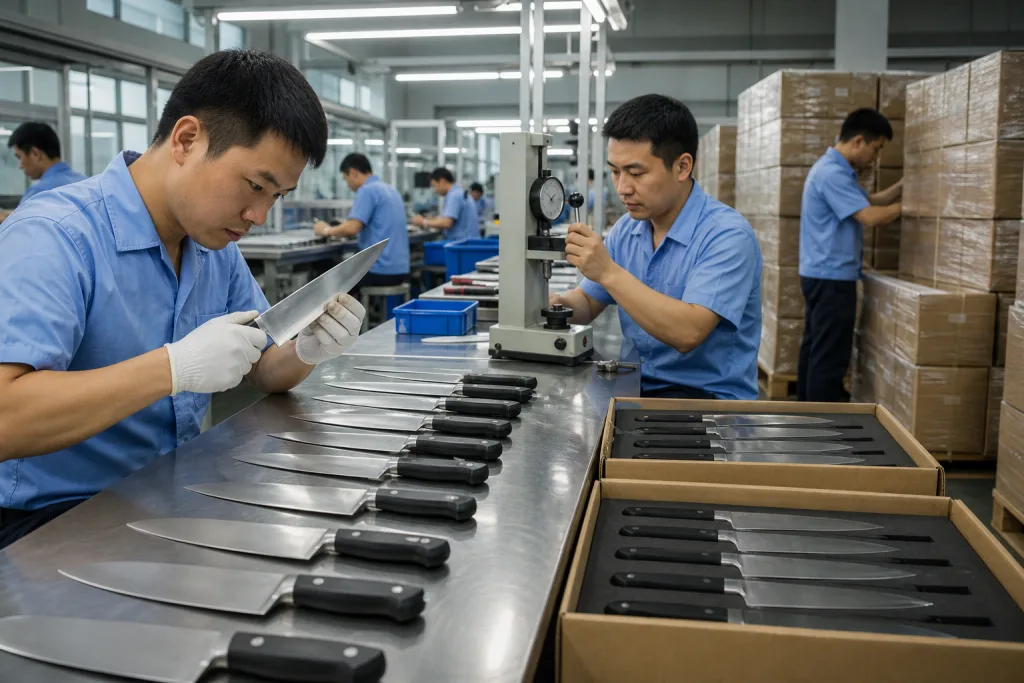
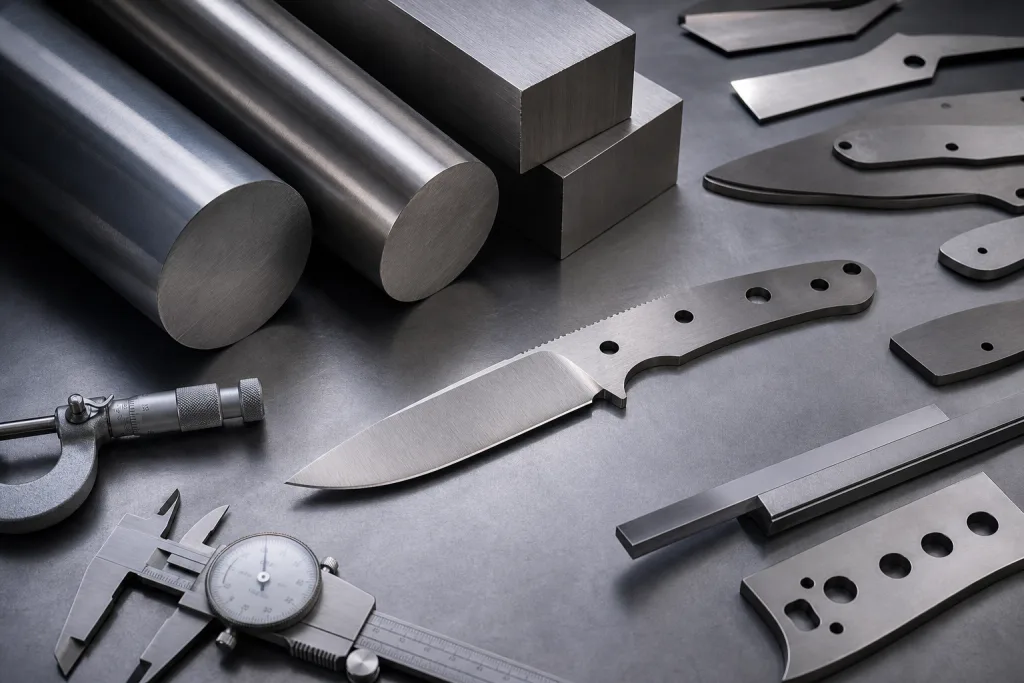
If you are sourcing a micarta handle knife for retail, distribution, or private label, the problem is not the material itself. The problem is that every factory quotes it differently. One shop gives a low price on a 3 mm scale set, another adds CNC work, hand sanding, and carton insert later. In Yangjiang, Zhejiang, China, we see buyers lose margin when they approve a sample before they lock the handle thickness, pin structure, and finish standard. QC pulled the sample with calipers at 0.1 mm, and the buyer still missed the cost jump. That is the wrong question to ask: unit price alone tells you nothing.
A realistic micarta handle knife MOQ often starts at 300 pcs per model for a repeat pattern, but a custom micarta handle knife with new molds, new color layup, or special engraving usually needs 500-1,000 pcs to make the unit price work. On the grinding line, we run into the same pushback: a buyer wants a custom handle and factory-level finishing at a trial order size. The math does not work. A good micarta handle knife factory China will also tell you the lead time up front: 45-60 days for production after sample approval is normal when the blade, handle, and packaging are all custom.
What Micarta Means in Knife Sourcing
Micarta is a laminated composite: cotton cloth, kraft paper, or linen sheets pressed with phenolic resin, then cured into handle blocks or slabs. In knife sourcing, buyers sometimes mark it on the spec sheet as “black handle finish.” That is the wrong way to read it. It is a working handle material, so the cutting saw, belt sander, drill jig, and polishing wheel all have to stay controlled. On our grinding line, a 0.3 mm gap at the tang is enough for QC to pull the sample, and rushed sanding leaves fuzzy edges, chipped corners, or slabs that rock instead of sitting flat.
For a micarta handle knife OEM program, the handle design often drives more cost than the blade shape. Flat slabs run faster than contoured handles; on a 1,000 pcs order, we usually see about 12 days vs 18 days once CNC shaping and hand blending are included. Full-tang construction feels stronger, but it needs more machining time and more bench labor. Pin layout changes the math too: two pins are clean, while three pins plus a 6 mm lanyard tube adds drilling, alignment checks, and scrap risk. Buyers ask for “premium feel” with chamfers or finger grooves, then push back on the unit price. We’ve seen this go sideways when the drawing looks simple but the handle takes 40 extra seconds per piece.
From a sales-engineering view, micarta works because it gives kitchen and outdoor SKUs a rugged matte look without the swelling complaints we get from some natural materials after a wet carton test. For export orders, buyers often match it with stainless steels around HRC 56-60, then ask QC to check handle flushness, pin height, and edge comfort under AQL 2.5. We ship this material often because color and texture stay steadier in China mass production than decorative wood or bone. If you already source other handles through handle material comparison guidance, place micarta above basic PP for feel and below high-risk decorative materials for reject rate.
MOQ and Price Bands You Can Expect
Micarta pricing is not a single line on a quote sheet. It changes with blade steel, handle shape, edge work, surface finish, and packing method. If you ask a micarta handle knife factory China for a clean OEM quote, ask for the split: blade blank, micarta slab cutting, CNC drilling, rivet assembly, belt grinding, sharpening, inner box, and master carton. We run this breakdown on a 1.5 mm cost sheet because one buyer once compared our bare-knife price with another supplier’s gift-box price, and the math did not work. For repeat orders, 300 pcs/model is a realistic entry point. For a new custom micarta handle knife with new artwork, custom micarta color, or a unique sheath or box, 500-1,000 pcs is the safer MOQ to quote.
The table below gives a sourcing range we would use for standard export quality, common steel, and normal carton packing. QC pulled the sample last month on a 500 pcs run because the micarta edge radius was 0.4 mm on one side and 0.9 mm on the other, so low MOQ is not just a price topic.
| Run size | Typical FOB unit price | MOQ | Notes |
|---|---|---|---|
| 300-499 pcs | USD 4.80-6.80 | 300 pcs/model | Setup cost is heavy; finish can look like sample-room work if the grinding line is rushed |
| 500-999 pcs | USD 3.90-5.90 | 500 pcs/model | Good starting point for private label launches with logo, barcode, and one carton mark |
| 1,000+ pcs | USD 3.20-4.90 | 1,000 pcs/style | Works better for repeat SKUs, stable jigs, and retail programs with fixed packing specs |
In Yangjiang, Zhejiang, China, a mid-size plant can often run 120,000-180,000 units/month across kitchen and outdoor lines, but micarta still needs more hand finishing than molded PP. One operator may spend 18-25 seconds just easing the handle corner on a 240-grit belt before polishing, and that time shows up in the FOB price. If you want laser engraving, sheath, gift box, or FNSKU labeling, budget another USD 0.15-1.20 per unit depending on complexity. A cheap quote is not cheap if the handle finish fails your first inspection; we have seen this go sideways on orders where the buyer flagged cloudy resin spots after AQL sorting.
Specs That Control Cost and Quality
Write the spec before you ask for samples. That is the cheap part. On the grinding line, a 0.2 mm miss shows up fast. For a custom micarta handle knife, lock the steel, blade thickness, hardness, handle thickness, pin size, finish, and packaging on one sheet. Leave one line open and we run on our standard, not yours. For kitchen orders, HRC 56-58 is common. For outdoor and tactical SKUs, HRC 58-60 is the usual band, and QC pulled the first sample to confirm the lot sat inside it.
Handle dimensions drive the feel. A common micarta scale thickness is 2.5-4.0 mm per side, with 4.0-5.0 mm total added to the tang depending on the model. At 2.2 mm per side, the buyer flagged the handle as thin, and the machining marks stayed visible after sanding. At 5.2 mm, the knife felt nose-heavy. Ask for edge break or 0.3-0.5 mm chamfer on exposed corners so the handle does not bite the palm. On higher-end orders, we add contoured sanding, matte seal, or bead-blast texture for grip. Thin handles save grams. They do not save sales.
Lock these details before RFQ: full-tang or hidden tang, pin material such as stainless or brass, spacer type, blade steel grade, finish level, and carton pack count. A proper micarta handle knife OEM quote should also show whether the price includes sharpening, logo laser engraving, and final wipe-down. We shipped a 500-piece trial with a PO typo on the carton pack count, and the reprint bill landed on my desk. If that line is missing, you will see the extras later.
QC Risks Specific to Micarta Handles
Micarta looks clean on the bench, but QC gets ugly once the grinding line starts running. We see slab-edge delamination from weak resin cure, a saw blade set too fast, or a worker leaning too hard on 120-grit belts. Loose pins show up after a heat-cold cycle from 18C to 48C in the test room. Color drift is another fight: one batch from Friday, one from Monday, and the black shifts under the same lamp. This is not a visual-only job; that is the wrong question to ask.
For export orders, we run AQL 2.5 for major defects and AQL 4.0 for minor defects on the first mass-production lot. QC pulled the sample, then we added a pin pull test at 20 N, a handle-to-tang gap check under 0.2 mm, and a carton drop test from 76 cm. If the knife goes into kitchen use, confirm REACH and, where relevant, LFGB or FDA paperwork for the full set, not just the blade. For hospitality or retail, ISO 9001 and BSCI files save time at the buyer desk; the math does not work if the factory cannot produce them on request.
Our rule in Yangjiang, Zhejiang, China is simple: if a Micarta handle needs rework after final sanding, we ship the same problem back in packing. Inspect after finishing, not after assembly. I have seen a PO typo on the handle color code turn into 500 mismatched scales, and the buyer flagged it only when the cartons were opened. If the supplier cannot show moisture logs, cure records, and in-process checks from the press room, you are buying variation, not a stable product.
How to Quote OEM and Private Label Orders
Send the inquiry with more than “best price.” Ask for a quote sheet that is ready for landed-cost calculation: sample charge, any CNC fixture or mold charge, FOB unit price, carton size with gross weight, and lead time by step. We run micarta scales on a jig, so if the handle profile changes 2 mm at the butt, the fixture cost is not imaginary. A clean sheet lets you compare factories and catch costs hidden in packaging or tooling. For private label programs, plain bulk pack versus retail-ready packaging usually moves USD 0.30-1.50 per set, based on printed inserts, barcode labels, and whether the master carton needs a new 5-ply spec.
Keep FOB and DDP separate on the quote. FOB works if your forwarder already consolidates Yangjiang knife shipments and checks CBM before booking. DDP gives one delivered number, but freight, duty, and clearance margin often get buried there. For a small launch order, I normally quote 300-500 pcs per style with one logo method, one carton size, and one blade steel, then push variants to the reorder. The grinding line hates tiny mixed batches. Split one PO into 6 handle colors and 4 blade markings, and the math doesn't work: unit cost climbs, QC pulled samples from more bins, and inspection time doubles.
Ask whether the price includes sample photography, barcode labeling, and the final carton drop test. We have seen this go sideways over small items, like a PO saying “black micarta” while the approved sample tag reads “green canvas micarta.” If you work with OEM manufacturing services, approve the commercial sheet before tooling starts. Negotiating after 600 blades are heat-treated and cartons are printed is the expensive way to buy knives.
Where Micarta Fits Best in Your Range
Micarta is not the answer for every knife. We usually spec it when a buyer wants a handle that feels a step above PP or ABS, holds grip after 500 wet-rub strokes, and still stays inside a sensible export price band. It fits chef knives with 2.5 mm full tangs, outdoor knives with 4.0 mm blades, and hunting models where the buyer flagged “slippery handle” in the last sample review. For glossy gift sets or the lowest supermarket opening price, the math does not work. Use another handle.
For kitchen lines, micarta gives a clean upgrade without pushing the retail ticket into luxury range; on our grinding line, we usually pair it with satin blades at 56-58 HRC and two stainless rivets for a stable look. For outdoor and tactical programs, the handle texture does the selling, more so when it sits behind a drop-point blade and a sheath that passes a 3 kg pull test. Retail and distributor buyers can explain “micarta” faster than a no-name composite. We have seen this go sideways when the PO just says “black composite handle” and QC pulled the sample with resin-rich patches near the front rivet.
A good factory in Yangjiang, Zhejiang should match the handle build to the SKU, not force one construction across the full range. We run different layup thicknesses for kitchen, chef, and field knives, and the sample room checks handle gaps with a 0.05 mm feeler gauge before photos go to the buyer. If you want to place it inside the wider product mix, review outdoor knife options and then choose the build around the channel, MOQ, and target shelf price. The right choice keeps returns low and margins predictable.
Frequently asked questions
Get Your Micarta Quote This Week
Send your blade size, handle thickness, logo method, and target MOQ. We will turn it into a clear FOB quote with sample timing and QC points.
Request a Quote