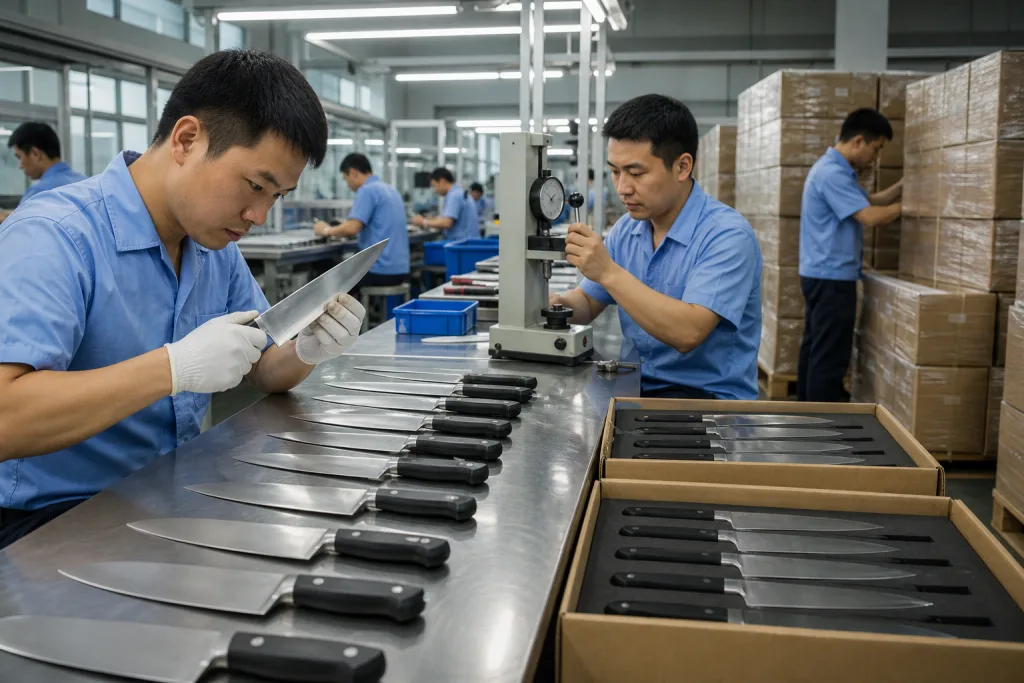
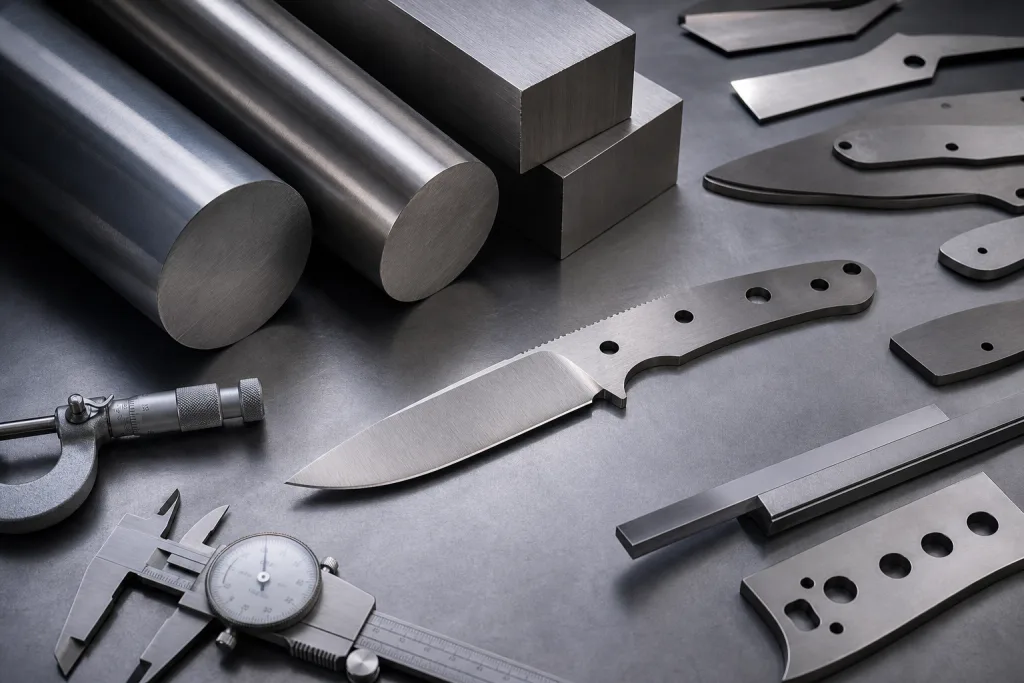
A folding multi-blade knife looks simple in a retail blister pack. On the assembly bench, it is picky work: add one opener or saw and we cut another spring slot, check another 0.10-0.20 mm clearance with a feeler gauge, run another hand-fit pass on the pin press, and give QC one more place to pull the sample.
If you are sourcing pocket multi-tools for a hardware or EDC brand, “What is the FOB price?” is the wrong first question. Ask how many blades and springs the factory must control, then check rivet fit and liner flatness before you argue about 5 cents; on a 7-function tool we run 18-24 assembly checks before carton sealing, and one buyer once flagged a 0.3 mm blade rub that only showed up during the closing test. Small gap. Big complaint. At TANGFORGE in Yangjiang, Zhejiang, China, we treat multi-tool knife manufacturing as a small assembly job, not just knife grinding. Our typical export lead time is 45-75 days after sample approval, depending on tooling and packaging.
Why multi-tools cost more than knives
A single-blade pocket knife has one main moving assembly: blade, pivot, handle, liner or lock, and screws. A folding multi-blade tool is built in layers. A normal spec carries 5 to 15 implements, two backsprings, spacers, rivets, washers, scale pins, plus pliers or screwdrivers. On the assembly bench, the worker checks stack height with a 0.05 mm feeler gauge, not just a quick tighten on one T6 pivot screw. Small gaps matter.
The costly part is usually not the steel. It is the fitting work. Each implement has to open without rubbing the next layer, stop at the right angle, close with no proud tip, and keep enough spring tension to feel solid in hand. QC pulled a 12-function sample last month because the small blade tip sat 0.8 mm proud after closing. That is a return claim waiting to happen. If the buyer wants nail nicks, satin polishing, black oxide, laser logos, and retail packaging with FNSKU labels, we add separate checks at the grinding line and packing table. One missed burr can hold up 600 pcs.
For hardware and EDC brand owners, the honest cost question is not “how many tools can we add?” This is the wrong question to ask. Ask which functions must work under real use. A bottle opener and flat screwdriver are forgiving parts because the contact edge is wide and the tolerance is loose. Scissors need tighter clearance at the rivet, usually under 0.10 mm, or they chew paper instead of cutting it. A saw needs clean tooth stamping and deburring on both faces. A file needs surface hardness and bite, or it turns shiny after 20 strokes on mild steel. We have seen cheap multi-tools pass listing photos and fail the first sample test.
In Yangjiang, China, we see buyers push function count because a bigger number looks stronger on an online listing. Then they ask for the same target price as a simple pocket knife. The math does not work. On a 3,000 pcs MOQ order, saving USD 0.18 by thinning the spring can create weak snap, rough opening, loose rivets, or cosmetic rejection at final inspection. The buyer flagged this exact issue on a PO where “14 function” was typed, but the approved sample was 12 function. A tight 7-function tool often sells better and brings fewer warranty claims than a loose 14-function tool built to a forced price.
Realistic MOQ and FOB cost bands
Multi tool OEM pricing starts with one blunt question: existing pattern or new tooling? With an existing pattern, the stamping die, drilling jig, rivet fixture, and assembly gauge have already taken real production abuse. We run them on the line and know where the tolerance stack sits. Change the body shape, add a can opener, or redraw the plier head by 2 mm, and the job turns into tooling cost plus slower sampling, often 18 days instead of 12 days for a normal logo-and-package sample.
These are starting bands for export-grade production from China. They are not quotations. They are working numbers before an RFQ, especially when the PO says “multi tool knife” but the PDF drawing shows 9 functions, black oxide finish, 1680D pouch, and no note on closed length tolerance. The buyer flagged that exact miss on a 2024 order after our caliper check showed no target length, and it cost 3 extra days before we could quote cleanly.
| Project type | Typical MOQ | FOB unit range | Best fit |
|---|---|---|---|
| Stock 5-7 function tool, private label | 500-1,000 pcs | USD 2.60-4.80 | Promo orders and entry retail |
| Upgraded 7-10 function folding multi-blade knife | 2,000-3,000 pcs | USD 4.20-8.50 | EDC brand line, hardware retail |
| Custom scale, logo, pouch, color box | 3,000-5,000 pcs | USD 5.80-11.50 | Amazon launch or distributor program |
| New implement set or custom frame | 5,000-10,000 pcs | USD 8.00-18.00+ | Long-term branded SKU |
Small MOQs look cheap on paper. The math often does not work. At 500 pcs, the color box setup and film charge can add USD 0.35-0.60 per unit, while a laser logo on the handle may only add USD 0.08-0.15. QC still pulls samples under AQL 2.5, the grinding line still sets the edge angle, and export docs still need the same HS code check. At 5,000 pcs, stamping and polishing have enough batch volume, inner cartons are not half-empty, and freight consolidation stops eating the margin.
We can assemble around 80,000-120,000 folding knife and multi-tool units per month, depending on function count and locking structure. For a new buyer, 2,000-3,000 pcs is usually the cleanest first run. It gives us enough volume to set the line properly with 0.6-0.8 N.m torque checks on the pivot screws, but it does not leave the buyer holding 10,000 pcs if QC pulled the sample and the belt clip position feels wrong in hand. We have seen this go sideways.
Lead time by project stage
Lead time problems start before production. We see 6-8 sourcing cases a month lose 14 days because the logo arrives as a JPG instead of an AI or PDF vector file, the packaging dieline is still sitting with the retailer, or the sample comment says “make it better” with no mm change, no HRC target, no finish reference. For pocket multi-tool sourcing, freeze the drawing, steel grade, function list with open/close photos, surface finish, logo position, packaging file, and target inspection standard before our sample room cuts the first scale on the CNC. The CNC operator needs a locked file. Guessing at that bench is the wrong place to save time.
A realistic timeline looks like this: existing pattern sample with logo takes 7-12 days. Custom scale color, laser artwork, and pouch adjustment take 10-18 days; the buyer still needs to approve a Pantone chip, or the grinding line waits with half-finished scales in the tray. A new stamped implement, such as a special screwdriver or pry tool, adds 18-35 days for die work and trial stamping. QC pulled one trial last month because the pry tip was 0.4 mm too thick and would not nest cleanly. Bulk production after approved pre-production sample is 35-55 days. Sea freight to Europe or North America adds roughly 25-40 days port to port, while air shipment is 5-9 days and the freight math hurts on metal tools.
For DDP shipments, add 3-7 days for customs classification checks, duty calculation, and last-mile scheduling. Folding knives and multi-tools raise different HS code questions because blade length, locking mechanism, and tool configuration are not treated the same. We have seen this go sideways when a PO says “camping tool” but the carton mark says “folding knife”; the broker asked for blade length photos with a caliper, and the shipment sat 6 extra days. One typo on the PO can cost more time than a slow assembly line.
The fastest route is not always the cheapest route. If you are building a retail launch, confirm the inspection date and ship date before you pay the deposit, then lock the packaging print deadline with the carton factory. In China, factories can move quickly, but multi-tool assembly still needs stable parts flow from stamping, heat treatment, and hand assembly benches. Rush final assembly and the math does not work: QC will find uneven spring tension, oily blister cards, or logo positions drifting 1-2 mm between left and right scales. We ship better when the last 5 days are for checking, not firefighting.
Assembly points that create defects
Most multi-tool defects start at the joint, not the handle finish. Scratches hurt on retail blister packs, sure, but returns usually come from heavy opening force, weak retention, off-center blades, lock slip, or a stamped corner standing proud. Last month QC pulled 32 samples from a 1,200 pcs pilot run; 5 failed because the small blade sat 0.4 mm off center. The photo passed. In hand, it felt wrong.
The assembly bench has to control rivet pressure and spacer thickness first, then washer position and backspring temper. Post-grind clearance comes right after. We check the rivet set with a 0.02 mm feeler gauge and a pull-force meter before the batch leaves the line. Too tight, and the tool opens like glue is inside the joint. Too loose, and the blade shows side play after 50 open-close cycles. A soft backspring makes the implement feel cheap; a hard spring, or one tempered badly, can crack at the bend. We have seen this go sideways when a buyer pushed us to cut USD 0.08 by changing washers. Wrong place to save money.
For a folding multi-blade knife, we set opening force by implement, not by one blanket number on the spec sheet. A small blade often runs at 1.5-3.5 kg pull force. A saw or screwdriver can sit at 2.0-4.5 kg because the nail nick and longer tool body give the user more grip. Scissors get their own bench check with copy paper: clean cut, no pivot bind, spring return without rubbing the liner. Locking blades get lock engagement checked with the spine test, then closing safety checked by hand. No shortcut here.
Deburring eats more bench time than buyers expect. Stamped tools leave burrs around the edge and inside the nail nick; on one PO the drawing called out "smooth nick" but the Chinese note said only "remove visible burr," so inspection stopped for 2 hours while we argued the wording. If the target price is squeezed too hard, deburring time is where some factories cut labor. The math does not work. A USD 0.15 saving can make the tool feel rough every time the customer opens it. For first production, we run 100% functional opening checks; after two stable lots, we move to tightened sampling with AQL 2.5 for function points.
Materials, hardness, and surface choices
Most folding multi-blade tool orders do not need premium powder steel. They need stainless sheet that stamps cleanly on a 45-ton press, heat treatment that stays inside target, and a finish that passes under our 600-lux QC lamp. For regular retail and promo tools, we usually run 3Cr13, 420, 420J2, 5Cr15MoV, or 7Cr17MoV. For the main blade, 5Cr15MoV or 7Cr17MoV makes sense when the buyer wants better edge retention, but expensive steel on a 3,000 pcs PO is the wrong question to ask. The math does not work.
Typical hardness targets are 52-56 HRC for 3Cr13 and 420 series utility implements, 56-58 HRC for 5Cr15MoV blades, and 57-59 HRC for 7Cr17MoV blades. We check parts on the Rockwell tester after tempering; last month QC pulled one sample lot because 8 screwdriver tips came back at 60 HRC. Too hard. Screwdrivers and pry-style implements should not be hardened like knife blades, because they need toughness under twisting load. A broken screwdriver tip is worse than a slightly softer one. Buyers usually stop arguing after the first return claim.
Handle scales decide cost and shelf position. Stainless scales are strong and easy to mark by laser engraving, and 0.08 mm logo depth is enough for most matte handles. Aluminum scales cut weight and take anodized color well, but color matching needs a physical sample. A Pantone number on a PO is not enough; we have seen red and gunmetal orders go sideways when the approved chip and the anodized batch sat under different light boxes. G10 and micarta feel more premium, then add CNC machining time and dust collection cost on the handle line. ABS or PP scales fit hardware-store promotions, but mold texture and color consistency need tight control, especially when the MOQ is split across 2 colors.
Surface finish changes lead time. Stonewash hides small scratches and works well for EDC; after the vibrating tumbler, we check 5 pcs against the retained sample before packing approval. Mirror polish sells in photos but raises rejection risk because tiny waviness shows under side light. Black coating, titanium color PVD, and oxide finishes need adhesion checks, plus a written salt spray target. A nice sample on the sales desk is not enough. If you sell into Europe, plan for REACH documentation. For tools touching food, such as small blades used in camping kits, LFGB or FDA material declarations are often requested by importers before shipment booking.
Packaging and compliance cost traps
Packaging is where a cheap quote usually breaks. A 165 g multi-tool looks harmless on a shelf, but 80 pcs in one 14 kg export carton will crush a soft color box. We ran this on a 5-layer carton with a 48 cm drop test, and QC pulled 7 crushed inner boxes from the first trial. Bad spec. A box that works for a kitchen peeler order is not built for folding pliers with saw teeth and exposed blade edges; the corner pressure is different, and the grinding line leaves burr risk if the tool shifts inside the tray.
Common packs include OPP bag plus white box; nylon pouch plus color box with a 300 g gray board insert; EVA case with zipper pull; blister card or clamshell with heat-seal edge; gift tin with foam. For online retail, fix the barcode and FNSKU position on the dieline before packing starts. Amazon buyers usually ask for +/-2 mm label position, and we had one buyer reject a 3 mm drift at pre-shipment inspection. Plan the carton drop test early. Add VCI paper or an oil wipe when the tool has carbon steel parts or satin-finished blades. We have seen a black pouch stain a mirror-polished handle after 12 days in a humidity cabinet, and a tight blister left blade-tip rub marks after 3 hours on the vibration table. The math does not work if packaging is treated as decoration.
Compliance depends on the sales market and the product claim printed on the listing. Europe can mean REACH, packaging waste markings, and LFGB statements if the listing shows food-contact use. North American importers ask for Prop 65 review, CPSIA checks on child-facing products, or a plain warning label that says the tool is sharp. The buyer once flagged the word “tactical” on a PO because the platform review team treated it like a weapon claim. We cut that copy before mass printing. Reprinting 10,000 blister cards after the vessel is booked is the wrong question to ask the factory to solve.
Factory audits start to matter when larger retailers enter the order. TANGFORGE has handled BSCI-style social compliance requests and ISO 9001-type quality system documentation, but those files pull time from HR, QC, and the carton-print supplier. If your distributor needs audit files, tell the factory before quoting. Preparing documents, material declarations, and carton markings after production adds 7-10 days in our normal export schedule, sometimes 18 days when a lab report name does not match the PO. We ship cleaner projects when compliance, packaging, and label data are locked before the purchase order is issued; in Zhejiang and Yangjiang export work, this is where rushed orders go sideways.
Inspection plan before shipment
A shipment inspection plan for a folding multi-blade knife has to go past a clean surface check. Start with scale scratches, logo fill, rivet marks, and oil stains, then measure the working parts: pivot play, blade centering, spring back, and tool fit against the liner. Appearance alone is the wrong question to ask. We saw a 91 mm pocket tool pass surface review, then QC pulled the sample with a 0.05-1.00 mm feeler gauge and found pivot shake over 0.35 mm on the main blade. Clean handle scales do not save a loose tool.
For first orders, we run incoming material checks before assembly and hold final random inspection after the packing trial. At incoming QC, digital calipers check liner thickness, the Rockwell tester checks spring steel hardness, and blade lot marking is verified before parts go to the grinding line. Final inspection can use ANSI/ASQ Z1.4 sampling with AQL 2.5 for major defects and AQL 4.0 for minor defects. Critical defects get no allowance: unsafe lock failure, exposed blade tip when closed, broken spring, or a sharp burr on the handle contact area. Zero tolerance means zero.
Practical tests should match the actual tool set, not a generic pocket-knife form. We check blade sharpness with paper cutting, or CATRA test for higher programs, then run opening and closing cycles, screwdriver torque, scissor fabric cutting, saw-tooth review under a 10x loupe, salt spray samples for coated or stainless parts, carton drop testing, and barcode scans. Be specific. For example, we set 300 open-close cycles on a pilot lot, 0.6 N.m on a 3 mm flat screwdriver, and a 24-hour salt spray sample when the buyer asks for black oxide or satin stainless. For locking blades, define spine pressure testing carefully; we have seen this go sideways when the test breaks good product just to prove a point.
Send the factory an inspection checklist with photos before mass production. Mark critical, major, and minor defects in the file with limit samples where possible, for example a burr over 0.10 mm or a blade tip visible by 1 mm when closed. If your importer will use a third-party inspector, send the same file to the factory and the inspector. We have watched 7 order disputes start because the PO said "standard inspection," the buyer flagged lock play after packing, and the inspector used his own judgment with a loose printed checklist on the packing table. A shared checklist is cheaper than arguing after 3,000 pcs are packed.
Frequently asked questions
For an existing pattern with laser logo and standard packaging, 500-1,000 pcs can work, although unit cost will be higher. For a serious multi tool OEM project with custom scales, color box, pouch, and barcode labels, 2,000-3,000 pcs is more realistic. If you need new stamped implements, new frame geometry, or dedicated molds, expect 5,000-10,000 pcs. Tooling has to be amortized, and assembly fixtures need stable volume. For first cooperation, many EDC brands start with 2,000 pcs, approve QC performance, then move to 5,000 pcs repeat orders.
If you use a stock pattern, sample preparation normally takes 7-12 days, and bulk production after approval takes 35-55 days. Custom scales, anodized colors, new pouches, or printed retail packaging can move the total production window to 50-75 days. New dies for custom implements may add 18-35 days before bulk production begins. Sea freight to Europe or North America usually adds 25-40 days port to port. If you have a fixed launch date, build the schedule from the retail delivery date backward, including inspection and customs time.
For mainstream hardware and EDC retail, 5Cr15MoV is a practical main blade steel, usually heat treated around 56-58 HRC. Lower-cost implements can use 3Cr13 or 420 series stainless at about 52-56 HRC, especially for openers, liners, and non-cutting tools. 7Cr17MoV is a useful upgrade for better edge retention, typically around 57-59 HRC. Do not specify high hardness for screwdrivers or pry tools; they need toughness. A balanced bill of materials often performs better than using one expensive steel everywhere.
The most important checks are blade play, pivot tightness, spring tension, lock engagement, exposed blade tips, burrs, opening force, and tool alignment. Cosmetic scratches should be checked, but mechanical defects cause more returns. Use AQL 2.5 for major defects and AQL 4.0 for minor cosmetic defects. Critical safety defects should be zero tolerance. Ask the inspector to open and close every tool in the sample set, check barcode scans, verify logo placement, and inspect cartons for correct shipping marks. For first production, include extra checks on scissors, saws, and screwdrivers.
The largest drivers are function count, steel grade, handle material, finishing method, deburring time, packaging, inspection level, and MOQ. A 10-function tool with scissors, saw, G10 scales, black coating, pouch, and color box can cost twice as much as a 6-function stainless tool in a white box. Be careful when comparing quotes line by line. One factory may include 100% opening checks, stronger carton packaging, and REACH documentation, while another quotes only basic assembly. Ask for steel grade, HRC target, packaging spec, AQL level, and lead time in writing.
Price your multi-tool project properly
Send your function list, target FOB price, MOQ, packaging idea, and market. We will return a practical cost and lead-time range before sampling.
Request a Quote