A nakiri looks simple on a line sheet: rectangular blade, flat edge, thin grind, vegetable knife. On the grinding line, it is not simple. A 0.25 mm change behind the edge can make the blade steer in cabbage, and QC pulled 8 samples last month for a slight belly near the heel that the buyer caught in one video cut test.
If you are buying from a nakiri knife manufacturer China supplier for retail, Amazon, catalog, or distributor channels, a nice sample is the wrong thing to trust. You need locked specs, a nakiri knife MOQ that matches real batch control, repeatable heat treatment, export cartons that pass drop testing, and an inspection plan before the container leaves China. We run nakiri as a precision kitchen SKU at TANGFORGE in Yangjiang, Zhejiang, with calipers on blade height, HRC checks after tempering, and handle-gap limits written on the QC sheet—not just a rectangle with a handle.
Define the Nakiri Before Asking Price
Seven buyers out of ten send one photo and ask for the best price. Wrong question. You will get five quotes that look close on Excel but are built on different knives. A nakiri knife OEM quote should start with a controlled spec sheet covering blade length and height, spine thickness at heel, steel grade with target HRC, grind type, handle material, surface finish, logo method, packaging, and test standard. Last month QC pulled two samples from the grinding line: both were called “165 mm nakiri” on the PO, but one measured 163.6 mm and the other 168.2 mm.
For most retail markets, the common blade length is 165 mm or 170 mm. Blade height usually sits between 45 mm and 52 mm. Spine thickness at the heel is often 1.8-2.2 mm for stamped knives and 2.0-2.5 mm for forged or Damascus knives. Thin sells. Too thin costs money. A thinner nakiri cuts cabbage cleanly, but if the grind drops below 0.35 mm behind the edge near the heel, we have seen chips after the buyer’s frozen-carrot abuse test and bending during buffing on the polishing wheel.
The edge profile matters more than buyers think. A nakiri should have a mostly flat cutting edge with a slight belly, not a chef knife curve copied onto a square blade. If your market expects push-cutting and chopping, specify the flatness tolerance in the drawing. We normally recommend no more than 0.5 mm visible gap when the edge is placed on a flat inspection plate for standard production. On one 2,000 pcs order, the buyer flagged a 1.2 mm rock at final inspection, and the rework time was 12 days vs 18 days for making replacement blades.
Do not leave handle balance to the factory unless you are buying an existing ODM model. Western full-tang handles feel safer for mass retail because buyers can see the rivets and weight in hand. Wa handles feel lighter and more Japanese, but they need tighter control over ferrule fit, glue fill, and moisture stability; a 0.3 mm step at the ferrule is already easy to feel. For a custom nakiri knife, approve one golden sample and keep it sealed at both buyer and factory sides. In Yangjiang, Zhejiang, our production team uses that sample at the assembly bench to check blade shape, handle contour, brushing direction, and packaging color during mass production.
Steel, Hardness and Edge Geometry
Steel choice changes landed cost, cutting feel, rust complaints, warranty rate, and the brand story on the box. Do not pick steel because the name sounds expensive. Wrong question. Match it to the customer’s washing habits and your return policy; we have seen one buyer’s PO call for “Japanese premium steel” while their care label still said dishwasher safe.
For entry and mid-market nakiri knives, we run 3Cr13 or 420J2 for promo work, 5Cr15MoV for basic retail, and X50CrMoV15 / 1.4116 when the buyer wants a European kitchen story with better corrosion behavior. These steels forgive rough home use and keep cost under control. A normal hardness band is 54-56 HRC for 3Cr13, 55-57 HRC for 5Cr15MoV, and 56-58 HRC for X50CrMoV15 or 1.4116. For higher performance lines, 7Cr17MoV and 9Cr18MoV sit in the practical upgrade range, while AUS-10, VG-10 core Damascus, or 10Cr15CoMoV can run 58-62 HRC depending on heat treatment and edge angle; our heat-treatment cart is tagged by furnace lot before the blades move to the grinding line.
The edge angle needs to be written on the spec sheet, not discussed later on WeChat. About 70% of Western retail nakiri orders we quote use 15-18 degrees per side. For harder Japanese-style steel, 12-15 degrees per side works, but chipping risk rises if the buyer also asks for a thin behind-edge measurement. The math does not work. A safer production target is 0.25-0.45 mm behind the edge before final sharpening for mid-market knives, depending on blade thickness and steel; QC pulled one 0.18 mm sample last month and it failed the bamboo board chop test in 12 cuts.
Ask your nakiri knife factory China supplier for hardness records, not a catalog claim. At TANGFORGE China, we normally check HRC by batch after heat treatment and again after final grinding for premium SKUs, using the Rockwell tester beside the polishing room. Our kitchen knife output is about 180,000 units/month across categories, and a stable HRC band is one of the easiest ways to prevent random performance complaints after shipment. We have seen this go sideways when one carton mixed 56 HRC and 60 HRC blades under the same barcode.
| Steel option | Typical HRC | Best use | Buyer warning |
|---|---|---|---|
| 5Cr15MoV | 55-57 | Entry retail and promo | Do not oversell edge retention |
| X50CrMoV15 / 1.4116 | 56-58 | European kitchen lines | Control mirror polish and 24-hour corrosion test |
| 9Cr18MoV | 58-60 | Mid-high performance | Needs tighter sharpening control on the belt grinder |
| VG-10 Damascus | 60-62 | Premium gift and brand lines | Higher chip risk and more cosmetic rejects at AQL 2.5 |
Realistic MOQ and Price Bands
Nakiri knife MOQ starts with one question: are we running a stock blade, or are we cutting new tooling for steel, handle mold, logo, packaging, or blade profile? A buyer once asked for 50 pcs with custom Damascus, new handle shape, and color box; the math did not work. On the factory floor, that “custom” offer often means a laser logo on a stock 165 mm nakiri, pulled from the rack after the grinding line.
For a standard ODM nakiri with buyer logo, 300 pcs per SKU is a workable MOQ. For private label packaging, 500 pcs is more realistic because color boxes, sleeves, inserts, and barcode labels each have print-shop MOQ; our box supplier often starts at 1,000 sheets. For a custom nakiri knife with new blade tooling, handle mold, or exclusive Damascus pattern, plan around 800-1,000 pcs per SKU. For mixed kitchen knife sets including nakiri, the MOQ may be 500 sets if packaging is shared and the PO does not split 6 barcode versions.
FOB Yangjiang or FOB Shenzhen pricing moves with material and finish. A simple 5Cr15MoV stamped nakiri with pakkawood or PP handle may sit around USD 3.80-5.80. A forged X50CrMoV15 nakiri with G10 or pakkawood handle often runs USD 6.50-10.50. A Damascus nakiri with VG-10 core, stabilized wood handle, gift box, and better polishing can run USD 13.00-18.50 or higher. These are working ranges, not promises; if QC pulls 12 pcs and finds wavy bevels under the 600 grit belt finish, polishing time goes up and the quote changes.
Lead time also matters. Standard samples take 7-15 days. Custom samples take 20-35 days if tooling or handle CNC programming is needed; a new G10 handle file can add 3 days before the first CNC piece is ready. Mass production is normally 35-55 days after deposit and sample approval. If you need LFGB, FDA food-contact documentation, REACH declarations, carton drop tests, or Amazon FNSKU labeling, put it on the PO before artwork release. We have seen this go sideways: the buyer flagged FNSKU labels after color box printing, and the shipment left 12 days later than planned.
Handle Choices and Assembly Risks
The blade wins the photo, but the handle brings back the warranty claim. We see it on return sheets: 7 out of 10 buyer complaints on entry and mid-range nakiri samples are loose scales, cracked wood, or rough rivets. Nakiri handles usually come as Western full-tang, half-tang, hidden-tang wa style, or molded synthetic. Same blade, different failure point. QC pulled one 165 mm sample last month because the handle step was 0.35 mm above the tang after final buffing.
Pakkawood sells well because it looks premium and cuts clean on the CNC router, but low-grade laminated wood can shrink, crack, or bleed color after dishwasher exposure. G10 is tougher and more stable, but it costs more and eats sanding belts faster on the grinding line. PP, ABS, and TPR handles work for supermarket and foodservice programs; still, the mold line, injection gate mark, and texture sample need written approval before we run the mold. Stabilized wood looks excellent on premium nakiri knives, but color variation is not a defect. If your brand team rejects natural grain change, choose G10 or pakkawood. The math does not work if you expect every wood handle to match a Pantone chip.
For full-tang handles, specify rivet material, rivet flushness, tang polishing, and gap tolerance with photos. We normally target no visible gap over 0.2 mm between scale and tang on branded orders, checked with a feeler gauge before packing. For wa handles, ask for ferrule alignment, glue fill, and pull test. A loose hidden tang can pass a quick visual check, then fail after humidity swings during ocean freight. We have seen this go sideways on a 3,000 pc order when the buyer approved the look but forgot to write the glue-fill requirement on the PO.
Assembly changes balance too. A 165 mm nakiri that feels blade-heavy can chop well, but too much front weight feels cheap to some Western buyers. Ask for target total weight, usually 150-220 g depending on construction, and ask where the balance point sits from the heel in mm. For private-label programs in Europe and North America, we recommend approving both a dry sample and a soaked sample after 24 hours at room temperature. It is not a lab test. It catches weak bonding before you place a 1,000 pc order, and QC can run it with a plastic tub, timer, and digital scale before mass production starts.
Logo, Packaging and Compliance Details
Brand owners sometimes spend 14 days arguing over blade steel, then approve the box in one email. That is where orders get hurt. The customer touches the box before the knife, and the problems we see at final inspection are usually on the label, insert card, carton mark, or test report. QC pulled one nakiri sample last month because the PO said “matte black box” but the artwork file showed gloss lamination.
Logo options include laser engraving, etching, silk screen printing on packaging, hot stamping, and metal badge inserts. For nakiri blades, laser engraving is still the safer choice for MOQ orders: we run it cleanly on the marking machine, it holds up after washing, and it does not slow the grinding line. Deep etching looks stronger, but we have seen it go sideways when passivation and ultrasonic cleaning are weak; small rust dots showed up near a 38 mm logo after salt-spray checking. Define logo size in mm, position from heel and spine, and acceptable color contrast if you sell on Amazon or through distributors.
Packaging choices include blade guard with hang tag, color box, magnetic gift box, kraft box, PET window box, or knife roll set. For DDP or e-commerce orders, carton strength beats fancy paper. The math does not work if a beautiful gift box arrives crushed. A common export carton spec is 5-ply K=A or K=K, with gross weight under 15 kg where possible. Ask for carton drop testing at 76 cm for small parcels if the knives ship through courier or fulfillment centers; our packing table checks corner dents with a 30 cm steel ruler before sealing the master carton.
For Europe, prepare REACH declarations and LFGB food-contact testing where required by your customer. For the US, FDA food-contact expectations may apply to materials in contact with food. Wooden packaging must avoid ISPM 15 issues unless treated. If you need BSCI, ISO 9001, or retailer social audit documents, ask before sampling, not after the deposit hits. A good nakiri knife manufacturer China partner should tell you which documents are already on file and which ones need fresh testing. TANGFORGE in Yangjiang, Zhejiang can support private-label packaging, laser marking, barcode labels, and FNSKU application during final packing, but put those details into the production order; adding them on loading day is how a 12-day packing plan becomes 18 days.
QC Risks You Should Inspect
Nakiri QC is not just sharpness. A sharp reject is still a reject. The checklist needs visual checks under a 600–800 lux light box, dimensional checks with a digital caliper, cut tests, and packing checks against the buyer’s PO. For most importer orders, AQL 2.5 major / 4.0 minor is a fair baseline. For premium Damascus or gift-box programs, 6 of our last 10 buyers used AQL 1.5 major or asked us to run 100% blade-face sorting before the knives went into sleeves.
The blade problems we see most are warp, uneven edge line, over-grinding at the heel, thick shoulders, satin scratches running the wrong way, weak Damascus contrast, and rust dots around the etched logo after salt-spray checking. A warped nakiri shows fast because the blade is wide and flat; QC pulled one 165 mm sample last month with a 1.8 mm lift on the granite plate, and the buyer flagged it in two photos. Ask the factory to check straightness from spine and edge views before final packing. Paper cut is fine for basic orders, but CATRA testing or BESS testing is the cleaner choice for performance claims if the unit price can carry the lab cost.
Handle risks are easy to miss on a clean product photo: raised rivets, cracked scales, glue overflow, color mismatch, loose wa handles, and corners that bite the palm. We run a finger wipe along every Pakkawood handle edge on higher-end lots because one sharp 0.3 mm lip can turn into a return comment. Packaging problems hit harder than buyers expect: wrong barcode, wrong country-of-origin mark, weak magnet closure, blade tip piercing the box, and mixed SKUs in master cartons. For Amazon programs, wrong FNSKU placement costs more than a small satin scratch because it blocks receiving; we have seen 480 pieces held over one label position error.
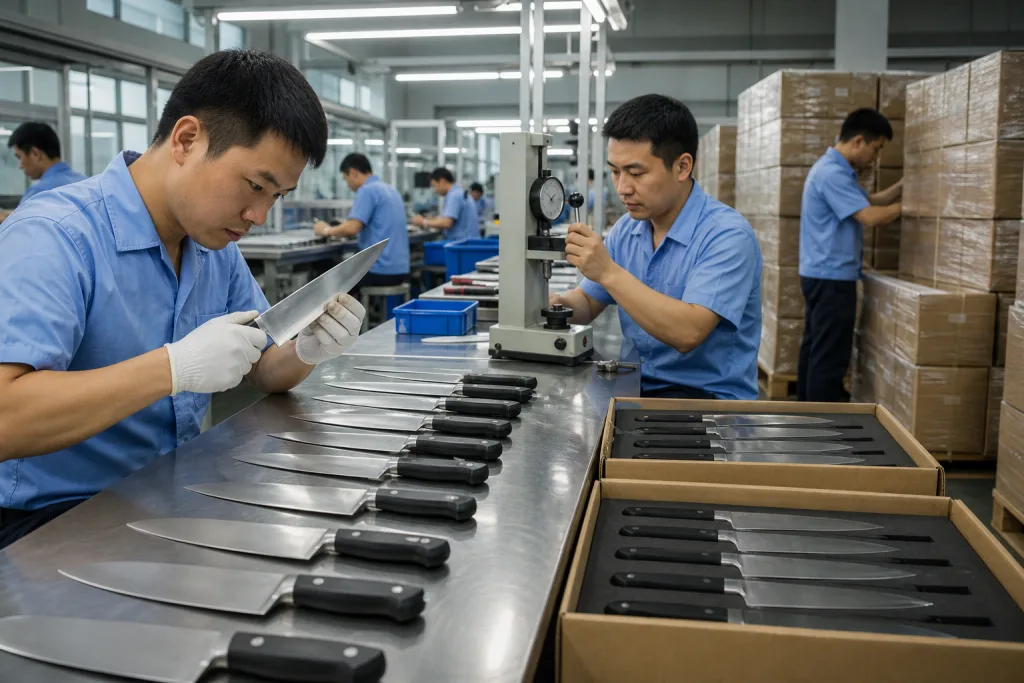
A practical pre-shipment inspection should cover at least these checkpoints: blade length tolerance ±1.5 mm, blade height tolerance ±1.0 mm, HRC within approved band, edge gap on flat plate, logo position ±1.0 mm, handle gap, carton quantity, gross weight, and drop test. At our China factory, we split first-article approval, in-process checks at the grinding line, and final random inspection after packing. It takes 12 days vs 9 days on a 3,000-piece nakiri order, but checking only finished cartons is the wrong question to ask. By then, a heel grind problem or loose handle has already eaten the margin.
How to Compare Factory Quotes Fairly
Do not compare factory quotes by unit price alone. Build one quote sheet with the same fields: Incoterm, steel, hardness, blade thickness in mm, handle material, packaging, MOQ, sample cost, tooling cost, lead time, inspection standard, payment terms, and document support. We had one buyer flag a USD 0.40 lower nakiri quote last March; after adding color box, inner carton, laser logo, and LFGB test, it landed USD 0.18 higher than our FOB Shenzhen price.
Ask which steps the factory runs in-house. Outsourcing is normal in Yangjiang for handle blanks or printed boxes, but the main supplier must control heat treatment, grinding, assembly, polishing, and final QC. QC pulled the sample after the grinding line measured 1.9 mm at the spine instead of the signed 1.7 mm, and that is the kind of issue one owner must catch before packing. If no one owns the full quality result, you will get pushed between subcontractors when a claim hits. For repeat orders, ask for batch traceability: steel lot, heat-treatment date, polishing line, packing date, and inspection report.
Payment terms for new buyers are usually 30% deposit and 70% before shipment. After 3 to 5 clean orders, established importers can usually negotiate better terms. If you need DDP pricing, confirm HS code, duty rate assumptions, destination port, insurance, and customs clearance responsibility; the math does not work if a supplier quotes DDP but guesses the duty rate. For FOB, specify FOB Shenzhen, FOB Guangzhou, or FOB nearest port so inland freight is not hidden. We once saw a PO typo say “FOB China,” and the buyer pushed back only after the cartons were already booked.
A good nakiri knife OEM relationship should feel boring: the sample matches mass production, cartons match the packing list, inspection photos show real defects, and the supplier reports bad news early. TANGFORGE has produced kitchen and outdoor knives in China since 2008 with about 240 employees, and our view is simple: a buyer should not need to chase basic production facts. We ship better when the spec sheet says 170 mm blade, 58 HRC target, 12 pcs inner carton, and AQL 2.5 before the deposit is paid. If your supplier cannot give stable specs, realistic MOQ, and written QC standards, the low price is not a price. It is warehouse risk.
Frequently asked questions
For an existing nakiri model with your laser logo, a normal nakiri knife MOQ is 300 pcs per SKU. If you need a printed color box, barcode, manual, or sleeve, 500 pcs is more realistic because packaging suppliers have their own minimums. For a new blade profile, custom handle mold, or exclusive Damascus pattern, expect 800-1,000 pcs per SKU. Some factories accept lower trial orders, but the unit price will rise and customization will be limited. For serious retail testing, 300-500 pcs gives enough volume for stable production without forcing you into a full container.
For FOB China pricing, a basic stamped 5Cr15MoV nakiri may cost around USD 3.80-5.80 with simple packaging. A forged X50CrMoV15 or 1.4116 model with pakkawood or G10 handle often sits around USD 6.50-10.50. A VG-10 Damascus nakiri with gift box, better polishing, and stabilized wood or G10 handle may run USD 13.00-18.50 or more. Tooling, sample development, custom packaging, LFGB or FDA-related testing, and third-party inspection are usually separate costs. Always compare quotes using the same Incoterm, packaging, HRC, and inspection standard.
There is no single best steel. For entry retail or promotional programs, 5Cr15MoV at 55-57 HRC is cost effective and corrosion resistant. For European-style kitchen lines, X50CrMoV15 or 1.4116 at 56-58 HRC gives a good balance of toughness and maintenance. For higher performance, 9Cr18MoV, AUS-10, 10Cr15CoMoV, or VG-10 core Damascus at 58-62 HRC can hold a finer edge, but sharpening, chipping control, and QC need to be better. If your customers put knives in dishwashers, do not choose a steel only for hardness.
For normal branded import orders, AQL 2.5 major / 4.0 minor is a sensible starting point. Premium gift sets or Damascus knives may need AQL 1.5 major plus 100% visual checks on blade face, logo, and packaging. Your checklist should include blade warp, edge flatness, HRC band, blade length, handle gap, rivet flushness, logo position, sharpness, carton strength, barcode accuracy, and country-of-origin marking. For a nakiri, blade straightness and grind symmetry deserve special attention because the wide rectangular blade makes defects easy to see.
Standard samples usually take 7-15 days if the factory already has the blade and handle. Custom samples normally take 20-35 days when new CNC programming, handle tooling, or packaging artwork is involved. Mass production is commonly 35-55 days after deposit, artwork confirmation, and sealed sample approval. Add time for LFGB, REACH, FDA-related material checks, third-party inspection, or DDP shipment preparation. If you are launching before Christmas or a spring catalog deadline, approve packaging and barcode files before sample approval, not after production starts.
Send Your Nakiri Spec for Factory Review
Share blade drawing, target price, MOQ, packaging, and market. We will check manufacturability, QC risks, and a realistic FOB China quote.
Request a Quote