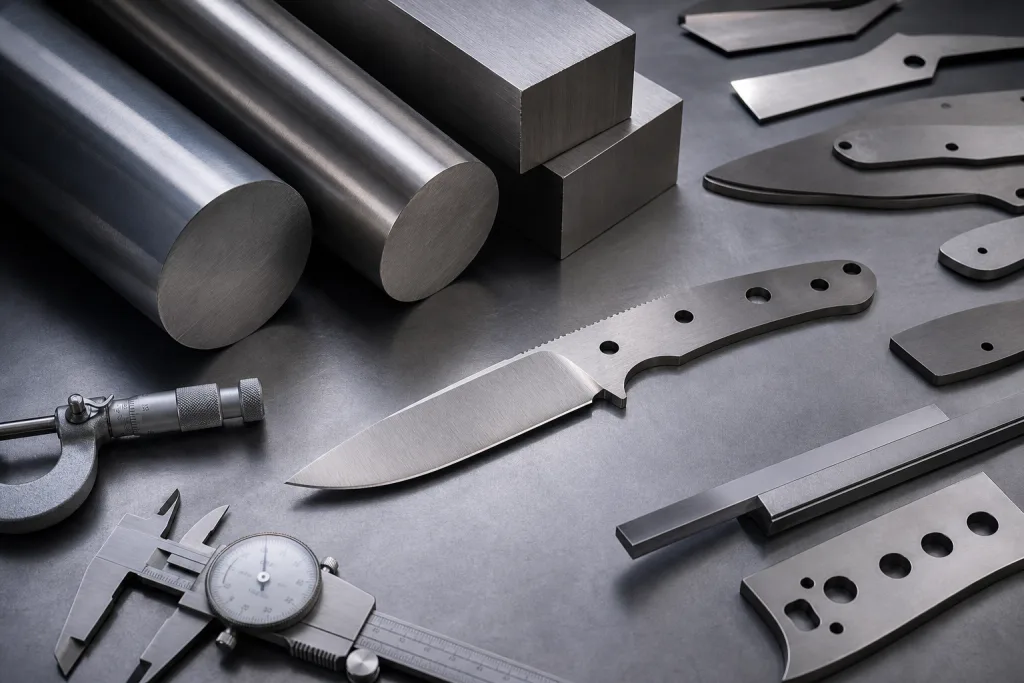
A nakiri looks simple: flat edge, thin blade, clean cuts through cabbage and scallion. Buying it is not. If the PO only says “high carbon stainless, 60 HRC” and skips steel grade, heat-treatment tolerance, edge angle, and test method, the supplier can pick the cheapest reading of that line. We have seen this go sideways: QC pulled a sample at 57.8 HRC on the Rockwell tester, and the buyer pushed back because their retail page promised a true 60 HRC blade.
As a nakiri knife factory in Yangjiang, Zhejiang, China, TANGFORGE sees this problem 3–4 times a month. Brand owners ask for a premium custom nakiri knife, then send a hardness target copied from a retail listing, not a spec matched to their price tier, steel cost, and warranty plan. Wrong question. For our kitchen knife lines, typical OEM MOQ starts from 600 pieces per SKU, lead time is 45–60 days after deposit and sample approval, and the HRC band must be locked before we run mass production tooling, set the heat-treatment batch card, and release work to the grinding line.
Why nakiri hardness is a sourcing decision
The nakiri is a vegetable knife, so buyers often write “make it thin and sharp” on the RFQ. That is not enough. The return risk sits in the hardness spec. A nakiri has a straight edge, thin grind, and low tip profile; on our line we run most samples through 30 push cuts on cabbage and onion after checking blade stock with a digital caliper. Board work only. No bones. No frozen food. No twisting cuts.
Thin blades expose weak hardness specs fast. On our grinding line, a 56 HRC edge can go dull or roll after 2 to 3 weeks of home use, while 61 HRC on the wrong steel can chip the first time the buyer hits a ceramic plate or a bamboo board. We’ve seen this go sideways: one PO came in with “Nakki knife” typed on it, and QC pulled the sample because the edge was already folding at the heel under a 10x loupe.
A sensible nakiri knife steel hardness specification starts with the steel grade, then confirms whether the heat treatment can hold that number across bulk production. Blade thickness and retail price set the rest. For a $19 promo knife, 54–56 HRC on 3Cr13 or 420J2 is workable, but this is the wrong question if the buyer expects a Japanese-style vegetable knife. For a $49–89 custom nakiri knife, 56–59 HRC on 5Cr15MoV, X50CrMoV15, AUS-8, or similar steel fits the job. Above $100 retail, 60–62 HRC can work, but only if the steel and quench are right, and the edge geometry stays around 0.4–0.6 mm behind the edge. We check that on the first-off sample before the polishing team touches the blade.
The hard truth: HRC alone does not make a knife premium. We’ve had importers push for 62 HRC on low-cost stainless because a competitor’s listing said 62, and the math does not work. That spec often gives brittle edges or claims that do not match the QC sheet after we test three points along the blade with the Rockwell tester. A professional nakiri knife manufacturer should tell you when the number is wrong for the steel, not just stamp it on the carton. One bad hardness spec can turn into 200 return claims.
Recommended HRC bands by product tier
For OEM and ODM buying, call out a hardness band, not one fixed number. The press line, quench oil at 82–86°C, 1.8 mm blade thickness, and steel batch all move the final Rockwell reading. If a factory claims every nakiri lands at exactly 60 HRC, ask how many blades they tested. Most of the time it is 2 or 3 pieces on the Rockwell tester, or a sales answer polished cleaner than the blade.
At TANGFORGE in Yangjiang, Zhejiang, we run mass-production kitchen knives with a ±1 HRC tolerance after sample confirmation. If the approved sample reads 58 HRC, the PO should state 57–59 HRC. That range works on the grinding line and gives QC a clear target during final inspection with the HRC file and Rockwell spot check. One buyer once typed “58±0.1” on the PO. The math does not work.
| Product tier | Common steel options | Suggested HRC | Typical use case |
|---|---|---|---|
| Entry retail | 3Cr13, 420J2 | 52–56 HRC | Promo sets and supermarket programs where unit price beats fine edge retention |
| Mid-range retail | 5Cr15MoV, X50CrMoV15, AUS-8 | 56–59 HRC | Private-label nakiri knife wholesale runs for normal home kitchens, usually 1,200–3,000 pcs per SKU |
| Premium stainless | 9Cr18MoV, VG10, 10Cr15CoMoV | 58–61 HRC | Giftable chef lines where the color box makes a stronger edge-retention claim |
| High carbon or powder steel | 1095, D2, SG-type steels | 59–63 HRC | Specialist ranges sold with clear care instructions and users who accept more maintenance |
For most kitchenware brands entering the nakiri category, 57–59 HRC is the safest commercial range. It holds a clean vegetable edge and still gives normal home users room for small mistakes without chips in the first week. If your buyers are chefs or knife hobbyists, 60–61 HRC can make sense. Then the carton, insert card, and warranty text need to say no bones, no frozen food, no dishwasher, and no side twisting. QC pulled a 61 HRC sample last month, checked it under the 10x loupe, and the buyer flagged the chip test after 20 cuts on carrot tops. Fair call.
Do not ask your nakiri knife factory to make it as hard as possible. Wrong question. Ask for the HRC band that matches the steel and the user. We ship fewer complaints that way, and final inspection has a number the team can control without arguing over one decimal point on the gauge.
Steel grade changes the hardness answer
A nakiri knife steel hardness specification has to name the steel grade. “German stainless,” “Japanese steel,” and “high carbon steel” look good in a catalog, but those words do not tell the heat-treatment team which recipe to run. Put the grade on the PO: X50CrMoV15, 5Cr15MoV, 9Cr18MoV, AUS-10, VG10, 10Cr15CoMoV, 1095, or D2. QC cannot inspect against a sales phrase. We run the heat lot by grade, record the furnace batch card, then check the target on the HR-150A Rockwell tester against that line item. Simple as that.
Each steel has its own hardness window. X50CrMoV15 is a safe retail choice because it resists rust and survives rough kitchen use; it usually sits around 56–58 HRC. If a buyer pushes it to 60 HRC, the math does not work for a vegetable knife. Edge retention gains are small, and toughness drops. 5Cr15MoV gives a similar answer for private-label programs, especially at 1.8 mm blade thickness. 9Cr18MoV and VG10 can run 59–61 HRC when quench and temper control are tight. D2 can go harder, but it is not true stainless, and that matters when the knife sits in a wet sink after acidic produce. We’ve seen this go sideways. The buyer flagged it after our 24-hour salt spray and rinse test showed staining near the heel.
For Damascus nakiri knives, the core steel is the number that counts. Decorative Damascus blades often use a hard core with softer cladding around it. The spec should call out the core cutting steel, not the outer layers. If the blade is VG10 core Damascus, we set the core at 59–61 HRC while the cladding carries the pattern and gives some protection. Write it that way. If you only write “Damascus 60 HRC,” QC pulled the sample, etched it in ferric chloride, and still could not tell which layer you meant. That is a weak spec, full stop.
Compliance still sits on top of hardness. For Europe, ask your nakiri knife supplier for REACH-related material statements and LFGB food-contact support where required. For the United States, FDA food-contact expectations and packaging labeling need checking before shipment. Hardness does not clear a bad handle coating. We had a PO typo on one handle code turn into a 12-day delay, while the steel was perfect at 60 HRC. A hard blade with a failed migration result is still a rejected import, no matter how clean the grinding line looks.
Heat treatment matters more than brochure claims
Two blades made from the same steel can cut like different knives when heat treatment drifts. We see it every week on the grinding line. Austenitizing temperature sets the base structure, quench delay changes hardness, the temper cycle decides how much stress stays in the blade, and cryo timing affects retained austenite. A brochure will not tell you whether the operator held soak time for 8 minutes or 14 minutes. Chasing the highest HRC is the wrong question. We need hardness that stays inside spec across the batch, carbides that sharpen cleanly on our #1000 wheel, and enough toughness to survive a 15° per side grinding pass without edge chips.
For a custom nakiri knife, ask how hardness is controlled on the floor. No lecture needed. Ask for process facts. Which furnace model is running the batch? Are blades tracked with a lot card from heat treatment to packing? Is tempering time logged on paper or in the furnace controller? Does QC pull the sample after heat treatment, then pull again after grinding? Are rejects locked out before handle assembly? A buyer once sent a PO with “59-61HRC” typed three times and no test point, so our QC team had to mark the Rockwell tester location at the heel and mid-blade before sampling. The math does not work.
At TANGFORGE China, we plan kitchen knife capacity by line and process, not by order size alone. A 1,000 to 3,000 piece nakiri OEM run usually moves through staged heat treatment and staged grinding so the profile does not wander. If you switch from 5Cr15MoV to VG10 after sample approval, that is a full reset. Furnace curve changes. Belt speed changes. Polishing time changes. Cost and lead time move too, often from 22 days to around 30 days for the next run. We have seen this go sideways on a 2,000-piece order when the buyer flagged the steel change only after deposit.
Heat treatment also controls straightness. Nakiri blades are wide and thin, so warping is not a theory in our shop; it is a scrap bin issue beside the correction press. A 165 mm blade at 1.8–2.2 mm spine thickness needs controlled quench speed and post-heat-treatment correction before the blade reaches the wide-belt grinder. If you ask for 61 HRC with an ultra-thin grind, expect more rejects or a higher unit price. A 0.3 mm drift at the heel is enough for QC to stop the line. The factory cannot delete physics from the quotation.
A good nakiri knife manufacturer will give you a working window: 58±1 HRC, 15° per side edge angle, 1.8 mm spine at heel, and final inspection under AQL 2.5 for major defects. That is a production spec we can run on the floor with calipers, a Rockwell tester, and a signed inspection sheet from the QC bench. It is also the kind of number a buyer can check on arrival instead of arguing about brochure claims later.
How to write the PO specification
Your purchase order needs more detail than a retail page. A retail listing can say “hardened stainless steel for lasting sharpness.” The PO should lock the steel grade, HRC window, blade length tolerance, edge angle, and the inspection point before the blades leave the grinding line. We check this against the first 10 pcs from heat treatment, not after the master carton is taped.
A clean PO line for a mid-range nakiri can read: “Blade: 5Cr15MoV stainless steel, 165 mm blade length, 1.8–2.0 mm spine thickness at heel, full flat or double bevel grind, hardness 57–59 HRC measured on blade body after heat treatment, final edge 15–17° per side, satin finish, burr removed, no visible overheating marks.” Short and clear. That line cuts out two or three rounds of email. We’ve seen a buyer flag a PO that said only “sharp blade”; the math doesn’t work when one side expects 56 HRC and the other side ships 59 HRC. The Rockwell tester does not care about marketing words.
Define the test sampling too. For small OEM orders around 300–1,000 pcs, 3–5 blades per SKU is enough for internal approval. For 3,000 pcs and above, put the sampling plan in writing. AQL 2.5 for major defects and AQL 4.0 for minor cosmetic defects is common for kitchen knives; premium programs often tighten the cosmetic limit after the first pilot run. Critical defects stay at zero: cracked blade; loose handle; exposed sharp tang; wrong steel; wrong logo; unsafe packaging. On the grinding line, we run into disputes when the PO skips this part, because QC then has no signed standard to measure against.
Hardness testing leaves a small indentation. Decide where that mark is allowed. About 7 out of 10 import buyers accept HRC testing near the heel before final polishing, or they ask us to test retained production samples instead of every finished retail unit. If the knife has mirror polish or Damascus etching, test timing matters. Don’t wait until the cartons are packed and then ask for mark-leaving tests on saleable stock. QC pulled the sample too late once, and we had to hold 120 pcs for replacement. Painful lesson.
For private-label programs, include logo method; packaging layout; barcode and FNSKU if needed; carton drop-test requirement; Incoterms such as FOB Ningbo, FOB Shenzhen, or DDP warehouse. A typo on the PO can turn into a reprint. One buyer sent “FNSKU” with the wrong label size, 40 mm instead of 50 mm, and the warehouse still knew what they meant, but we had to confirm the label format before printing. Hardness matters, but the customer receives the whole knife, not a steel coupon. This is the wrong place to save 5 minutes on paperwork.
Cost impact of higher hardness specs
Higher hardness is not free. On the grinding line, we run into six real cost hits: steel with a tighter carbon range costs more; quench and temper windows get narrower; Rockwell testing rejects more blades; #400 belts must run slower; QC adds extra checkpoints; tip polish rejects climb after final buffing. Buyers sometimes compare two China quotes and say the cheapest 60 HRC line wins. Wrong question. The cheapest quote is usually the one with blanks left in the spec sheet.
As a rough FOB reference, a simple 5Cr15MoV nakiri with a basic pakkawood or PP handle sits in one cost band. A VG10 core Damascus nakiri with a stabilized wood handle and gift box sits in another. The second build needs higher steel cost, acid etching, hand re-polishing after etch, tighter edge finishing at about 0.3 mm behind the edge, and slower packing because workers check the gift box corners one by one with a paper gauge. We have seen a 2 HRC jump cost almost nothing when the steel is already in range, then jump fast when the buyer flagged a steel upgrade. A 0.3 mm change in finish can also move the quote.
MOQ changes the unit math. For custom nakiri knife projects, 600 pieces per SKU works for standard steel and an existing handle shape. New tooling, special handle molds, custom Damascus patterning, or low-volume premium steels can push MOQ to 1,000 pieces or more. If you need 200 pieces for a market test, an ODM design with logo engraving is cleaner. We once had a PO with “200 pcs” typed where the buyer meant 2,000. That one went back twice before we opened the material card.
Lead time has to match the spec. A repeat order of a standard nakiri can ship in 35–45 days after deposit if materials are on hand. A new OEM program needs 45–60 days because we must confirm steel, make the prototype, check packaging artwork, approve the pre-production sample, and book inspection. Add time for third-party lab testing, LFGB review, BSCI document updates, or DDP delivery, because those files do not move at belt-grinder speed. QC pulled the sample on day 18 once because the hardness spread was off by 1 HRC.
For a brand owner, the best cost target is not the lowest FOB price. It is the lowest total risk at the retail position you want. A stable 58 HRC knife that customers keep beats a claimed 61 HRC knife that starts edge-chip complaints after the first batch of returns. We ship fewer headaches that way. The math does not work any other way.
Inspection methods before shipment
Run the hardness check before the goods leave China. After shipment, a wrong HRC claim costs money and takes 12 days vs 2 days to verify with retained samples. Our QC sheet starts with incoming steel inspection, including heat-lot traceability if the buyer requests it, then spot checks after heat treatment, checks on the grinding line, finished-goods inspection, and 2 to 5 retained samples kept by PO number. For a premium PO, we can arrange third-party testing, but the PO must state who pays and which test standard the lab follows. We once had a buyer flag a missing heat-lot number because the PO typed “HCR” instead of “HRC.” Small typo. Big delay.
Rockwell C is the normal method for knife hardness. The tester needs a flat spot, a clean surface, and steady pressure from a calibrated Rockwell machine. A curved heel, thin spine, or mirror-polished patch can push the reading off by 1 HRC if the operator rushes it. We run the machine with calibration on file, usually within 12 months, and QC pulls the sample ID against the packing list before recording the result. If you need formal paperwork, ask for the calibration certificate, tested sample numbers, and a signed QC sheet with photos of the test point. For a regular wholesale order, an internal report is enough. For a launch order, buyers ask for a stamp and signature.
Cutting tests tell you about the edge. They do not prove hardness. CATRA edge retention testing is more formal and costs more, so we use it for development work or a marketing claim, not for every PO. On the shop floor, we run paper slicing, vegetable cutting on a PE board, edge inspection under an LED lamp, and a burr check by thumb pad. For a nakiri, one clean demo cut is the wrong question to ask if the edge folds after board contact. We want a stable edge after repeated cuts, not a pretty first slice.
At TANGFORGE, our inspection team matches hardness checks with appearance review, handle gap measurement in mm, blade straightness, logo position, carton label text, and drop-test packing. We ship export programs from Yangjiang, Zhejiang, China, and we push buyers to lock the steel and HRC spec at the pre-production sample stage. Once 3,000 units are polished, etched, boxed, and carton-packed, a hardness dispute stops being technical. It becomes a loss. We have seen this go sideways over a 1-point HRC mismatch. The math does not work.
Frequently asked questions
For most mid-range kitchenware brands, specify 57–59 HRC if the steel is 5Cr15MoV, X50CrMoV15, AUS-8, or a similar mainstream stainless grade. This range gives decent edge retention while keeping chipping risk under control for normal home users. Pair it with a 15–17° per side edge angle and a spine thickness around 1.8–2.2 mm for a 165 mm nakiri. If you want 60–61 HRC, upgrade the steel and packaging instructions accordingly. Do not specify only “60 HRC” without a tolerance. A realistic mass-production band is usually ±1 HRC after sample approval.
No. 60 HRC can be good, but only when the steel and heat treatment support it. A VG10 or 10Cr15CoMoV nakiri at 60±1 HRC can work well for premium retail. A low-cost stainless pushed to the same number may become brittle or inconsistent. Vegetable knives are thin, so edge chipping is a real warranty risk if customers cut pumpkin stems, frozen food, or use glass boards. For many private-label nakiri knife wholesale programs, 58 HRC is a better commercial target than chasing a higher number that increases returns.
For a small order, at least 3–5 pieces per SKU should be tested and recorded, especially after heat treatment and before final packing. For larger orders of 1,000–5,000 pieces, use batch-based sampling and combine it with final inspection under AQL 2.5 for major defects. Hardness testing leaves a small mark, so agree where testing happens and whether the tested pieces are retained samples or saleable goods. Premium programs can use third-party testing, but that should be written into the PO before production starts.
Not exactly. For stainless mono-steel blades, the HRC applies to the whole blade steel. For Damascus knives with a core and cladding, the meaningful hardness is the core cutting steel. A VG10 core Damascus nakiri may be specified at 59–61 HRC for the core, while the outer Damascus layers are not the performance reference. Your PO should state “core steel hardness” and name the core material. If you only write “Damascus, 60 HRC,” you leave too much room for misunderstanding between buyer, factory, and inspector.
Send blade length, steel grade, target HRC band, blade thickness, edge angle, handle material, finish, logo method, packaging, order quantity, compliance market, and delivery term. A strong RFQ might say: 165 mm nakiri, 5Cr15MoV, 57–59 HRC, 1.8–2.0 mm spine, pakkawood handle, laser logo, color box, 1,200 pieces, FOB China port, EU market with REACH and LFGB support. With those details, a nakiri knife manufacturer can quote more accurately and avoid hiding cost in vague assumptions.
Send Your Nakiri Hardness Spec
Share your target retail price, steel grade, MOQ, and packaging plan. We will recommend a realistic HRC band before sampling starts.
Request a Quote